

Identifying and Managing Seizure Triggers
Alastair Greenway
BVM&S MRCVS
In the days after a seizure, most owners arrive at the same question, and they usually ask it quietly, half-afraid the answer points back at them. Was it the walk? The fireworks? The new food? Underneath sits a very human hope: find the thing that set it off, and you can stop it happening again.
I'll be straight with you, because plain talk here is the kind thing. Some triggers are real and worth reducing. Plenty of the things owners blame are coincidence. Most dogs have a mix of triggered and untriggered seizures. And nothing you did caused your dog's epilepsy. Holding all four of those at once is what separates useful management from an exhausting hunt for a switch that doesn't exist.
What a "trigger" really is
In the literature a trigger is called a seizure-precipitating factor: a stimulus that makes a seizure more likely in a brain that is already prone to seizures. It lowers the seizure threshold; it does not create the epilepsy, and in the main canine study almost all of the dogs had both precipitated and unprecipitated seizures (Forsgård et al., 2019). A trigger raises the odds on a given day; it is not a button that produces a seizure on demand.
A trigger is also a different thing from a reactive seizure, and the gap matters. A reactive seizure is a normal brain responding to a temporary insult such as a poison or low blood sugar, reversible once corrected and not epilepsy at all, whereas a trigger precipitates a seizure in a dog who already has epilepsy (De Risio et al., 2015). The full picture of reactive, structural and idiopathic seizures lives in its own article.
One piece of biology makes this harder than you'd think: a precipitating factor can be followed by the seizure within roughly 24 hours rather than at once (Forsgård et al., 2019). So the storm on Tuesday afternoon might be linked to the seizure on Tuesday night, or to nothing at all, which is exactly why memory is an unreliable guide.
Which triggers actually have evidence
Start with the gap between prompting and recall. In a study of 50 dogs with idiopathic epilepsy, owners identified at least one precipitating factor in 74% of dogs when prompted with a checklist, but only 58% named one spontaneously (Forsgård et al., 2019). Handing someone a menu makes them find more, which is itself a clue that some "triggers" are over-attributed.
When prompted, the commonest factors were visitors at home (30%), a change in life situation (27%), a change in daily routine (24%), altered sleep (24%), unfamiliar places (24%) and weather (24%, almost always hot). Asked openly, the top three were stress (21%), excitement (21%) and hot weather (17%) (Forsgård et al., 2019). A separate, larger survey of 229 owners found 43.1% reported a trigger at all, with stress the single most common, named by 39.1% of those who reported any (Finnegan et al., 2020).
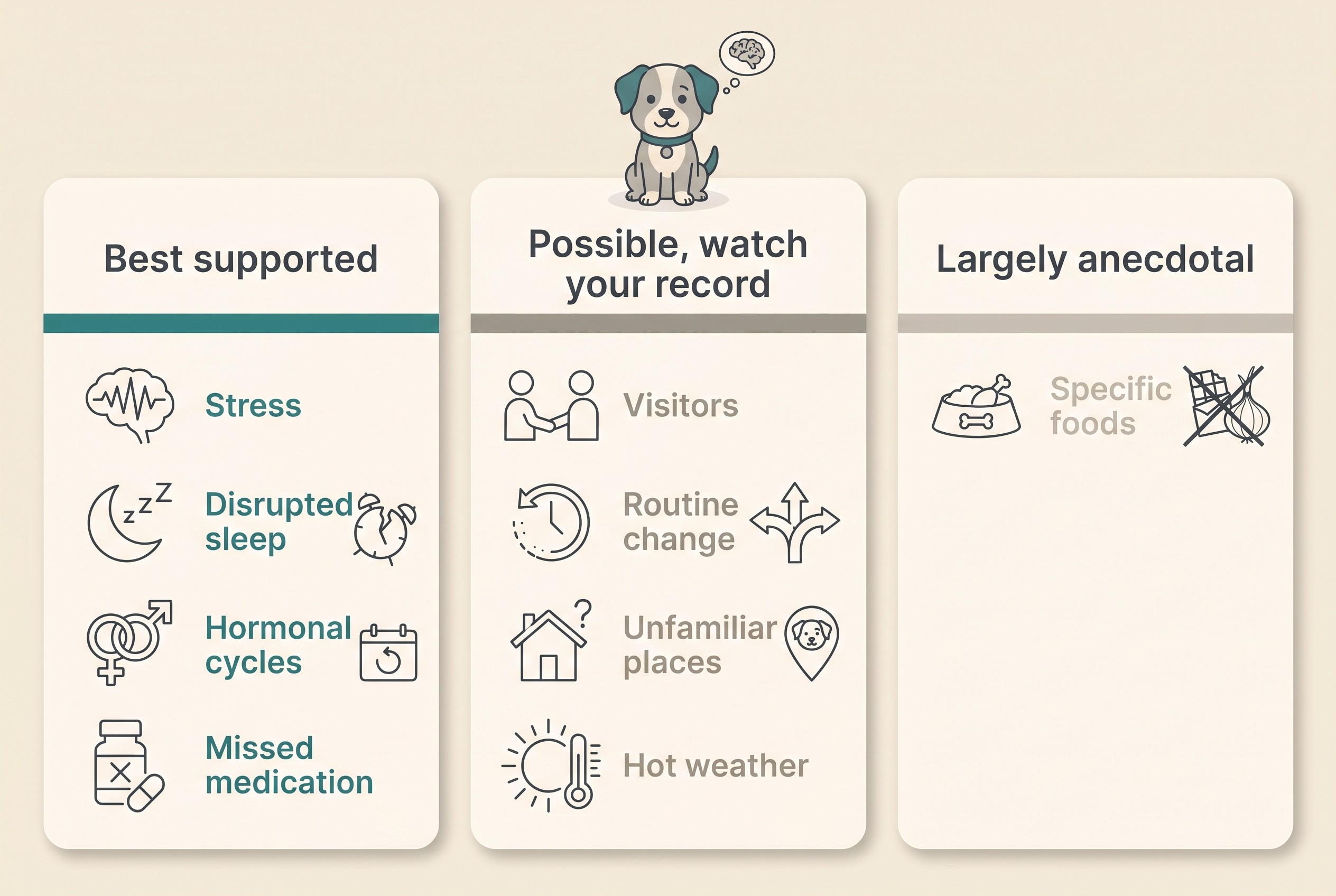
If I had to name the best-supported trigger, I'd say stress, and it isn't just owner impression. The human research the canine authors draw on reports stress as a precipitant in up to around 83% of people with epilepsy, stress hormones acting on the brain in a potentially seizure-promoting way (Forsgård et al., 2019).
Sleep comes next, and it runs both ways. Altered sleep was a reported trigger, and sleep deprivation is a well-established precipitant in people (Forsgård et al., 2019). Newer canine work backs this up: dogs with idiopathic epilepsy had significantly poorer sleep quality than matched healthy dogs, and 59% of owners noticed their dog's sleep changed after a seizure, usually sleeping more (Mondino et al., 2025). So poor sleep can help precipitate seizures, and seizures in turn disturb sleep, which makes protected sleep one of the few genuinely low-risk levers you have.
Hormonal triggers are real too. In intact females the oestrous cycle was a precipitating factor in 42% (five of twelve), and in intact males, exposure to a female in season affected 33% (four of twelve), with seizures in intact bitches tending to cluster around oestrus and the following one to three months (Forsgård et al., 2019). Sex hormones genuinely shift the seizure threshold, so this is worth raising with your vet, including whether neutering belongs in the plan.
Weather is softer ground. Hot weather was reported by around a quarter of owners, but the canine evidence is owner-reported and inconsistent (Forsgård et al., 2019), so treat it as "possible, watch your record". Food, as a day-to-day trigger, is largely anecdotal and isn't established in the canine literature (Forsgård et al., 2019). That's separate from diet as a therapeutic adjunct, covered in diet and epilepsy.
Why so many "triggers" are really coincidence
In that 50-dog study, 78% of the dogs (39 of 50) had their seizures during rest, sleep or while waking up, versus only 8% during activity (Forsgård et al., 2019). Seizures cluster in low-arousal states. So if your dog seizes shortly after a walk, a thunderstorm or an exciting visitor, the seizure very often actually happens once the dog has settled down: the walk didn't cause it, it simply came before the rest, and the rest is when seizures surface. That alone accounts for a great many of the apparent triggers owners spot.
It also explains why memory joins dots that aren't connected. The study's own authors were candid that owners relied on memory and perceptions, that any recall bias may contradict the results, and that more reliable data could come from a prospective diary (Forsgård et al., 2019). You cannot reliably identify a trigger from memory; you find it, or rule it out, by logging forward in time.
The vivid single story is the trap. A Frontiers paper documented six Border Collies whose owners attributed seizures to highly individual situations, including a lack of mental stimulation, a ball thrown on the beach, and one particular person. The authors were explicit that this was a tiny, uncontrolled handful of cases and that larger prospective studies are needed (Mandigers & Santifort, 2023). A compelling story about your own dog is a hypothesis worth testing, not proof.
One last distinction before we get practical. A trigger is something external that precipitates a seizure, whereas a prodrome is a change in your dog, such as the clinginess or restlessness that 64.9% of owners reported, that may predict a coming one (Finnegan et al., 2020). A trigger comes from the world; a warning sign comes from your dog.
Seizures often follow their own rhythm
Researchers implanted continuous EEG monitors in six dogs with naturally occurring epilepsy and watched them for an average of 65 weeks, and seizure timing was not random: the dogs showed circadian rhythms across the day, multiday rhythms repeating roughly weekly or monthly, and frequent clusters (Gregg et al., 2020). Some of what looks like an external trigger is actually the disease keeping its own internal clock, and a seizure that seems to come "out of nowhere" may simply be the next beat in a rhythm. A rhythm can be anticipated; a flipped switch cannot.
How to find and reduce triggers, properly
Good practice comes down to one principle: log first, conclude later. For every seizure, record the date and time, what was going on in the preceding 24 hours, sleep, the season and weather, the oestrous stage if relevant, and whether any dose was late or missed. Then look for repeated associations across several seizures, not a single coincidence: one storm before one seizure is not a pattern, but the same association three or four times is worth a conversation. The Seizure Diary is built for this, and keeping a seizure diary covers how to log well.
Once something holds up, put your effort into the triggers that are both well-supported and harmless to reduce: protect consistent sleep, keep a steady daily routine, and lower avoidable stress. These carry essentially no downside (Forsgård et al., 2019), and the day-to-day detail sits in routine, exercise and quality of life. If your dog is entire, raise the hormonal angle with your vet too (Forsgård et al., 2019).
One "trigger" you must not overlook, because it is the most controllable and also the most dangerous: missed or late medication. Inconsistent dosing destabilises seizure control, and stopping anti-seizure medication abruptly can precipitate cluster seizures or even status epilepticus (Bhatti et al., 2015). How to build a reliable system, and why you must never stop suddenly, sits in giving medication reliably.
Whatever the trigger, know the emergency line. A seizure lasting more than five minutes, or two or more seizures in 24 hours, or seizures running into each other without recovery, is an emergency: vet or emergency clinic now (Bhatti et al., 2015). A single short seizure with full recovery, triggered or not, is frightening but not in itself an emergency. The emergency article covers why.
When looking for triggers starts to hurt
Many seizures have no identifiable trigger at all, and most dogs have both triggered and untriggered seizures, so a seizure that seems to come from nowhere is normal and expected (Forsgård et al., 2019). That isn't a failure of your management; it's how the disease works.
The danger is when this curdles into a shrinking world for the dog, as more is avoided "just in case", and a quiet, corrosive guilt in the owner. So, plainly: epilepsy is a brain disorder, nothing you did caused it, and a seizure is not a verdict on how well you managed the day before. The realistic goal is fewer, shorter, less severe seizures, reduction rather than cure (Bhatti et al., 2015), and trigger reduction is a helpful adjunct to medication, never a replacement for it.
A brief word for cat owners. The canine trigger research doesn't transfer cleanly to cats, and feline data are sparse. The same principles apply, but in a cat a sudden "new trigger" is more likely a reactive cause needing urgent attention, above all permethrin or pyrethroid toxicity from a dog flea treatment applied to a cat, which is a true emergency rather than an epilepsy trigger (De Risio et al., 2015). Causes of seizures in cats covers that.
So: log the patterns rather than trust your memory, reduce the cheap and safe triggers, bring the record to your vet, and then, gently, let go of the rest. You're not hunting for a switch you flipped; you're learning your dog's rhythms and steering around the few things you genuinely can.
References
- Bhatti, S. F. M., De Risio, L., Muñana, K., Penderis, J., Stein, V. M., Tipold, A., Berendt, M., Farquhar, R. G., Fischer, A., Long, S., Mandigers, P. J. M., Matiasek, K., Packer, R. M. A., Pakozdy, A., Patterson, E. E., Platt, S., Podell, M., Potschka, H., Rusbridge, C., & Volk, H. A. (2015). International Veterinary Epilepsy Task Force consensus proposal: medical treatment of canine epilepsy in Europe. BMC Veterinary Research, 11, 176.
- De Risio, L., Bhatti, S., Muñana, K., Penderis, J., Stein, V., Tipold, A., Berendt, M., Farquhar, R., Fischer, A., Long, S., Mandigers, P. J. M., Matiasek, K., Packer, R. M. A., Pakozdy, A., Patterson, E., Platt, S., Podell, M., Potschka, H., Rusbridge, C., & Volk, H. A. (2015). International Veterinary Epilepsy Task Force consensus proposal: diagnostic approach to epilepsy in dogs. BMC Veterinary Research, 11, 148.
- Finnegan, S. L., Volk, H. A., Asher, L., Daley, M., & Packer, R. M. A. (2020). Investigating the potential for seizure prediction in dogs with idiopathic epilepsy: owner-reported prodromal changes and seizure triggers. Veterinary Record, 187(4), 152.
- Forsgård, J. A., Metsähonkala, L., Kiviranta, A.-M., Cizinauskas, S., Junnila, J. J. T., Laitinen-Vapaavuori, O., & Jokinen, T. S. (2019). Seizure-precipitating factors in dogs with idiopathic epilepsy. Journal of Veterinary Internal Medicine, 33(2), 701-707.
- Gregg, N. M., Nasseri, M., Kremen, V., Patterson, E. E., Sturges, B. K., Denison, T. J., Brinkmann, B. H., & Worrell, G. A. (2020). Circadian and multiday seizure periodicities, and seizure clusters in canine epilepsy. Brain Communications, 2(1), fcaa008.
- Mandigers, P. J. J., & Santifort, K. M. (2023). Remarkable anecdotes illustrating the nature and effect of seizure-precipitating factors in Border Collies with idiopathic epilepsy. Frontiers in Veterinary Science, 10, 1254279.
- Mondino, A., Nettifee, J., & Muñana, K. R. (2025). An exploratory study on the relationship between idiopathic epilepsy and sleep in dogs. Journal of Veterinary Internal Medicine, 39(2), e70026.
Free downloads
Companion worksheets to put what you've read into practice. Free PDFs, print at home.

Seizure Diary
PDF · 236 KBThe record your vet doses against. Log every seizure: when it happened, how long it lasted, whether it came in a cluster, and how recovery went. Frequency is the number treatment is adjusted against, so a good diary is the single most useful thing you can bring to an appointment.
Trigger Log
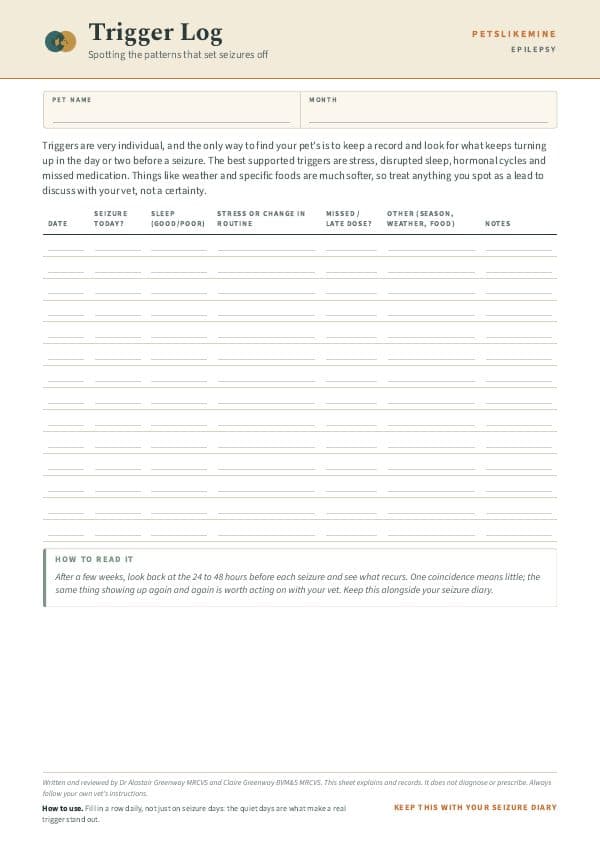
PDF · 132 KBA daily log to spot the patterns that set seizures off. Track sleep, stress, missed doses and more alongside seizure days, then look for what keeps turning up in the day or two before. The best-supported triggers are stress, disrupted sleep, hormonal cycles and missed medication.
Keep track of how your pet is doing
The owners who cope best are the ones who notice changes early. A simple health log shows you what is working, and what is not, before the next vet visit.
Start tracking, freeYou're not doing this alone
Compare treatment journeys and talk to owners managing epilepsy. Free to join.
Join PetsLikeMine