
The Kidney Hub
Everything you need when your dog or cat has kidney disease
From the first raised result to the long view: what the numbers actually mean, the treatments that change the outcome, what they cost in the UK, and how to give your pet good days at home.
Written and reviewed by vets. Honest about what works. Free to read.

The whole journey
One library, from diagnosis to the long view.
Evidence, not opinion
Every guide cites its sources and is checked by a second vet, with the date it was last reviewed shown.
Why this library exists
A kidney diagnosis is frightening. It is also, very often, manageable.
Chronic kidney disease is one of the most common conditions in older cats and dogs, and one of the most misunderstood. The diagnosis sounds final. For many pets it is not: with the right diet, the right monitoring and a few home-care skills, cats and dogs live comfortably with kidney disease for months or years.
This is our answer to the gap. The best kidney guidance online is written for cats and can be dense going. We cover cats and dogs equally, in plain English, following the whole journey from the first raised result to the long view. Every claim is backed by a source and checked by a second vet. None of it is behind a paywall.
Start here
New to this? Begin with these.
The four guides most owners need first, whether your pet was just diagnosed or you are still making sense of a blood test result.
Just had a result back?
Made sense of the numbers yet?
Kidney disease is often caught on routine senior bloods, before any symptoms. If your vet has mentioned a raised creatinine or SDMA, or your pet is an older cat or an at-risk breed, you can see where things stand in two minutes.
Why this is the place to come
Four things you will struggle to find together anywhere else in the UK.
The full library
The guide library, stage by stage
Kidney care changes as you go. These guides follow the journey, from the first raised result to living well with it long term. Read in order, or jump to where you are.
1Understanding the diagnosis
7 guides

Chronic Kidney Disease in Cats: What Every Owner Needs to Know
10 minA diagnosis of chronic kidney disease is not the end of your cat's good life. That is the single most importan…

Chronic Kidney Disease in Dogs: The Owner's Complete Guide
11 minGo looking for information after your dog is diagnosed with chronic kidney disease, or after a vet mentions "b…
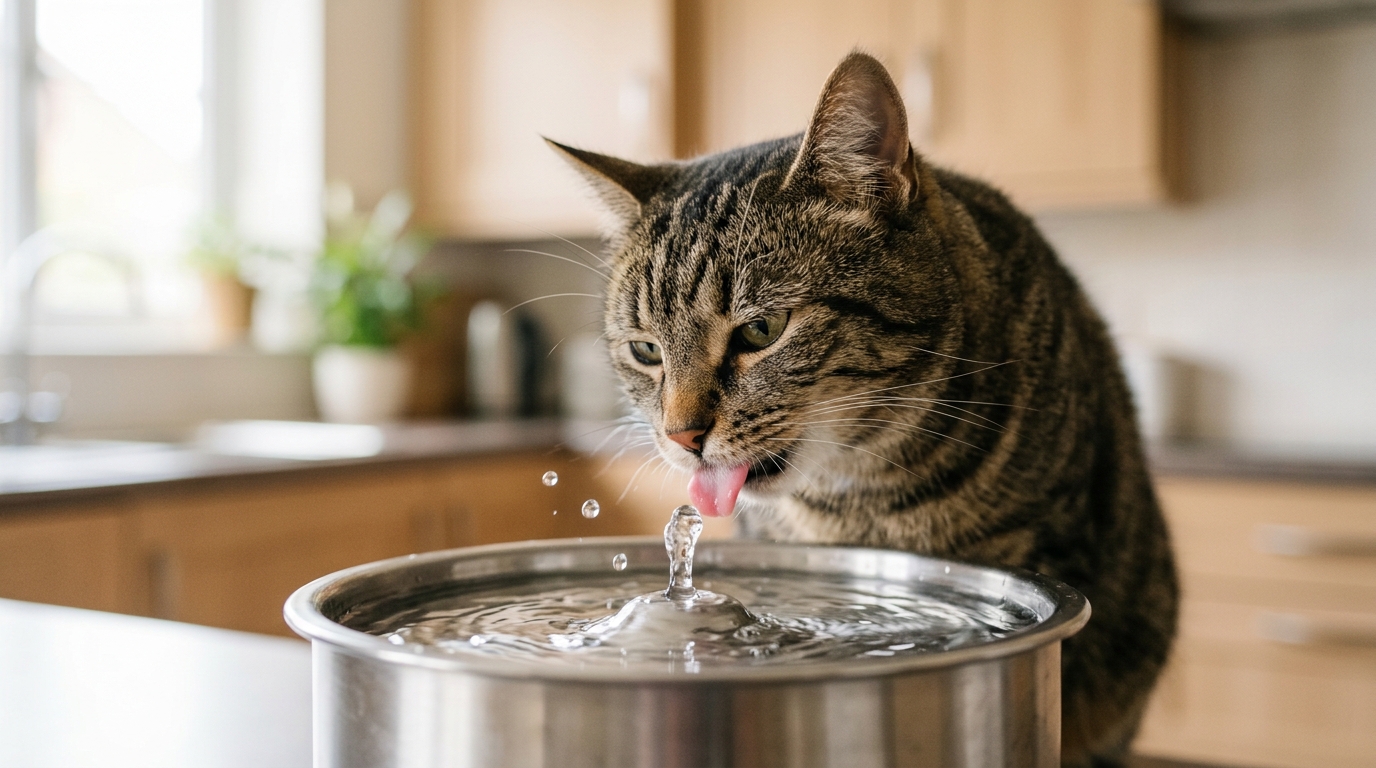
Is Your Pet at Risk of Kidney Disease? Breeds and Early Signs
9 minKidney disease is at its most manageable when it's caught early, and yet the early signs are precisely the one…

Reading Your Pet's Kidney Bloods: A Plain-English Guide
11 minA printout of your pet's kidney bloods is a wall of abbreviations and numbers that mean very little at first g…

Understanding IRIS Staging: What Your Pet's Stage Actually Means
13 minYour vet has used a word that sounds clinical and a little frightening: your dog or cat is at "stage 2", or "s…

What Causes Chronic Kidney Disease in Cats and Dogs?
9 minAfter a kidney diagnosis, owners almost always ask the same thing, often with a catch in their voice: why? Why…

Your Pet Has Kidney Disease: The First 30 Days
9 minA kidney disease diagnosis lands hard. One moment your pet is just a bit off, drinking a little more, perhaps…
2The treatments you control
6 guides

Helping Your Pet Feel Better: Comfort Medications for Kidney Disease
9 minSome kidney medicines slow the disease. The ones in this article do something just as precious, and more immed…

High Blood Pressure and Kidney Disease: The Silent Risk
8 minHigh blood pressure travels alongside kidney disease far more often than most owners realise, and it is danger…
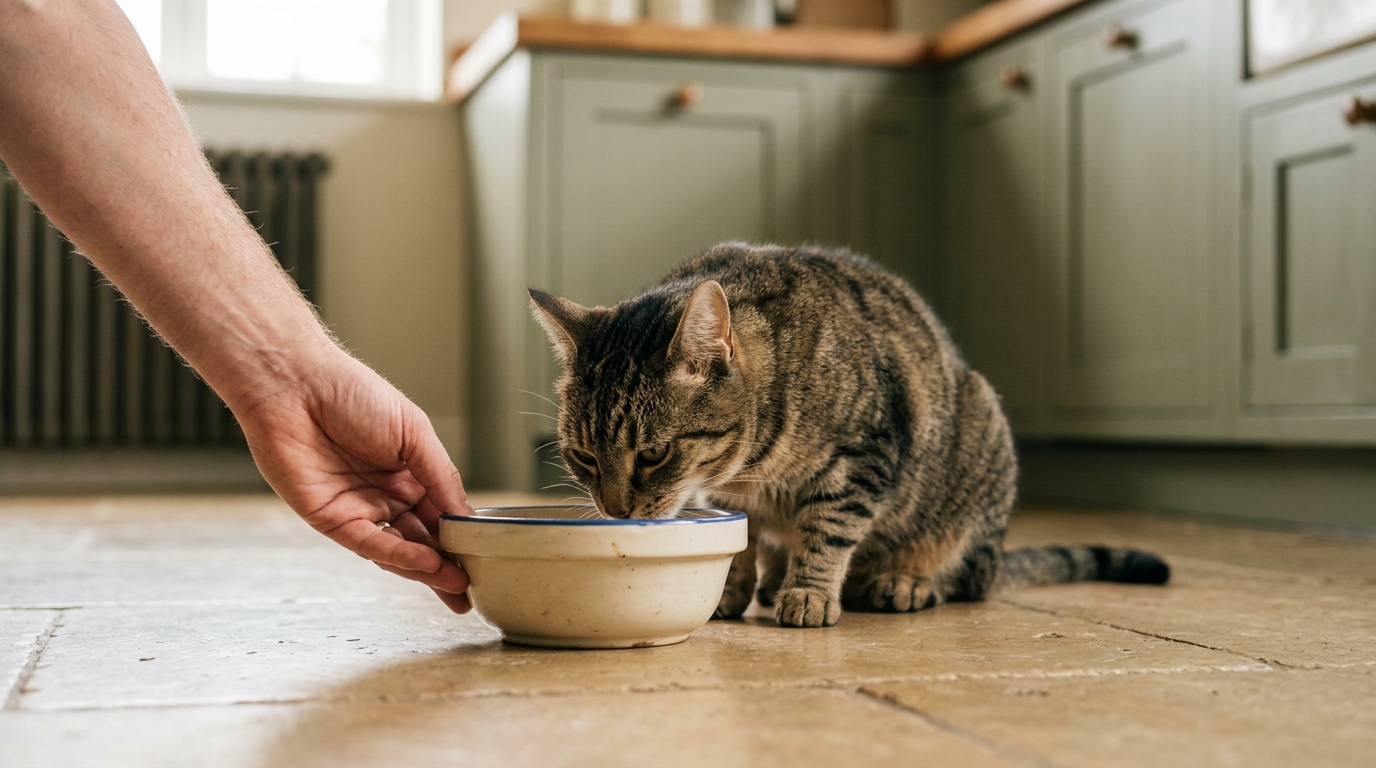
Phosphate Binders: When the Renal Diet Isn't Enough
9 minPhosphate is the number the whole renal diet is quietly chasing, as our guide to that diet explains. Controlli…

Potassium, Anaemia and Acidosis: The Supporting Cast of Kidney Disease
8 minBehind the headline kidney numbers, the creatinine and SDMA and phosphate, sit a handful of supporting problem…

Protein in the Urine: Why the UP/C Ratio Matters, Especially in Dogs
8 minProtein in the urine sounds like a minor footnote on a results sheet, and it is anything but. A kidney filter…

The Renal Diet: The Single Most Important Treatment You Control
10 minOf everything in the kidney-disease toolkit, the prescription renal diet has the best evidence for extending y…
3Daily management
5 guides

Getting a Cat to Eat the Renal Diet: The Owner's Battle Plan
11 minGetting a cat onto a prescribed kidney diet is one of the genuinely hard parts of managing kidney disease, and…

Everyday Life with a Kidney Patient: Litter, Comfort and Routine
8 minA kidney diagnosis can feel as though it is about to take over your whole house, turning your home into a clin…

Keeping Your Pet Hydrated: A Water Strategy for Kidney Disease
8 minHere is a quiet paradox at the heart of kidney disease: a pet can be drinking more than ever and still be runn…

Subcutaneous Fluids at Home: A Complete Beginner's Guide
10 minA needle, at home, given by me? Is that cruel? Could I actually do it? When a vet first suggests giving fluids…

Weight and Muscle: The Home Signs That Matter Most
8 minWhen an older pet slowly loses weight, it is the easiest thing in the world to put it down to age. "She's just…
4Complications and advanced options
4 guides

Concurrent Conditions: When Kidney Disease Doesn't Travel Alone
10 minOlder bodies rarely have just one thing wrong with them, and kidneys are no exception. By the time a cat or do…

Acute-on-Chronic: Recognising and Responding to a Kidney Crisis
9 minChronic kidney disease is usually a slow story, a gentle drift measured in months and years, and most days wit…

Advanced Kidney Treatments: Dialysis, Transplant and What's on the Horizon
8 minMost owners of a pet with kidney disease eventually ask the same hopeful questions. Is there a transplant? A d…

Complementary and Unproven Kidney Treatments: What the Evidence Says
9 minWithin minutes of a diagnosis, the internet fills with products promising to help: kidney "support" supplement…
5Working with your vet
3 guides
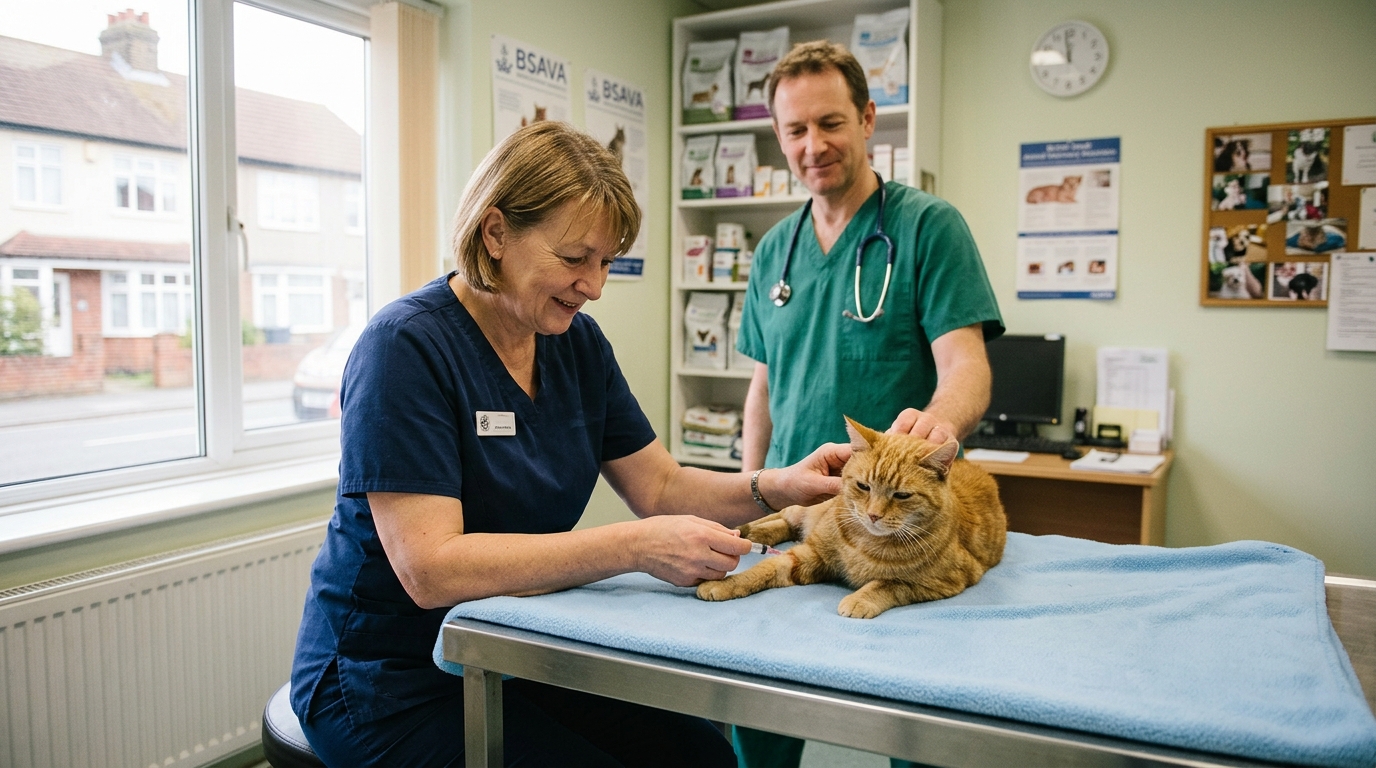
The CKD Monitoring Schedule: What to Check and How Often, by Stage
9 minA pet with kidney disease gets called back to the vet a lot, and then called back again, with a regularity tha…

What CKD Care Actually Costs in the UK: An Honest Breakdown
10 minMoney is part of the picture with kidney disease, a real and often heavy part, and almost nobody talks about i…

Getting the Most From Your Vet Appointments With a Kidney Patient
8 minManaging a pet with kidney disease is a partnership, and a slightly unusual one, because you and your vet each…
6The long view
3 guides

Living Well With Kidney Disease: Pets Who Thrive for Years
8 minThe word "kidney disease" lands like a countdown for most owners. It sounds final, the mind leaps to the worst…

Quality of Life and Saying Goodbye: The Honest Conversation
11 minThis is the hardest article in our kidney guide, and there is no way to make the subject easy, so I will simpl…

When Kidney Disease Progresses: Late-Stage Care and Comfort
8 minThere comes a point in kidney disease where the condition you have managed so well for so long starts to ask m…
Who writes this
Practising vets, named and accountable.
Every guide is written and reviewed by practising RCVS-registered vets from Greenway Veterinary Group. Each article names its author and the vet who reviewed it, shows when it was last checked, and links to the studies behind its claims. If we cannot back something up, we do not say it.
Free printable downloads
Vet-built worksheets and trackers. Print at home, no signup required.
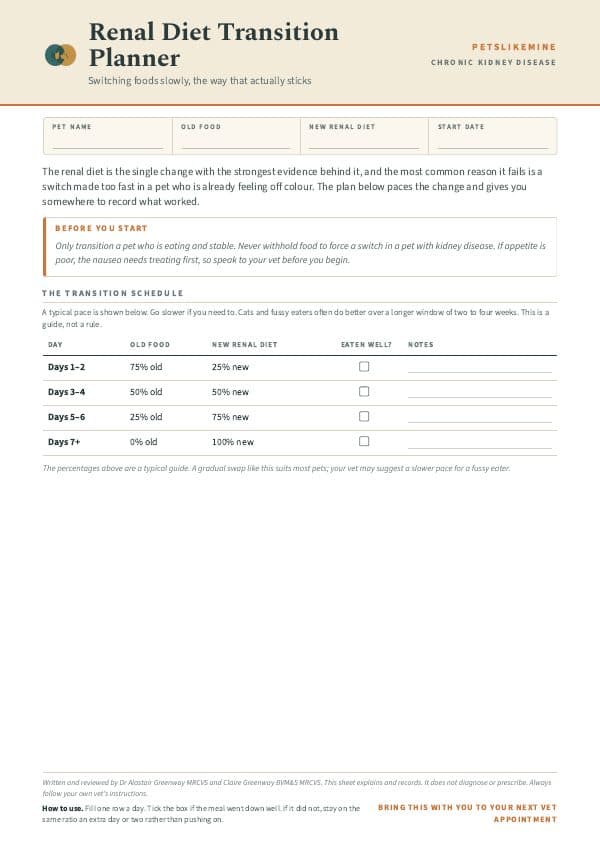
Renal Diet Transition Planner
PDF · 258 KBA day-by-day plan for moving your pet onto a renal diet at a pace that actually sticks. The transition ladder, tricks for winning round a fussy eater, and somewhere to record what worked. The renal diet is the change with the strongest evidence behind it, so it is worth getting right.
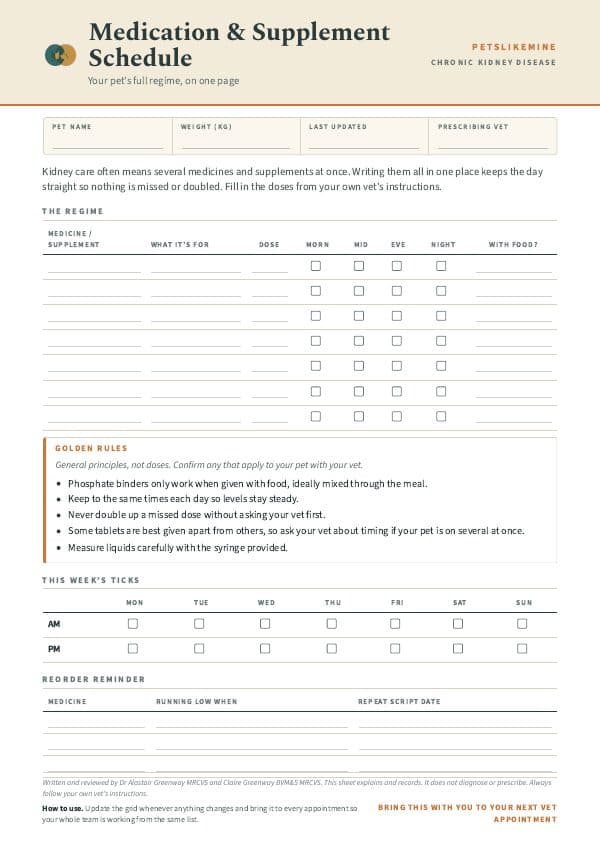
Medication & Supplement Schedule
PDF · 192 KBYour pet's whole kidney regime on one page: every medicine and supplement, what each is for, the dose you fill in from your vet, and a tick grid for the week. Keeps the day straight so nothing is missed or doubled.
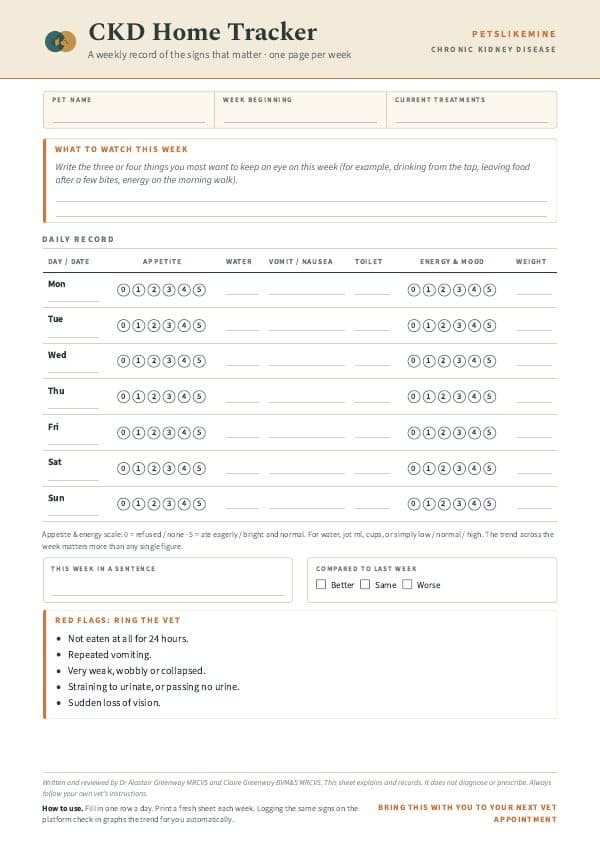
CKD Home Tracker
PDF · 236 KBA weekly record of the signs that matter in kidney disease: appetite, drinking, nausea, energy and weight, one page per week. The trend across the weeks tells you far more than any single day, and the red-flag list shows when to ring the vet.
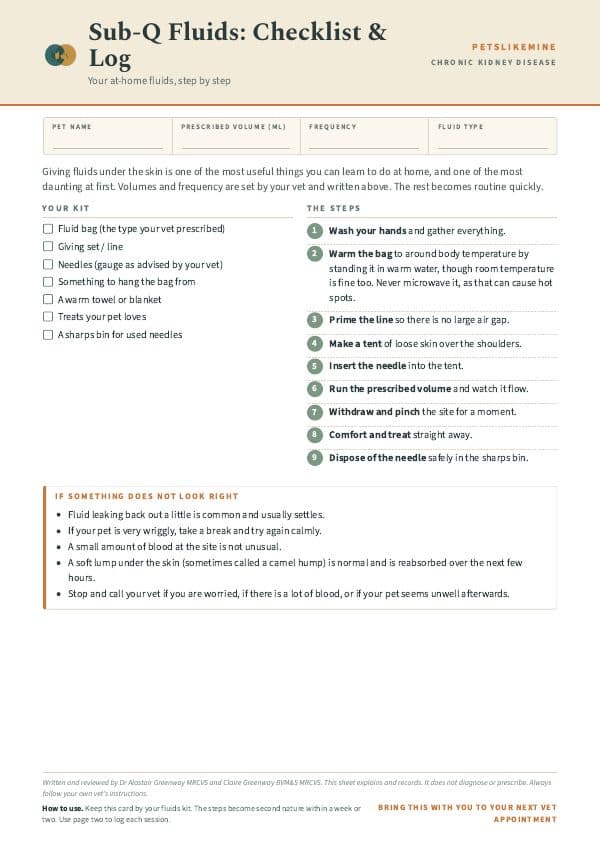
Sub-Q Fluids: Checklist & Log
PDF · 294 KBEverything you need to give fluids under the skin at home with confidence: a kit list, the steps in order, what is normal and what is not, and a running log to bring to rechecks. Daunting at first, routine within a fortnight.
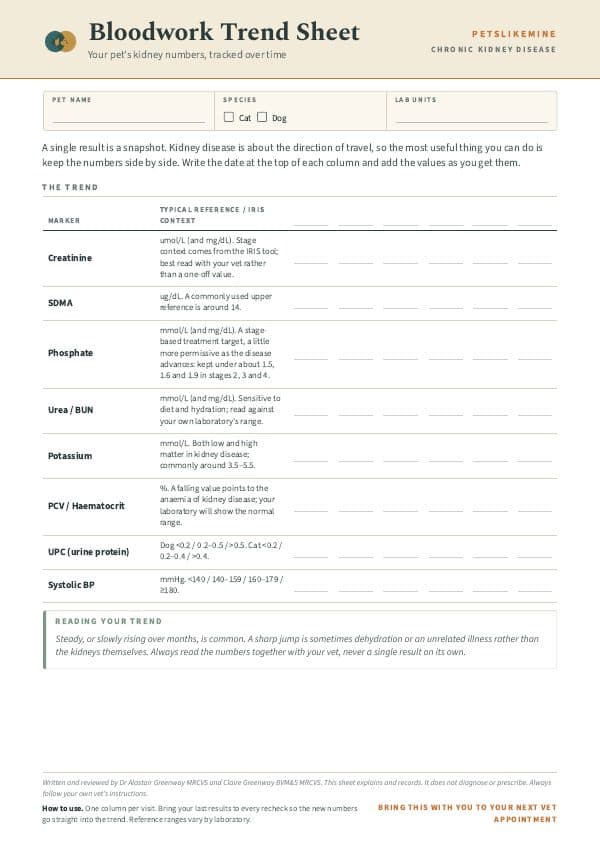
Bloodwork Trend Sheet
PDF · 212 KBYour pet's kidney numbers side by side over time, with plain-English context for each marker: creatinine, SDMA, phosphate, potassium, urine protein and blood pressure. Kidney disease is about the direction of travel, not a single snapshot.
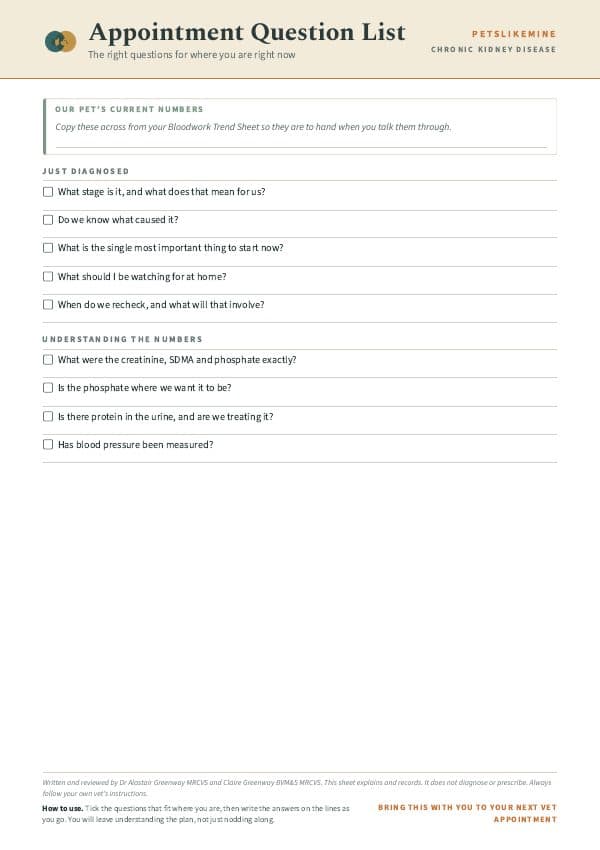
Appointment Question List
PDF · 152 KBThe right questions for where you are right now, from newly diagnosed to reviewing treatment and the longer view. Tick what fits, write the answers on the lines, and leave the consult understanding the plan rather than just nodding along.

UK Cost Planner
PDF · 220 KBPlan the year ahead with clear eyes. Typical UK cost ranges for diet, medicines, monitoring and fluids, room for your own quotes, and the practical ways to make it manageable, from insurance to written prescriptions. Money worries should never quietly steer the medical decisions.
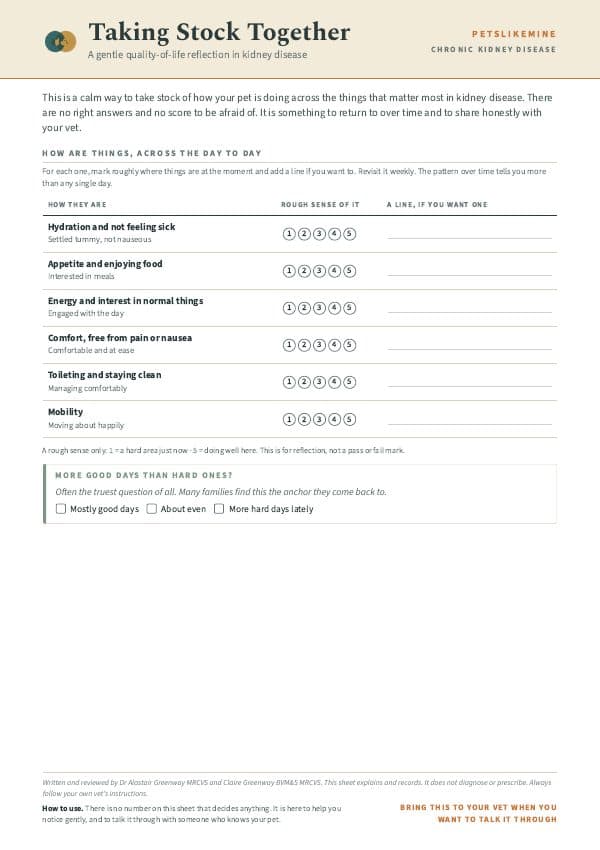
Quality-of-Life Assessment
PDF · 253 KBA gentle way to take stock of how your pet is really doing, across the things that matter most in kidney disease. There is no score to be afraid of here. Something to return to over time, and to share honestly with the people who know your pet.
FAQ
The questions owners ask us most
Short, honest answers to the questions kidney owners search for most, drawn from the vet-written guides above.
How long can a cat live with kidney disease?
There is no single number, but for many cats the disease unfolds slowly, over months and often years, and cats diagnosed at an earlier stage often live years of comfortable life with diet and monitoring. What you feed makes a measurable difference: in one study, cats on a renal diet lived a median of 633 days against 264 days on a normal diet.
Read the complete guide to CKD in catsWhat do the IRIS stages actually mean?
IRIS stages 1 to 4 grade how far kidney disease has progressed, based mainly on blood creatinine and SDMA, then substaged by urine protein and blood pressure. Stage 2 is often picked up on a routine senior blood test before a pet seems ill, and it is the point where the best-evidenced treatments start to earn their place. By stage 4 the focus shifts firmly towards comfort and quality of life. Our stage checker turns your pet’s numbers into a stage in plain English.
Read the plain-English IRIS staging guideDoes a prescription kidney diet really make a difference?
Yes. The renal diet stands almost alone in having been tested in randomised controlled trials and shown to reduce uraemic crises and kidney-related deaths, which is why vets treat it as the cornerstone of management. In cats it more than doubled median survival in one study. Renal diets are generally introduced from IRIS stage 2 onward, the point where the evidence for benefit is clearest.
Read why the renal diet matters mostCan I really give my pet fluids under the skin at home?
Yes. In a survey of nearly 400 owners giving their cats fluids at home, 85 percent described it as easy, low stress or at least okay for themselves, and 89 percent said the same for their cats. Vets most often recommend home fluids in the more advanced stages, IRIS 3 and 4. Fluids are supportive rather than curative, but they ease the nausea, lethargy and poor appetite that dehydration makes worse.
Read the complete beginner’s guide to sub-q fluidsIs kidney disease different in dogs and cats?
Yes, in ways that change the priorities. In cats it is most often a slow, age-related wearing out of the kidney’s filtering tissue. In dogs it more often involves the tiny filters becoming leaky, which is why protein in the urine takes centre stage in dogs in a way it does not in cats. Inherited forms matter more in dogs and can affect dogs only a year or two old, and the canine form tends to progress faster with a generally worse prognosis.
Read the complete guide to CKD in dogsWhat are the early signs of kidney disease?
Increased drinking and increased urination are usually the earliest outward clue: refilling the water bowl more often, or larger clumps in the litter tray. Gradual weight loss, a reduced or fussier appetite, a duller coat and occasional vomiting often follow. None of these is dramatic, and each is easy to put down to age, which is exactly why kidney disease is so often caught later than it could be. Many cases are picked up on routine senior bloods before any signs at all.
See which pets are most at riskCan kidney disease be cured or reversed?
No. Chronic kidney disease usually progresses over time and cannot be reversed. But progresses over time is the important phrase: for many pets it unfolds slowly, and good management can meaningfully slow it and keep quality of life high along the way. The goal is not to cure the kidneys but to slow the disease, ease its effects and keep your pet comfortable and happy for as long as possible, and modern veterinary medicine is genuinely good at that.
How much does kidney disease care cost in the UK?
A prescription renal diet typically costs somewhere in the region of £20 to £50 a month for a cat, and more for a dog, scaling with size. The common medicines each run from a few pounds to £20 or £30 a month, a monitoring visit from several tens of pounds to over a hundred, and a crisis needing a hospital stay several hundred pounds or more. One honest caveat: once diagnosed, kidney disease counts as a pre-existing condition, so standard insurance will not cover a problem your pet already has.
See the full UK cost breakdownThese answers summarise our vet-written guides. They are general education, not advice about your own pet: your vet knows the individual.