

Helping Your Pet Feel Better: Comfort Medications for Kidney Disease
Alastair Greenway
BVM&S MRCVS
Some kidney medicines slow the disease. The ones in this article do something just as precious, and more immediate: they make your pet feel better today. Nausea, a fading appetite, and a low-grade, persistent queasiness are common in kidney disease, they are genuinely miserable for a pet, and they are deeply treatable. Yet time and again, owners do not know to ask for help with them, and pets soldier on feeling sick when they did not need to. This guide covers the anti-nausea and appetite medicines, what each one does, and why asking for them sooner rather than later can change how your pet eats, feels, and lives, even when it is not changing a single number on the blood test.
You are allowed to ask your vet to help your pet feel better, not just to treat the disease. Comfort is a legitimate goal in its own right. If your pet seems queasy or off their food, that is worth raising, and there is very often something simple that helps.
Two kinds of medicine
It helps to understand that the medicines used in kidney disease fall into two broad groups, with two different jobs. The first group works on the disease itself, slowing its progression and managing its consequences: the renal diet, the phosphate binders, the blood-pressure and kidney-protecting drugs we cover in their own articles. These are aimed at the long game.
The second group, the subject of this article, works on how your pet feels day to day. These medicines do not claim to slow the kidney disease or change the bloods. What they do is treat the symptoms, the nausea, the poor appetite, the queasiness, that make a pet with kidney disease feel unwell. And this second group is chronically under-used, not because the medicines are unavailable or risky, but simply because owners often do not realise these symptoms can be treated, and so do not ask. Feeling better is not a luxury add-on to kidney care; it is a central part of it.
Why kidney disease makes pets feel sick
To see why these medicines matter, it helps to understand why kidney disease makes a pet feel unwell in the first place. As the kidneys struggle to clear waste products from the blood, those waste products build up, and that build-up causes nausea, irritates the stomach, and saps the appetite. Rising phosphate and the other imbalances we describe in our article on reading the bloods add to the general feeling of malaise.
The result is a pet who feels persistently queasy, a bit like low-grade travel sickness that never quite lifts, and who therefore loses interest in food. This matters enormously for two reasons. First, the obvious one: a pet who feels sick is suffering, and easing that is worthwhile in itself. Second, a pet who will not eat is a serious practical problem, because good nutrition, especially the renal diet, is central to managing the disease, and because in cats in particular, going without food for even a short time carries its own real dangers. So the nausea and appetite loss of kidney disease are not minor quality-of-life footnotes; they are central, and happily, they are treatable.
Calming the nausea
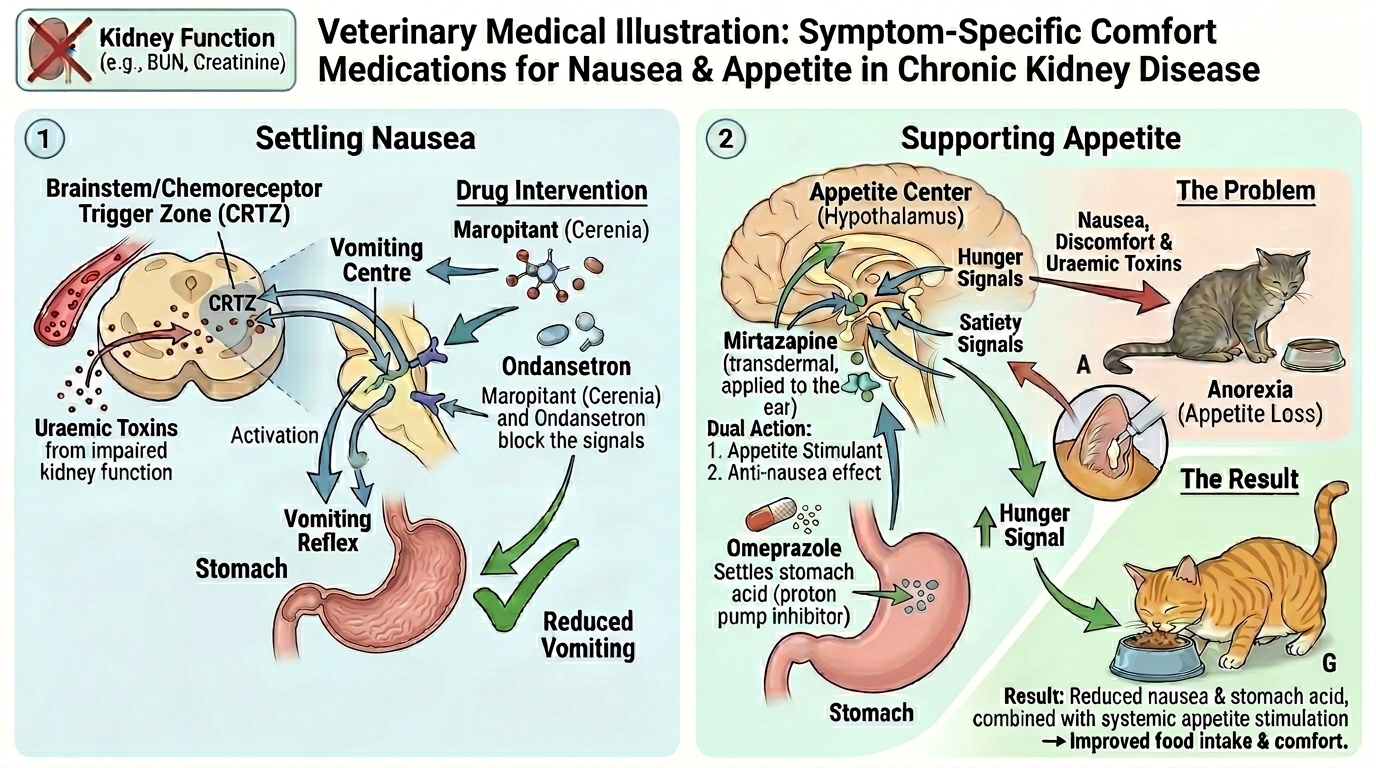
The first line of attack is to treat the nausea directly, and there are effective, well-tolerated medicines for this. The most widely used is maropitant, known by the brand name Cerenia, which blocks nausea and vomiting at their source. It is well established in both cats and dogs; in cats it is the injectable form that is specifically licensed, though vets also use the tablets where that suits the pet. Another is ondansetron, which works by a different mechanism and is often used alongside or instead of maropitant when nausea is a particular problem. Both are generally well tolerated.
There is a crucial insight hidden in this, and it surprises many owners. A pet refusing their food, including refusing the renal diet you have worked so hard to introduce, may not be stubborn or fussy at all. They may simply be nauseous. A nauseous pet turns away from food for exactly the reason a queasy person does, and no amount of coaxing or new flavours will fix that if the underlying problem is nausea. Treating the nausea can transform a pet's relationship with food almost immediately, turning a reluctant eater back into a willing one. So if your pet has gone off their food, the question "could they be feeling sick?" is one of the most useful you can ask, because the answer often points to a simple, effective fix.
Stimulating the appetite
Beyond settling nausea, there are medicines that directly stimulate appetite, and the mainstay in cats is mirtazapine. In the UK this is available as Mirataz, a transdermal ointment that is licensed for cats and applied to the inside of the ear, which is a real boon for cats who resist being given tablets. Mirtazapine has a useful dual action: it stimulates appetite and also has an anti-nausea effect, so it tackles both sides of the problem at once, which is part of why it has become so valuable in caring for cats with kidney disease. Many cats show renewed interest in food quite quickly after starting it.
The appetite helpers do not work in isolation, though, and they are not a substitute for addressing nausea or for the practical business of tempting a pet to eat. The goal is simply to get a pet eating something nourishing, and our article on helping a fussy eater covers the hands-on tactics, the warming of food, the gentle encouragement, that go alongside the medicines. One important caution applies throughout: with a pet whose appetite is fragile, take care not to create a food aversion by pairing meals with anything unpleasant, a point we return to in the feeding article. The medicines and the practical tactics work best together.
Settling the stomach
A third group helps by settling the stomach itself. Kidney disease can be associated with excess stomach acid and irritation, and gastroprotectant medicines can ease that. The one with the better evidence behind it is omeprazole, a proton-pump inhibitor that reduces stomach acid; the older H2-blocker type of drug, such as famotidine, is generally considered to have weaker evidence for this purpose. These are used where stomach irritation seems to be part of the picture, as a further way to make a pet more comfortable and more willing to eat. As with everything here, whether and which to use is a judgement for your vet, based on your individual pet.
Why asking early matters
These comfort medicines can change a pet's quality of life quickly, often within days, and yet they are consistently under-requested, because owners do not know the symptoms are treatable. The common mistake is not over-medicating; it is under-asking, watching a pet feel quietly unwell and assuming nothing can be done.
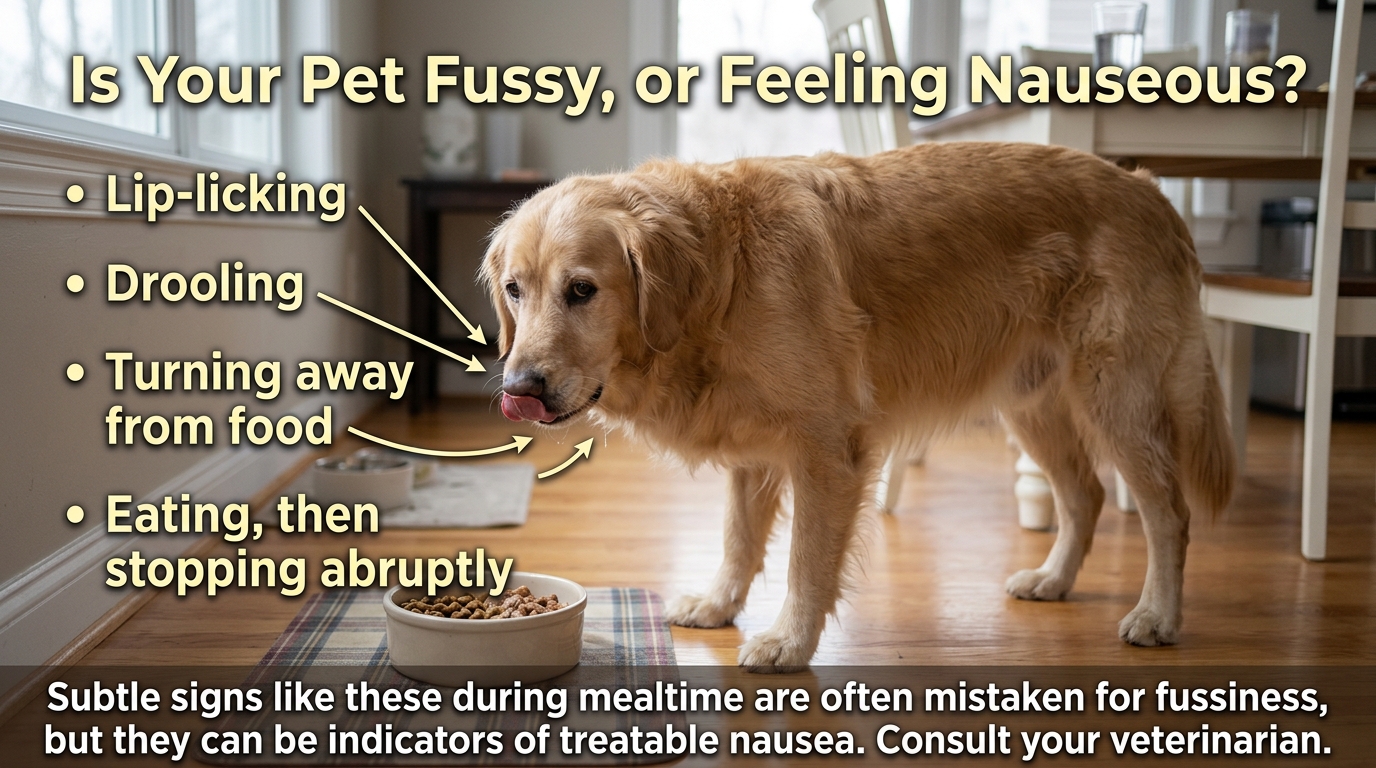
So I want to encourage you, plainly, to raise these things. You are entirely within your rights to tell your vet "she seems queasy," or "he's gone off his food," or "she just doesn't seem herself," and to ask what can be done to help her feel better. That is not making a fuss; it is good advocacy for your pet. The signs worth mentioning include drooling or lip-licking, turning away from food, approaching the bowl then backing off, eating less or more slowly than usual, or a general subdued flatness. Any of these can signal nausea or queasiness, and any of them is worth a conversation. Catching and treating these symptoms early spares your pet needless misery and often protects their eating before weight loss sets in.
Fitting it into daily life
A final, practical word, because the aim is a pet who feels well, not a household ruled by a medication timetable. The comfort medicines are designed to fit reasonably easily into daily life. Some come in forms that make life simpler. The transdermal appetite ointment rubbed into the ear, for instance, sidesteps the battle of pilling a cat, and tablets can often be timed around meals to become part of a routine rather than a daily ordeal. Your vet and the practice nurses can advise on the easiest way to give each one, and small adjustments, the right formulation, the right timing, can make the difference between a medicine that is a struggle and one that quietly becomes part of the day.
The balance to aim for is sensible, not maximal. The point is not to medicate every minor variation or to turn your pet into a pin-cushion of pills, but to recognise genuine discomfort and treat it, so your pet feels well enough to eat and to enjoy their days. A pet whose nausea is controlled and whose appetite is supported is a pet who is more comfortable, eating better, and very often brighter in themselves, and that is squarely worth having.
So the message to take away and act on is simple. Alongside the medicines that slow kidney disease sits a second group whose job is to make your pet feel better now, by treating the nausea, supporting the appetite, and settling the stomach, and these are powerful tools for quality of life that owners too often do not think to ask for. If your pet with kidney disease seems queasy, off their food, or simply not themselves, do not assume that is just part of the disease to be endured. Raise it with your vet, ask specifically what can help them feel better, and you may be surprised how much difference a small, well-chosen addition can make to how your pet feels and eats. That conversation is one of the kindest things you can initiate on your pet's behalf.
References
- Quimby JM, Lunn KF. Mirtazapine as an appetite stimulant and anti-emetic in cats with chronic kidney disease: a masked placebo-controlled crossover clinical trial. The Veterinary Journal, 2013.
- Sparkes AH, Caney S, Chalhoub S, et al. ISFM Consensus Guidelines on the Diagnosis and Management of Feline Chronic Kidney Disease. Journal of Feline Medicine and Surgery, 2016.
- International Renal Interest Society (IRIS). IRIS Staging of CKD (modified 2023).
Free downloads
Companion worksheets to put what you've read into practice. Free PDFs, print at home.
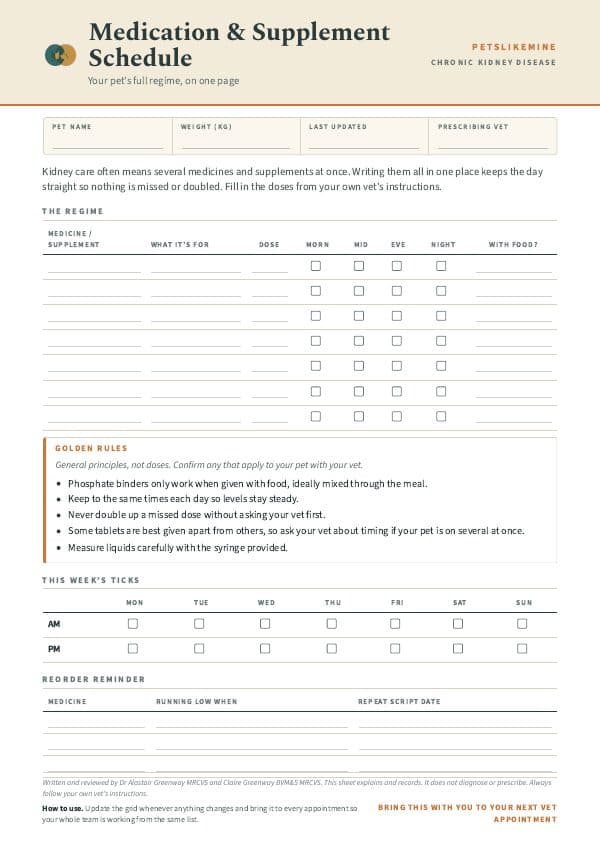
Medication & Supplement Schedule
PDF · 192 KBYour pet's whole kidney regime on one page: every medicine and supplement, what each is for, the dose you fill in from your vet, and a tick grid for the week. Keeps the day straight so nothing is missed or doubled.
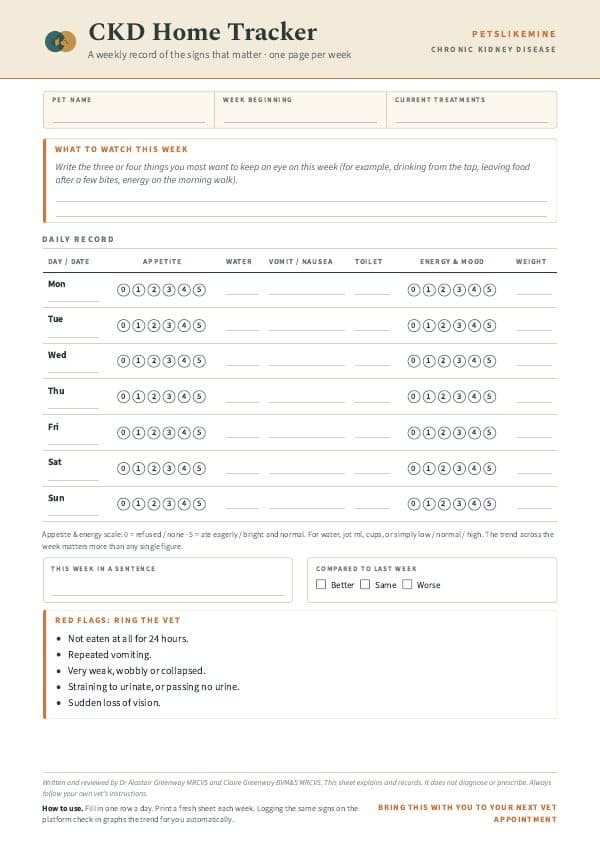
CKD Home Tracker
PDF · 236 KBA weekly record of the signs that matter in kidney disease: appetite, drinking, nausea, energy and weight, one page per week. The trend across the weeks tells you far more than any single day, and the red-flag list shows when to ring the vet.
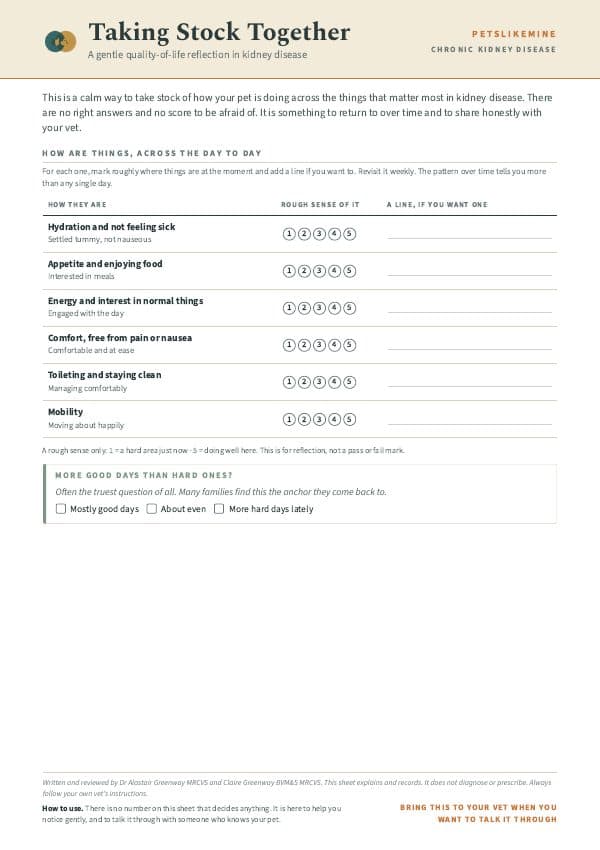
Quality-of-Life Assessment
PDF · 253 KBA gentle way to take stock of how your pet is really doing, across the things that matter most in kidney disease. There is no score to be afraid of here. Something to return to over time, and to share honestly with the people who know your pet.
See where your pet stands today
Tracking is the other half of managing kidney disease. Drop in the latest bloods to see the IRIS stage, then follow the trend as treatment settles in.
Check the IRIS stageYou're not doing this alone
Compare treatment journeys and talk to owners managing kidney disease. Free to join.
Join PetsLikeMine