


Understanding IRIS Staging: What Your Pet's Stage Actually Means
Alastair Greenway
BVM&S MRCVS
Your vet has used a word that sounds clinical and a little frightening: your dog or cat is at "stage 2", or "stage 3", kidney disease. It is natural to hear that as a verdict, a fixed position on a countdown. It is not. A stage is a map reference. It tells you and your vet roughly where your pet is on a well-charted road, so you can choose the right turning and know what to watch for next. This article translates that map into plain English: what the stages mean, the actual numbers behind them, why the cut-offs differ between dogs and cats, and why two extra measurements, protein in the urine and blood pressure, often matter more for your pet than the headline stage. If you have your pet's results to hand, you can drop the numbers straight into our interactive Kidney Disease Stage Checker and read along.
Where the stages come from
The staging system is the work of the International Renal Interest Society, usually shortened to IRIS, a group of veterinary kidney specialists who set out a shared way to describe chronic kidney disease so that any vet, anywhere, means the same thing by "stage 2". That shared language is genuinely useful. It lets your vet match the treatment to the right point in the disease, compare today's results with last year's on a like-for-like basis, and explain the plan clearly to you and to any other vet your pet sees.
Two things are worth being clear about from the start. First, staging happens after diagnosis, not instead of it: it describes a kidney disease that has already been confirmed, it does not by itself diagnose one. Second, the stage describes how much kidney function has been lost, not what caused the loss and not, on its own, how long your pet has. Pets at the same stage can travel very different roads depending on the cause, the substages we will come to, and how they respond to treatment.
One rule to know before you read a number
Here is the single most important caveat, and it is the one owners most often miss. A stage is only meaningful when it is measured in a stable, well-hydrated pet, on a fasting blood sample, ideally confirmed on more than one occasion. IRIS is explicit that staging should be done once the kidney values have settled, not in the middle of a crisis or an unrelated illness.
This matters because the headline number, creatinine, rises when a pet is dehydrated or acutely unwell, for reasons that have nothing to do with the long-term state of the kidneys. A single high creatinine taken from a poorly, dehydrated animal can read a whole stage too severe, then fall again once they are rehydrated. So if your pet was staged during an illness or a hospital stay, treat that number as provisional, and ask about rechecking once they are settled at home. Staging done properly is patient: it waits for a fair reading.
The two numbers that set the stage
The stage itself is built from one or both of two blood markers.
Creatinine is the traditional one. It is a waste product from normal muscle activity that healthy kidneys clear from the blood, so when the kidneys are failing it builds up. Its great limitation is that it is a late signal: blood creatinine generally does not rise above the normal range until roughly three quarters of kidney function is already gone. It is also affected by muscle, so a thin, elderly pet with little muscle can show a normal-looking creatinine despite meaningful kidney disease.
SDMA, symmetric dimethylarginine, is the newer marker, and it addresses both weaknesses. It tends to rise earlier, often once only around a quarter to a third of function is lost rather than three quarters, and it is much less influenced by how much muscle a pet carries. That earlier, muscle-independent signal is why SDMA has become such a useful addition, especially in older, skinnier cats and in dogs, where catching the disease sooner genuinely changes what you can do about it.
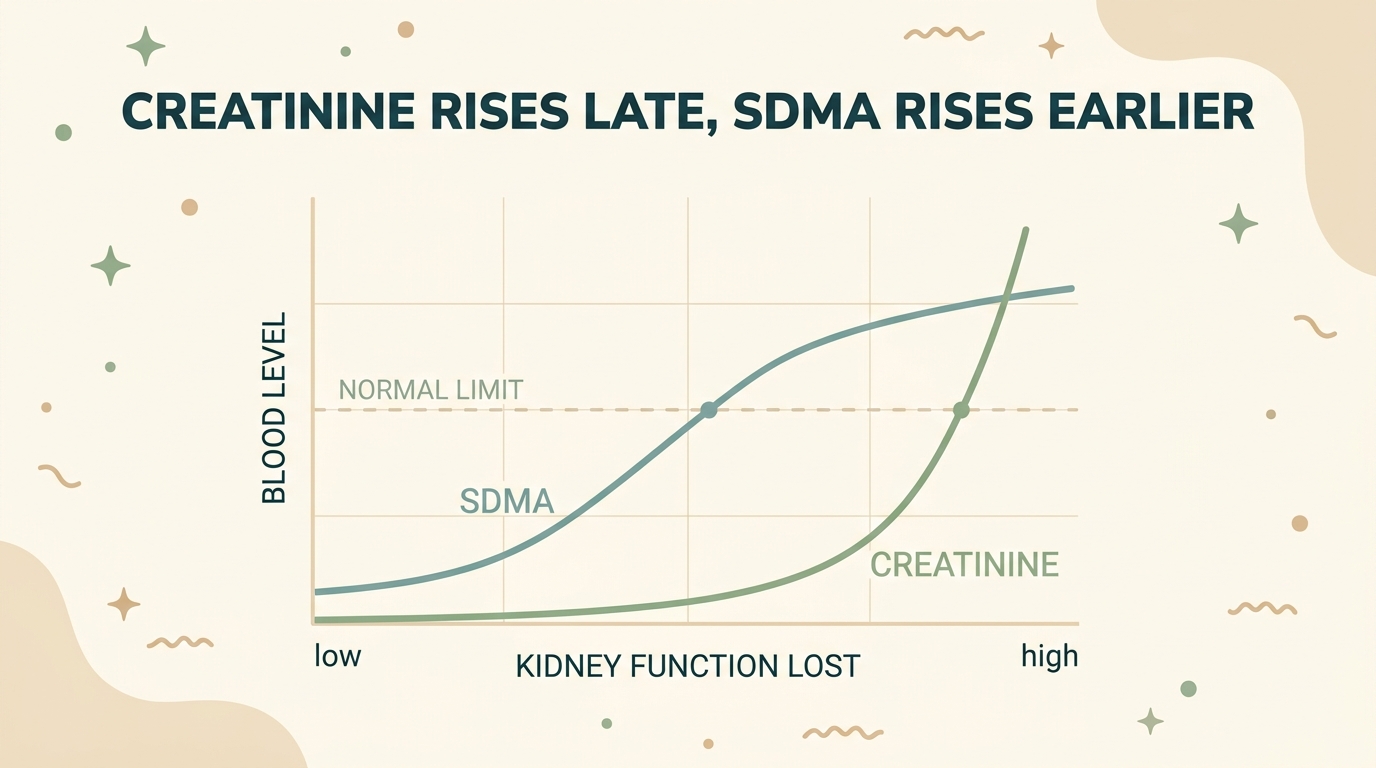
Because the two markers can tell slightly different stories, IRIS gives a simple rule for when they disagree: stage at the higher of the two. If creatinine suggests stage 2 but a persistently raised SDMA points to stage 3, your pet is treated as stage 3. The marker that detects more trouble wins, because it is usually the one seeing the disease more clearly. One practical note for the earliest disease: an SDMA that sits just above the usual upper limit of 14, and stays there on repeat testing, can be an early flag worth taking seriously even when creatinine is still entirely normal.
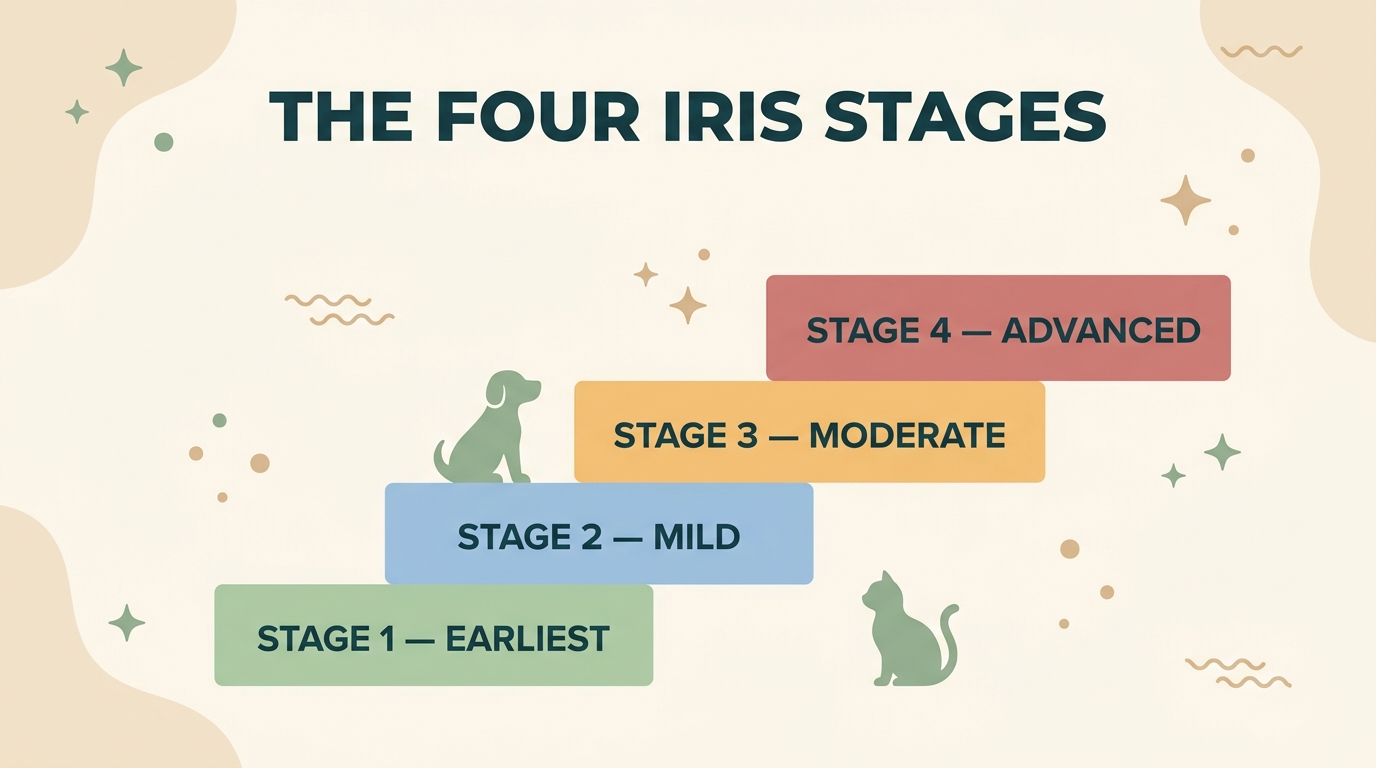
The four stages, in plain English
IRIS divides the road into four stages, set mainly by the fasting blood creatinine, with SDMA alongside. The creatinine bands are the same for dogs and cats from stage 2 upward; only the stage 1 ceiling differs, which the next section explains. The figures below give both common units, micromoles per litre (µmol/L), used by most UK labs, and milligrams per decilitre (mg/dL), used by many others.
Stage 1, the earliest. Creatinine is still in the normal range (under 140 µmol/L, or 1.6 mg/dL, in cats; under 125 µmol/L, or 1.4 mg/dL, in dogs) and SDMA is normal or only mildly raised, but something else points to the kidneys: urine that is too dilute, protein in the urine, an abnormality felt on examination or seen on a scan, or values that are creeping upward across repeated tests. Most pets at this stage feel completely well. The work here is to confirm the picture is real, look for any treatable underlying cause, and record a baseline blood pressure and urine protein, then keep your pet well hydrated and agree how often to monitor. Caught this early, many pets stay stable for a very long time.
Stage 2, mild. Creatinine sits at or just above the top of normal (roughly 140 to 250 µmol/L, or 1.6 to 2.8 mg/dL, in cats; 125 to 250 µmol/L, or 1.4 to 2.8 mg/dL, in dogs) and SDMA is mildly raised. Outward signs are usually mild or absent, so stage 2 is often picked up on a routine senior blood test rather than because the pet seems ill. This is the point at which the treatments with the strongest evidence start to earn their place, above all the prescription renal diet, which our renal-diet article covers in depth. Starting those steps early is exactly why being found here is genuinely good news rather than bad.
Stage 3, moderate. Creatinine is clearly raised (roughly 251 to 440 µmol/L, or 2.9 to 5.0 mg/dL, in both species). This is a deliberately wide band, and IRIS notes it spans pets who still feel well (early stage 3) through to those with more obvious signs (late stage 3): more drinking and urinating, a smaller appetite, some nausea, gradual weight loss. It is where the full toolkit comes into play, the diet, phosphate binders, anti-nausea and appetite support, help with hydration, and treatment of blood pressure, urine protein, potassium and anaemia as needed. Plenty of cats and dogs live comfortably in this stage for a long time with good support.
Stage 4, advanced. Creatinine is high (above 440 µmol/L, or above 5.0 mg/dL) and the risk of feeling unwell is greatest. The focus shifts firmly towards comfort and quality of life: keeping your pet hydrated, often with fluids under the skin, controlling nausea and protecting appetite, managing anaemia and the other complications, and staying in close touch with your vet. Many pets still have good days here, and this is the stage to talk openly about what those good days look like.
Why dogs and cats have different cut-offs
You may have noticed the stage 1 ceiling is higher for cats (140 µmol/L) than for dogs (125 µmol/L). That is not an oversight. Cats naturally run with slightly higher creatinine than dogs, partly a matter of their muscle metabolism, so the threshold is set a little higher to avoid over-staging a healthy cat. From stage 2 upward the creatinine bands line up, but the SDMA guide values IRIS publishes for the higher stages do differ between the species. The point for owners is simple: a dog and a cat with the same creatinine are not necessarily at the same stage, and your vet uses species-specific cut-offs to get it right. Our checker does the same automatically once you tell it which animal you have.
The substages that often matter more
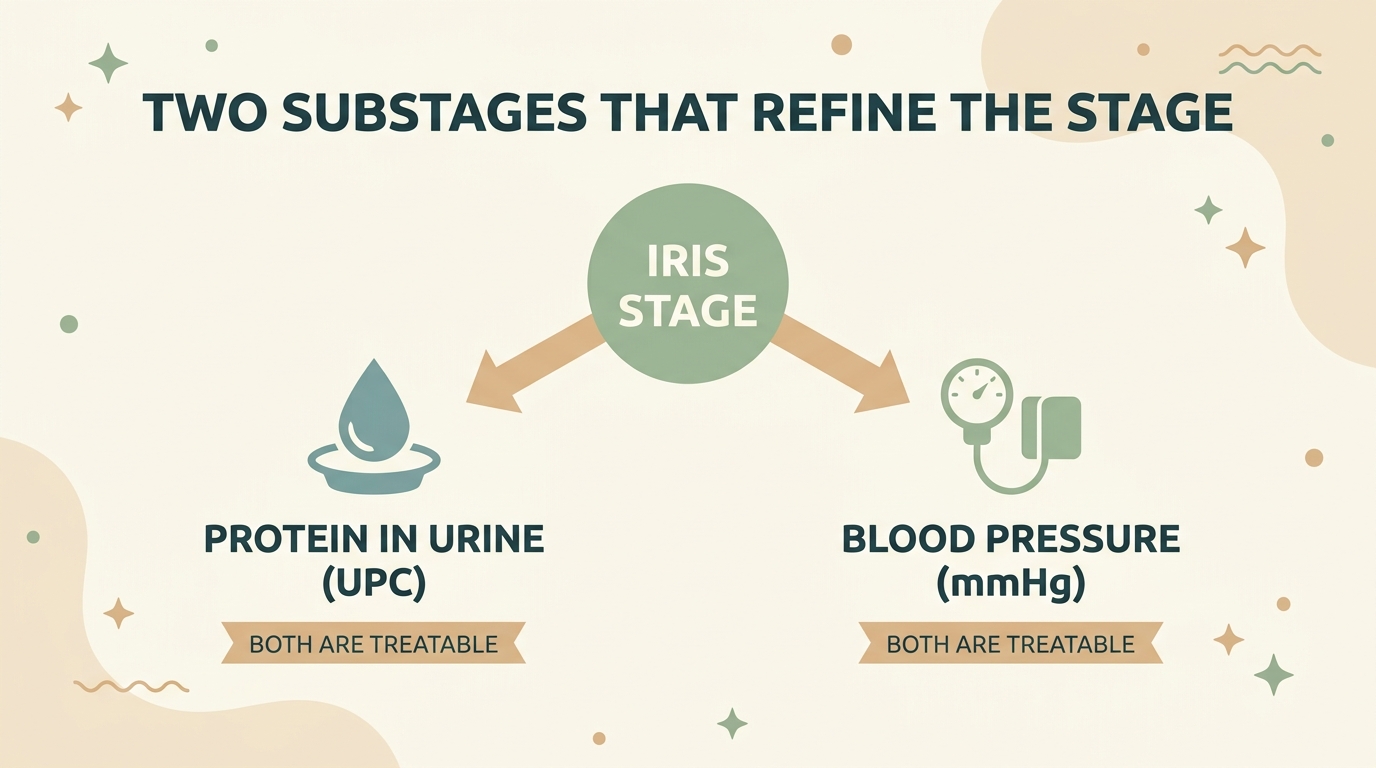
Here is the part the headline stage can hide, and it is where careful staging really pays off. Once the stage is set, IRIS adds two substages, and for many pets these matter as much as, or more than, the number itself, because they flag specific, treatable problems.
Protein in the urine
The first substage is proteinuria, measured by the urine protein to creatinine ratio, written UPC. Healthy kidneys keep protein in the blood and out of the urine; a leaking filter lets it through, and that leak both signals damage and appears to drive the disease faster. The bands differ slightly by species. In dogs, a UPC under 0.2 is non-proteinuric, 0.2 to 0.5 is borderline, and above 0.5 is proteinuric. In cats, the borderline band is narrower: under 0.2 is non-proteinuric, 0.2 to 0.4 borderline, and above 0.4 proteinuric.
This substage matters because protein loss is both a warning sign and a treatment target. It is especially central in dogs, where protein-losing kidney disease can be aggressive, but it counts in cats too. Where a pet is proteinuric, vets often reach for a kidney-protecting medicine, an ACE inhibitor such as benazepril, or telmisartan (licensed in cats for exactly this), then recheck the UPC to confirm the protein is coming down. A borderline result is usually rechecked rather than treated straight away. If your pet's results do not mention a UPC, it is well worth asking for one.
Blood pressure
The second substage is systolic blood pressure, the top number, measured in millimetres of mercury (mmHg). High blood pressure is common in kidney disease and dangerous precisely because it is silent: the first sign can be sudden blindness, from bleeding or detachment at the back of the eye, and it also harms the brain, heart and the kidneys themselves. The IRIS bands run: under 140 is normotensive (minimal added risk); 140 to 159 prehypertensive (low risk); 160 to 179 hypertensive (moderate risk); and 180 or above severely hypertensive (high risk).
The reassuring part is that this is very treatable. In cats, amlodipine is the usual first choice and works well; dogs are sometimes managed a little differently. Because the damage is silent and the treatment is straightforward, the veterinary consensus is that every pet with kidney disease should have its blood pressure measured, and rechecked over time. If yours has not, add it to the list to ask about.
Putting it together
Imagine a cat whose results read: creatinine 220 µmol/L, SDMA 30 µg/dL, UPC 0.5, blood pressure 175 mmHg. The creatinine alone puts her in stage 2; the SDMA, read against the cat bands, points higher, so by the higher-stage rule she is staged at 3. She is proteinuric (UPC above 0.4) and hypertensive (175 sits in the 160 to 179 band). The full picture is therefore "stage 3, proteinuric, hypertensive", and that description does real work: it tells the vet to treat the protein loss and the blood pressure, not simply to note the stage. The same numbers in our checker return the same plain-English summary, which members can save to a pet and watch across rechecks.
What the stage says about time, and what it doesn't
Owners understandably want the stage to answer the unspoken question: how long. It cannot, not on its own, and anyone who tells you a stage is a fixed timetable is overstating what the number knows. What is true is gentler and more useful. The stage at diagnosis does carry some weight, and earlier is better, but how the disease behaves over the following months, and in particular the substages, often matter more than the starting point. A proteinuric pet whose protein loss is brought under control, or a hypertensive one whose pressure is treated, can do markedly better than the bare stage suggests. Many pets, especially those found early, stay stable and comfortable for a long time. The stage is the start of the conversation about the future, not the end of it.
Turning the stage into action
Turn the number into action with a short list for your next conversation with your vet. Ask for the actual values, the creatinine, the SDMA, and crucially the UPC and the blood pressure, written down, so you have a baseline you can track. Ask which stage and which substages your pet is in, and what the plan is aiming for: a renal diet from stage 2 onward, phosphate control, and treatment of any protein loss or high blood pressure. Agree when the next recheck is and what it will measure. And keep your own record, because a stage read once is a snapshot, while the same numbers tracked over time tell you the thing that actually matters, the direction of travel. Dropping each set of results into our Kidney Disease Stage Checker and saving them to your pet turns a folder of loose numbers into a trend you can see, and bring back to your vet.
Read the stage, then, as what it is: not a sentence, but a map you are now equipped to read. Knowing where your pet stands, and which two substages to ask about, puts you exactly where your pet needs you, beside your vet, making the handful of choices that genuinely change the road ahead.
References
- International Renal Interest Society (IRIS). IRIS Staging of CKD (2023).
- International Renal Interest Society (IRIS). IRIS Treatment Recommendations for CKD in Cats and Dogs (2023).
- Hall JA, Yerramilli M, Obare E, Yerramilli M, Jewell DE. Comparison of serum concentrations of symmetric dimethylarginine and creatinine as kidney function biomarkers in cats with chronic kidney disease. Journal of Veterinary Internal Medicine, 2014.
- Nabity MB, Lees GE, Boggess MM, Yerramilli M, Obare E, Yerramilli M, Rakitin A, Aguiar J, Relford R. Symmetric dimethylarginine assay validation, stability, and evaluation as a marker for the early detection of chronic kidney disease in dogs. Journal of Veterinary Internal Medicine, 2015.
- Acierno MJ, Brown S, Coleman AE, Jepson RE, Papich M, Stepien RL, Syme HM. ACVIM consensus statement: Guidelines for the identification, evaluation, and management of systemic hypertension in dogs and cats. Journal of Veterinary Internal Medicine, 2018.
- Sparkes AH, Caney S, Chalhoub S, Elliott J, Finch N, Gajanayake I, Langston C, Lefebvre HP, White J, Quimby J. ISFM Consensus Guidelines on the Diagnosis and Management of Feline Chronic Kidney Disease. Journal of Feline Medicine and Surgery, 2016.
Free downloads
Companion worksheets to put what you've read into practice. Free PDFs, print at home.
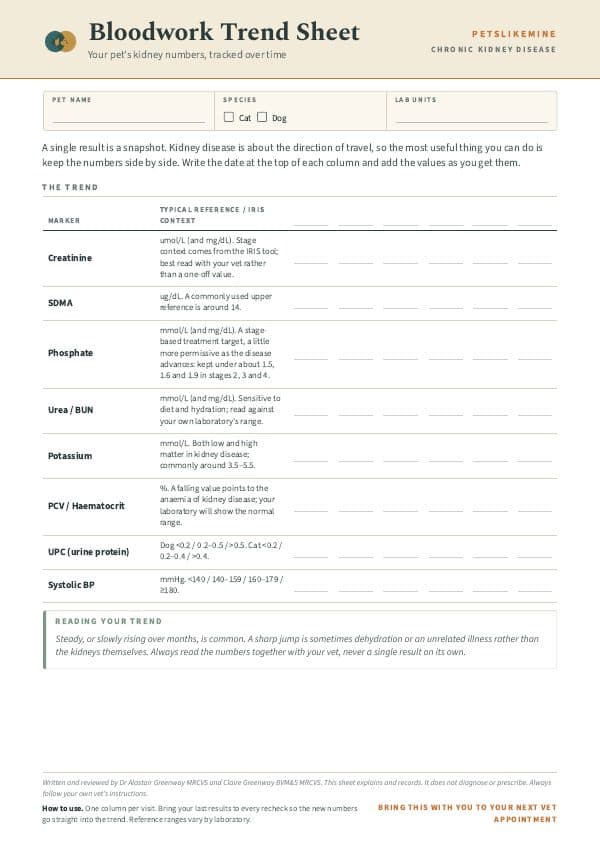
Bloodwork Trend Sheet
PDF · 212 KBYour pet's kidney numbers side by side over time, with plain-English context for each marker: creatinine, SDMA, phosphate, potassium, urine protein and blood pressure. Kidney disease is about the direction of travel, not a single snapshot.

Appointment Question List
PDF · 152 KBThe right questions for where you are right now, from newly diagnosed to reviewing treatment and the longer view. Tick what fits, write the answers on the lines, and leave the consult understanding the plan rather than just nodding along.
See where your pet stands today
Tracking is the other half of managing kidney disease. Drop in the latest bloods to see the IRIS stage, then follow the trend as treatment settles in.
Check the IRIS stageYou're not doing this alone
Compare treatment journeys and talk to owners managing kidney disease. Free to join.
Join PetsLikeMine