


Potassium, Anaemia and Acidosis: The Supporting Cast of Kidney Disease
Alastair Greenway
BVM&S MRCVS
Behind the headline kidney numbers, the creatinine and SDMA and phosphate, sit a handful of supporting problems that kidney disease can cause: low potassium, anaemia, and a gradual acidity in the blood. Each one sounds alarming when it appears as an unfamiliar word on a results sheet, and each can feel like a fresh disaster piled on top of the diagnosis you are already absorbing. They are nothing of the kind. They are well-understood, expected pieces of kidney disease, each with its own straightforward fix, and treating them is a big part of why a well-managed pet feels well. This guide explains what they are, why kidney disease causes them, how they make your pet feel, and what your vet does about them, so the next surprise on the printout is not a surprise at all.
Think of these as the supporting cast to the main kidney numbers. They are worth understanding precisely because, met cold and unexplained, they frighten owners, and met with a little knowledge, they become simply more things that are being looked after.
Potassium: the weakness mineral
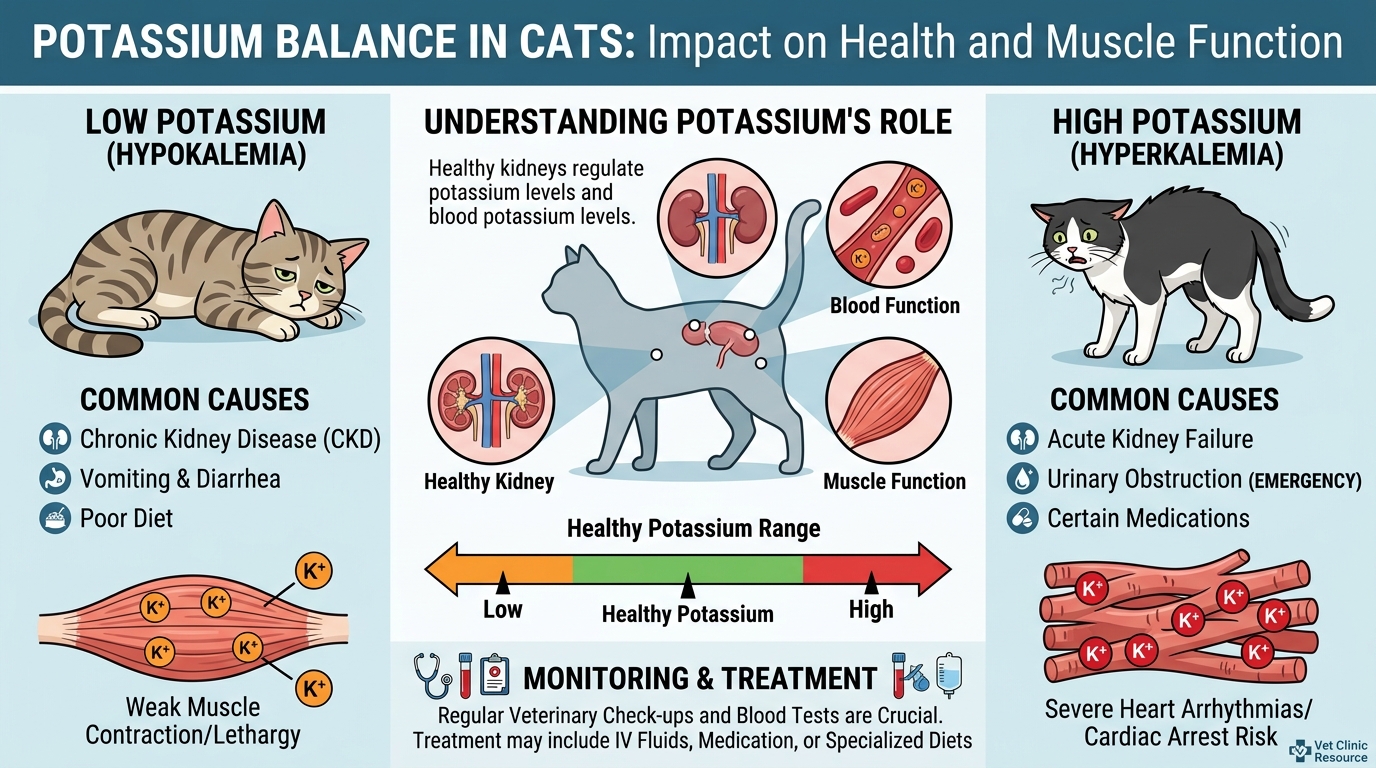
Potassium is a mineral the body needs for healthy muscle and nerve function, and kidney disease can disturb it, most often by letting it run too low, a state called hypokalaemia. This is particularly a feline issue, and it is relatively common in cats with kidney disease.
When potassium drops, the most noticeable effect is on the muscles: a cat may become weak, lethargic, and off their food. In more severe cases there is a striking and very characteristic sign, the cat holds its head dropped down toward the floor, unable to hold it up normally, a posture vets call cervical ventroflexion, sometimes alongside a general muscular weakness. It looks alarming, but it has a clear cause and a clear remedy. Low potassium is corrected with potassium supplements, given as potassium gluconate or potassium citrate, often as a palatable gel or powder, and a good renal diet helps too, because these diets are formulated to be non-acidifying and are supplemented with potassium, which in milder cases can be enough on its own. There is an added reason to take low potassium seriously, beyond how it makes a cat feel: it can itself place further strain on the kidneys, so correcting it helps the kidneys as well as the muscles.
The opposite problem, potassium running too high, called hyperkalaemia, is less common but worth knowing about, because it tends to appear either in advanced kidney disease, particularly when urine output falls, or as a possible effect of the kidney-protecting ACE inhibitor and related drugs we discuss in our article on proteinuria. This is one of the reasons your vet monitors potassium after starting those medicines. Either way, potassium is a number your vet keeps an eye on, correcting it gently in whichever direction it has strayed.
Anaemia: why the energy fades
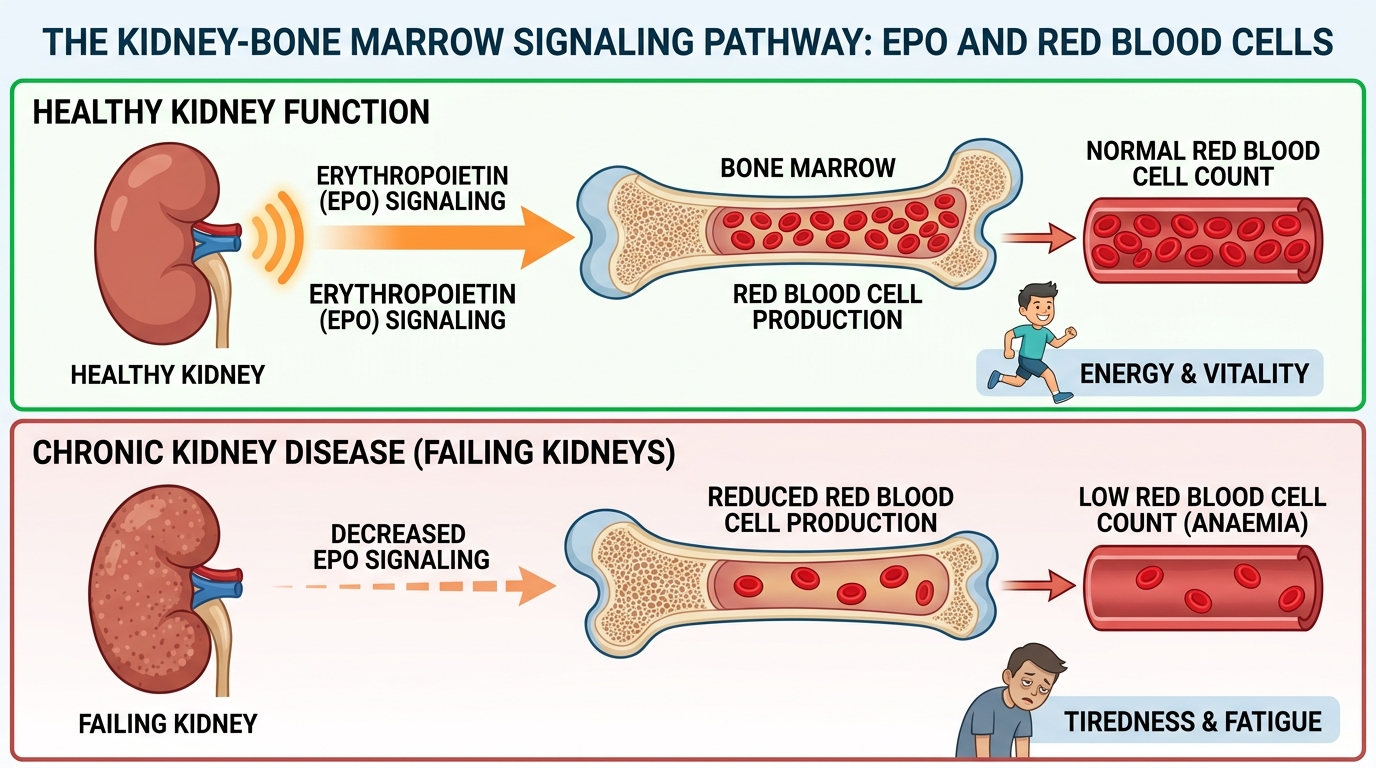
Anaemia means too few red blood cells, the cells that carry oxygen around the body, and it is one of the reasons a pet with more advanced kidney disease can become tired, flat, and low in energy. Understanding why kidney disease causes it makes the treatment make sense.
The kidneys do more than filter waste. Among their quieter jobs is producing a hormone called erythropoietin, which travels to the bone marrow and signals it to make red blood cells. As the kidneys fail, they produce less erythropoietin, so the marrow receives a weaker signal and makes fewer red cells, and anaemia gradually develops. There are usually other contributing factors layered on top, too: pets with kidney disease can lose small amounts of blood from an irritated, uraemic stomach, and they can become deficient in iron, both of which worsen the anaemia. The effect on how a pet feels is significant, because much of the tiredness, the reduced appetite, and the general flatness of advanced kidney disease can be down to the anaemia, and the lack of oxygen it causes can itself be hard on the kidneys.
The encouraging part is that anaemia of kidney disease can be treated, by addressing each of its causes. Where it is significant, the marrow can be prompted to make more red cells with a medication that replaces the missing erythropoietin signal, most commonly a drug called darbepoetin. A practical point worth knowing, since you may hear it mentioned: darbepoetin is the modern, preferred drug of its kind, and it is favoured over an older version partly because that older drug carried a greater risk of an uncommon complication in which the body turns against the treatment and red-cell production is suppressed, a problem called pure red cell aplasia. Darbepoetin carries a lower risk of this, though not a zero one, which is one reason it has become the choice where this kind of treatment is needed. Alongside it, your vet will correct any iron deficiency, supplement B vitamins, which are lost in the increased urine, and address any source of blood loss such as a uraemic stomach. Treating the anaemia can make a real, visible difference to a pet's energy and brightness.
Acidosis: the slow souring
The third supporting problem is a gradual change in the body's acid balance. One of the kidneys' jobs is to help keep the blood from becoming too acidic, by handling acid that the body produces and excreting it. As the kidneys fail, they manage this less well, and the blood can become slightly too acidic over time, a state called metabolic acidosis.
The effects of this are less visible than weak muscles or tiredness, but they are real: a creeping acidity tends to sap appetite and energy, adding to the general malaise of kidney disease, and it has been linked to faster progression of the disease, so it is worth correcting rather than ignoring. Reassuringly, it is usually manageable through the diet and simple supplements. Renal diets are deliberately formulated to be alkalinising, that is, to counteract the acidity, which often goes a long way on its own. Where more is needed, an alkalinising supplement such as potassium citrate or bicarbonate can be added to bring the balance back, with the neat bonus that potassium citrate helps with low potassium at the same time. As with the other pieces, it is corrected gently and monitored, rather than being a crisis to fear.
How these are found and followed
You may be wondering how your vet knows about any of these, given that, by their nature, several are not very visible. The answer is the routine monitoring blood tests that are part of good kidney care. The same blood samples that track the kidney values also report the potassium, the red cell count, and the body's acid-base balance, so these supporting problems are picked up as part of the regular checks, often before they have caused much in the way of obvious signs.
This is, in fact, one of the best arguments for keeping up with the recheck schedule your vet recommends, a theme that runs right through kidney care. Regular monitoring is not box-ticking; it is how these manageable problems are caught early and corrected before they make your pet feel unwell, and how each is then followed over time and adjusted to the numbers. Each of these pieces, once found, is treated to its target and rechecked, the same measure-and-adjust rhythm that governs the rest of kidney management. Our other articles on monitoring go into the schedule in more detail; the point here is simply that the supporting cast is watched for, not stumbled upon.
Pulling the threads together
Encountered as scary one-off words on a results sheet, these problems can feel far worse than they are.
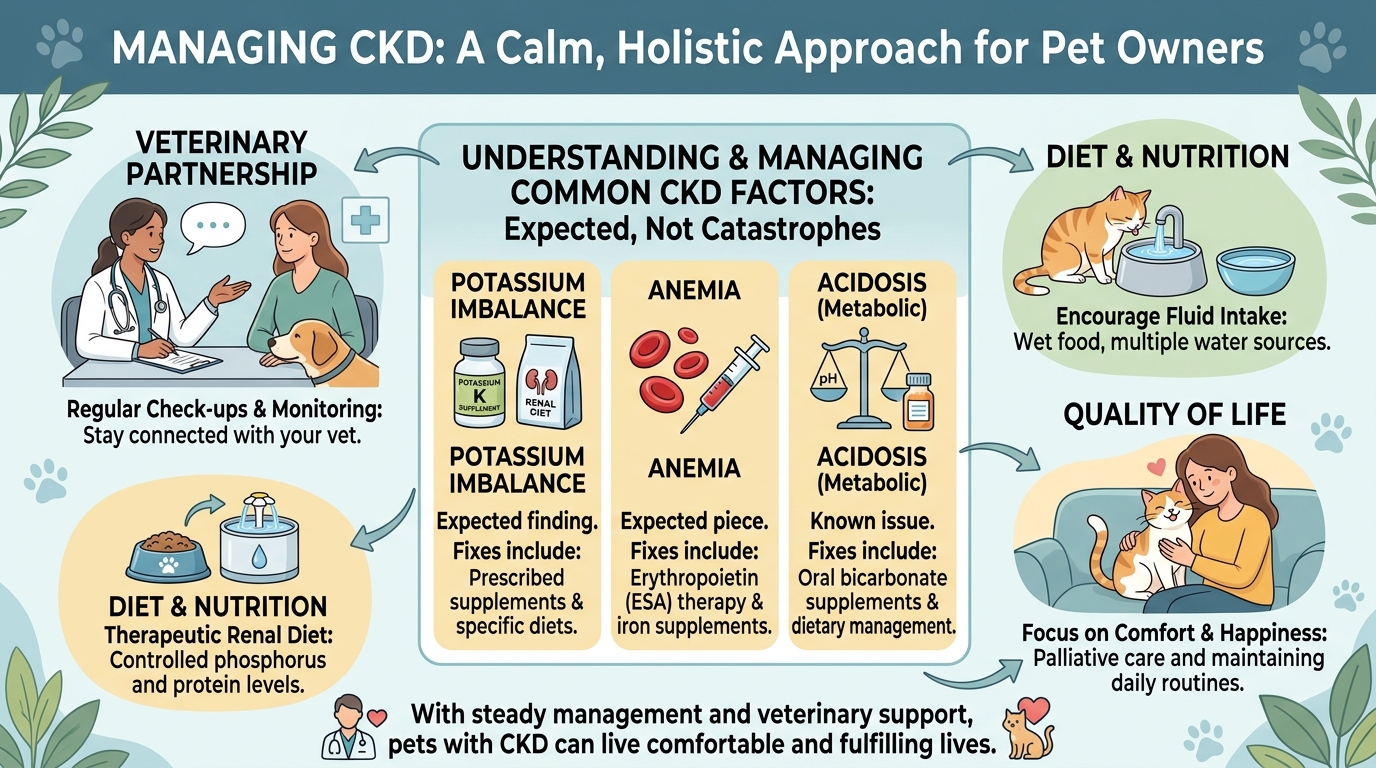
None of these is a separate disaster or a sign that everything is falling apart. Low potassium, anaemia, and acidosis are expected, well-understood pieces of kidney disease, each arising for an understandable reason as the kidneys' many jobs are affected, and each with a known, effective fix. The fact that your vet is finding and treating them is good news, not bad, because treating them is a large part of why a well-managed pet with kidney disease can feel well, eat well, and stay bright. A pet whose potassium is corrected, whose anaemia is treated, and whose acid balance is restored is a more comfortable, more energetic pet, and managing these supporting problems is precisely how good kidney care delivers quality of life.
So if one of these words turns up on your pet's next set of results, you now know what it means and that it can be handled. The practical thing to do is simply to keep up with the monitoring blood tests your vet recommends, because that is how these pieces are caught and corrected in good time, and to ask, when one appears, what it is and how it will be managed, knowing as you do so that the answer will almost always be a straightforward, effective one. The supporting cast, properly looked after, is a big part of what keeps the main story a hopeful one.
References
- Sparkes AH, Caney S, Chalhoub S, et al. ISFM Consensus Guidelines on the Diagnosis and Management of Feline Chronic Kidney Disease. Journal of Feline Medicine and Surgery, 2016.
- Chalhoub S, Langston CE, Farrelly J. The use of darbepoetin to stimulate erythropoiesis in anemia of chronic kidney disease in cats: 25 cases. Journal of Veterinary Internal Medicine, 2012.
- International Renal Interest Society (IRIS). IRIS Staging of CKD (modified 2023).
Free downloads
Companion worksheets to put what you've read into practice. Free PDFs, print at home.

See where your pet stands today
Tracking is the other half of managing kidney disease. Drop in the latest bloods to see the IRIS stage, then follow the trend as treatment settles in.
Check the IRIS stageYou're not doing this alone
Compare treatment journeys and talk to owners managing kidney disease. Free to join.
Join PetsLikeMine