

Getting the Most From Your Vet Appointments With a Kidney Patient
Alastair Greenway
BVM&S MRCVS
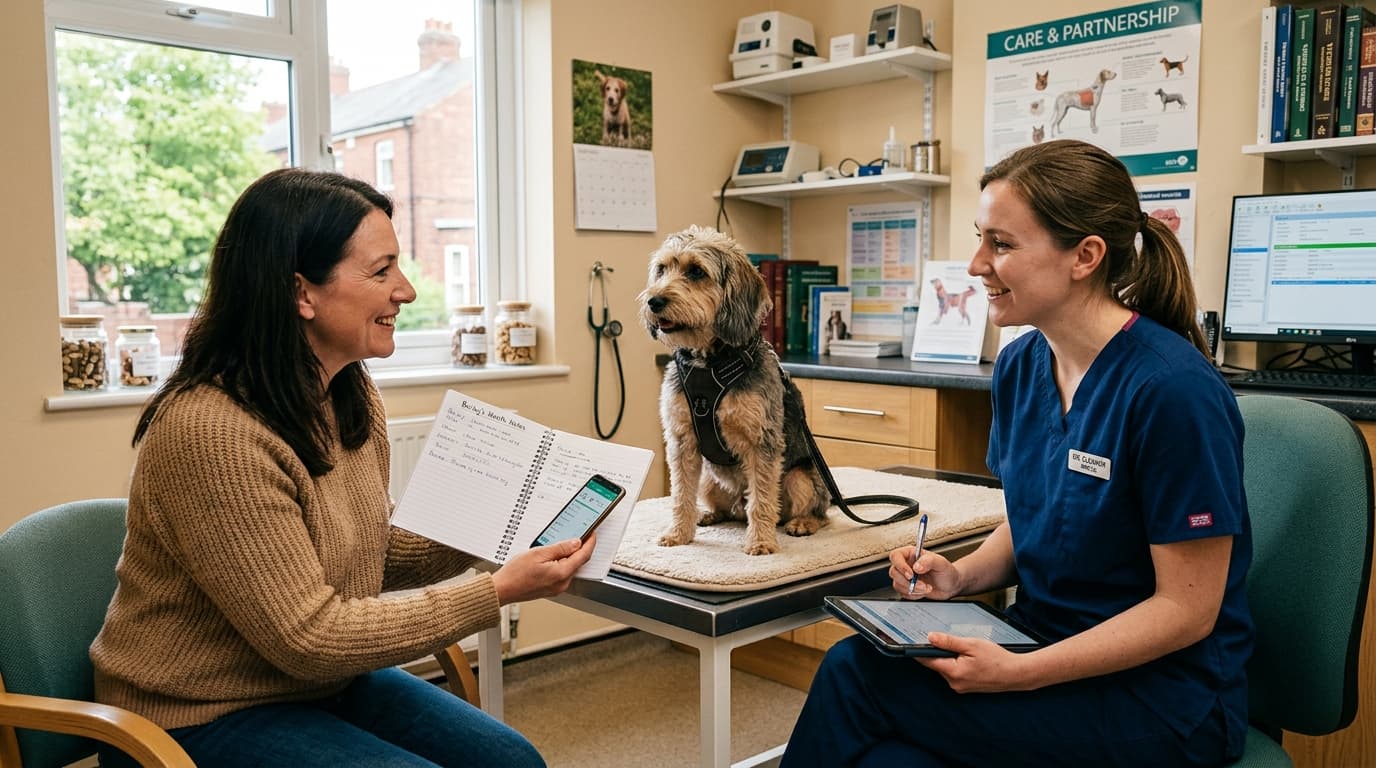
Managing a pet with kidney disease is a partnership, and a slightly unusual one, because you and your vet each hold half of what is needed. You are the expert on your pet at home, how they are eating, drinking, moving, and behaving day to day, and your vet is the expert on the medicine, the tests, and what it all means. The best outcomes come from pooling both halves, and a little preparation does a surprising amount to make that happen. This guide is about being an effective partner in your pet's care: how to prepare for appointments, what to ask, what to speak up about, and how to build the kind of working relationship that makes a long-term condition genuinely easier to manage.
It is worth saying plainly, as a practice run by vets: a well-prepared, communicative owner is a gift to their vet, not a nuisance. The questions, the home notes, the frank reporting, all of it helps us do a better job for your pet. So none of what follows is about being demanding. It is about being the active half of a team.
Before the appointment: bring the data
The single most useful thing you can do happens before you even arrive: gather your home data and write down your questions. Appointments are short and, for many pets, a little stressful, and it is astonishing how completely a carefully held thought can evaporate the moment you are in the room with a wriggling cat or an anxious dog.
So come prepared with the things only you can provide. Bring your pet's recent trends, their weight, their appetite, how much they have been drinking, any vomiting, and any changes in toileting, which our home tracker is designed to capture and which turn a vague impression into something concrete your vet can act on. Bring an up-to-date list of every medication and supplement your pet is on, with doses, because this matters more than owners realise, particularly when more than one vet or practice is involved. And bring a written list of your questions, because everything you meant to ask has a way of vanishing in the moment, and our appointment question list gives you a ready structure to fill in beforehand. Walking in with these three things, the trends, the medicines list, and the questions, transforms an appointment from a slightly flustered catch-up into a focused, productive conversation.

What to ask, and when
Knowing what to ask makes a consultation far more useful, and it helps to group your questions by theme so you cover the whole picture rather than fixating on one worry. A few areas are worth returning to at most appointments.
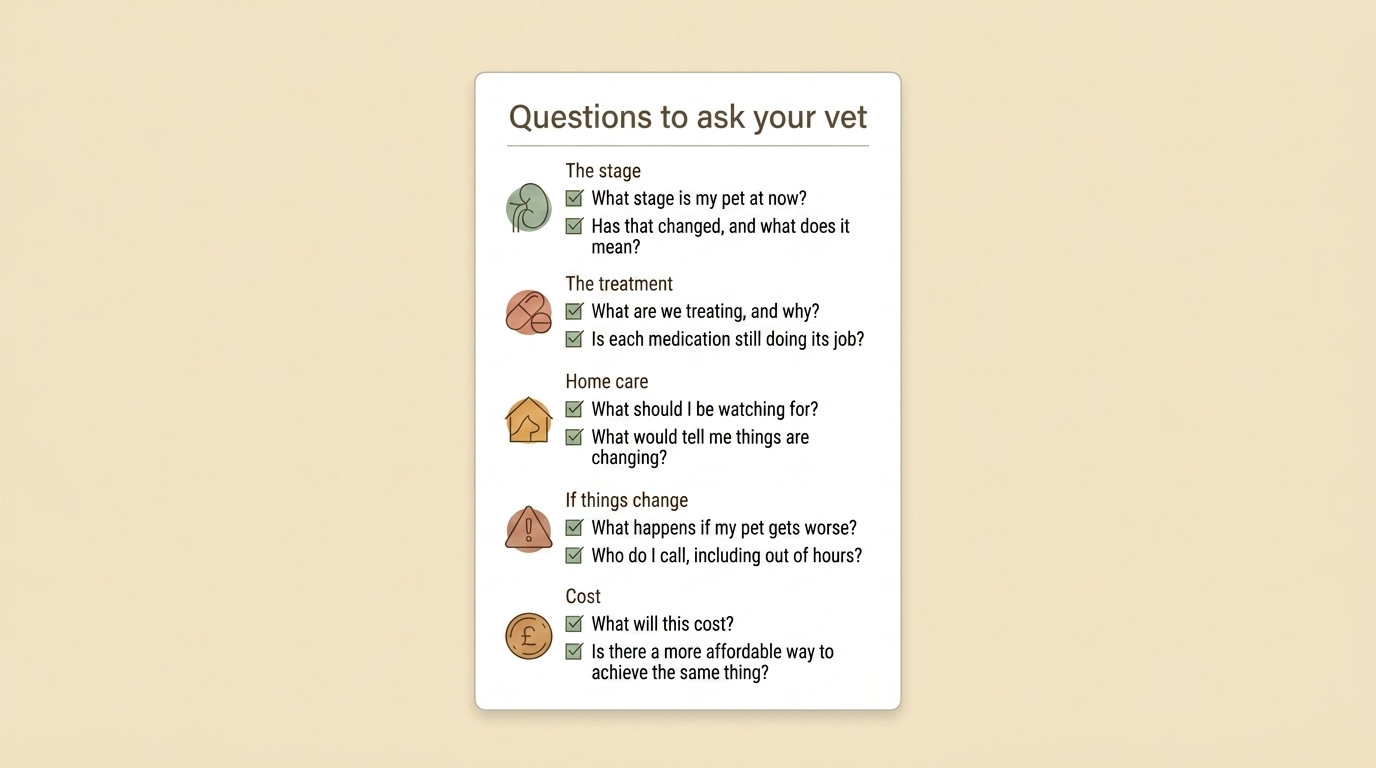
Ask about the stage and what it means: what stage is my pet at now, has that changed, and what does it mean for them, our guide to understanding the IRIS stages explains the framework behind the answer. Ask about the treatment: what are we treating, why, and is each medication still doing its job. Ask about home care: what should I be watching for, and what would tell me things are changing. Ask about the plan if things shift: what happens if my pet gets worse, and who do I call, including out of hours. And ask about cost, openly: what will this cost, and is there a more affordable way to achieve the same thing, a question good vets respect rather than resent, and one our costs guide is built to help you navigate. You will not need all of these every time, but keeping them in mind, and writing down the ones that matter to you before each visit, ensures the important ground gets covered.
Speak up about quality of life
The things owners most often leave unmentioned, usually out of a wish not to make a fuss, are exactly the things that are most treatable. So please speak up about them, because doing so genuinely changes outcomes.
Owners routinely under-report nausea, a reduced or fussy appetite, low energy, and signs of discomfort or stiffness, often assuming these are just part of the disease to be endured, or not wanting to bother the vet with something vague. But as our guide to comfort medications explains, these symptoms are very often treatable, and treating them can transform how your pet feels day to day, even when it is not changing the underlying disease. A pet that seems "a bit off her food" may be nauseous, and nausea can be treated. A pet that has slowed down may be in discomfort, perhaps from the arthritis that so often accompanies kidney disease in older animals, and that discomfort can be eased. So tell your vet about the small things: the lip-licking, the food left in the bowl, the reluctance to jump up, the general flatness. Ask directly, "is there anything we can do to help her feel better?" Those under-reported details are frequently the open door to genuinely improving your pet's quality of life, and raising them is one of the most valuable things you can do in the consulting room.
Making sense of what you are told
An appointment is only as useful as what you take away from it, so it is worth making sure you genuinely understand what you are being told, rather than nodding along and looking it up anxiously later. Vets sometimes slip into shorthand without meaning to, and it is entirely reasonable to ask for plain English.
A few habits help enormously. Ask for the numbers in writing, your pet's actual results, so you can keep your own record and track them over time rather than relying on memory. Ask the most useful single question in chronic disease management: "how does that compare with last time?", because, as our monitoring guide explains, it is the trend that matters far more than any single value. And do not be shy about asking your vet to explain anything you do not follow, or to repeat it, since understanding the plan is what lets you carry it out properly at home. Keeping the focus on the trend, and on what the results mean in practice for your pet, turns a stream of numbers into something you can actually use.
Second opinions and referral
Sometimes you may wonder whether to seek another opinion, and I want to reassure you on this directly, because owners often worry it would offend their vet: wanting a second opinion or a specialist referral is completely reasonable, and it is not disloyalty. Good vets understand this entirely, and many will suggest it themselves.
For a complex or advanced case, referral to a veterinary internal-medicine specialist can add real value, bringing deeper expertise, advanced diagnostics, and experience with difficult cases, and your own vet can arrange it. Asking "do you think a specialist opinion would help here?" is a perfectly respectful question, and a confident vet will give you a straight answer, sometimes yes, sometimes that the case is straightforward enough not to need it. Seeking a second opinion when you feel uncertain is part of being a good advocate for your pet, and a secure professional relationship can accommodate it without any awkwardness. It is your pet, and your peace of mind matters too.
Playing the long game
Finally, a word about the long game, because kidney disease is managed over years, not weeks, and continuity is genuinely valuable. A practice that knows your pet's whole history, that has watched the trend unfold and knows your pet as an individual, can manage a chronic condition far better than a series of disconnected encounters with whoever happens to be available.
So there is real value in building a relationship with a practice and, where possible, seeing the same vet for your pet's kidney care, so that the context carries from visit to visit. It is also worth asking how the practice handles the logistics of a chronic condition: whether routine rechecks can be booked efficiently, whether some monitoring can be streamlined, and whether telehealth or nurse-led check-ins are available for the simpler touchpoints, all of which can make managing a long-term illness less burdensome for you and less stressful for your pet. A good working relationship with a practice that knows your pet turns kidney care from a series of anxious one-offs into a steady, collaborative routine.
Put that collaboration into practice before every appointment: bring your home trends and your medicines list, bring a written list of questions, and make a point of raising anything that might be making your pet uncomfortable, because those are so often the treatable things. Do that, and you walk in as the active, informed half of your pet's care team, which is exactly what gets the best out of every visit, and out of the years of partnership ahead.
References
- International Renal Interest Society (IRIS). IRIS Staging of CKD (2023).
- Sparkes AH, Caney S, Chalhoub S, Elliott J, Finch N, Gajanayake I, Langston C, Lefebvre HP, White J, Quimby J. ISFM Consensus Guidelines on the Diagnosis and Management of Feline Chronic Kidney Disease. Journal of Feline Medicine and Surgery, 2016.
See where your pet stands today
Tracking is the other half of managing kidney disease. Drop in the latest bloods to see the IRIS stage, then follow the trend as treatment settles in.
Check the IRIS stageYou're not doing this alone
Compare treatment journeys and talk to owners managing kidney disease. Free to join.
Join PetsLikeMine