


Acute-on-Chronic: Recognising and Responding to a Kidney Crisis
Alastair Greenway
BVM&S MRCVS
Chronic kidney disease is usually a slow story, a gentle drift measured in months and years, and most days with a kidney patient are quiet ones. But it can flare hard and fast, and when it does, the question a worried owner most needs answered is "is this an emergency?" The short answer is that the difference between a bad day and a genuine crisis is mostly about how much has changed and how fast it has happened. This guide is about telling the two apart and knowing what to do, without panicking, and, just as importantly, without waiting too long. If your pet looks suddenly worse tonight and you want the quickest steer, go straight to the red-flag list below, and when in doubt, ring.
This piece is about recognising and responding to a crisis. It does not re-teach the day-to-day skills like giving fluids under the skin or managing nausea, our subcutaneous-fluids and comfort-medications guides cover those, it is about spotting when something has changed enough to need help, and getting that help in time.
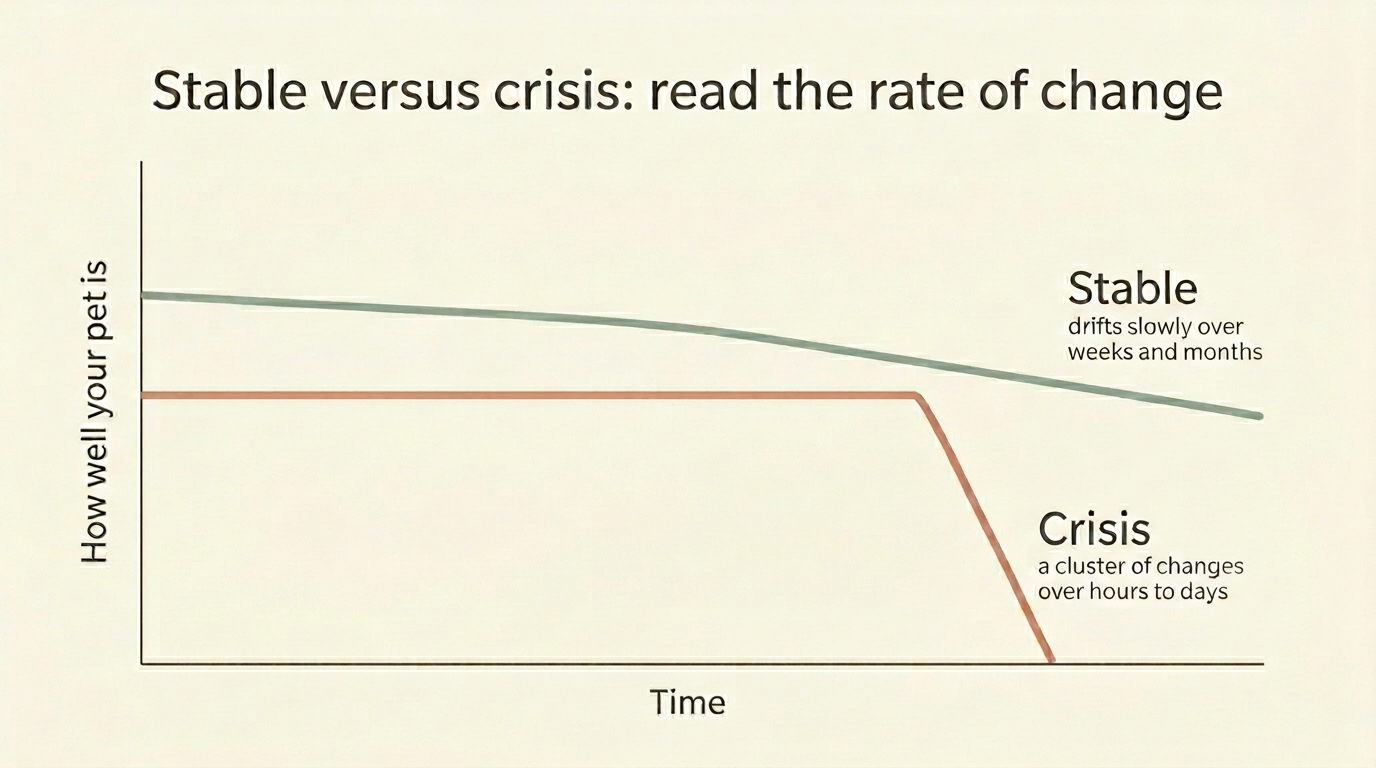
Stable versus crisis: read the rate of change
The single most useful idea for telling a bad day from an emergency is to look at the rate of change. Chronic kidney disease, when it is behaving, changes slowly: a stable patient drifts gently over weeks and months, with the odd off day that passes, and the overall picture shifting only gradually. A crisis looks completely different. It is a cluster of changes arriving together over hours to days, a pet who was reasonably well a day or two ago now clearly and rapidly unwell.
So when you are trying to judge how worried to be, the pattern and the pace matter far more than any single sign. One slightly smaller meal, or one quiet afternoon, in a pet who is otherwise themselves, is usually just the ordinary variation of life with kidney disease. But several things going wrong at once, quickly, appetite gone and vomiting and a marked drop in energy over the same day or two, is the pattern of a crisis, and it is the pattern, not the individual symptom, that should prompt action. Hold that distinction in mind as you read the red flags: it is the speed and the clustering that turn ordinary signs into urgent ones.
Red flags: call the vet today, or tonight
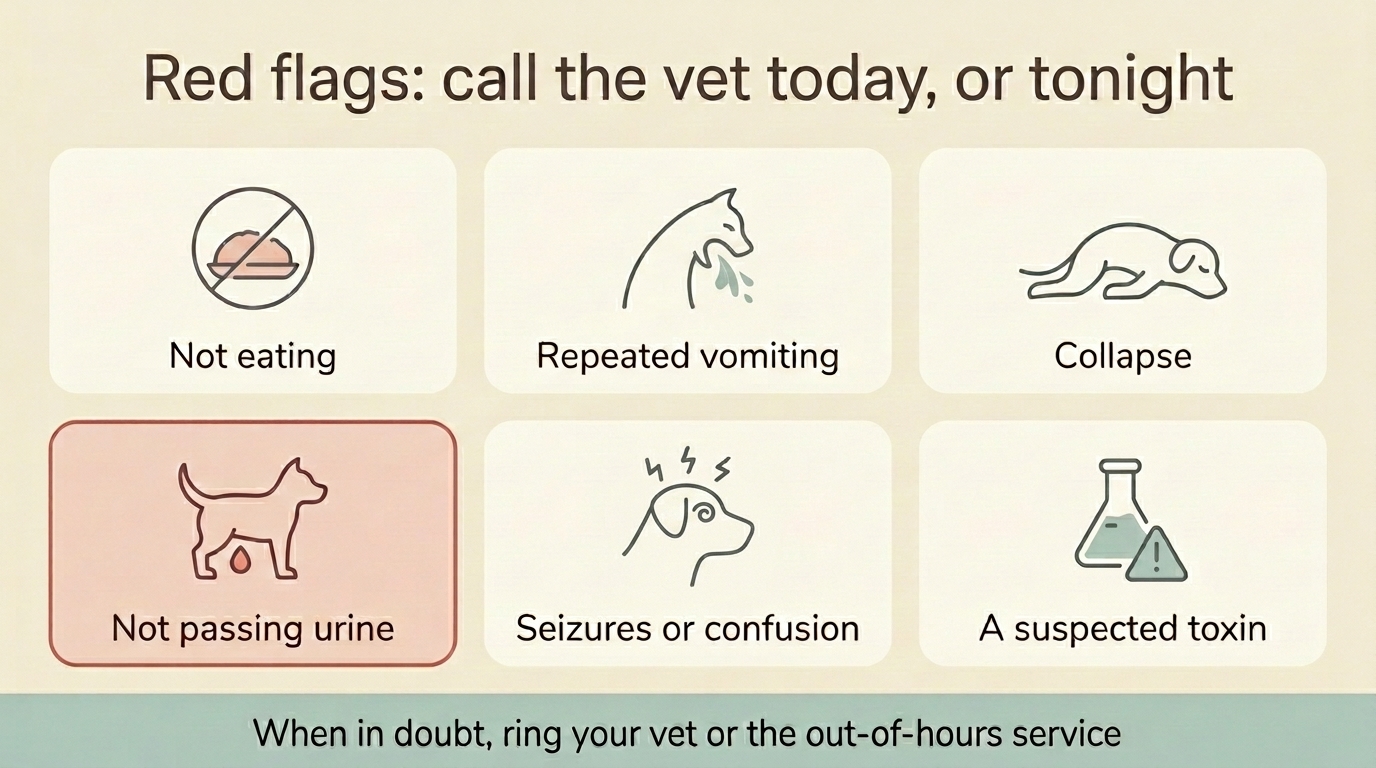
These are the signs that warrant a call to your vet the same day, or to the out-of-hours service that same night, rather than waiting to see how things go. Scan this list, and if your pet shows any of them, ring.
- Complete refusal to eat. A pet who will not eat anything at all.
- Repeated vomiting. More than a one-off.
- Marked lethargy, weakness, or collapse. A pet who is much flatter than their usual self or cannot get up.
- Not passing urine, or straining to urinate and producing little or nothing. This can mean a urinary obstruction and is a true, life-threatening emergency, especially in male cats, where it can become fatal within a day or two. Do not wait, ring straight away.
- Seizures, disorientation, or any sudden change in mental state.
- A suspected poisoning. If you think your pet may have eaten something toxic.
- Any sudden, marked worsening that you can feel is genuinely different from their usual ups and downs.
The golden rule with every one of these is the same: when in doubt, ring your vet or the out-of-hours service. Do not sit at home wondering, do not wait until morning to see if it settles, and do not talk yourself out of calling because you do not want to be a nuisance. A phone call costs nothing and the people on the end of it would far rather hear from you early than late. If something feels wrong, that feeling is reason enough to pick up the phone.
What tips a stable patient over
It helps to understand what commonly pushes a previously stable kidney patient into a crisis, both because it makes the red flags make sense and because several of the triggers are preventable. A stable pet is usually tipped over by something identifiable.
The common culprits are dehydration, which a kidney patient slips into more easily than a healthy animal; an infection, particularly a kidney infection, pyelonephritis, or a urinary tract infection; a toxin, and the important ones to know are lilies in cats, which are deadly even in tiny amounts, the antifreeze chemical ethylene glycol, grapes and raisins in dogs, and the inappropriate use of human anti-inflammatory painkillers in either species; a urinary obstruction blocking the outflow of urine; a medication problem, such as a missed dose or an over-correction; or simply another illness elsewhere in the body placing the kidneys under extra strain. Our article on the causes of kidney disease covers several of these in more depth. The reason this matters in the moment is that many crises have a findable, treatable cause, which is exactly what the veterinary team will go looking for, and some of these triggers, the toxins above all, are ones you can keep out of your pet's reach to stack the odds in their favour.
Inside the consulting room
Knowing what happens at the practice takes some of the fear out of making the call. When you bring in a kidney patient in crisis, the veterinary team's approach is logical and aimed at stabilising your pet and finding what went wrong. Typically that means admitting your pet for intravenous fluids, fluids into the vein, to rehydrate them, support the kidneys, and help flush out the built-up waste products that are making them feel so ill. At the same time the team will hunt for and treat the trigger, the infection, the toxin, the obstruction, whatever tipped your pet over, and will give medicines to control nausea and support the appetite so your pet feels better and can start eating again. They will also recheck the bloods and the electrolytes to see how the kidneys are responding and to guide the treatment.
There is one important distinction the team will be working out as they go, and it matters a great deal for what the crisis means. Sometimes what looks like a kidney crisis is an acute injury layered on top of the chronic disease, an acute-on-chronic episode, and the crucial point is that the acute part can sometimes be recovered from, with the pet returning close to where they were before. This is genuinely hopeful, and it is worth knowing that even a frightening crisis is not automatically the end of the road. At other times the crisis reflects the chronic disease itself taking a genuine step down to a new, lower level. Often it is not possible to tell which at the outset, which is precisely why stabilising the pet and giving them the chance to recover is the right first move, and why the team treats first and judges the longer-term picture once your pet is stable.
After a crisis: what it means for the long view
When the crisis is over and your pet is home, the natural question is what it all means for the future, and the truthful answer is that it varies. Sometimes a crisis turns out to have been a one-off, a single identifiable trigger dealt with, and your pet returns close to their previous baseline and carries on much as before. Sometimes, instead, the crisis leaves your pet at a new, lower "normal," a step down from where they were, around which you and your vet recalibrate the plan and the expectations.
I want to put this plainly but without doom, because both outcomes are real and neither is a foregone conclusion. A crisis is frightening, but it is not automatically a disaster or a sign the end is near, many pets come through one and go on to have a good stretch of life afterwards. The useful response, once the dust settles, is to keep tracking the trend, using the home monitoring this space describes, so you and your vet can see clearly where your pet's new baseline sits and adjust accordingly. A crisis is a significant event to learn from, not necessarily a verdict.
Stacking the odds against the next one
While not every crisis can be prevented, you can genuinely stack the odds in your pet's favour, and the measures are the same sensible ones that run through good kidney care. Keep your pet well hydrated, since dehydration is such a common trigger, and our guide to keeping your pet hydrated is full of practical ways to do that. Never skip the monitoring rechecks, because they catch brewing problems, an early infection, a creeping change, before they become a crisis, as our monitoring-schedule guide explains. Toxin-proof your home, keeping lilies out of any cat household entirely and antifreeze, grapes, and raisins well away from dogs, and never giving human painkillers. And act early on infections and on any change you notice, rather than waiting. None of these guarantees a smooth course, but together they meaningfully reduce the chance of a crisis and improve the odds if one comes.
Here is the at-a-glance version to remember. The signs that mean ring your vet or the out-of-hours service are: not eating at all, repeated vomiting, collapse or marked lethargy, not passing urine or straining to (a true emergency, do not wait), seizures or confusion, or a suspected toxin. And the rule that sits above all of them is the simplest one there is: when in doubt, ring. You will never regret making a call that turned out to be nothing, but you might regret waiting on one that turned out to be something. Trust your instinct, keep your vet's number and the out-of-hours number where you can find them fast, and when your gut tells you something has changed, pick up the phone.
References
- International Renal Interest Society (IRIS). IRIS Grading of Acute Kidney Injury (2016).
- International Renal Interest Society (IRIS). IRIS Staging of CKD (2023).
- Ross L. Acute Kidney Injury in Dogs and Cats. Veterinary Clinics of North America: Small Animal Practice, 2011.
- Langston CE. Acute renal failure caused by lily ingestion in six cats. Journal of the American Veterinary Medical Association, 2002.
- Cooper ES. Controversies in the management of feline urethral obstruction. Journal of Veterinary Emergency and Critical Care, 2015.
See where your pet stands today
Tracking is the other half of managing kidney disease. Drop in the latest bloods to see the IRIS stage, then follow the trend as treatment settles in.
Check the IRIS stageYou're not doing this alone
Compare treatment journeys and talk to owners managing kidney disease. Free to join.
Join PetsLikeMine