

Getting a Cat to Eat the Renal Diet: The Owner's Battle Plan
Alastair Greenway
BVM&S MRCVS
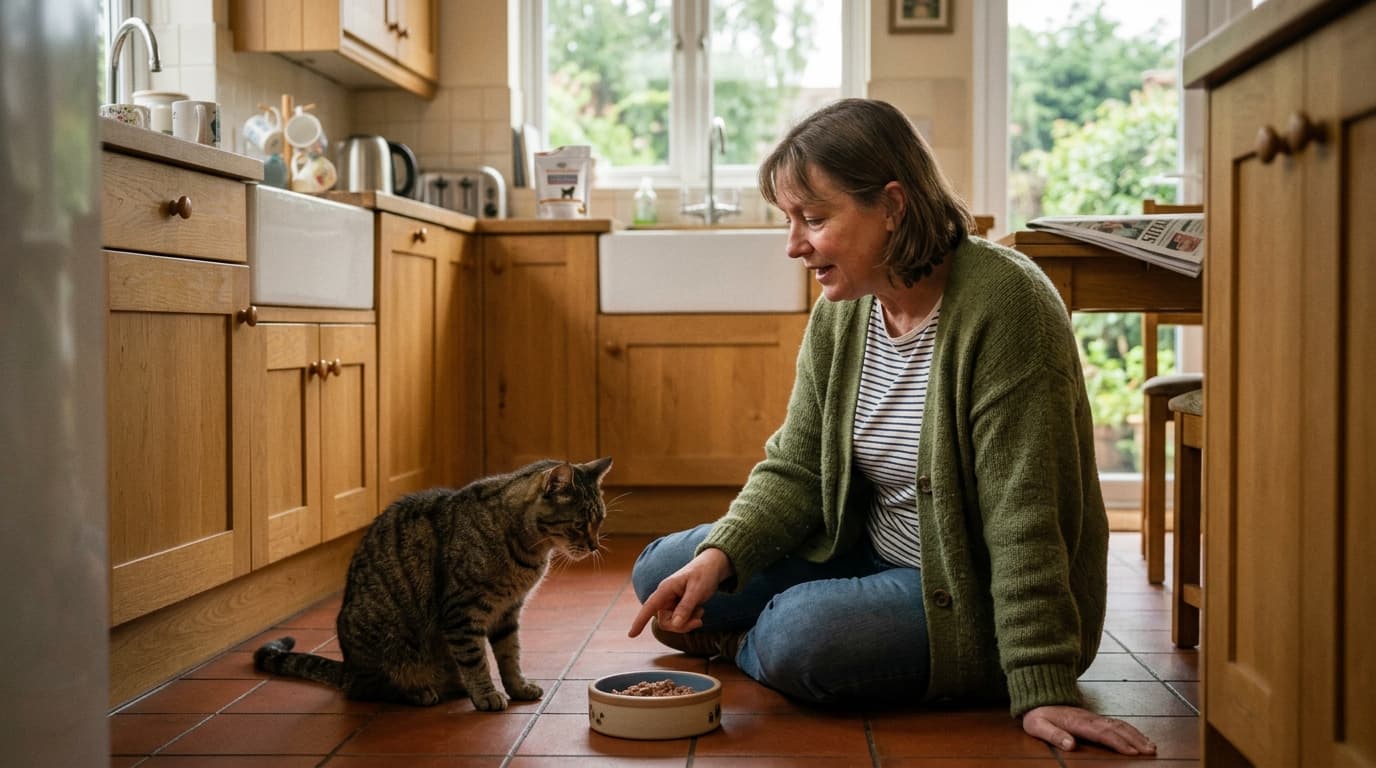
Getting a cat onto a prescribed kidney diet is one of the genuinely hard parts of managing kidney disease, and almost every owner struggles with it. If your cat has turned its nose up at the food your vet prescribed and is sitting by an untouched bowl, you are not failing, and your cat is not simply being difficult. There is a great deal you can do, and this guide is the practical battle plan. We will not rehearse why the renal diet matters so much here, our guide to the renal diet makes that case in full, and the short version is that it is the single most powerful thing you control. This article is about the other question entirely: how do you actually get a reluctant cat to eat it?
The most important principle, the one to hold onto when you feel discouraged, is this. A not-quite-perfect diet that your cat will actually eat beats a perfect diet it refuses. The goal is a cat that is eating well, and getting there is a campaign rather than a single battle won or lost at the first bowl. Some cats take to the new food quickly, many do not, and persistence, with the right tactics, usually wins. So take a breath, and let us work through it.
Why cats are so hard to switch
It helps to understand why cats, specifically, are such notoriously difficult patients when it comes to changing food, because it is not stubbornness, it is biology.
Cats are neophobic by nature, meaning they are naturally wary of new and unfamiliar foods, an instinct that served their wild ancestors well by steering them away from anything that might be unsafe. On top of that, a cat's food preferences, the flavours and textures it considers "food" at all, are largely set when it is young, so a cat raised on one type of food may simply not recognise something very different as edible. Cats are also strongly smell-driven eaters, relying on aroma far more than we do to decide whether to eat. And then kidney disease itself enters the picture: as we will see, it can cause nausea that suppresses appetite, so you are often asking a cat that feels slightly unwell to accept an unfamiliar food, which is a genuinely tall order. None of this is your cat being awkward. It is a wary, smell-led animal, with fixed preferences and perhaps a queasy stomach, being asked to embrace the unfamiliar. Understanding that is the first step to working with it rather than against it.
Never force the diet during a flare or hospital stay
Before any of the tactics, there is one rule that matters more than all the rest put together, because getting it wrong can cause lasting harm: never try to introduce the new renal diet while your cat is feeling unwell, during a kidney crisis, or while it is in hospital.
The reason is a powerful phenomenon called learned food aversion. Cats very readily form a lasting association between a food and feeling sick: if a cat eats, or even smells, a particular food at a time when it feels nauseous or unwell, it can link the two and refuse that food, sometimes for a very long time afterwards. This is exactly why you must not introduce the renal diet, the very food you most need your cat to accept long-term, at a moment when it feels ill. Do it during a flare or a hospital stay, and you risk poisoning your cat against that food permanently, making the whole task far harder. Force-feeding carries the same risk: trying to push the new food into a reluctant, queasy cat is one of the surest ways to create an aversion to it.
So the timing is everything. Introduce the new diet at home, when your cat is stable and feeling reasonably well, never in the middle of a bad patch. If your cat is currently unwell, the diet transition waits until it has recovered. This single piece of timing protects the whole endeavour.
Go slow: the transition that actually works
With the timing right, the next principle is patience: a renal diet introduced gradually is far more likely to be accepted than one switched abruptly. Cats reject sudden change, so the trick is to make the change so slow that it almost sneaks past them.
In practice, this means mixing a small amount of the new renal food into the familiar old food, then increasing the proportion of new to old very gradually over a couple of weeks or longer, often up to three weeks for a kidney patient. You start with just a trace of the new food, enough that your cat barely notices, and inch the ratio along only as fast as your cat tolerates. The crucial part is what you do when it baulks. Do not push on. Step back to the previous ratio it was happy with, settle there for a few days, and then resume more slowly. A refusal is not a failure; it is information telling you to slow down. Our Renal Diet Transition Planner lays out a week-by-week schedule you can follow and adjust, which takes the guesswork out of pacing it. Slow and patient genuinely wins here, where rushing fails.
Win on smell, warmth and texture
Because cats eat with their noses as much as their mouths, many of the most effective tactics work by making the food more appealing to smell and feel. These small touches make a real difference.
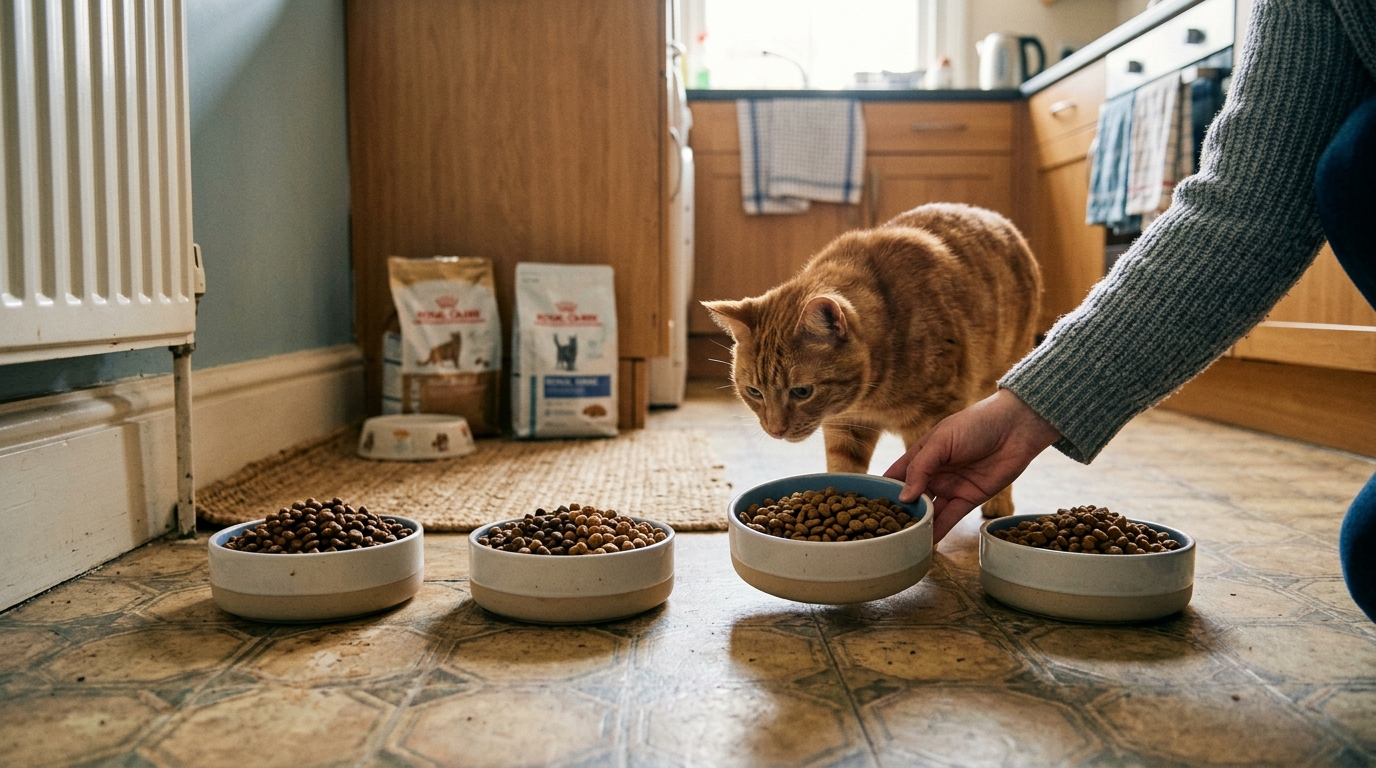
Warming the food to around body temperature is perhaps the single best trick, because gentle warmth releases the aroma, and a cat that can smell its food is far more likely to eat it. A few seconds of warming, or a little warm water stirred in, can transform a cat's interest. Texture matters enormously too, and it is highly individual: some cats want pâté, others prefer chunks in gravy, so it is well worth offering different textures to find what your cat favours. Many renal diets come in both wet and dry forms, and wet food, being more aromatic and more palatable to many cats, is often the better bet, with the bonus that it adds valuable water, which our hydration guide explains is its own benefit in kidney disease. Some owners gently hand-feed a reluctant cat to get it started, or smear a little food on a paw. The bowl itself can matter: some cats dislike their whiskers touching the sides of a deep, narrow bowl, so a wide, shallow dish can help. And the setting counts. A quiet, calm spot away from disturbance, where the cat feels safe to eat, beats a busy thoroughfare.
One caution on toppers and flavour-enhancers, the splash of tuna water or a tasty topping that can tempt a cat to eat. Used sparingly they can help, but some are high in things like sodium that are best limited in kidney disease, so it is worth checking with your vet which additions are safe to use and keeping them modest, rather than undoing the diet's benefits in the effort to make it appealing.
Try more than one renal diet
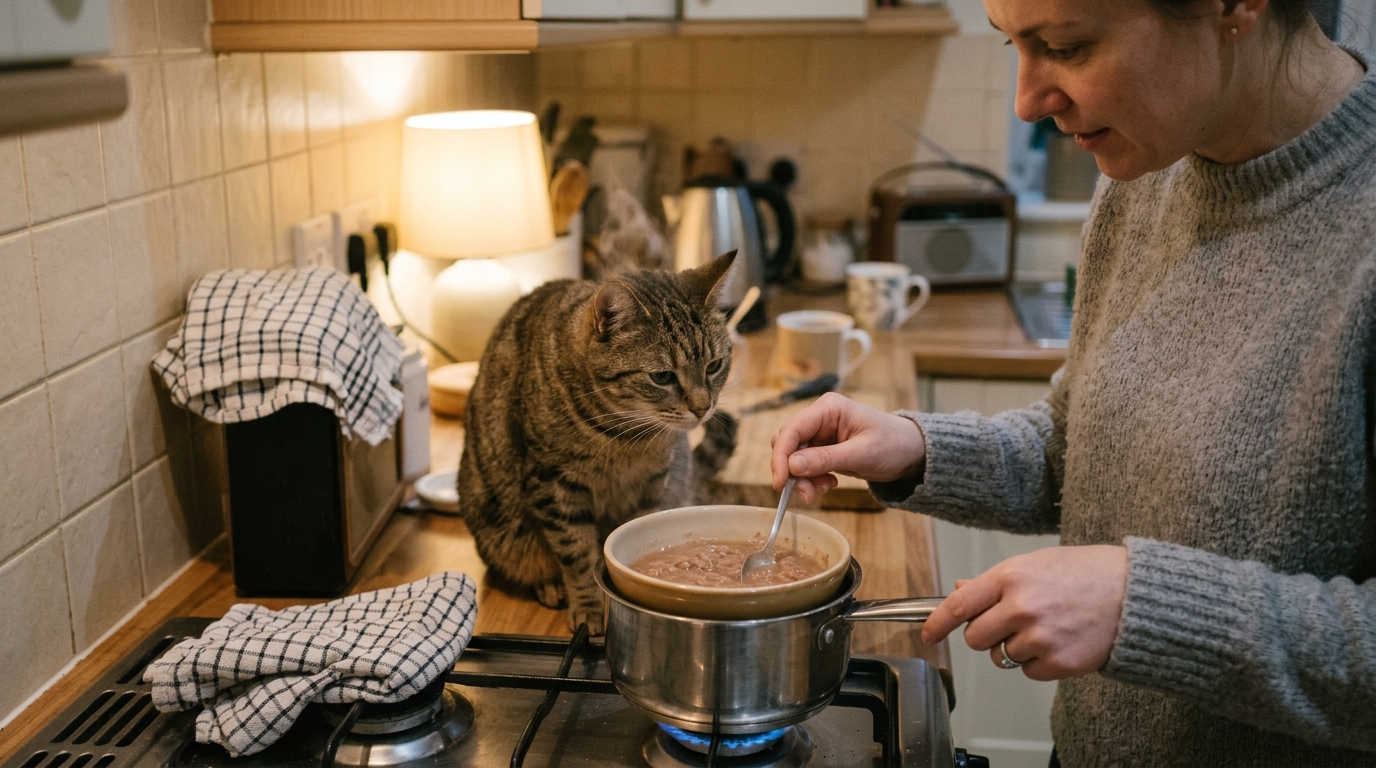
Here is a point that rescues many a stalled transition, and that owners often do not realise: there is not one single renal diet, but several, made by different manufacturers, and they differ considerably in taste, texture, and form. A cat refusing one renal diet has not refused them all.
The main veterinary renal ranges include Royal Canin Renal, Hill's k/d, Purina Pro Plan NF, Specific, and Virbac, and between them they offer a wide variety of flavours and both wet and dry formats. If your cat turns its nose up at the first one you try, that is a cue to ask your vet about trying a different brand or format, not to abandon the renal diet altogether. Many vets can provide samples or smaller packs so you can find your cat's preference without committing to a large bag of something it will reject. It is genuinely worth working through the options, because cats can have strong and surprising preferences, and the diet your cat happily eats is the one that will help it, whichever brand that turns out to be. Cycling through a few palatable renal foods can also help stave off the boredom and aversion that sometimes creep in over time.
When the cat still won't eat: appetite is a medical problem
If you have got the timing right, transitioned slowly, tried the smell-and-texture tactics, and offered more than one brand, and your cat is still not eating well, it is time to recognise something important: appetite is a medical issue, and a cat that will not eat needs the vet, not just more coaxing.
Often the reason behind a poor appetite in kidney disease is nausea, and a nauseous cat will refuse food no matter how cleverly you present it, because it feels too queasy to eat. The good news, covered fully in our guide to comfort medications, is that this is very treatable. Your vet can prescribe an anti-nausea medicine such as maropitant, known as Cerenia, or ondansetron, and an appetite stimulant, most commonly mirtazapine, which in cats comes as Mirataz, a transdermal ointment licensed for cats and applied to the ear, which neatly sidesteps the battle of giving a tablet. These can transform a cat's willingness to eat, and a cat that seemed hopelessly fussy often turns out simply to have been feeling sick. There is a further reason not to soldier on alone: a persistent loss of appetite can itself be a signal that the kidney disease has progressed and the overall plan needs reviewing, so it is information your vet needs. If your cat's eating is not improving despite your best efforts, that is the moment to pick up the phone, not to try yet another flavour.
The realistic fallback
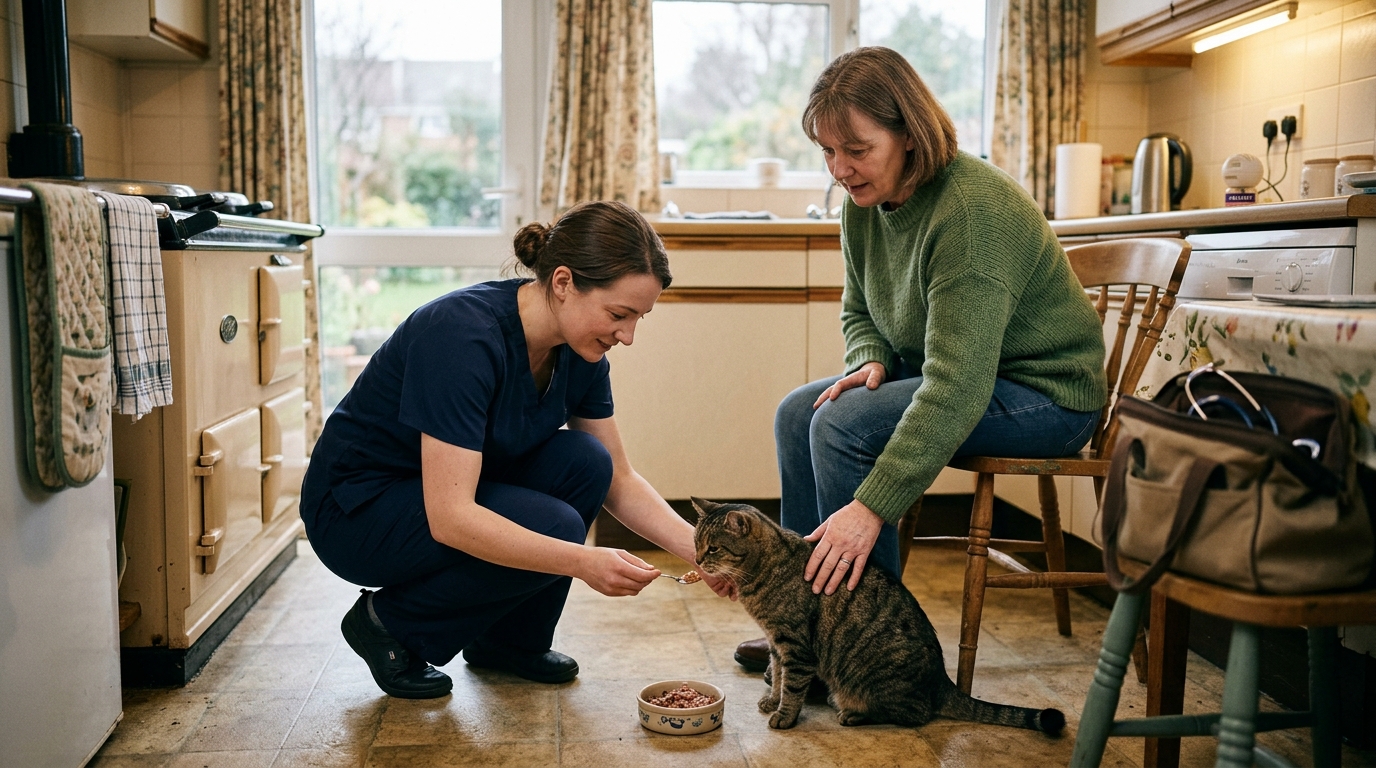
Finally, the pragmatic truth, because despite everything, some cats simply will not accept any renal diet, and you need to know what then. If no renal diet can be made to work, a diet your cat will actually eat, supported by other measures, is better than the standoff of a cat eating nothing.
A cat that refuses all renal food but eats a regular diet can often still have its phosphate controlled by adding a phosphate binder to that food, an approach our guide to phosphate binders explains, which recovers much of the benefit the renal diet would have provided. This is very much a conversation to have with your vet rather than a decision to make alone, but the principle is reassuring: the renal diet is the ideal, not the only option, and the real enemy is a cat that is not eating at all. Your vet can help you find the best achievable compromise for your particular cat, whether that is a renal diet eaten happily, a renal diet plus appetite support, or a tolerated ordinary diet with a binder added.
So here is your practical sequence for the week ahead. If your cat is unwell right now, wait, and get it feeling better with your vet before changing anything. Once it is stable, begin a slow, graded transition at home using the planner, leaning on warmth, aroma, and the texture your cat prefers. If the first renal diet is refused, ask your vet about trying another brand or format. And if your cat still will not eat despite all this, treat it as the medical matter it is and speak to your vet about nausea and appetite, because that is very often the missing piece. Worked through patiently, in that order, this is a battle most owners win, and a cat eating a kidney-friendly diet is one of the best gifts you can give it for the years ahead.
References
- Taylor S, Chan DL, Villaverde C, Ryan L, Peron F, Quimby J, et al. 2022 ISFM Consensus Guidelines on Management of the Inappetent Hospitalised Cat. Journal of Feline Medicine and Surgery, 2022.
- Sparkes AH, Caney S, Chalhoub S, Elliott J, Finch N, Gajanayake I, Langston C, Lefebvre HP, White J, Quimby J. ISFM Consensus Guidelines on the Diagnosis and Management of Feline Chronic Kidney Disease. Journal of Feline Medicine and Surgery, 2016.
- Quimby JM, Lunn KF. Mirtazapine as an appetite stimulant and anti-emetic in cats with chronic kidney disease: a masked placebo-controlled crossover clinical trial. The Veterinary Journal, 2013.
- Quimby JM. Update on Medical Management of Clinical Manifestations of Chronic Kidney Disease. Veterinary Clinics of North America: Small Animal Practice, 2016.
- Ross SJ, Osborne CA, Kirk CA, Lowry SR, Koehler LA, Polzin DJ. Clinical evaluation of dietary modification for treatment of spontaneous chronic kidney disease in cats. Journal of the American Veterinary Medical Association, 2006.
- Polzin DJ. Evidence-based step-wise approach to managing chronic kidney disease in dogs and cats. Journal of Veterinary Emergency and Critical Care, 2013.
See where your pet stands today
Tracking is the other half of managing kidney disease. Drop in the latest bloods to see the IRIS stage, then follow the trend as treatment settles in.
Check the IRIS stageYou're not doing this alone
Compare treatment journeys and talk to owners managing kidney disease. Free to join.
Join PetsLikeMine