

The CKD Monitoring Schedule: What to Check and How Often, by Stage
Alastair Greenway
BVM&S MRCVS
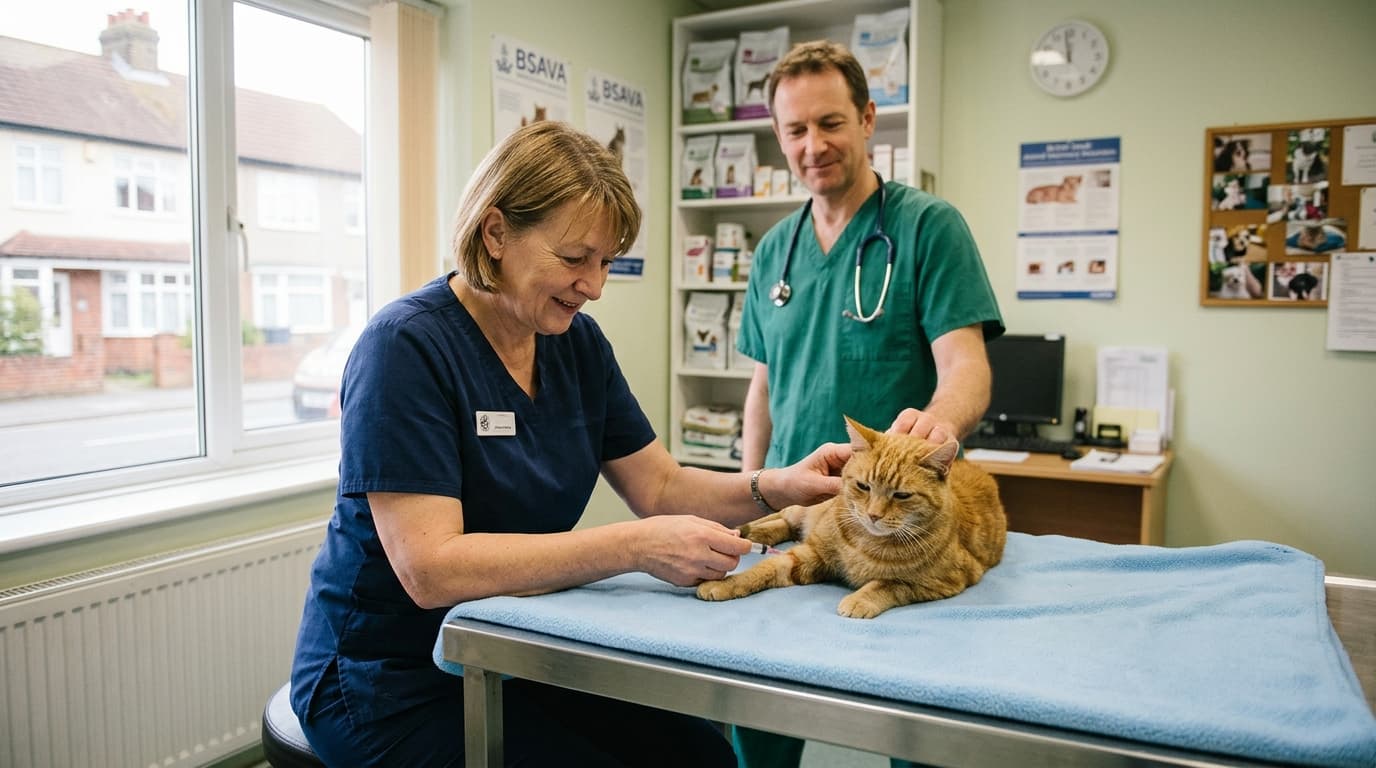
A pet with kidney disease gets called back to the vet a lot, and then called back again, with a regularity that can start to feel like a lot. Plenty of owners quietly wonder the same thing at this point: is all this rechecking really necessary, or is the practice "milking it"? Let me answer that head on. Kidney disease is managed by trends, not single results, and a predictable rhythm of monitoring is precisely how problems get caught while they are still fixable, before they become a crisis. The rechecks are not padding. They are the early-warning system that keeps your pet well, and once you understand what they are for, they turn from a worry, and an expense, into the most useful tool you have.
This guide explains what actually gets checked and why each thing matters, how often monitoring is needed at each stage of the disease, and how your own observations at home turn a clinic snapshot into a moving picture your vet can actually act on.
What a recheck actually measures
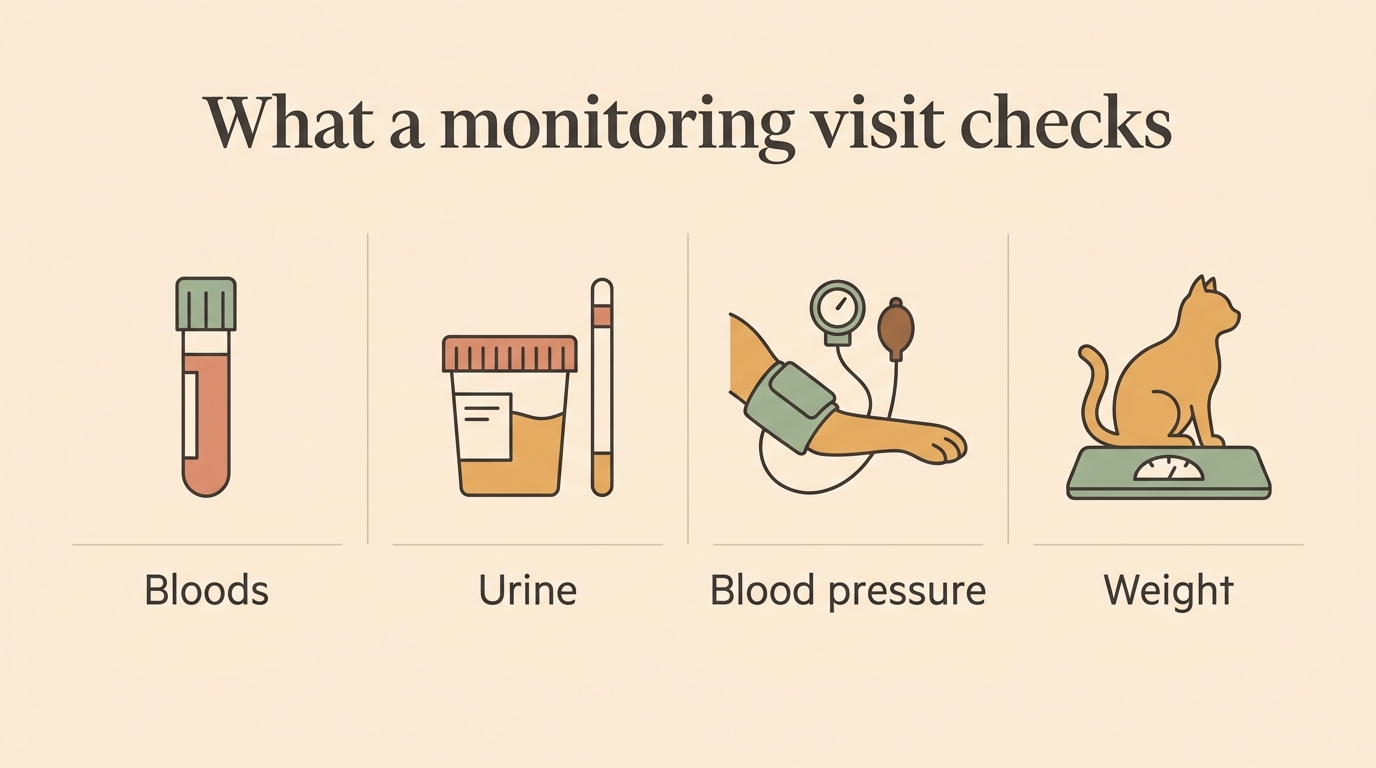
A kidney monitoring visit is not just "a blood test." It is a small panel of measurements, each watching a different part of the disease, and knowing what they are makes the whole thing far less mysterious.
The blood tests track the core kidney markers and their knock-on effects: creatinine and SDMA, the two markers of kidney function our guide to reading the bloods explains in full; urea; phosphate, the number that both drives the disease and is the target of the renal diet and binders; potassium, which can run too low or too high; and a measure of the red blood cells, the PCV, to catch the anaemia that kidney disease can cause. The urine tests matter just as much as the blood: the urine specific gravity, which shows how well the kidneys are concentrating, the urine protein-to-creatinine ratio or UPC, which our protein-in-the-urine guide explains is especially important in dogs, and, where an infection is suspected, a urine culture, because urinary infections are common in kidney patients and can quietly make things worse. Blood pressure is checked too, because high blood pressure rides along with kidney disease and does silent harm, as our blood-pressure guide describes. And your pet's weight, together with their body and muscle condition, is tracked, since weight loss and muscle wasting are among the most telling signs of all, as our weight-and-muscle guide explains.
Each of these is a different window onto the same disease, and together they build the full picture. That is why a proper recheck looks at several things, not just one number, and why it is genuinely informative rather than a box-ticking exercise.
How often, by IRIS stage
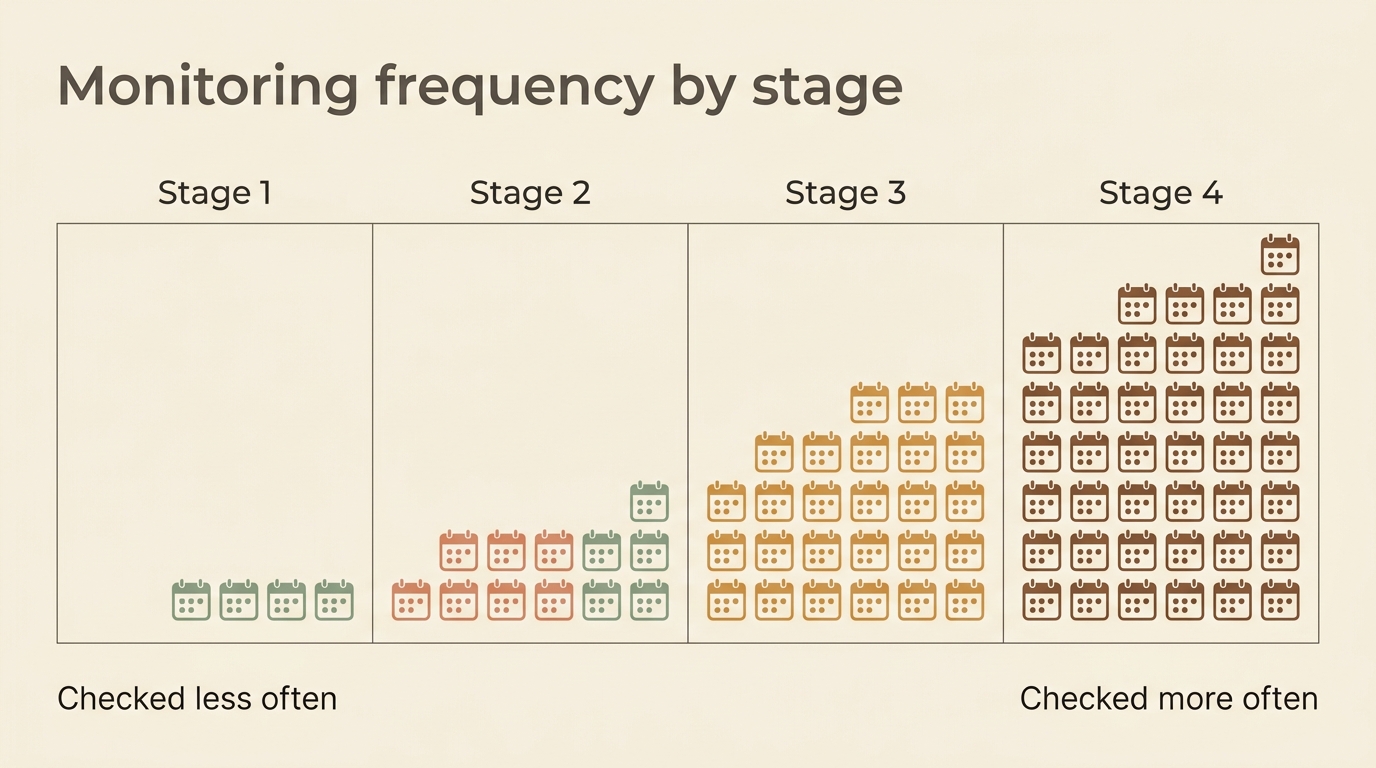
The single most useful thing to understand about monitoring frequency is that it scales with the stage of the disease, and that stability earns longer intervals. A settled pet in early kidney disease needs checking far less often than a pet in advanced disease, and the cadence below is the general shape your vet will tailor to your individual pet. These are guideline ranges, not rigid rules, and your own vet sets the schedule that fits your pet.
In the earliest disease, a stable Stage 1 or well-controlled Stage 2 pet is typically monitored relatively infrequently once things are settled, often around every six to twelve months, with more frequent checks at first to establish the trajectory. As the disease advances to Stage 3, monitoring steps up, commonly to around every three to six months, because there is more to keep an eye on and more that can change. And in advanced Stage 4 disease, monitoring is the most intensive, with the most frequent rechecks, because these pets are the most fragile and need the closest support. The headline to take from this is reassuring: the calmer and more stable your pet is, the less often they need to be seen, so a long gap between visits is a sign that things are going well, not a sign of neglect.
After any change, recheck sooner
There is one important exception to the stage-based rhythm: whenever something changes in your pet's treatment, an earlier recheck follows, regardless of where they sit in the usual schedule. This is not extra fuss; it is how your vet makes sure a change is actually working.
Starting a phosphate binder, beginning a blood-pressure medication, starting a kidney-protecting drug, or switching to a renal diet all earn a follow-up sooner than the routine interval, to confirm two things: that the change is having the desired effect, the phosphate is coming down, the blood pressure is controlled, the protein is falling, and that your pet is tolerating it well. The international guidelines reflect this, recommending a recheck within a few weeks of starting or adjusting treatment. So if your vet wants to see your pet again a fortnight after starting a new medicine, that is exactly the right instinct: it is the check that tells them whether the new approach is doing its job, and it lets them fine-tune the dose to your individual pet rather than guessing.
Where your home record comes in
This is where you become an active part of the monitoring, and it matters more than most owners realise. A clinic visit is a single snapshot, one moment in time, often of a stressed pet in an unfamiliar place. Your observations at home, gathered over weeks, turn that snapshot into a moving picture, and that picture is something your vet simply cannot get any other way.
The things worth tracking at home are your pet's weight, their appetite, how much they are drinking, and any vomiting or changes in toileting, all of which our home tracker and bloodwork trend sheet are designed to capture. Brought to an appointment, this home record transforms the conversation: instead of "he seems about the same," you can show that his weight has drifted down by a few hundred grams over two months, or that his drinking jumped a fortnight ago, and that is the kind of concrete trend that lets your vet act early. Keeping the record, whether on our downloadable trend sheet, in the on-platform tracker, or simply in a notebook, is one of the most valuable contributions you can make to your pet's care, because you are the one who sees them every day, and the data you gather fills in everything between the visits.
Reading a trend, not a number
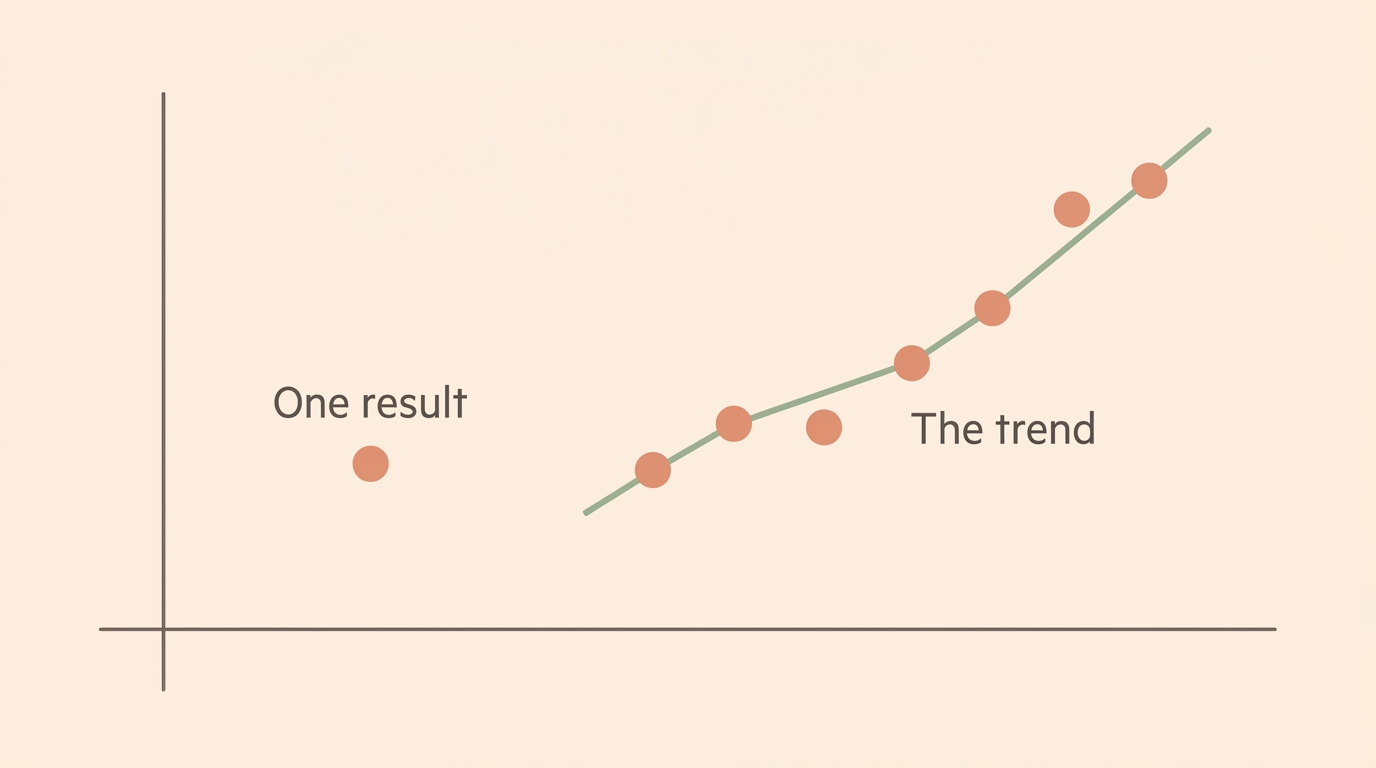
This brings us to a principle that runs through the whole of kidney monitoring, and that saves a great deal of unnecessary alarm: it is the trend that matters, not any single number. Blood and urine results vary naturally from test to test, influenced by hydration, by a recent meal, by the lab, and by the ordinary noise of biology, so one result that is a little higher than last time is rarely cause for panic.
What your vet is looking for is the direction of travel over several tests: a genuine, sustained rise, confirmed on repeat, means something, whereas a single odd reading often does not and is usually rechecked rather than acted upon. This is why one result rarely changes the whole plan, and why your vet may say "let's repeat that in a few weeks" rather than overhauling everything on the strength of one number. Understanding this helps you read your pet's results with the same calm your vet does, watching the line rather than reacting to every dot, and it is exactly why the steady accumulation of data, at the clinic and at home, is worth so much more than any single test.
What it costs, and why it is worth it
It would be wrong to discuss regular monitoring without acknowledging that it is a real, recurring cost, and a meaningful line in the budget of caring for a kidney patient. This is worth planning for rather than being surprised by, and our guide to what CKD care actually costs in the UK lays out realistic figures and how to budget for the monitoring across the year. The reassuring way to think about it is that monitoring is what protects all your other investment in your pet's care, catching problems early, when they are cheaper and kinder to treat, rather than late, in a crisis. Planning the monitoring into your budget from the start, and talking openly with your vet about the schedule and its cost, lets you keep it up consistently, which is exactly what makes it work.
Monitoring is not the vet milking it, it is the early-warning system that keeps your pet well, and its rhythm is logical and stage-based, with stable pets seen less often and any treatment change earning a prompt recheck. Your job, the genuinely valuable half of it, is to bring the home data that turns each visit's snapshot into a trend. Picture your monitoring year as a rhythm set by your pet's stage, busier when things are changing and calmer when they are stable, and ask your vet to map out that schedule with you, so you know what is coming and can plan for it. Done that way, monitoring becomes the quiet, steady thing that lets a kidney patient live well for as long as possible.
References
- International Renal Interest Society (IRIS). IRIS Treatment Recommendations for CKD in Cats and Dogs (2023).
- Sparkes AH, Caney S, Chalhoub S, Elliott J, Finch N, Gajanayake I, Langston C, Lefebvre HP, White J, Quimby J. ISFM Consensus Guidelines on the Diagnosis and Management of Feline Chronic Kidney Disease. Journal of Feline Medicine and Surgery, 2016.
- Quimby JM. Update on Medical Management of Clinical Manifestations of Chronic Kidney Disease. Veterinary Clinics of North America: Small Animal Practice, 2016.
See where your pet stands today
Tracking is the other half of managing kidney disease. Drop in the latest bloods to see the IRIS stage, then follow the trend as treatment settles in.
Check the IRIS stageYou're not doing this alone
Compare treatment journeys and talk to owners managing kidney disease. Free to join.
Join PetsLikeMine