

Reading Your Pet's Kidney Bloods: A Plain-English Guide
Alastair Greenway
BVM&S MRCVS
A printout of your pet's kidney bloods is a wall of abbreviations and numbers that mean very little at first glance. Creatinine, SDMA, urea, phosphate, a thing called specific gravity, each with a value and a reference range, some perhaps flagged high. The natural pull is to scan for the scariest number and brace. There is a more useful way to read it, though: this printout is not a verdict, it is a set of clues, and no single clue makes the diagnosis on its own. We are going to walk each one together, in plain English, so that by the end you can look at your pet's results and understand the story they tell rather than just the fright they cause.
One reassurance before we start. Understanding these numbers does not turn you into your vet, and it is not meant to. It is meant to make your pet's appointments make sense, help you ask better questions, and let you follow the trend over time rather than lurching from one result to the next. That understanding is genuinely powerful, and it is well within reach.
Why the trend matters more than any one number
The single most important principle in reading kidney bloods is this: one result is a snapshot, and a snapshot can mislead. What you really want is the trend over time, and a result taken under the right conditions.
Kidney values are best measured when a pet is well hydrated and, ideally, has been fasted, because both dehydration and a recent meal can push the numbers around. A single high creatinine in a pet who is dehydrated, or unwell from something else entirely, can read a whole stage more severe than the pet truly is, because some of that rise is the dehydration, not the kidneys. This is why your vet may want to recheck a worrying result once your pet is stable and settled, rather than acting on one alarming reading. It is not indecision; it is good medicine. A number confirmed on a calm, hydrated, repeated basis is worth far more than a one-off, and a value that holds steady or drifts over several checks tells you more than any single day ever could. Keep that in mind as we go through each marker, because it applies to all of them.
Creatinine: trusted, but a late riser
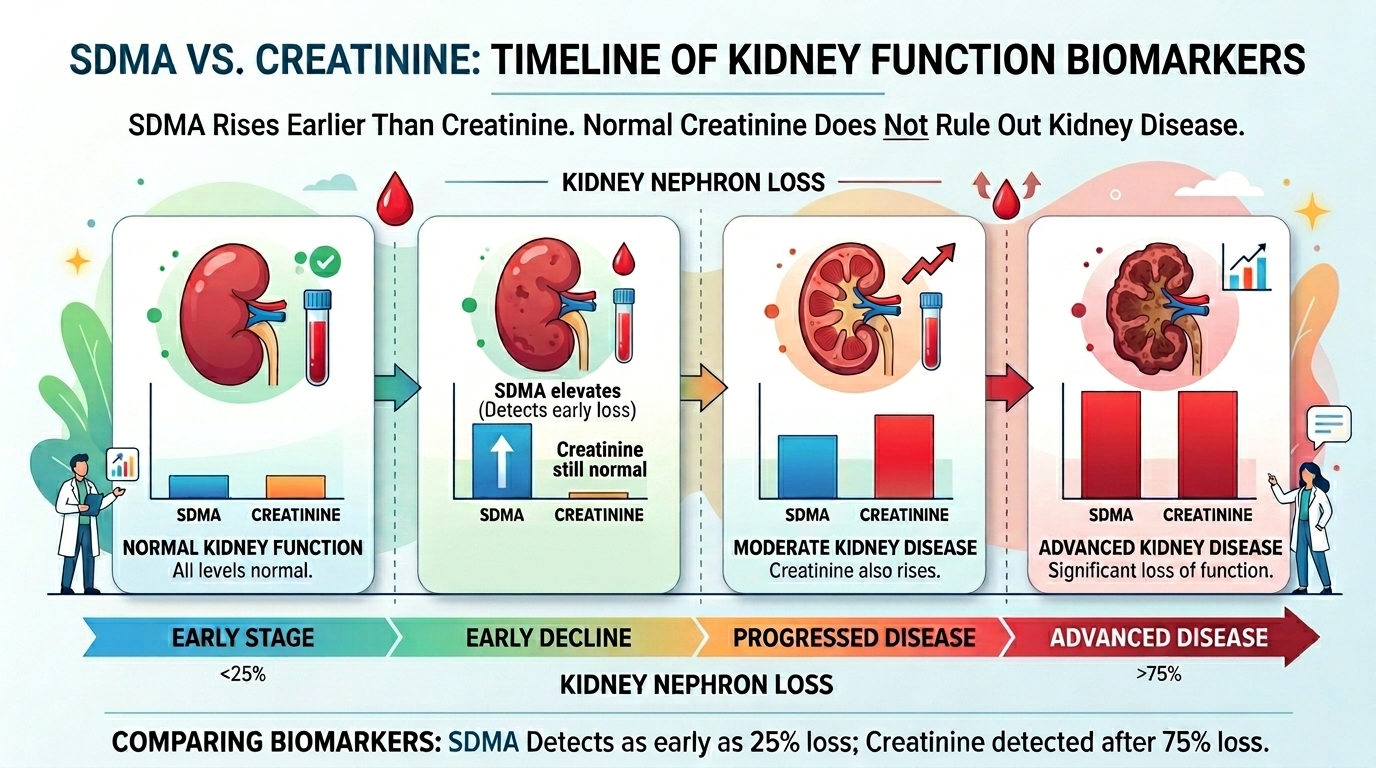
Creatinine is the number vets have relied on longest, and it is a genuinely useful marker, but it has a quirk you need to understand. Creatinine is a waste product of normal muscle activity, cleared from the blood by the kidneys, so when the kidneys are not clearing it well, it builds up. The catch is that it does not rise above the normal range until a great deal of kidney function is already gone, by most estimates around three-quarters of it. That makes a high creatinine a reliable signal, but a late one: by the time it is clearly raised, the disease is already established.
Creatinine has a second quirk worth knowing, because it can mislead in opposite directions in different pets. Because it comes from muscle, the amount of muscle a pet carries affects it. A thin, elderly cat with little muscle can have a deceptively low creatinine even with meaningful kidney disease, so a "normal" creatinine in a skinny old cat is not the all-clear it might seem. At the other end, a very muscular dog can run a creatinine at the upper end of normal with perfectly healthy kidneys, while a lean sighthound such as a Greyhound naturally sits differently again. This is one reason your vet interprets the number against your individual pet and the laboratory's own range, rather than treating a single universal cut-off as gospel, and it is part of why the next marker has become so valuable.
SDMA: the earlier warning
SDMA is a newer blood marker, and it has genuinely changed kidney medicine, because it spots trouble earlier than creatinine can. SDMA is also a substance cleared by the kidneys, but it starts to rise after a smaller amount of function is lost, on average around 40 percent, and sometimes with as little as 25 percent gone. Compared with waiting for creatinine to climb at around 75 percent, that is a substantial head start, often many months, during which the disease can be caught and managed earlier, when there is the most to gain.
SDMA has a second advantage that pairs neatly with creatinine's main weakness: it is not meaningfully affected by muscle mass. So in that thin old cat whose creatinine reads falsely reassuring, SDMA can reveal the kidney disease the creatinine missed. The usual upper limit of the reference range is around 14 µg/dL, and a value that sits persistently above that is worth taking seriously even when the creatinine is still normal. The important nuance, which your vet will weigh, is that a mildly raised SDMA on a single test is not infallible and is best confirmed as persistent rather than acted on from one result. But the principle is simple and important: when SDMA and creatinine disagree, the marker that "sees more" of the early disease, SDMA, generally earns the closer attention, and a normal creatinine alone does not rule kidney disease out.
Urea (BUN): the moody one
Urea, sometimes labelled BUN for blood urea nitrogen, is another waste product the kidneys clear, this time from the breakdown of protein. It rises in kidney disease too, but it is the moodiest number on the panel, swayed by things that have nothing to do with the kidneys, so it is best treated as supportive rather than definitive.
Urea climbs after a high-protein meal, which is why fasting matters, and it rises with dehydration. It also goes up with bleeding in the gut, because the digested blood is a protein load, and it can be lowered by liver disease. The practical upshot is that urea is most useful read alongside the other markers, not on its own. A raised urea with a normal creatinine and normal SDMA is often not kidney disease at all, but something more mundane like a recent meal or mild dehydration. So if the urea is the only thing flagged on your pet's printout, it is usually not cause for alarm by itself; it earns its place as part of the wider picture, adding colour rather than delivering the verdict.
Phosphate: the one that drives the disease
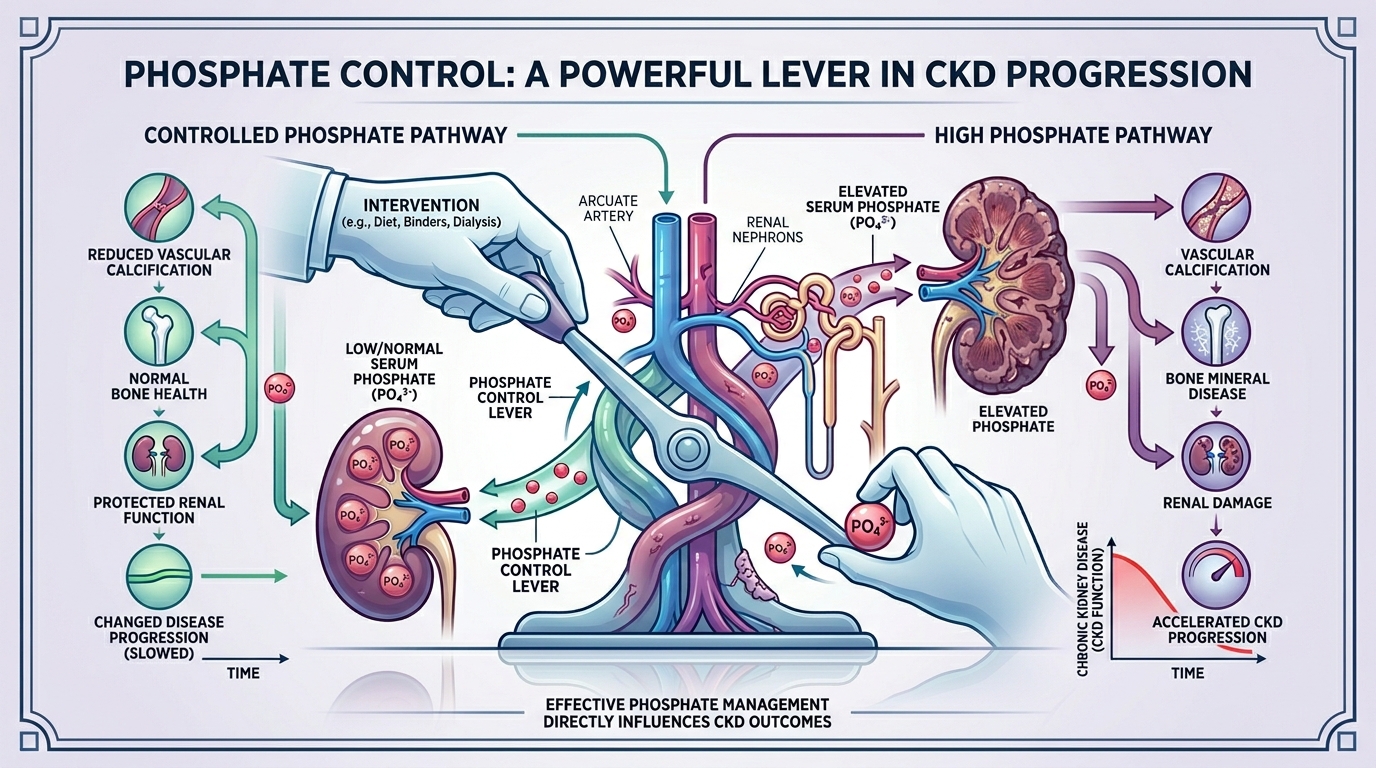
If one number on the panel deserves your attention beyond the headline kidney markers, it is phosphate, because it does not just reflect the disease, it helps drive it, and it strongly affects how your pet feels day to day.
Healthy kidneys clear excess phosphate from the body. As kidney function declines, phosphate is cleared less well and begins to build up in the blood, and that rising phosphate sets off a damaging chain. In plain terms, the body responds to high phosphate in ways that pull calcium out of balance and ramp up a hormone system that, over time, harms the bones and the kidneys themselves, a process vets call secondary renal hyperparathyroidism. The result is twofold: high phosphate makes a pet feel genuinely unwell, and it accelerates the underlying kidney damage. That is why phosphate is not just a number to monitor but a number to actively control, and why the international kidney guidelines set target phosphate ranges for each stage of the disease. This is the number that the renal diet and the phosphate binders are both chasing, and our guides on the renal diet and on phosphate binders explain how that control is achieved. For now, the key point is that if your pet's phosphate is creeping up, bringing it back down is one of the genuinely high-value moves in the whole of kidney care.
Urine specific gravity: why the wee matters
Most owners are surprised to learn that a urine test matters just as much as the blood, and sometimes more, which is why your vet keeps asking for a urine sample rather than being satisfied with bloods alone.
The relevant measure is urine specific gravity, or USG, which is simply how concentrated the urine is. One of the kidneys' core jobs is to concentrate urine, conserving water for the body. Healthy kidneys produce nicely concentrated urine; failing kidneys lose that ability and produce urine that is too dilute. When urine drifts down toward the dilute, roughly the band around 1.008 to 1.012 that vets call isosthenuric, meaning about as dilute as unprocessed blood filtrate, that points to kidneys that can no longer concentrate properly. As a rough guide, vets generally expect a healthy cat to concentrate urine above about 1.035 and a healthy dog above about 1.030, so values below those, especially alongside raised blood markers, are meaningful.
Here is the crucial bit: it is the combination that confirms kidney disease. Dilute urine together with raised creatinine or SDMA is what tells your vet the problem is genuinely renal, rather than, say, a dehydration effect on the bloods. Bloods alone can be ambiguous; bloods plus urine concentration together tell a much clearer story. So when your practice asks you to bring a urine sample, or to let them collect one, it is not bureaucratic thoroughness, it is half the diagnosis.
Putting the panel together
Here is how this works in practice, gently, because the whole point is that these numbers are read together, not as four or five separate scares.
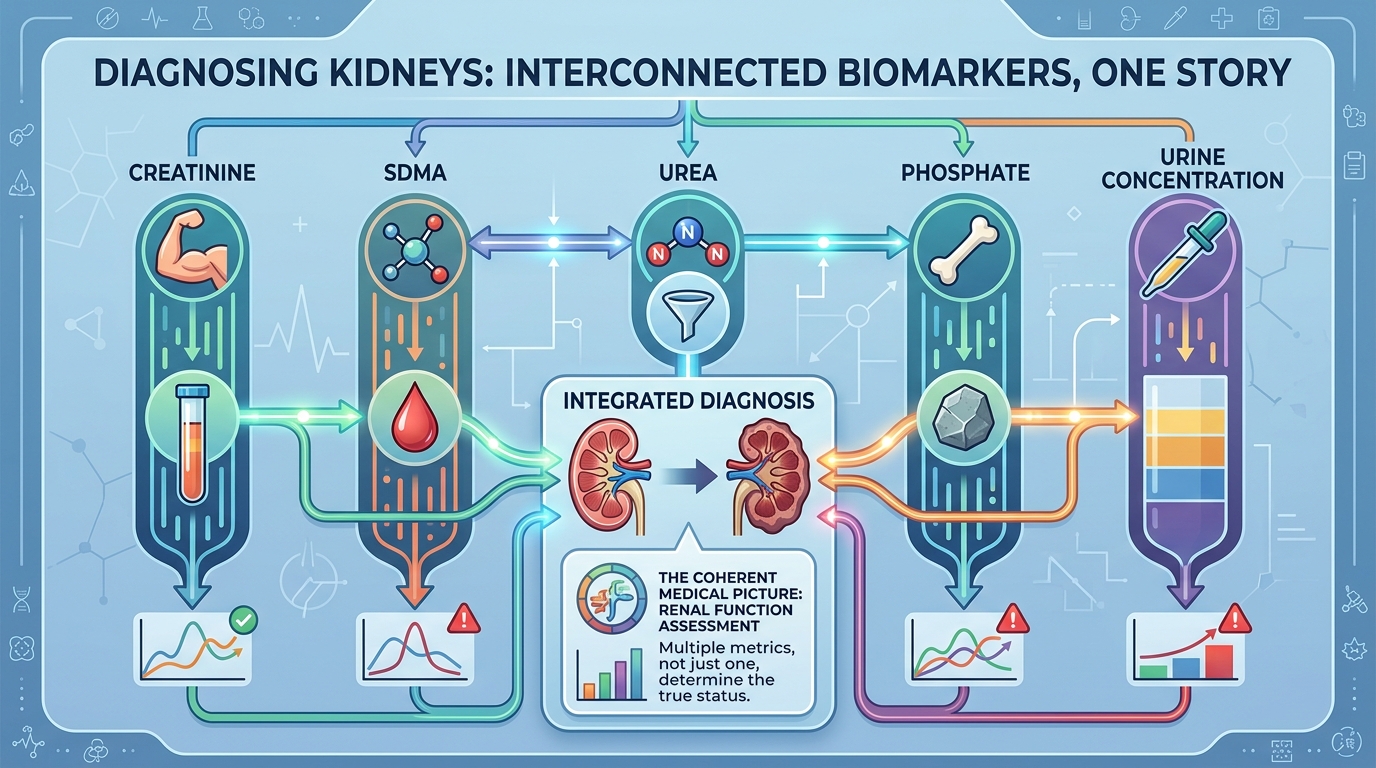
Picture a printout that shows a mildly raised creatinine, a clearly raised SDMA, urine that is more dilute than it should be, and a phosphate that is just starting to creep up. Read one row at a time, that looks like four problems, and four reasons to panic. Read together, it is one coherent picture: early-to-moderate kidney disease, caught while there is plenty that can be done, with the SDMA confirming the early creatinine change, the dilute urine confirming it is truly renal, and the phosphate flagging the lever to start working on. Not four catastrophes, one consistent and very manageable story.
That is how your vet reads the panel, and it is how you can learn to read it too: not hunting for the single worst number, but asking what story the numbers tell as a group. A marker out of place prompts a question; the markers together give the answer.
Questions worth taking to your vet
Rather than leave you with a general "talk to your vet," here are concrete, specific questions that will get you a clearer picture at your next appointment. They are worth writing down and taking with you.
Ask what stage your pet's kidney disease is, and what that means for them specifically. Ask whether this blood sample was taken fasted and when your pet was well hydrated, since that affects how much weight to put on it. Ask whether it is worth rechecking the values once your pet is stable, particularly if any result was a surprise. Ask whether you have a urine specific gravity and a urine protein measurement, the UP/C, to go alongside the bloods, because without the urine the picture is incomplete. And ask what phosphate target your vet is aiming for, and how you will work toward it, since that is one of the most actionable numbers on the sheet.
The deeper reassurance in all of this is that these numbers are not a one-off sentence handed down on a single day. They are the first entry in a trend you and your vet will track over time, and tracking that trend, ideally by keeping your pet's key numbers recorded so you can see the direction of travel, is exactly how good kidney care works. The printout that meant nothing an hour ago is, in fact, the start of a clear and followable map, and you are now equipped to read it.
References
- International Renal Interest Society (IRIS). IRIS Staging of CKD (modified 2023).
- International Renal Interest Society (IRIS). IRIS Treatment Recommendations for CKD (2023).
- Hall JA, Yerramilli M, Obare E, Yerramilli M, Jewell DE. Comparison of serum concentrations of symmetric dimethylarginine and creatinine as kidney function biomarkers in cats with chronic kidney disease. Journal of Veterinary Internal Medicine, 2014.
- Nabity MB, Lees GE, Boggess MM, et al. Symmetric dimethylarginine assay validation, stability, and evaluation as a marker for the early detection of chronic kidney disease in dogs. Journal of Veterinary Internal Medicine, 2015.
- Sparkes AH, Caney S, Chalhoub S, et al. ISFM Consensus Guidelines on the Diagnosis and Management of Feline Chronic Kidney Disease. Journal of Feline Medicine and Surgery, 2016.
Free downloads
Companion worksheets to put what you've read into practice. Free PDFs, print at home.
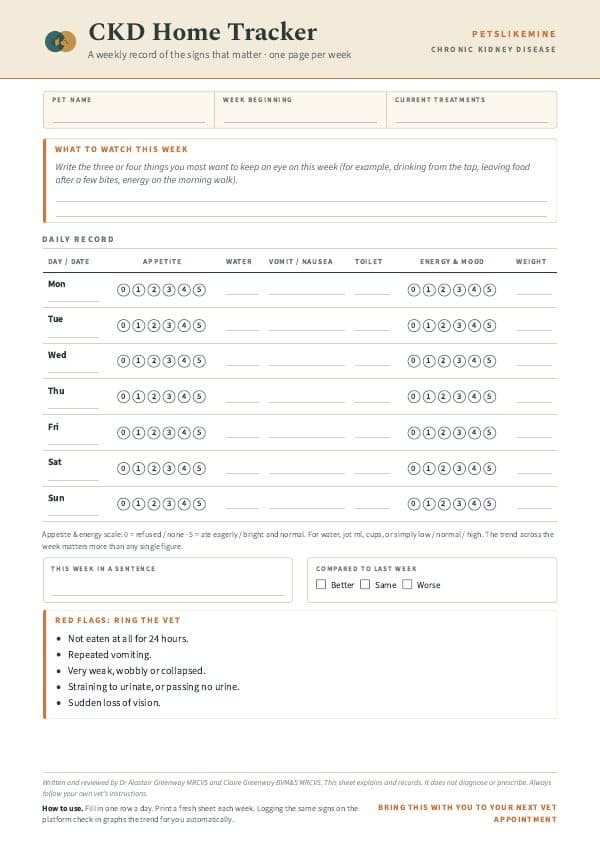
CKD Home Tracker
PDF · 236 KBA weekly record of the signs that matter in kidney disease: appetite, drinking, nausea, energy and weight, one page per week. The trend across the weeks tells you far more than any single day, and the red-flag list shows when to ring the vet.
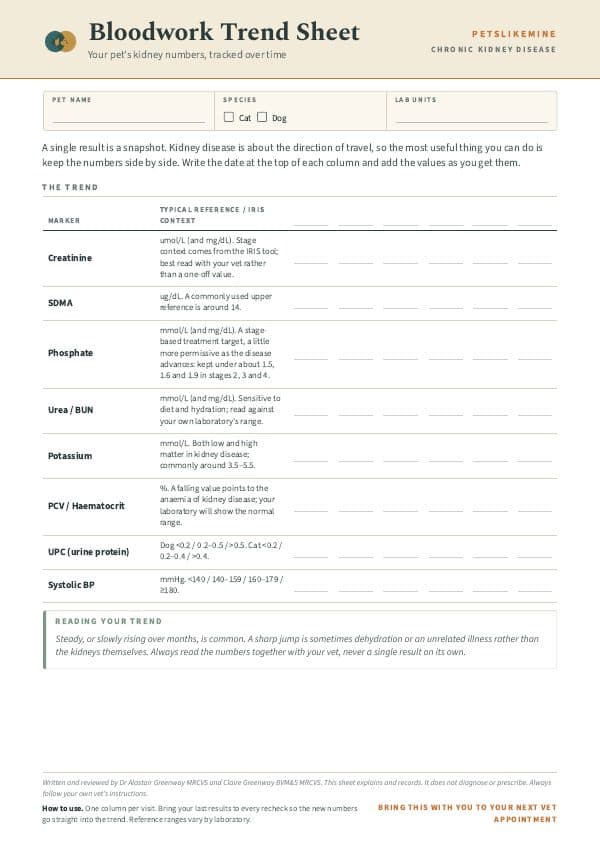
Bloodwork Trend Sheet
PDF · 212 KBYour pet's kidney numbers side by side over time, with plain-English context for each marker: creatinine, SDMA, phosphate, potassium, urine protein and blood pressure. Kidney disease is about the direction of travel, not a single snapshot.

Appointment Question List
PDF · 152 KBThe right questions for where you are right now, from newly diagnosed to reviewing treatment and the longer view. Tick what fits, write the answers on the lines, and leave the consult understanding the plan rather than just nodding along.
See where your pet stands today
Tracking is the other half of managing kidney disease. Drop in the latest bloods to see the IRIS stage, then follow the trend as treatment settles in.
Check the IRIS stageYou're not doing this alone
Compare treatment journeys and talk to owners managing kidney disease. Free to join.
Join PetsLikeMine