


Your Pet Has Kidney Disease: The First 30 Days
Alastair Greenway
BVM&S MRCVS
A kidney disease diagnosis lands hard. One moment your pet is just a bit off, drinking a little more, perhaps a touch thinner, and the next a vet is using words like "chronic" and "kidney" and "stages," and the floor tilts. Then you get home, type it into a search engine, and within about ninety seconds the internet has made everything worse: worst cases, frightening timelines, a wall of clinical detail you did not ask for. If that is roughly where you are right now, take a breath.
I am not going to bury you in numbers or pretend the diagnosis is nothing. Instead, I will tell you what kidney disease does and does not mean, what genuinely needs doing this week, what can safely wait, the questions worth asking your vet, and give you full permission not to panic. Here is the single most important thing to hold onto from the outset: many pets live well for a long time after this diagnosis, and the steps that matter most are ones you can absolutely manage. A diagnosis is the start of a plan, not the start of a countdown.
Clearing away the worst fears
Before anything practical, let me clear away the fears that the late-night googling has probably planted, because most of them are wrong.
This is not your fault. Chronic kidney disease in cats most often comes from a slow, age-related change in the kidneys that no owner causes and no owner could have prevented, and in dogs it frequently stems from inherited or filtering problems equally outside your control. Whatever you are quietly blaming yourself for, the food, missing it sooner, something you did or did not do, set it down. It is not warranted.
This is not necessarily fast. The word "chronic" frightens people, but it actually means the opposite of sudden: it means slow and long-term. For many pets, kidney disease progresses over months and years, not days and weeks, and that slowness is your ally, because it gives you time to act and to make a real difference.
And this is not untreatable. There is no cure, no point hiding that, but kidney disease is one of the most manageable serious conditions a pet can have. The goal is not to fix the kidneys but to slow the disease, ease its effects, and keep your pet feeling well, and at that, modern veterinary care is genuinely good. A great many pets go on to have good years after diagnosis, and our long-view guide looks squarely at what that road can hold. For now, simply know that "manageable" is the truthful word, not "doomed."
This week: the genuinely important bit
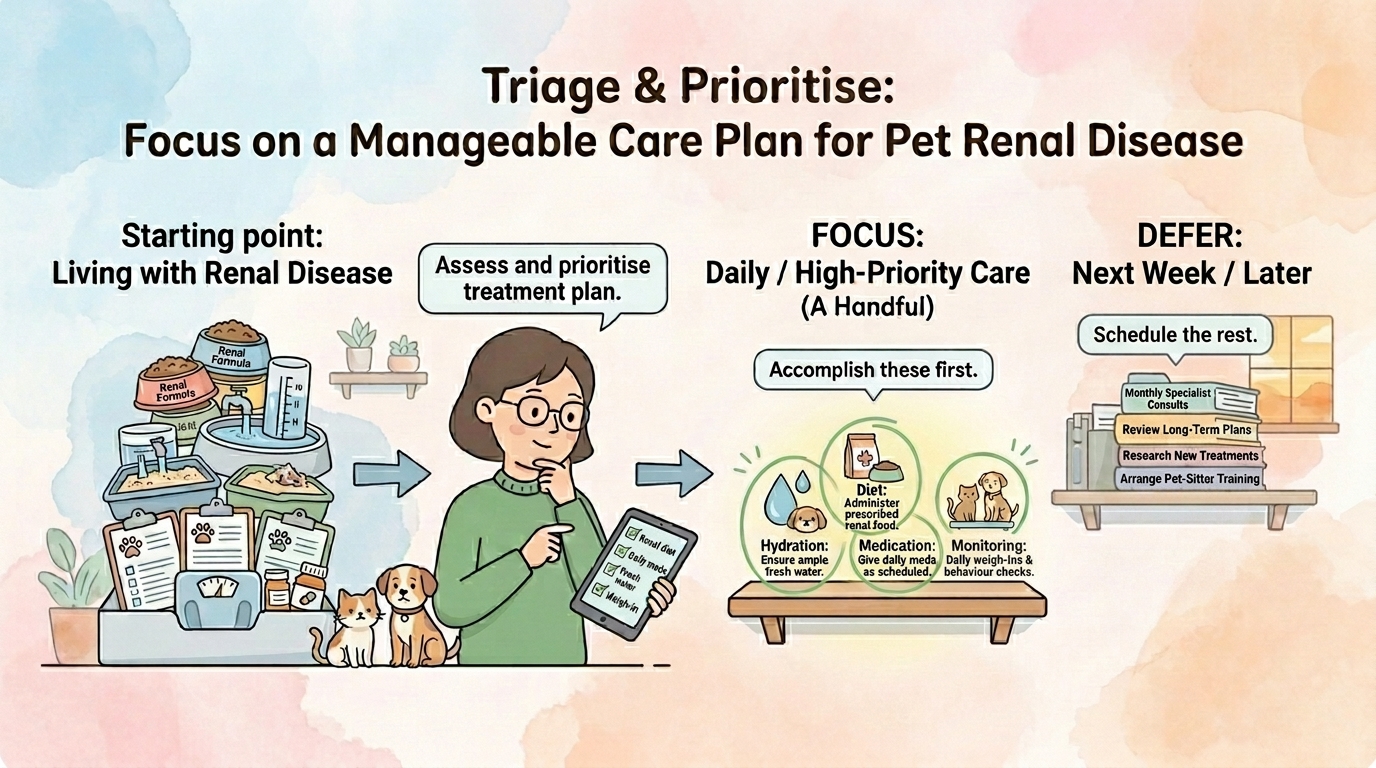
So what actually needs doing in these first days? Less than you fear, and it is all achievable. Here is the short list that matters now.
First, make sure the diagnosis is on stable footing. A kidney result taken when a pet is dehydrated or unwell can read more severe than the truth, so if there is any doubt, your vet may recheck the values once your pet is settled and well hydrated. This is not backtracking; it is making sure the plan is built on solid ground.
Second, make sure the full picture is on the plan, not just the blood test. That means a urine sample to check how concentrated the urine is, a blood pressure measurement, and a urine protein measurement called a UP/C. These three are often where the most useful information and the most treatable problems hide, and they round out the bloods into a complete assessment.
Third, start the renal-diet conversation, gently. Diet is the single most powerful thing you control in kidney disease, with better evidence behind it than almost any medication, which is why it is worth raising early. But, and this matters, do not force a sudden food switch onto a pet who is stressed or feeling unwell, because a bad first encounter with the new food can put them off it for good. Our renal-diet guide and our guide for fussy eaters cover how to introduce it slowly and successfully; this week is about starting the conversation, not winning the whole battle.
Fourth, keep water freely available everywhere, several bowls around the home, perhaps a pet fountain, and never restrict it. The extra thirst is your pet's body doing exactly what it should.
What can wait
Now the part that lifts a weight off your shoulders. Almost everything else can wait.
You do not have to understand phosphate binders this week. You do not have to learn how to give fluids under the skin, master every medication, or be able to recite the four stages of kidney disease and what each one means. Those things may become relevant in time, and when they do, they will be explained to you step by step, and our guides will be here for each of them. But none of it belongs on your plate in the first few days.
Kidney disease is a marathon, not a sprint, and it is genuinely fine, in fact it is wiser, to take it in stages. Trying to absorb the entire condition at once is overwhelming and unnecessary. Learn what you need as you need it. The owners who cope best are not the ones who cram everything in week one; they are the ones who do a few important things well now and let the rest unfold at a manageable pace. Give yourself that permission.
Getting the starting numbers down
There is one small piece of admin genuinely worth doing early, because it pays off for the whole journey: get your pet's key numbers written down, so you have a baseline to measure against.
Ask your vet to note, in plain figures you can keep, your pet's stage, their creatinine and SDMA, their phosphate, their UP/C, their blood pressure, and their weight today. This is your starting point, the "this is where we began" picture. Without it, you are comparing the future against memory, which is unreliable; with it, you and your vet can see at a glance whether things are holding steady, improving, or drifting, and act accordingly. Our guide to reading the kidney bloods explains what each of these numbers means, and keeping them recorded somewhere you can track them over time turns a frightening one-off result into a followable trend. It takes five minutes now and makes everything clearer later.
Questions worth asking
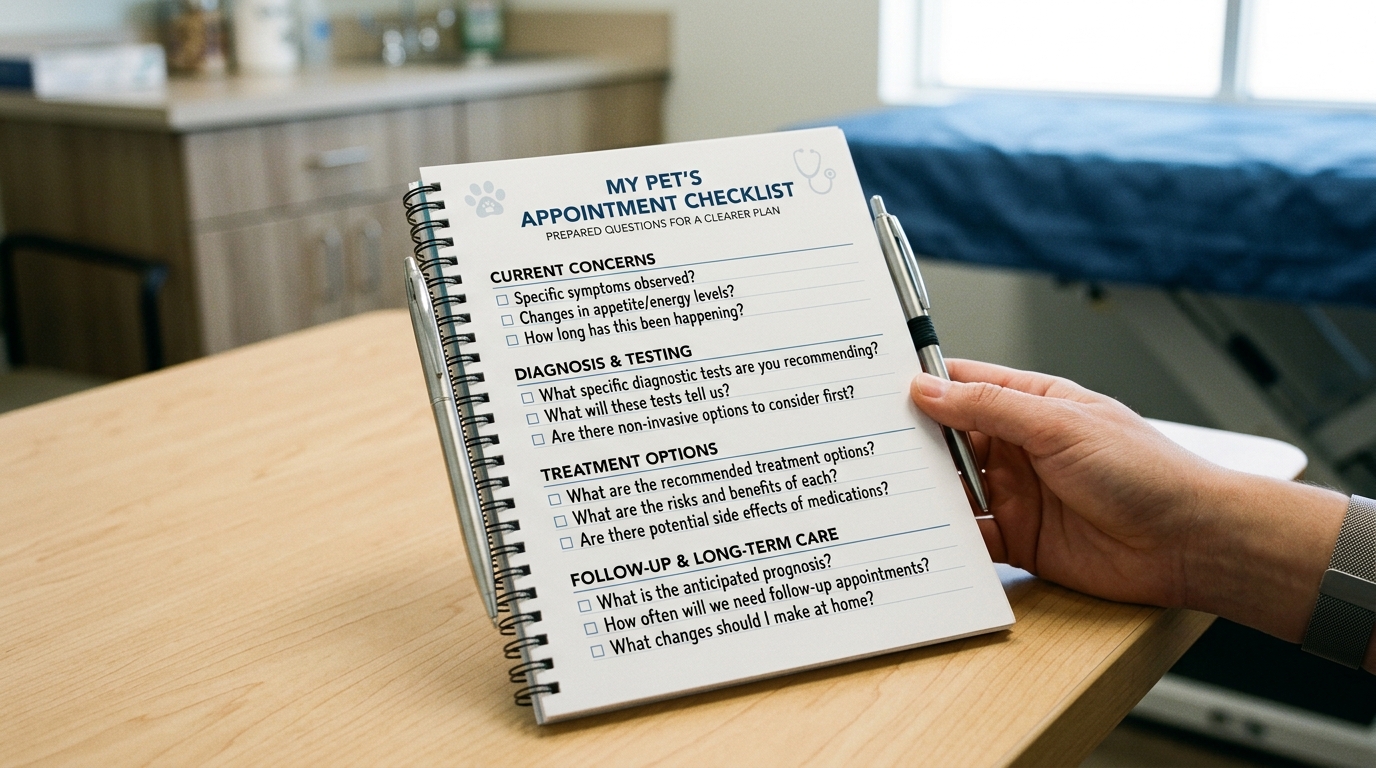
Walking into the next appointment with a few questions written down gets you a clearer plan and saves you remembering them in the moment. Here is a short list worth copying:
What stage is my pet's kidney disease, and what does that mean for them? Is it worth trying to find a specific cause, or is this the common age-related kind? Which renal diet would suit my pet, and how do I introduce it? How often should we recheck, and what will those rechecks involve? And, importantly, what would a bad turn or a crisis look like, and who do I call if it happens, including out of hours? That last question matters, because knowing the plan for a bad day removes a great deal of background fear.
A brief word on the cat-and-dog difference, since it shapes a couple of these answers. In cats, kidney disease is often the slow, age-related kind and is very commonly managed well for a long time. In dogs, it can sometimes move a little faster or involve protein loss through the kidney's filters, which is why your vet may push for that UP/C and for earlier, proactive monitoring in a dog. Neither picture is cause for alarm; they simply mean the plan is tailored to your particular pet, and our species guides for cats and for dogs go into each in depth.
Looking after you
A diagnosis like this asks something of you, the carer, and that deserves acknowledging. The worry, the appointments, the new routines, and in time perhaps medications or monitoring, all add up, and it is easy to run yourself down or feel guilty on the days you cannot do everything perfectly.
So let me say it plainly: looking after yourself is part of looking after your pet. Pace yourself for the long haul rather than sprinting and burning out. Accept help where it is offered. Lean on others who have walked this road, the people in our community know exactly what these first weeks feel like and can offer both practical tips and real reassurance. And forgive yourself the imperfect days, because doing a few things well, calmly, over months matters far more than doing everything anxiously this week. A steady, present owner who is still going strong a year from now is worth more to a pet than a perfect one who is exhausted by the end of the month.
A map of the months ahead
Let me leave you with a gentle map, so the future feels like a sequence rather than a scramble.
In the coming weeks, the shape is simple. First, settle the diagnosis, confirm it on stable footing and complete the picture with urine and blood pressure. Then start the diet, gradually and patiently, as the single highest-value step you control. Then set a monitoring rhythm with your vet, so rechecks happen on a sensible schedule and you are watching the trend rather than waiting for problems. And then learn the further skills only if and when they become relevant, one at a time, with support. That is the whole of it, four unhurried movements, not a mountain to climb in a day.
You do not need to do all of this today. You need to do the small handful of things this week, breathe, and trust that the rest will follow at a pace you can manage. So here is the one concrete thing to do next: book the recheck your vet has suggested, and write down your pet's starting numbers so you have your baseline.
References
- International Renal Interest Society (IRIS). IRIS Staging of CKD (modified 2023).
- Sparkes AH, Caney S, Chalhoub S, et al. ISFM Consensus Guidelines on the Diagnosis and Management of Feline Chronic Kidney Disease. Journal of Feline Medicine and Surgery, 2016.
- Ross SJ, Osborne CA, Kirk CA, Lowry SR, Koehler LA, Polzin DJ. Clinical evaluation of dietary modification for treatment of spontaneous chronic kidney disease in cats. Journal of the American Veterinary Medical Association, 2006.
Free downloads
Companion worksheets to put what you've read into practice. Free PDFs, print at home.
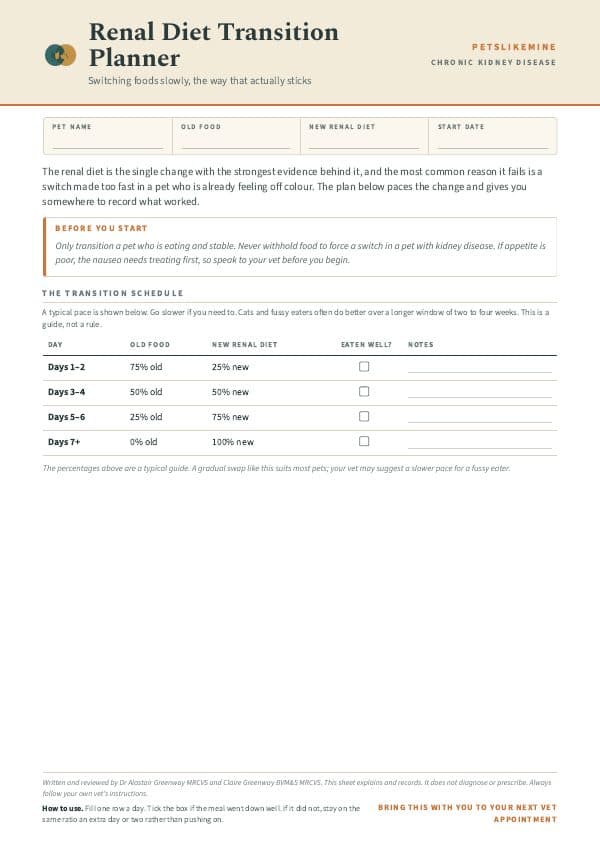
Renal Diet Transition Planner
PDF · 258 KBA day-by-day plan for moving your pet onto a renal diet at a pace that actually sticks. The transition ladder, tricks for winning round a fussy eater, and somewhere to record what worked. The renal diet is the change with the strongest evidence behind it, so it is worth getting right.
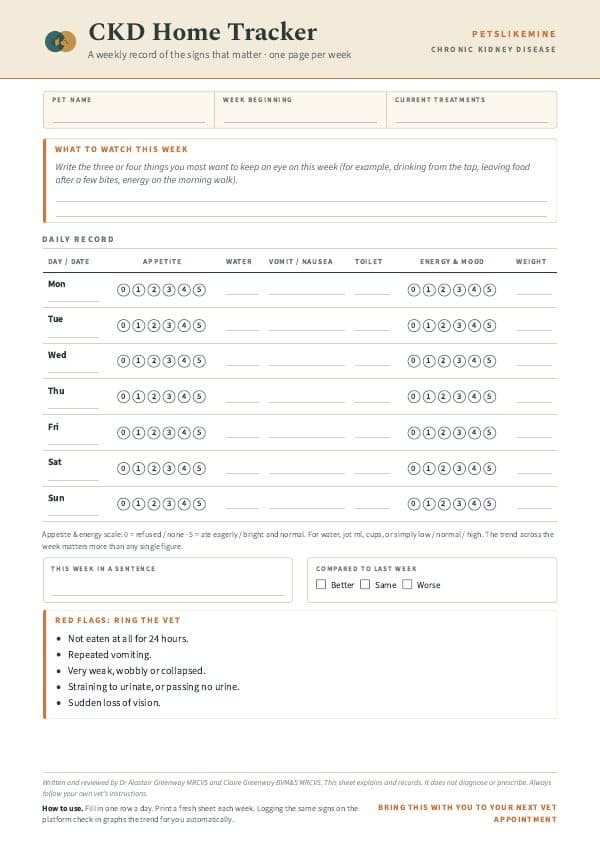
CKD Home Tracker
PDF · 236 KBA weekly record of the signs that matter in kidney disease: appetite, drinking, nausea, energy and weight, one page per week. The trend across the weeks tells you far more than any single day, and the red-flag list shows when to ring the vet.
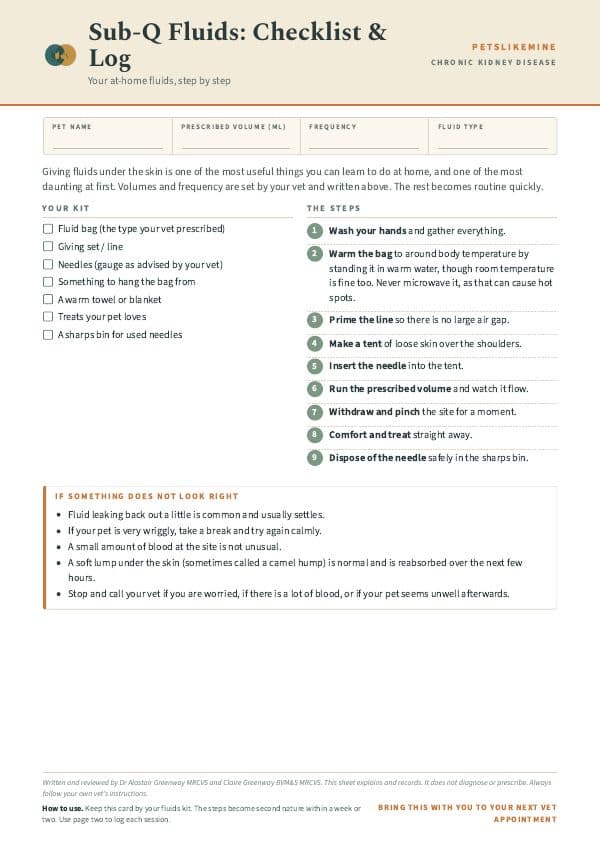
Sub-Q Fluids: Checklist & Log
PDF · 294 KBEverything you need to give fluids under the skin at home with confidence: a kit list, the steps in order, what is normal and what is not, and a running log to bring to rechecks. Daunting at first, routine within a fortnight.

Appointment Question List
PDF · 152 KBThe right questions for where you are right now, from newly diagnosed to reviewing treatment and the longer view. Tick what fits, write the answers on the lines, and leave the consult understanding the plan rather than just nodding along.

UK Cost Planner
PDF · 220 KBPlan the year ahead with clear eyes. Typical UK cost ranges for diet, medicines, monitoring and fluids, room for your own quotes, and the practical ways to make it manageable, from insurance to written prescriptions. Money worries should never quietly steer the medical decisions.
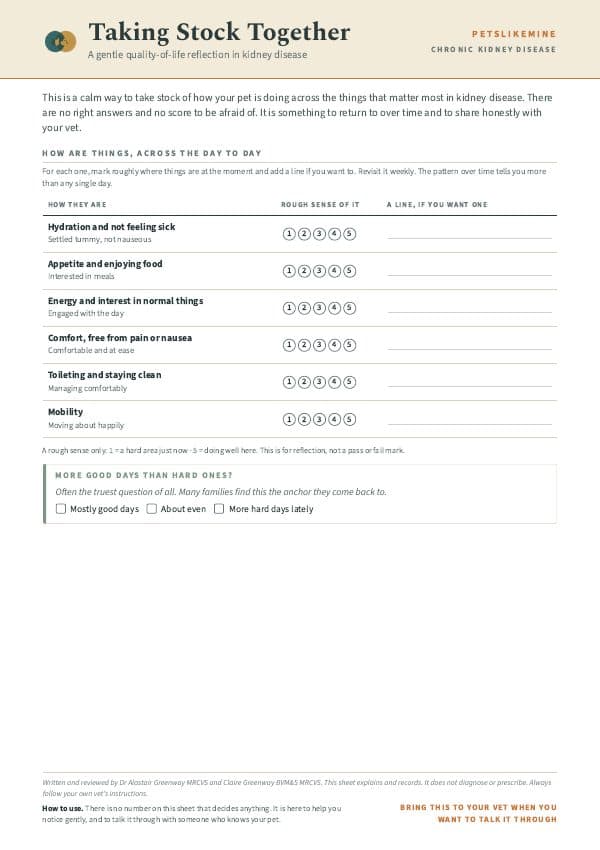
Quality-of-Life Assessment
PDF · 253 KBA gentle way to take stock of how your pet is really doing, across the things that matter most in kidney disease. There is no score to be afraid of here. Something to return to over time, and to share honestly with the people who know your pet.
See where your pet stands today
Tracking is the other half of managing kidney disease. Drop in the latest bloods to see the IRIS stage, then follow the trend as treatment settles in.
Check the IRIS stageYou're not doing this alone
Compare treatment journeys and talk to owners managing kidney disease. Free to join.
Join PetsLikeMine