

Phosphate Binders: When the Renal Diet Isn't Enough
Claire Greenway
BVM&S MRCVS
Phosphate is the number the whole renal diet is quietly chasing, as our guide to that diet explains. Controlling it is one of the few things genuinely shown to change the course of kidney disease, as well as how well your pet feels day to day. The renal diet is the first and most important move on phosphate. But for many pets, especially as the disease advances, diet alone stops being enough to keep phosphate where it needs to be. That is where phosphate binders come in, and this guide explains what they are, when they get added, the main types you will meet in the UK, and the simple trick that makes them actually work.
A binder is not a sign of failure or of the diet not working. It is a normal, expected next step in many cases, a way of finishing the job the diet started, and it is straightforward once you understand it. So let us take the mystery out of it.
Why phosphate earns this much attention
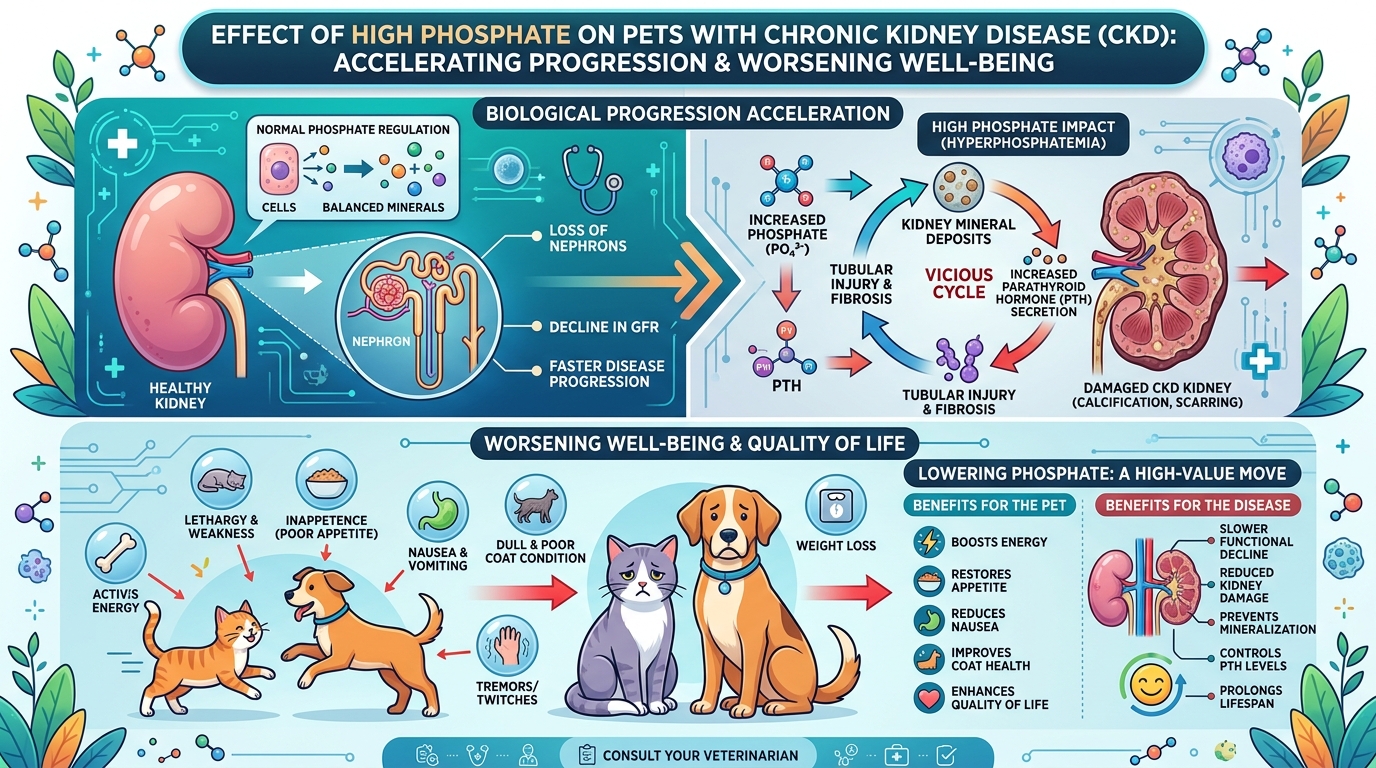
Spend a moment on why phosphate matters so much, because understanding it makes everything else make sense. Phosphate is a mineral that healthy kidneys clear from the body. As kidney function declines, that clearance falters and phosphate begins to build up in the blood, and that rising phosphate does real harm on two fronts.
First, it drives the disease forward. High phosphate sets off a damaging hormonal chain: the body responds by pulling calcium out of balance and ramping up a hormone system, which over time harms the bones and, critically, accelerates the kidney damage itself, a process vets call secondary renal hyperparathyroidism. A related hormone called FGF-23 rises early in this process too. The upshot is that high phosphate is not merely a marker of how advanced the disease is; it actively helps it get worse. Second, high phosphate makes a pet feel genuinely unwell, contributing to the nausea, poor appetite, and general malaise of kidney disease. So bringing phosphate down does double duty: it slows the disease and it helps your pet feel better. This is why controlling it is considered one of the highest-value moves in the whole of kidney care, and why our article on reading the bloods singles phosphate out as the number to watch most closely.
The point where diet alone falls short
So when does a binder get added? The logic is simple and sequential, and the order matters. The renal diet comes first, always, because it is the foundation: a good renal diet is restricted in phosphate and does much of the work on its own, and you cannot binder your way out of a non-renal diet. Binders are an addition to the diet, not a substitute for it.
If, despite your pet eating a strict renal diet for a few weeks, their blood phosphate stays above the target your vet is aiming for, that is the trigger to add a binder. The target itself is not one fixed number: it tends to become a little more permissive as the disease advances, so your vet works to a stage-appropriate target rather than a single universal figure. The principle to take away is the sequence: diet first, give it a fair trial, recheck the phosphate, and add a binder if the diet alone has not brought it to target. It is a logical, stepwise approach, not a leap.
Meet the binders, and how they differ
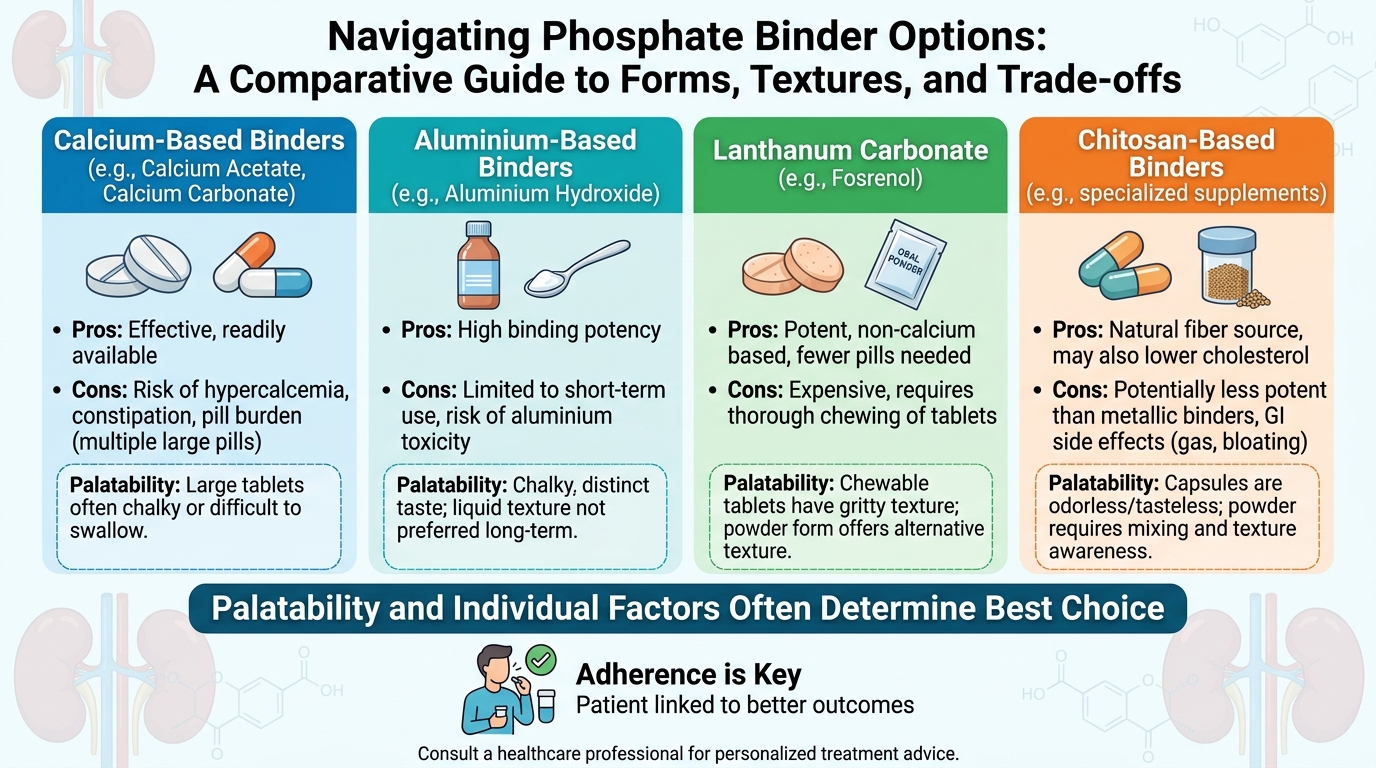
There are several types of phosphate binder, and owners often get confused about which is which, so here is a plain-language tour of the main ones you might encounter in the UK. Read this as a comparison, not a ranking: each has trade-offs, and the best binder is ultimately the one that controls your pet's phosphate and that your pet will actually accept.
Aluminium hydroxide is cheap and a very effective phosphate binder, which is why it remains widely used. The consideration with it is long-term safety: aluminium can accumulate in the body over extended use, so vets use it thoughtfully and monitor accordingly, particularly with prolonged use. It is effective and has a real place; it simply warrants a sensible eye on the long game.
Calcium-based binders, such as calcium carbonate and calcium acetate, are another mainstay. They work well, but because they contain calcium, the main thing to watch is the blood calcium level, since these binders can raise it, so your vet will monitor calcium as well as phosphate when using them.
Lanthanum carbonate is a non-calcium, non-aluminium option that is effective and, because it sidesteps both the aluminium and the calcium concerns, is often considered suitable for longer-term use.
Chitosan-based combination products are very commonly used in practice, and in the UK these include Ipakitine and Pronefra, which combine a phosphate-binding action with other ingredients, and which many owners find practical: Ipakitine is a palatable powder you mix into food, and Pronefra is a palatable oral liquid.
You may also hear about gut adsorbents such as Porus One, which contains a spherical carbon material called Renaltec. These work differently from binders: rather than locking up phosphate, they soak up some of the gut-derived toxins that build up in kidney disease and carry them out of the body in the faeces. That makes them a complement to the phosphate binders above rather than a replacement for them, and availability of these newer products is evolving, so your vet can advise on what is current.
The takeaway from all this is not that one binder is best, but that there are several reasonable options with different trade-offs, and your vet will choose based on your pet's bloods, their other conditions, and, crucially, what your pet will tolerate.
Always give it with food
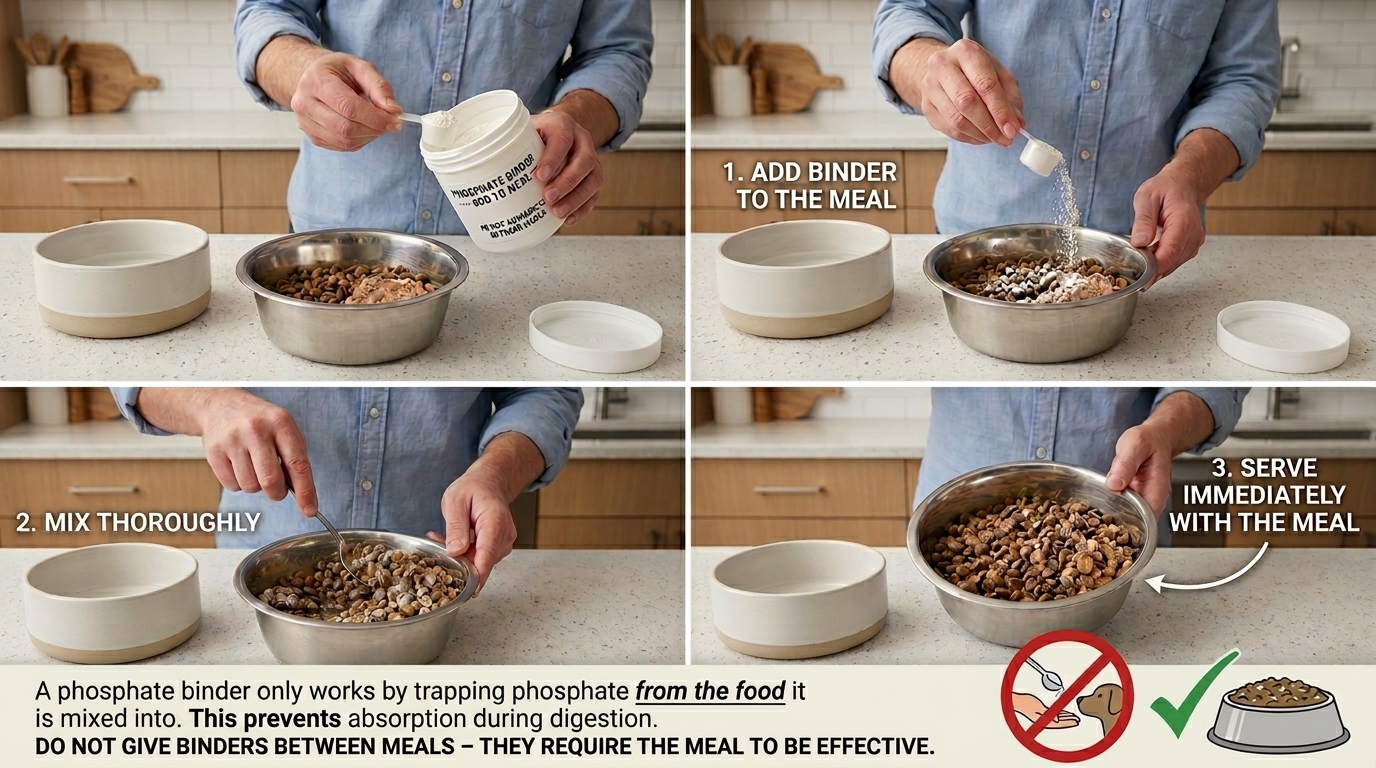
Here is the one thing that makes or breaks a binder, and that owners most often get wrong: binders must be given with food, mixed into or given alongside the meal, not on their own between meals. This is not a minor preference; it is how they work.
A phosphate binder does its job in the gut, by trapping the phosphate from the food as it is being digested, so that the phosphate is carried out in the stool instead of being absorbed into the blood. If you give a binder on an empty stomach, away from food, there is no meal phosphate for it to bind, and it simply does not work. So the binder has to meet the food in the gut, which means it goes in or with every relevant meal. Get this right and the binder earns its keep; get it wrong, giving it as a standalone tablet between meals, and you may see no benefit at all despite the effort.
The practical challenge, of course, is mixing a binder into food without putting your pet off the very renal diet you have worked so hard to get them eating. This takes a little care, because a pet who associates their food with an unpleasant additive can develop an aversion to it, which is the last thing you want. Our guide to feeding a fussy eater covers the tactics in depth, mixing thoroughly, using palatable forms, choosing the right product for a picky pet, but the headline is to introduce the binder gently and watch that it does not sour your pet on their meals. When in doubt, your vet can suggest the most palatable option and the best way to combine it with the diet.
How your vet keeps it on target
Binders are not a fixed prescription you give and forget; they are adjusted to the numbers, which is why monitoring matters. After a binder is started, your vet will recheck the blood phosphate to see whether it has come down to target, and adjust the dose accordingly, because the right dose is the one that achieves the target, not a number fixed in advance. For calcium-based binders, your vet will also keep an eye on the blood calcium level, since those binders can push it up. The dose is titrated, raised or lowered, in response to repeated phosphate checks until the target is reached and held, and then monitored over time as the disease evolves and the target may shift.
This is, in truth, the same pattern that runs through all of good kidney care: a measure taken, a number rechecked, the approach adjusted to what the number shows. The binder is one more lever, pulled in response to the phosphate reading and fine-tuned to your individual pet.
There is one practical bonus worth knowing, which our renal-diet guide also mentions: because binders control phosphate from whatever food they are mixed into, they can sometimes help a pet who simply will not accept a renal diet, by allowing better phosphate control even on a less restricted diet. That is a conversation for your vet, and the renal diet remains the ideal, but it is a reminder that the goal throughout is the best achievable phosphate control your pet will tolerate, by whatever combination of diet and binder works for them.
Phosphate is one of the most important numbers in kidney disease, the renal diet is the first move on it, and if diet alone is not enough to reach the target, a binder is the logical, normal next step. There are several reasonable binders with different trade-offs, your vet will pick the right one for your pet, and the one rule you must get right yourself is to give it with food, every time, so it can do its job. If your pet's phosphate has been creeping up despite a good diet, that is exactly the moment to ask your vet whether a binder should be added, and to get the recheck booked that will tell you whether it is working.
References
- International Renal Interest Society (IRIS). IRIS Treatment Recommendations for CKD (2023).
- International Renal Interest Society (IRIS). IRIS Staging of CKD (modified 2023).
- Ross SJ, Osborne CA, Kirk CA, Lowry SR, Koehler LA, Polzin DJ. Clinical evaluation of dietary modification for treatment of spontaneous chronic kidney disease in cats. Journal of the American Veterinary Medical Association, 2006.
Free downloads
Companion worksheets to put what you've read into practice. Free PDFs, print at home.
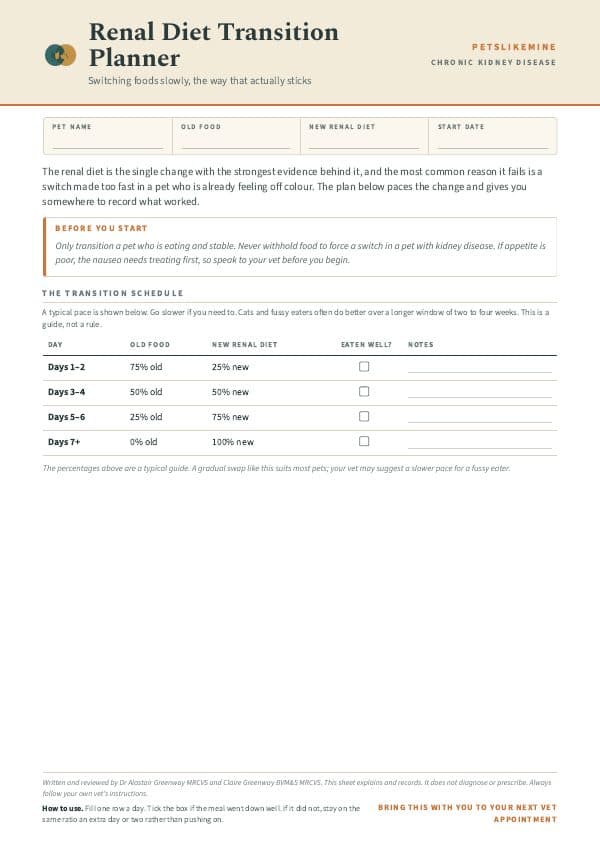
Renal Diet Transition Planner
PDF · 258 KBA day-by-day plan for moving your pet onto a renal diet at a pace that actually sticks. The transition ladder, tricks for winning round a fussy eater, and somewhere to record what worked. The renal diet is the change with the strongest evidence behind it, so it is worth getting right.
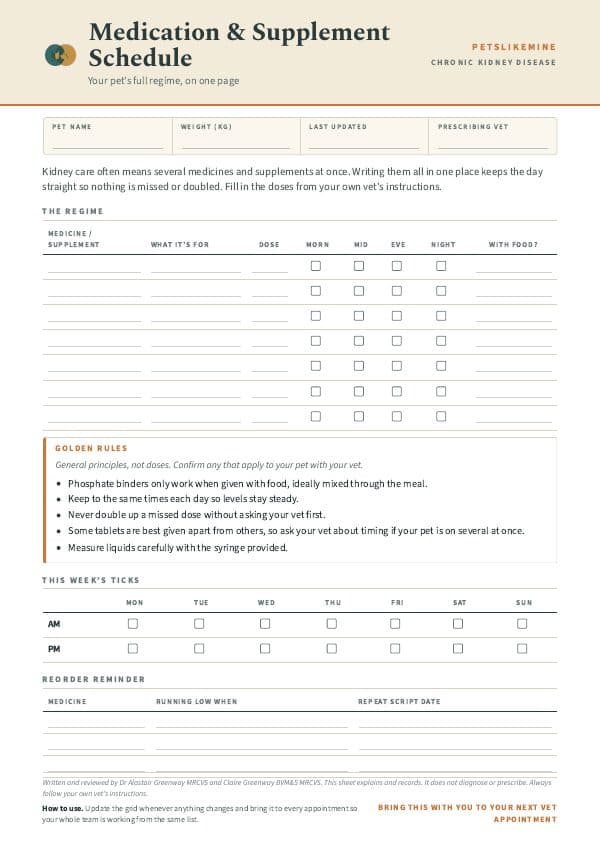
Medication & Supplement Schedule
PDF · 192 KBYour pet's whole kidney regime on one page: every medicine and supplement, what each is for, the dose you fill in from your vet, and a tick grid for the week. Keeps the day straight so nothing is missed or doubled.
See where your pet stands today
Tracking is the other half of managing kidney disease. Drop in the latest bloods to see the IRIS stage, then follow the trend as treatment settles in.
Check the IRIS stageYou're not doing this alone
Compare treatment journeys and talk to owners managing kidney disease. Free to join.
Join PetsLikeMine