


Advanced Kidney Treatments: Dialysis, Transplant and What's on the Horizon
Alastair Greenway
BVM&S MRCVS
Most owners of a pet with kidney disease eventually ask the same hopeful questions. Is there a transplant? A dialysis machine, like people have? A new drug just around the corner? They're completely natural questions, and you deserve a straight, UK-grounded answer to each one, an answer that neither crushes your hope nor sells you a false promise. What follows is a calm, realistic look at the big interventions and the research pipeline, written for the UK, so you can ask your vet informed questions and recognise false hope when you meet it.
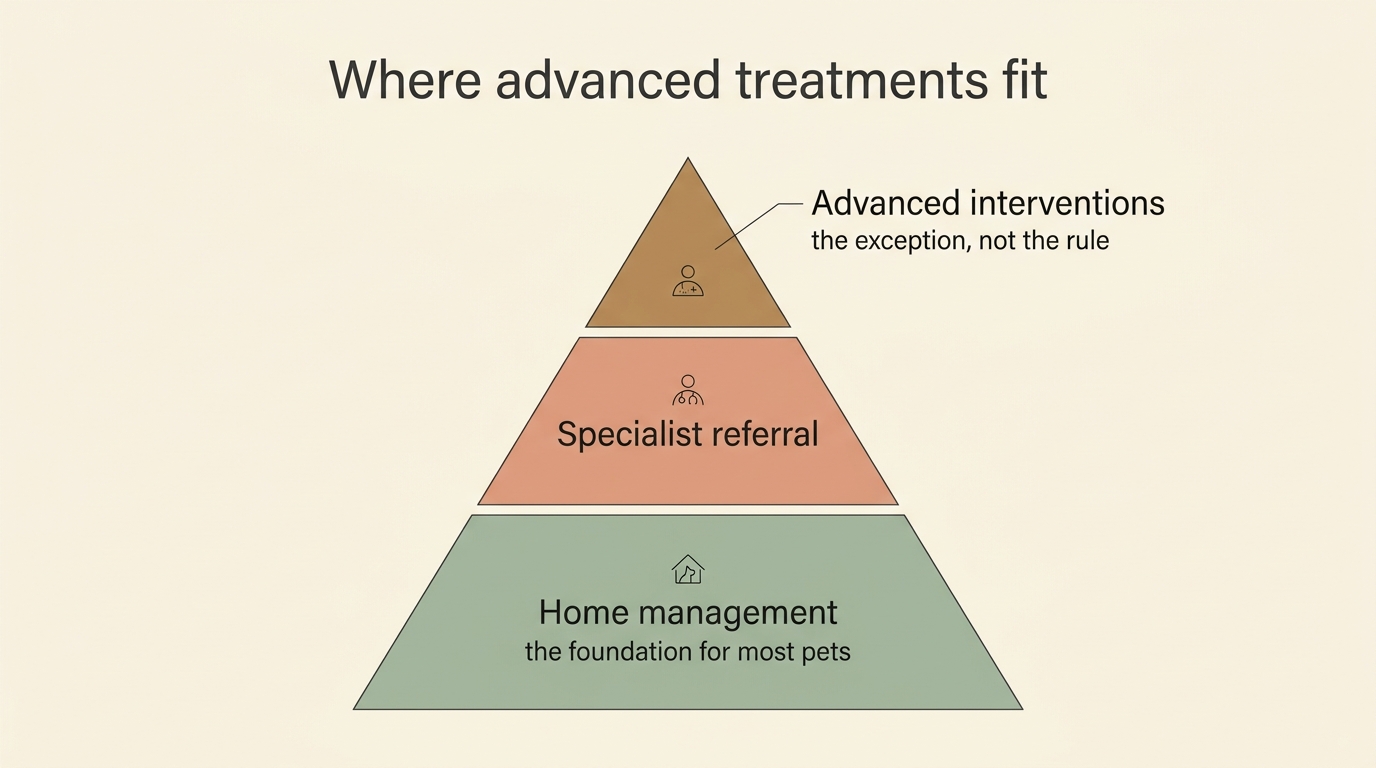
Some context first, because it matters. The great majority of kidney disease, in cats and dogs alike, is managed medically, at home, with the diet, the fluids, the medicines, and the monitoring this space describes. Managed well, that approach buys good, comfortable time, often a great deal of it. The advanced interventions below are the exception, not the rule, and choosing home management is no failure and no second-best. For most pets it's simply what works best. With that firmly said, here's the real picture of the bigger options.
Haemodialysis: real, but rare here
Dialysis does exist for animals, but it works quite differently from the picture most people carry over from human medicine, and that difference is the key to understanding it. In people, dialysis is typically a long-term treatment for chronic kidney disease, used indefinitely to do the kidneys' job while a patient waits for a transplant. In veterinary medicine, it isn't used that way. Animal dialysis, more properly called renal replacement therapy, mainly supports a pet through an acute kidney injury, a sudden and potentially recoverable insult, or helps manage a severe poisoning. It buys time for the kidneys to heal rather than replacing their function for the rest of the pet's life.
Here in the UK it's rare. Only a very small number of referral centres offer it at all. It's intensive and costly, requiring specialised equipment and round-the-clock expertise, and, crucially, it's generally not offered as a long-term treatment for chronic kidney disease in this country. It's reserved instead for those acute, bridge-to-recovery situations. So while it's a genuine and sometimes life-saving technology, it isn't, realistically, a long-term answer for a pet with chronic kidney disease in the UK, and it isn't something managed at home. If your pet ever suffered an acute crisis, your vet would know whether referral for this kind of support was appropriate and available. For the day-to-day management of chronic disease, it isn't part of the picture here.
When owners ask about a kidney transplant
A kidney transplant sounds like the obvious cure, and it's the question owners ask most wistfully, so it deserves a clear and candid answer. Transplantation is performed in some countries, notably in parts of the USA, and almost entirely in cats rather than dogs, where it has helped some cats live longer. But it carries profound practical and ethical complexities that explain why it isn't a routine option, and in the UK it's rare to effectively unavailable.
The ethical heart of it is the donor. A transplant requires a healthy young cat to undergo major surgery to give up one of its kidneys, a cat that cannot consent and gains no medical benefit from the operation, and the usual ethical requirement is that this donor cat is then adopted and cared for by the recipient's family for life. Different countries and professional bodies answer the difficult questions that raises in different ways, and in the UK the regulatory and professional position has made the procedure rare to effectively unavailable, with serious concerns raised about whether it can be justified at all. There are also significant practical demands: lifelong immunosuppressive medication for the recipient, a real risk of rejection and of complications, and substantial cost and specialist care. None of this dismisses transplantation or the owners who consider it, since the wish to do everything for a beloved cat is deeply understandable. But the UK reality is that it isn't a practical route for the great majority of pets here, and it's right to know that rather than pin hope on it.
Stem-cell and regenerative approaches
Stem-cell therapy is an area of genuine scientific interest, and you may see it marketed with real enthusiasm, so it's worth a clear-eyed appraisal. The theory is rational and appealing. Certain stem cells have anti-inflammatory and anti-scarring effects, and since feline kidney disease involves inflammation and scarring of the kidney tissue, there's a plausible reason to think they might help.
Where it stands on the evidence, though, is early and so far unproven. The pilot studies done to date, including careful work in cats, have generally found the treatment to be safe but haven't shown clear, reliable improvement in kidney function, and it remains an experimental approach rather than an established treatment. That matters, because where there's enthusiasm and hope, there are also businesses willing to charge substantial sums for therapies not yet shown to work. So the sensible stance is interest tempered with caution. It's a promising area to watch, but be wary of paying significant money for stem-cell treatments marketed as breakthroughs when the evidence doesn't yet support that billing, and discuss any such offer frankly with your own vet before committing.
Emerging medical options
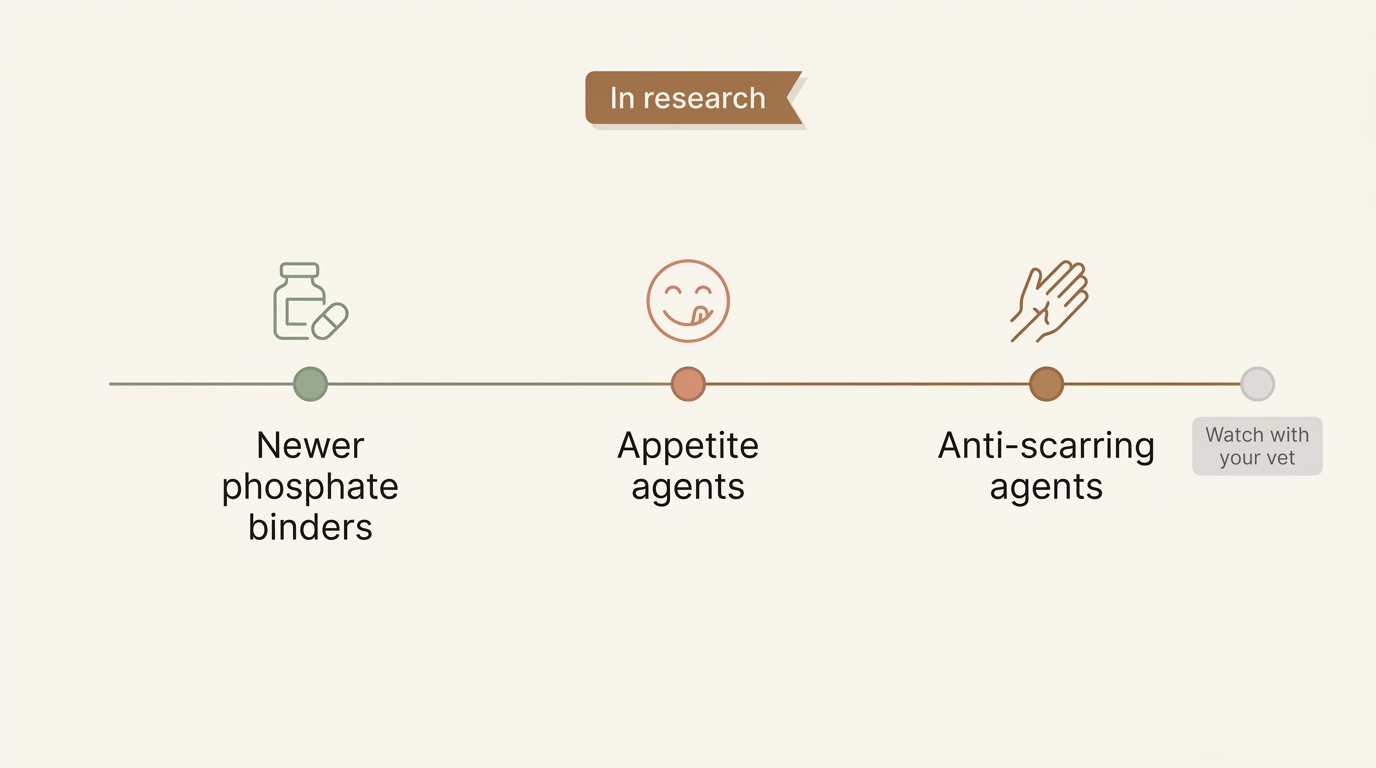
Beyond these headline interventions, kidney medicine does continue to develop, and there's reason for measured optimism about the future. Researchers are working on newer phosphate binders, and on novel agents aimed at appetite, at slowing the scarring that drives the disease, and at other aspects of kidney care, some of which may become available in the years ahead.
The sensible framing here is "watch this space, with your vet," rather than "wait for it." It would be wrong to encourage anyone to hold off on proven management today in the hope of something better tomorrow, because the established treatments work and the time they buy is real. But it's genuinely reassuring to know that the field is active, that new options do arrive, and that your vet keeps abreast of what becomes available and licensed for use here. As and when something new and proven reaches UK practice, your vet is the person to tell you whether it suits your pet.
Weighing up an advanced option
If you ever find yourself genuinely considering an advanced treatment, or a referral to explore one, a few clear-eyed questions will serve you and your pet well. Ask what the realistic benefit is, in terms of both how much longer and, more importantly, how good that time would be, since quality of life matters more than quantity. Ask what it involves for your pet: the procedures, the hospital time, the ongoing treatment, and how they would experience it. Ask what it costs, plainly and in full, as our guide to what kidney care costs in the UK discusses. And ask the most important question of all: is this genuinely in my pet's best interests, or is it doing everything possible for my sake rather than theirs?
The practical route to good answers is referral. Your own vet can refer you to a veterinary internal-medicine specialist, who has the deepest expertise in these conditions and can give you a frank, expert assessment of whether an advanced option is realistic and worthwhile for your individual pet, and our guide to getting the most from your vet appointments can help you make that conversation count. A good specialist will be as candid about when not to pursue something as about when to, and that straight talk is exactly what you want.

So where does this leave the hopeful owner who came looking for a cure? With hope, but hope grounded in the facts. The truthful picture is that there's no cure for chronic kidney disease, that the big interventions are limited, situational, and in the UK often unavailable, and that the research pipeline, while real and worth watching, isn't something to wait on at the expense of proven care today. And the genuinely reassuring truth underneath all of that is that the great majority of pets do best on exactly what most owners can provide: excellent, consistent home management, the diet, the hydration, the medicines, the monitoring, delivered with care over months and years. That isn't the consolation prize. For nearly every pet, it's the best medicine there is, and doing it well, while watching the horizon with your vet, is the most powerful thing you can do for the years ahead.
References
- International Renal Interest Society (IRIS). IRIS Staging of CKD (2023).
- Fischer JR, Pantaleo V, Francey T, Cowgill LD. Veterinary hemodialysis: advances in management and technology. Veterinary Clinics of North America: Small Animal Practice, 2004.
- Schmiedt CW, Holzman G, Schwarz T, McAnulty JF. Survival, complications, and analysis of risk factors after renal transplantation in cats. Veterinary Surgery, 2008.
- International Cat Care. Renal (kidney) transplantation in cats: position statement.
- Quimby JM, Webb TL, Randall E, Marolf A, Valdes-Martinez A, Dow SW. Assessment of intravenous adipose-derived allogeneic mesenchymal stem cells for the treatment of feline chronic kidney disease: a randomized, placebo-controlled clinical trial in eight cats. Journal of Feline Medicine and Surgery, 2016.
- Quimby JM, Webb TL, Habernicht LM, Dow SW. Safety and efficacy of intravenous infusion of allogeneic cryopreserved mesenchymal stem cells for treatment of chronic kidney disease in cats: results of three sequential pilot studies. Stem Cell Research & Therapy, 2013.
See where your pet stands today
Tracking is the other half of managing kidney disease. Drop in the latest bloods to see the IRIS stage, then follow the trend as treatment settles in.
Check the IRIS stageYou're not doing this alone
Compare treatment journeys and talk to owners managing kidney disease. Free to join.
Join PetsLikeMine