

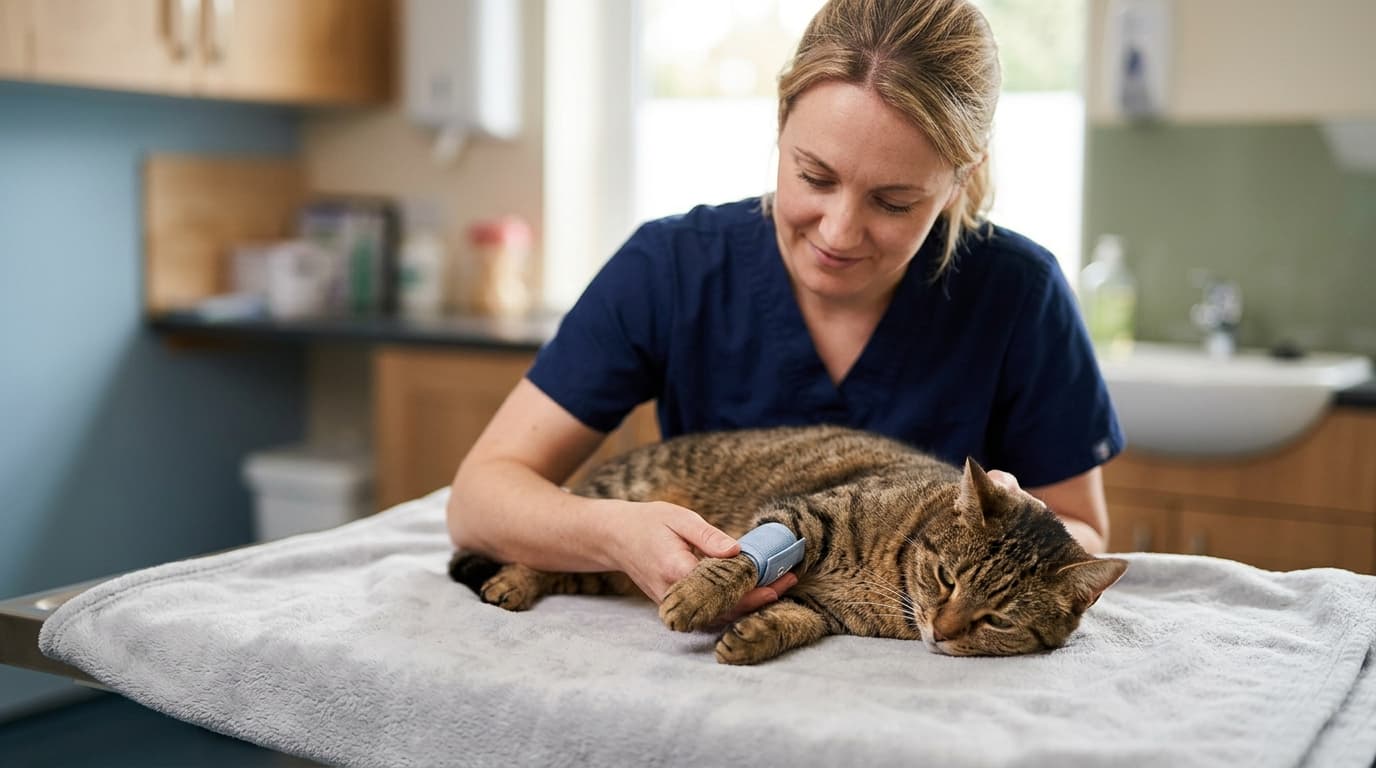
High Blood Pressure and Kidney Disease: The Silent Risk
Alastair Greenway
BVM&S MRCVS
High blood pressure travels alongside kidney disease far more often than most owners realise, and it is dangerous for one particular, unsettling reason: it is silent. There is usually nothing to see and no symptom to notice, right up until something breaks, and in pets the first visible sign can be sudden blindness. That is a frightening prospect, and the risk is real, but the other half of the story is reassuring. High blood pressure is straightforward to measure and very treatable. This guide explains why kidney disease and high blood pressure go hand in hand, the numbers that define the risk, the medicines that bring it down, and why every pet with kidney disease deserves to have its blood pressure checked, and rechecked.
The single practical message is this: if your pet has kidney disease and has not had its blood pressure measured, that is worth asking about. It is a quick, painless check, and it can catch a hidden, treatable danger before it does any harm.
How the kidneys and blood pressure connect
Kidney disease and high blood pressure, which vets call hypertension, are closely connected, and the link runs in both directions. The kidneys play a central role in regulating blood pressure, through their control of fluid balance and the hormone systems that govern the tension in blood vessels. So when the kidneys are damaged, that regulation can go awry and blood pressure can climb.
The trouble is that it then becomes a vicious circle. High blood pressure damages the delicate filtering structures of the kidneys, which worsens the kidney disease, which in turn pushes the blood pressure higher still. Each problem feeds the other, which is exactly why breaking the cycle, by bringing the pressure down, matters so much. It is also why hypertension turns up so commonly in pets with kidney disease rather than as a rare complication: the two are mechanistically tied together, and finding one should always prompt a look for the other.
A danger you can't see
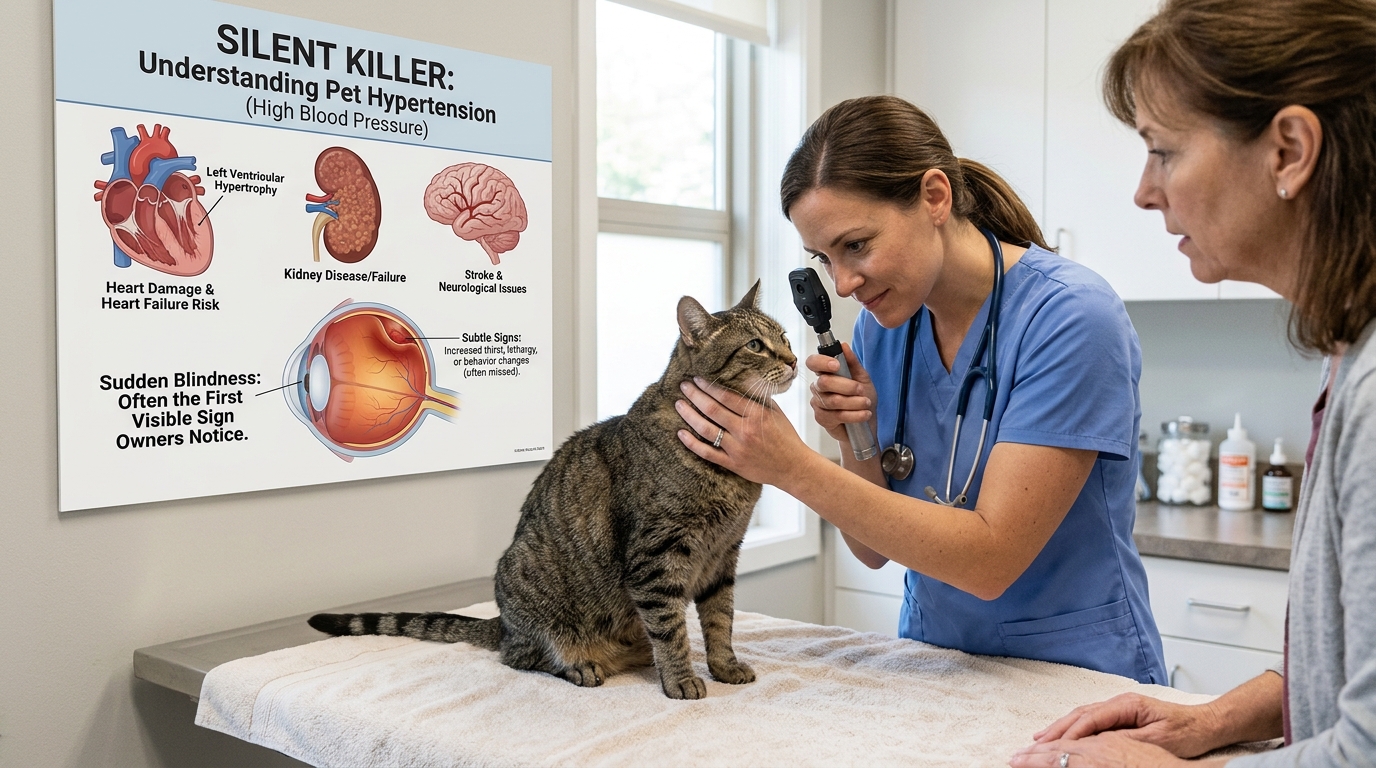
Hypertension is so insidious because it does its damage quietly, to the organs with the richest blood supply, long before you would know anything was wrong. Vets call this target-organ damage, and it is worth understanding what is at stake.
The eyes are especially vulnerable. Persistently high pressure can cause bleeding within the eye or detach the retina, and the result can be sudden, sometimes permanent, blindness, an owner waking to find their pet has lost its sight overnight, with no prior warning. The brain can be affected too, producing neurological signs. The heart can thicken its walls in response to pumping against the higher pressure. And the kidneys themselves, as we have seen, are damaged further. The unifying, unsettling feature is that all of this can be silent until something gives way. There is no cough, no obvious distress, no signal you could reasonably be expected to spot at home, which is precisely why measuring blood pressure matters: it is the only way to catch the danger before it announces itself through harm.
What the numbers mean
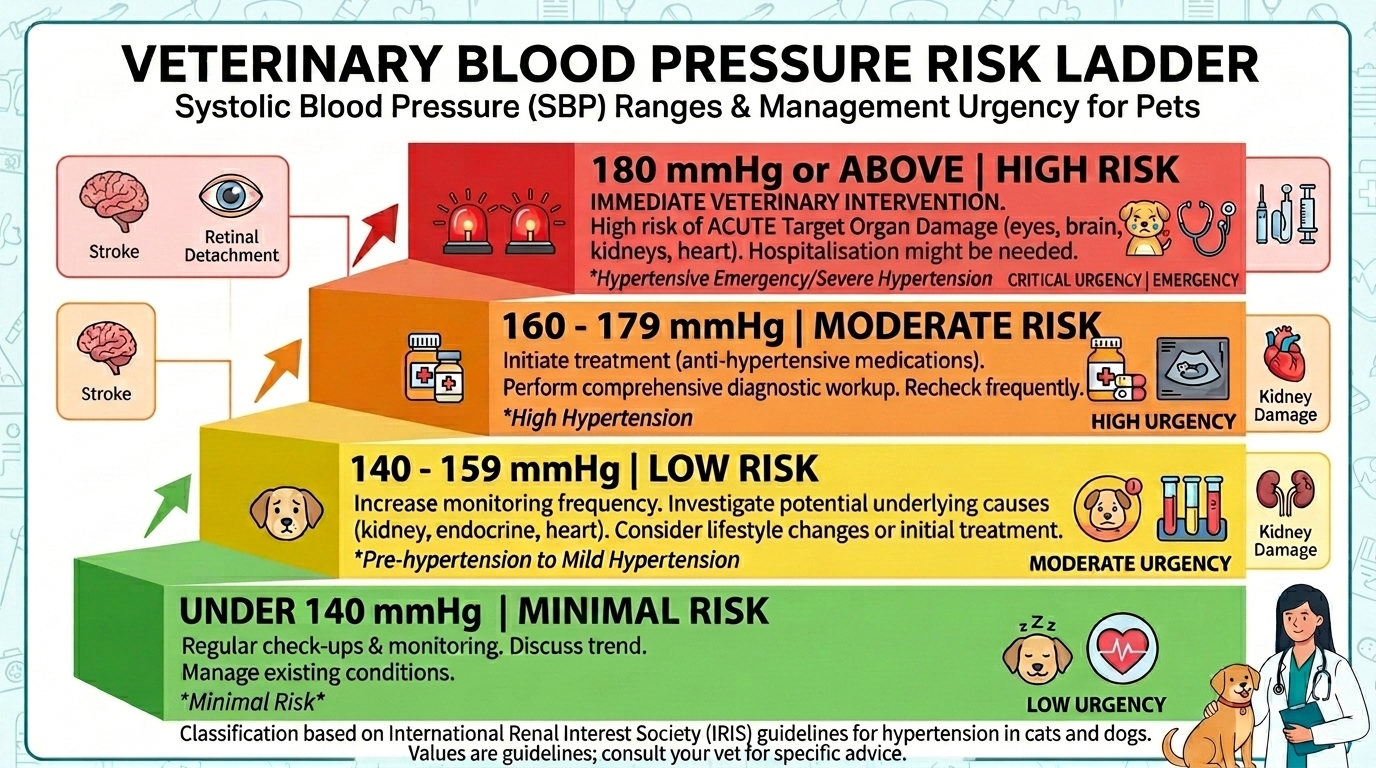
Blood pressure is measured as a systolic figure, in millimetres of mercury, written mmHg, and vets sort the readings into risk categories that tell them how urgently to act. These categories are well established, and they are worth knowing.
A systolic blood pressure under 140 is considered normotensive, carrying minimal risk. From 140 to 159 is prehypertensive, a low risk. From 160 to 179 is hypertensive, a moderate risk. And 180 or above is severely hypertensive, a high risk of damage to those vulnerable organs. The reason 160 is such an important threshold is that it is around this level that the risk of target-organ damage becomes significant, which is why persistently sitting at or above it prompts treatment.
One crucial caveat goes with all of these numbers: a single reading, especially a single high one, is not enough to act on, because of what is sometimes called the white-coat effect. A pet that is anxious at the vet can have a temporarily raised blood pressure purely from stress, just as people do, so a stressed reading does not necessarily reflect the true resting pressure. For this reason, vets take several readings, in as calm a setting as possible, and use the average, and they will repeat the measurement on another occasion before diagnosing hypertension off a borderline result. So if your pet records one high reading, it is a prompt to look more closely, not an immediate diagnosis.
What happens at the measurement
Measuring a pet's blood pressure is painless and quick, and knowing what to expect helps. It is done much as it is in people, with an inflatable cuff placed around a limb or the tail, using either a Doppler device, which detects blood flow with an audible signal, or an oscillometric machine that reads it automatically.
The key to a meaningful reading is calm, because, as we have seen, stress inflates the number. A good practice will let your pet settle first, keep the environment quiet, often have you present, and take a series of readings to average out the noise. A single stressed reading is repeated rather than trusted. The practical recommendation that flows from all this is simple: blood pressure should be measured when kidney disease is first diagnosed, and then monitored over time as part of routine kidney care, because it can develop or worsen as the disease progresses. If it has not been checked, it is entirely reasonable to ask for it.
Bringing the pressure down
Here is the genuinely good news: hypertension is very treatable, with medication that is usually well tolerated and that works. The approach does differ between cats and dogs, though, so it is worth being clear about each.
In cats, the first-line treatment is usually amlodipine, a medicine that relaxes and widens the blood vessels, and which is well evidenced and effective in cats specifically. An alternative first-line option is telmisartan, which is licensed for use in cats and works on one of the hormone systems that raises blood pressure. Either can be chosen to start, and the need for more than one medication in cats is relatively uncommon, though some cats do need a second agent added.
In dogs, the approach is typically different. Here the medicines that act on the renin-angiotensin hormone system, the ACE inhibitors and the related angiotensin receptor blockers, are often chosen first, partly because many hypertensive dogs also have protein loss through the kidneys, and these drugs help with that too. If the pressure is not adequately controlled, amlodipine is commonly added. So while cats often start with amlodipine and dogs often start with a hormone-system drug, the goal is the same.
And that goal is worth stating: treatment aims to bring the systolic pressure down below the level at which organ damage occurs, generally below 160 and ideally comfortably so, while taking care not to drop it too low. The encouraging reality is that, with the right medication, most pets' blood pressure can be brought into a safe range and kept there, removing that silent threat to their eyes, brain, heart, and kidneys.
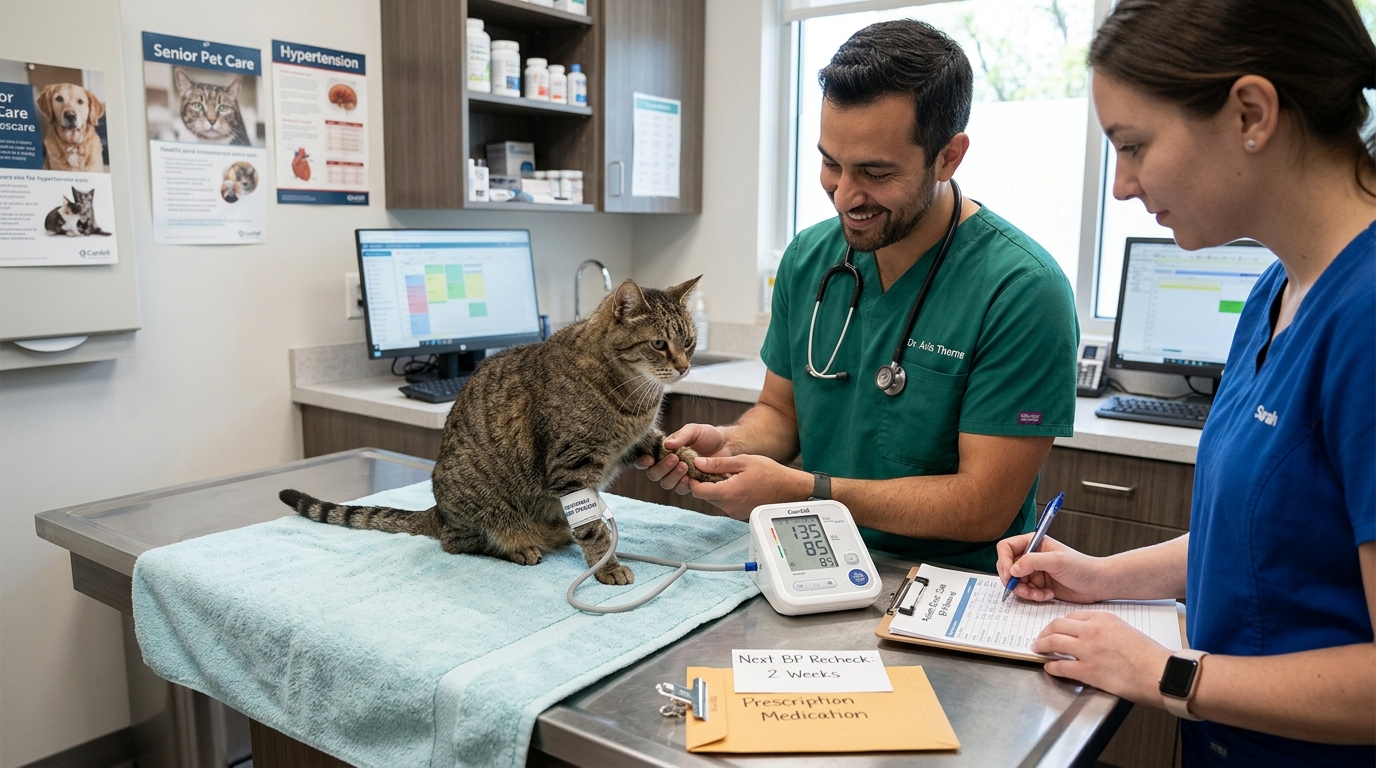
Because the dose is matched to the reading, a recheck after starting treatment is an essential part of the plan, not an optional extra. Your vet will re-measure the blood pressure a couple of weeks after starting or changing a medication, to confirm it has come down enough and to adjust the dose if needed, and then continue to monitor it over time. This is the same measure-and-adjust rhythm that runs through all of kidney care: a reading taken, a treatment given, the reading rechecked, the dose fine-tuned to what the number shows.
The one thing to ask for
The one concrete thing to act on is this: every pet with kidney disease should have its blood pressure checked, and rechecked over time. Hypertension is common in kidney disease, it is dangerous precisely because it gives no warning until it causes harm such as sudden blindness, and it is both easy to measure and very treatable. Those facts together make the case overwhelming.
So when your pet next sees the vet for their kidney disease, ask whether their blood pressure has been measured and when it is next due to be checked. If it has not been done, request it; if it has, ask what the reading was and whether it needs watching. It is a painless check that takes a few minutes, and it can be the difference between catching a silent danger in good time and discovering it only after it has stolen your pet's sight. For a problem this treatable, that check is one of the easiest and most valuable things you can ask for.
References
- Acierno MJ, Brown S, Coleman AE, et al. ACVIM consensus statement: Guidelines for the identification, evaluation, and management of systemic hypertension in dogs and cats. Journal of Veterinary Internal Medicine, 2018.
- International Renal Interest Society (IRIS). IRIS Staging of CKD (modified 2023).
- Sparkes AH, Caney S, Chalhoub S, et al. ISFM Consensus Guidelines on the Diagnosis and Management of Feline Chronic Kidney Disease. Journal of Feline Medicine and Surgery, 2016.
- Jacob F, Polzin DJ, Osborne CA, et al. Association between initial systolic blood pressure and risk of developing a uremic crisis or of dying in dogs with chronic renal failure. Journal of the American Veterinary Medical Association, 2003.
Free downloads
Companion worksheets to put what you've read into practice. Free PDFs, print at home.
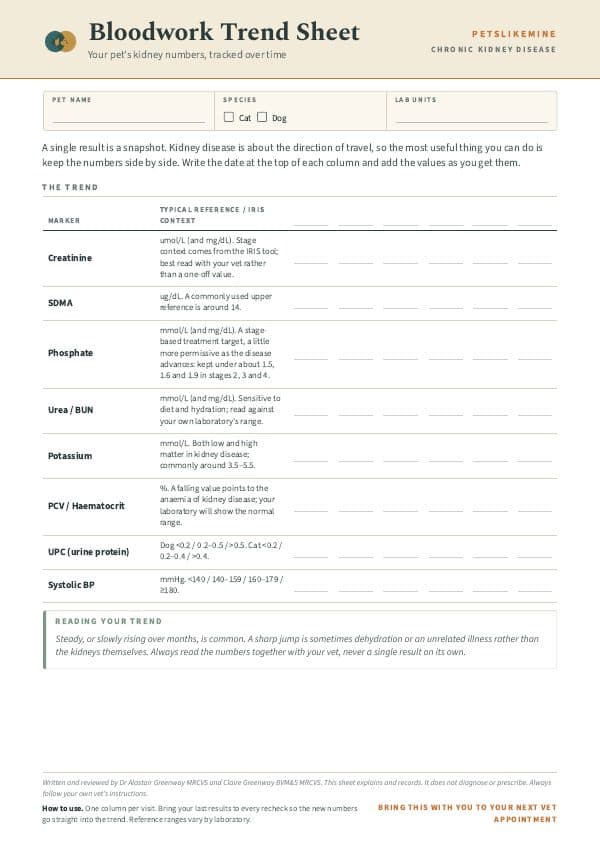
See where your pet stands today
Tracking is the other half of managing kidney disease. Drop in the latest bloods to see the IRIS stage, then follow the trend as treatment settles in.
Check the IRIS stageYou're not doing this alone
Compare treatment journeys and talk to owners managing kidney disease. Free to join.
Join PetsLikeMine