


What CKD Care Actually Costs in the UK: An Honest Breakdown
Alastair Greenway
BVM&S MRCVS
Money is part of the picture with kidney disease, a real and often heavy part, and almost nobody talks about it openly. Owners are left to discover the costs piecemeal, at the worst moments, with no sense of what the year ahead might hold. That silence helps no one, so this guide does the opposite. It lays out realistic UK ranges for what caring for a kidney patient actually costs, so you can plan rather than panic, and decide where each pound does the most good. There is no judgement here. Budgets are real, every household's is different, and knowing the figures in advance is what lets you make calm, informed choices for your pet rather than frightened ones.
One caveat matters before any numbers. Every figure in this article is an illustrative ballpark, not a quote. Prices vary considerably by region, by practice, and by the size of your pet, and they change over time. Treat the ranges here as a planning guide to set expectations, and always ask your own practice for their actual prices for your pet. With that firmly in mind, let us talk real money.
First, a note on ranges
Veterinary pricing in the UK is not standardised, so two practices a few miles apart can charge quite differently for the same thing, and a treatment that costs one amount for a small cat can cost more for a large dog who needs bigger doses and bigger food bags. City practices often charge more than rural ones, and referral and out-of-hours care more than routine daytime care. So the ranges below are deliberately broad. They are there to give you a realistic sense of the shape of the costs, what is a small monthly expense and what is a big occasional one, rather than a precise total. Your own vet is the only source of an accurate figure for your pet, and asking them for one, openly, is entirely reasonable. Use these numbers to plan and to prioritise, not as a bill to expect.
Food and the renal diet
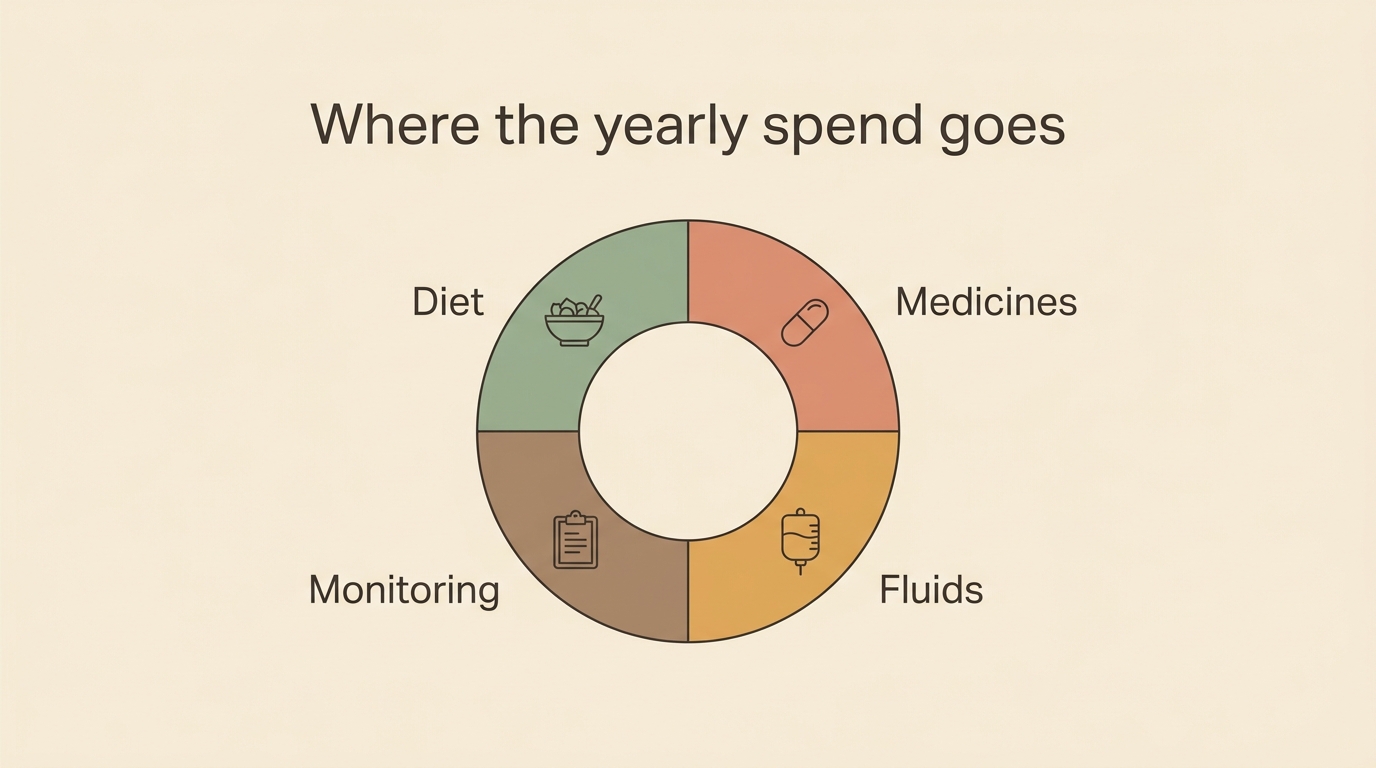
The renal diet is the foundation of treatment and, happily, one of the more predictable costs. As a rough monthly guide, a prescription renal diet typically costs somewhere in the region of twenty to fifty pounds a month for a cat, and more for a dog, scaling up with the dog's size, since a large dog eats considerably more than a small one. Wet and dry forms differ in price, and feeding a mix, or all wet for the hydration benefit our renal-diet guide describes, affects the total. The reassuring part is that this is a steady, plannable expense rather than a nasty surprise, and because the diet is the single most evidence-backed thing you can do, it is also money very well spent. Buying in larger quantities, where your pet's preference is settled and storage allows, can reduce the per-meal cost.
Medication
Medication costs depend entirely on what your pet needs, which varies with their stage and their particular problems, so not every pet incurs every cost. As a sense of the monthly ranges, phosphate binders, the kidney-protecting drugs such as telmisartan or benazepril, and a blood-pressure medicine like amlodipine each typically run from a few pounds to twenty or thirty pounds a month, and the comfort medicines, an anti-nausea drug such as maropitant or an appetite stimulant such as mirtazapine, add similar amounts when they are needed. A pet on several of these at once will naturally cost more than one managed on diet alone. One genuinely useful way to control this cost, discussed more below, is to ask whether generic versions are available and whether a written prescription to fill at an online pharmacy would be cheaper, both of which can meaningfully reduce the monthly medicine bill. Our guides to each treatment explain what these medicines do. The point here is simply that they are mostly modest monthly costs individually, which add up according to how many your pet needs.
Subcutaneous fluids
If your pet reaches the stage of needing fluids under the skin, as our subcutaneous-fluids guide describes, there is an initial outlay for the starter kit and then a modest ongoing cost. The setup, the first bags of fluid, the giving lines, and the needles, is a one-off cost to get going, after which the recurring expense is the fluid bags, lines, and needles you use, which is generally a relatively low monthly amount. An important practical point that affects the cost is what your practice supplies versus what you source. Some items are obtained through your vet as prescription supplies, and your practice can advise on the most economical way to keep stocked. Compared with many of the other costs, ongoing fluids are usually one of the smaller recurring lines once you are set up, which is worth knowing if the idea of them feels financially daunting.
Regular monitoring
The regular rechecks our monitoring guide explains are a real and recurring cost, and an easy one to underestimate because it is spread across the year. Each monitoring visit, with its blood tests, urine tests, and blood pressure check, typically costs somewhere from several tens of pounds to over a hundred, depending on exactly what is run and where, and the annual total depends on how often your pet is seen, which, as the monitoring guide explains, depends on their stage. A stable early-stage pet checked a couple of times a year costs far less in monitoring than an advanced pet needing frequent visits. It is worth budgeting for monitoring specifically, because it is the cost owners most often forget and then find stressful, and because keeping it up is exactly what protects all your other investment in your pet's care by catching problems early. Plan it into the year from the start, and it stops being a surprise.
The big, occasional costs
Beyond the predictable monthly and per-visit costs sit the occasional big ones, and these are the spikes worth keeping a financial buffer for. If your pet has a crisis, the kind our acute-on-chronic guide describes, a hospital stay with intravenous fluids and intensive treatment can run into several hundred pounds or more, and a referral to a specialist, if it is ever needed, adds significantly too. These are not monthly costs, and many pets go long stretches without one, but they do happen, and they are the reason to hold some financial buffer or, far better, to have insurance in place, which brings us to the single most important money topic in kidney disease.
Insurance, the hard truth
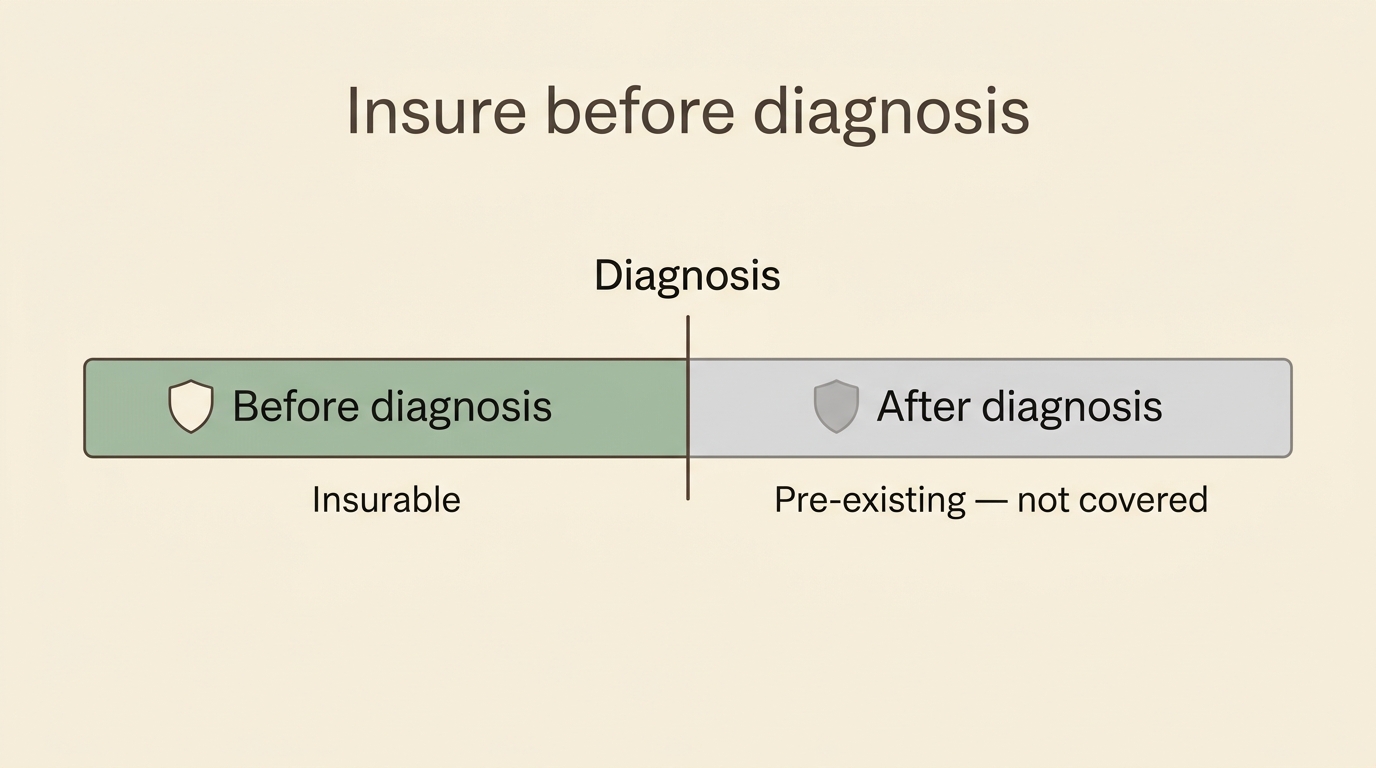
Here is the central, and for many owners painful, truth about insuring a pet with kidney disease, and it is worth understanding clearly. Once kidney disease has been diagnosed, it becomes a pre-existing condition, and standard pet insurance policies exclude pre-existing conditions, which means you generally cannot insure a pet against a kidney problem it has already been diagnosed with. The implication is stark but important. The time that insurance matters is before diagnosis, while a pet is young and healthy, which is exactly why vets so often urge owners to insure early.
If you do hold insurance from before your pet's diagnosis, the type of policy matters enormously. A lifetime policy, which renews its cover for ongoing conditions each year as long as you keep renewing it, is the kind that genuinely supports a chronic disease like kidney disease over the years, whereas annual, time-limited, or maximum-benefit policies typically stop covering a condition after twelve months or once a per-condition cap is reached, leaving you to fund it thereafter. So if you have a policy, the thing to check is whether it is a lifetime policy and what its annual and per-condition limits are. There are a small number of specialist insurers who may cover a condition after a long symptom-free period, but for an active kidney diagnosis the realistic position is that the disease itself will usually not be covered unless you were already insured under a suitable policy. This is hard news for those hearing it after diagnosis, and the useful takeaway is twofold: insure future pets early, and, if you have a policy now, understand exactly what it covers before you need it.
Making it affordable
If the costs feel daunting, and for many households they genuinely are, there are real ways to make caring for a kidney patient more affordable, and using them is sensible, not second-best. Several are worth knowing.
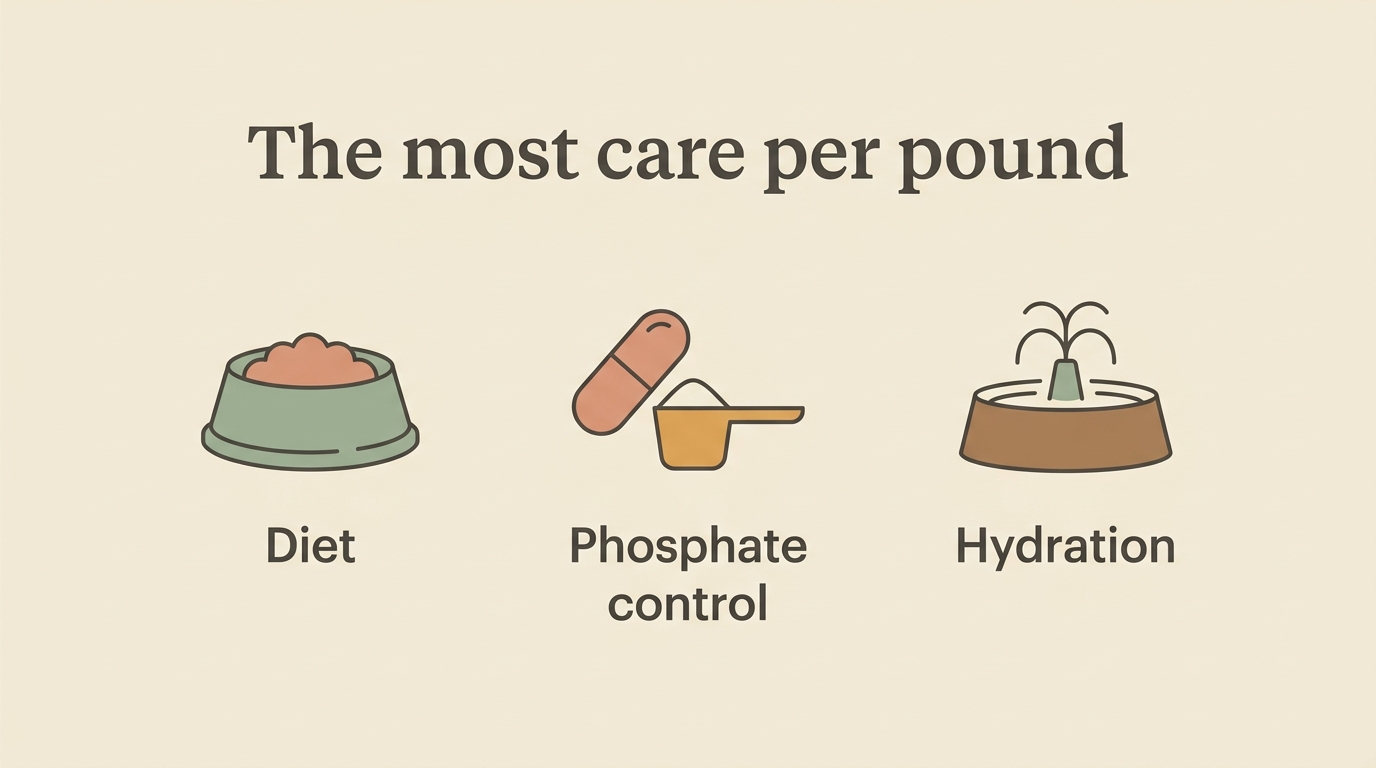
Ask your vet about generic versions of medicines, which can cost considerably less than branded ones, and about getting a written prescription to fill at a registered online pharmacy, which is often cheaper for ongoing medication. Buy the diet in larger quantities once your pet's preference is settled, to lower the per-meal cost. Use our UK Cost Planner download to map out the year's likely costs and spread them in your budget rather than meeting them as shocks. If you are on a low income and receive qualifying means-tested benefits, the major veterinary charities, the PDSA, Blue Cross, and RSPCA, may be able to help with costs, though their help is tied to eligibility criteria and to local capacity, so it is worth checking your eligibility and contacting your local service directly. Ask your own practice too whether they offer payment plans or a health-care plan that spreads routine costs. And, when the budget is genuinely tight, prioritise the spending that does the most good, which our whole space points to: the renal diet, phosphate control, and good hydration are the highest-value, most evidence-backed interventions, so if choices have to be made, these are the ones to protect first, in discussion with your vet.
So, to turn all of this into something you can act on rather than worry about: the costs of kidney care are a mix of steady monthly expenses, the diet, the medicines, perhaps fluids, regular monitoring visits across the year, and the occasional big spike of a crisis, and while the totals are real, they become far less frightening once you can see their shape and plan for them. Use our UK Cost Planner to budget the year ahead, ask your own practice for their actual prices and about every way to bring them down, and, if money is tight, concentrate it where it does the most good. Caring well for a kidney patient need not mean spending the most. It means spending wisely on the things that genuinely help, and planning calmly for the things that might come.
References
- Veterinary Medicines Directorate (VMD). Product Information Database (UK authorised veterinary medicines).
- International Renal Interest Society (IRIS). IRIS Staging of CKD (2023).
- PDSA. Pet Insurance Guide (pre-existing conditions; lifetime versus time-limited and maximum-benefit policies).
- PDSA. Eligibility for low-cost and free veterinary treatment (means-tested; qualifying benefits).
Sister directory · PetCare Atlas
See what a blood test costs
PetCare Atlas, our sister directory, publishes an indicative UK price range for blood tests. It is a guide for planning. Your own practice gives the real quote.
See blood test prices on PetCare Atlas →See where your pet stands today
Tracking is the other half of managing kidney disease. Drop in the latest bloods to see the IRIS stage, then follow the trend as treatment settles in.
Check the IRIS stageYou're not doing this alone
Compare treatment journeys and talk to owners managing kidney disease. Free to join.
Join PetsLikeMine