


Protein in the Urine: Why the UP/C Ratio Matters, Especially in Dogs
Alastair Greenway
BVM&S MRCVS
Protein in the urine sounds like a minor footnote on a results sheet, and it is anything but. A kidney filter that leaks protein is both a sign that damage has occurred and, it appears, something that helps drive the damage faster. It is also one of the more treatable parts of kidney disease, which is the hopeful flip side. This guide explains what proteinuria means, the simple ratio your vet uses to measure it, and the kidney-protecting medicines, the ACE inhibitors such as benazepril and the angiotensin blocker telmisartan, that reduce the leak. It matters for both species, but it is especially central for dogs, in whom protein-losing kidney disease is a bigger part of the story.
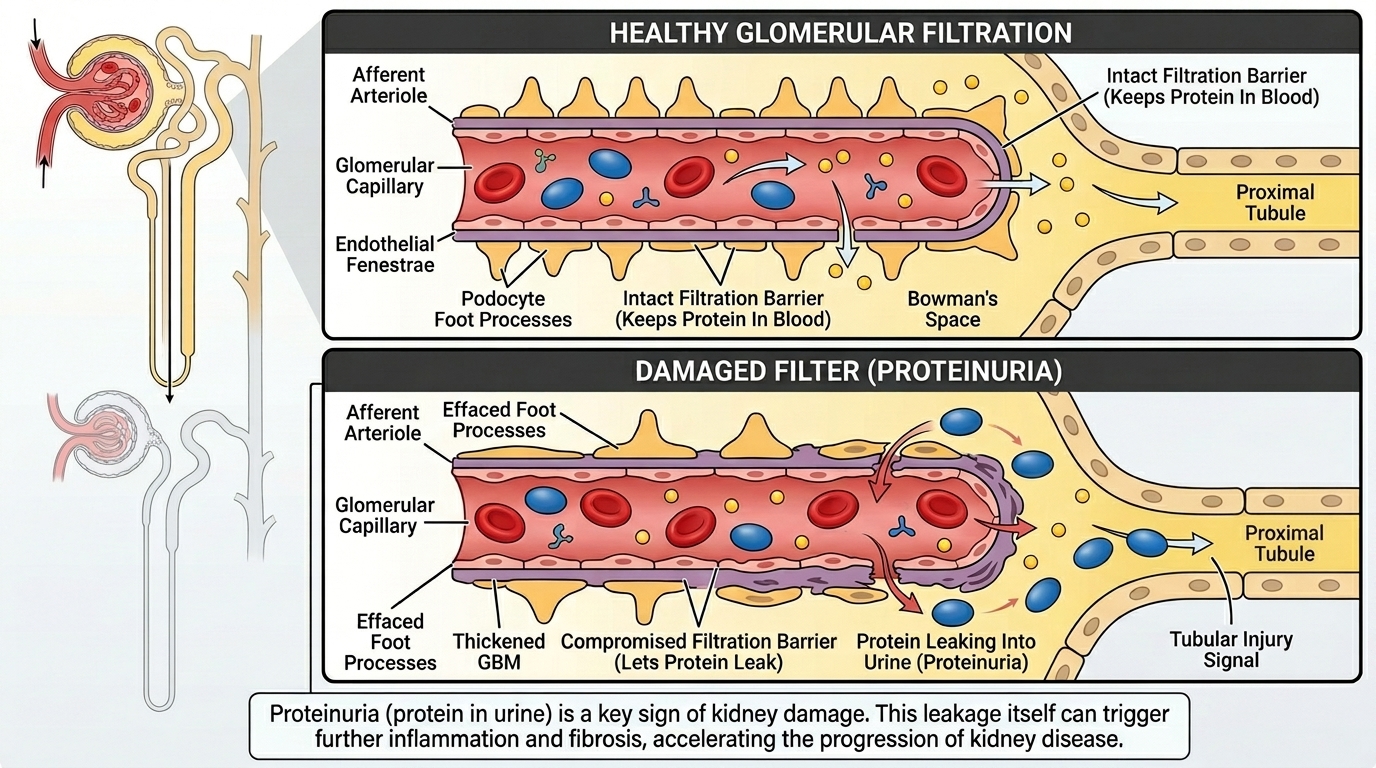
"Just a bit of protein in the urine" undersells it. Think of the kidney's filter as a very fine sieve, designed to let waste and water through into the urine while keeping the larger, valuable protein molecules back in the blood where they belong. When protein starts appearing in the urine, it means that sieve is damaged and letting through what it should retain. That is why it is worth taking seriously, and why it is worth treating.
What protein in the urine means
In a healthy kidney, the filtering membrane holds protein back, so very little ends up in the urine. When the filter is damaged, protein leaks through, and that leak carries two distinct meanings, both important.
First, it is a warning sign: protein in the urine tells us the kidney's filters are damaged, and roughly how badly. Second, and more troubling, the leaking protein itself appears to harm the kidney further. The current understanding is that protein passing through and along the kidney's delicate structures is not a harmless byproduct but something that actively inflames and scars them, accelerating the disease. So proteinuria is both a symptom and a driver, a sign of damage already done and a contributor to damage still to come. That dual role is exactly why vets do not shrug at it: reducing the leak addresses not just a marker but a mechanism, and may slow the disease itself.
Putting a number on it: the UP/C ratio
To know whether protein is being lost, and how much, vets use a urine test called the urine protein-to-creatinine ratio, usually written UP/C or UPC. It is a simple, powerful number: it compares the amount of protein in the urine to the amount of creatinine, which gives a reliable measure of protein loss from a single urine sample, without needing to collect urine over a whole day.
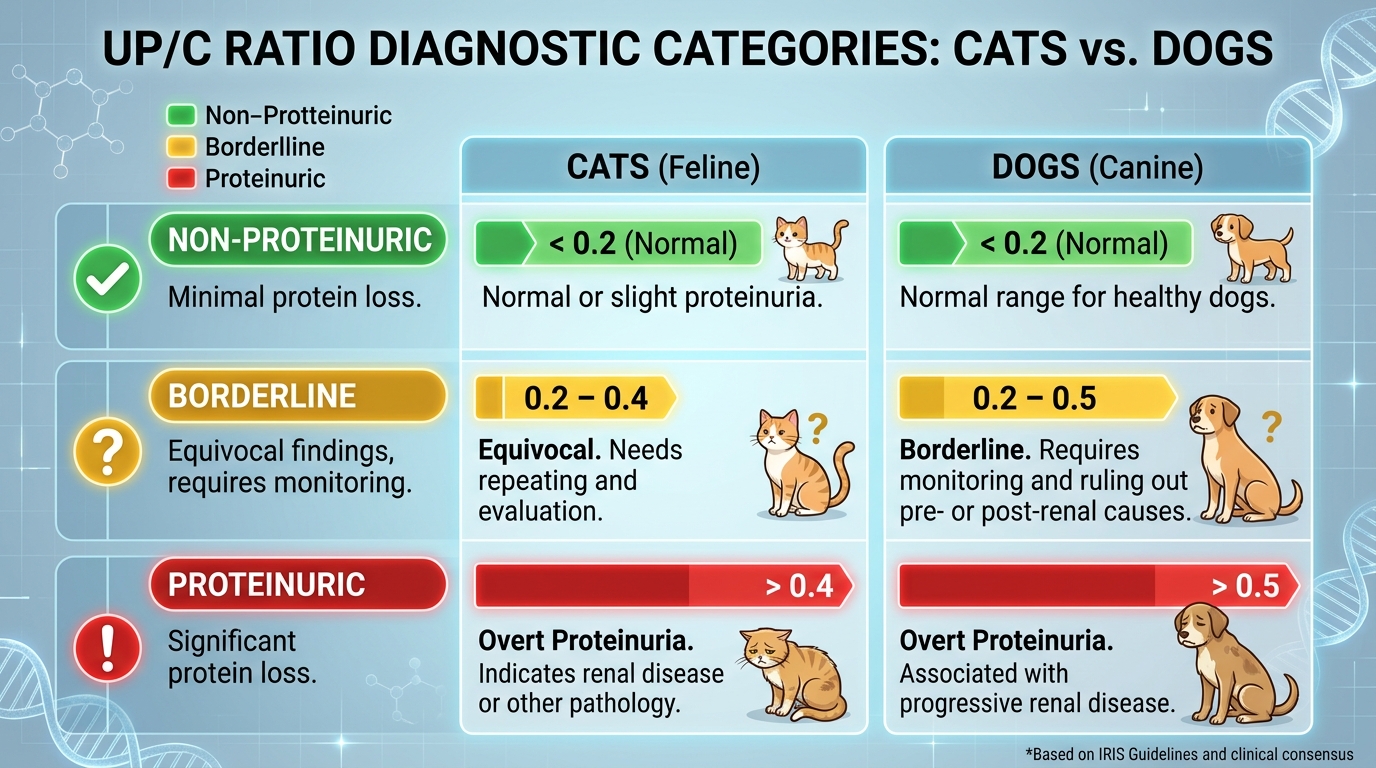
The result sorts a pet into one of three bands, and these thresholds differ slightly between dogs and cats. In dogs, a UP/C below 0.2 is non-proteinuric, 0.2 to 0.5 is borderline proteinuric, and above 0.5 is proteinuric. In cats, the bands are very slightly tighter: below 0.2 is non-proteinuric, 0.2 to 0.4 is borderline, and above 0.4 is proteinuric. A couple of practical points matter for interpreting these. The result should be confirmed on a clean sample and shown to be persistent, not a one-off, because a single reading can be affected by things like a urinary tract infection or blood in the sample, which need ruling out first. And the UP/C is always read alongside the urine concentration and the rest of the picture, rather than in isolation, because context changes its meaning. Your vet will often recheck a borderline result rather than act on it immediately, for exactly these reasons.
Why dogs are the bigger concern
This is where the species difference becomes important, and where the canine kidney story, so often crowded out by cat-focused information, really matters. As our article on the causes of kidney disease explains, dogs more commonly develop the protein-losing forms of kidney disease, where the leak through the filters is the central problem, sometimes grouped under the term protein-losing nephropathy.
There are a few consequences of this. In dogs, proteinuria is a particularly important marker to measure and to act on, because it is so often central to the disease rather than incidental to it, and significant protein loss in dogs is associated with a worse outlook, which is why your vet may treat it more proactively. There is also sometimes a specific, identifiable, and occasionally treatable cause behind heavy protein loss in a dog, which is another reason to investigate it rather than simply note it. None of this means every proteinuric dog faces a grim course, far from it, and I want to be careful not to overstate the gloom. But it does mean that in dogs, the UP/C is a number to watch closely and to treat seriously, and that is a genuine difference from the typical feline picture, where age-related disease without heavy protein loss is more common. For cats, proteinuria still counts, and reducing it still matters, it is simply that in dogs it more often takes centre stage.
The kidney-protecting drugs
Now for the encouraging part: there are medicines that reduce protein loss, and they are a mainstay of treatment for proteinuric kidney disease in both species. They fall into two related groups.
The ACE inhibitors, such as benazepril and enalapril, are the longest-established. Benazepril in particular has been studied in cats with kidney disease and shown to reduce proteinuria, and it is licensed in many countries for treating proteinuria associated with feline kidney disease. The other group is the angiotensin receptor blockers, of which telmisartan is the one you are most likely to encounter; it is licensed for use in cats, including for the proteinuria of kidney disease, and has been shown to reduce protein loss at least as effectively as benazepril.
How do they work, in plain terms? Both groups act on a hormone system, the renin-angiotensin system, that among other things controls the pressure inside the kidney's tiny filters. By easing that internal pressure, these drugs reduce the force driving protein through the damaged filter, so less protein leaks out. In doing so they lower the proteinuria, and the hope and expectation, based on the understanding that protein loss drives damage, is that this also helps protect the kidney over time. They are generally well tolerated, which makes them a practical as well as a logical part of treatment. In dogs with protein loss, these same classes of drug are used, and are an important part of managing canine protein-losing kidney disease.
Starting, checking, adjusting
As with every other lever in kidney care, these drugs are not given and forgotten; they are started, then checked, then adjusted to the response. The logic is straightforward.
After starting a kidney-protecting drug, your vet will recheck the UP/C to confirm that the protein loss is actually coming down, since the falling number is the whole point and the proof the drug is doing its job. They will also keep an eye on the kidney values and the blood potassium after starting, because these drugs act on the kidney's internal workings and those parameters can shift, so a check shortly after starting is part of the plan. The dose may then be adjusted, and as mentioned, a merely borderline result is often monitored and rechecked rather than treated straight away, since not every borderline reading needs medication. The pattern, once again, is measure, treat, recheck, adjust, the same disciplined rhythm that runs through the whole of good kidney management.
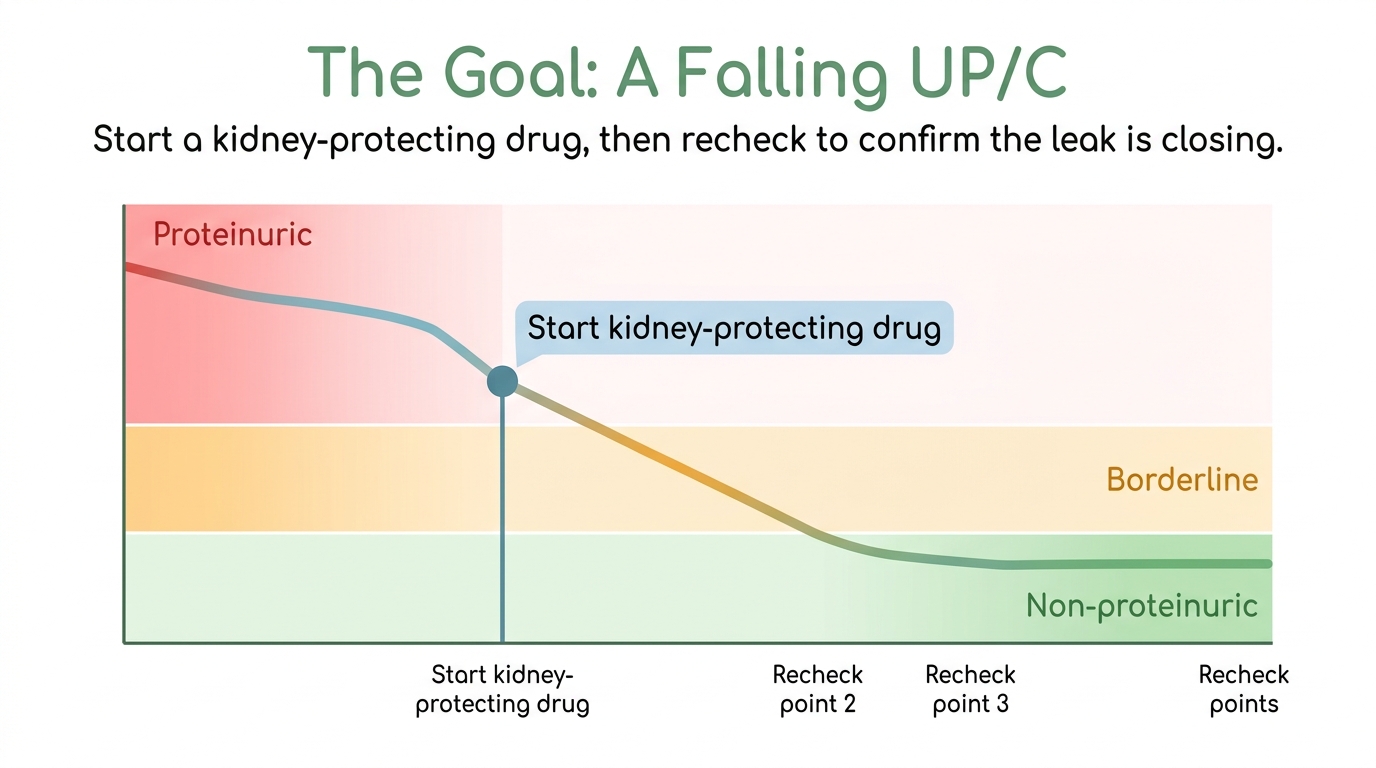
The takeaway from all this is concrete and worth acting on. Protein in the urine is not a trivial footnote; it is both a sign of kidney damage and, it appears, a driver of it, which is why measuring and reducing it matters, especially in dogs, where protein-losing kidney disease is so often central. Encouragingly, it is measurable, with a simple urine ratio, and treatable, with well-tolerated medicines that ease the leak. So if your pet has kidney disease and you have not seen a UP/C among their results, that is worth asking about directly: has my pet's urine been checked for protein, what was the ratio, and if it is raised, should we be doing something about it? For dogs especially, that single question can open the door to one of the most worthwhile parts of treatment.
References
- International Renal Interest Society (IRIS). IRIS Staging of CKD (modified 2023).
- King JN, Gunn-Moore DA, Tasker S, Gleadhill A, Strehlau G; BENRIC (Benazepril in Renal Insufficiency in Cats) Study Group. Tolerability and efficacy of benazepril in cats with chronic kidney disease. Journal of Veterinary Internal Medicine, 2006.
- Syme HM, Markwell PJ, Pfeiffer D, Elliott J. Survival of cats with naturally occurring chronic renal failure is related to severity of proteinuria. Journal of Veterinary Internal Medicine, 2006.
- Sent U, Gössl R, Elliott J, Syme HM, Zimmering T. Comparison of efficacy of long-term oral treatment with telmisartan and benazepril in cats with chronic kidney disease. Journal of Veterinary Internal Medicine, 2015.
- Jacob F, Polzin DJ, Osborne CA, et al. Evaluation of the association between initial proteinuria and morbidity rate or death in dogs with naturally occurring chronic renal failure. Journal of the American Veterinary Medical Association, 2005.
- Lourenço BN, Coleman AE, Brown SA, et al. Efficacy of telmisartan for the treatment of persistent renal proteinuria in dogs: a double-masked, randomized clinical trial. Journal of Veterinary Internal Medicine, 2020.
Free downloads
Companion worksheets to put what you've read into practice. Free PDFs, print at home.
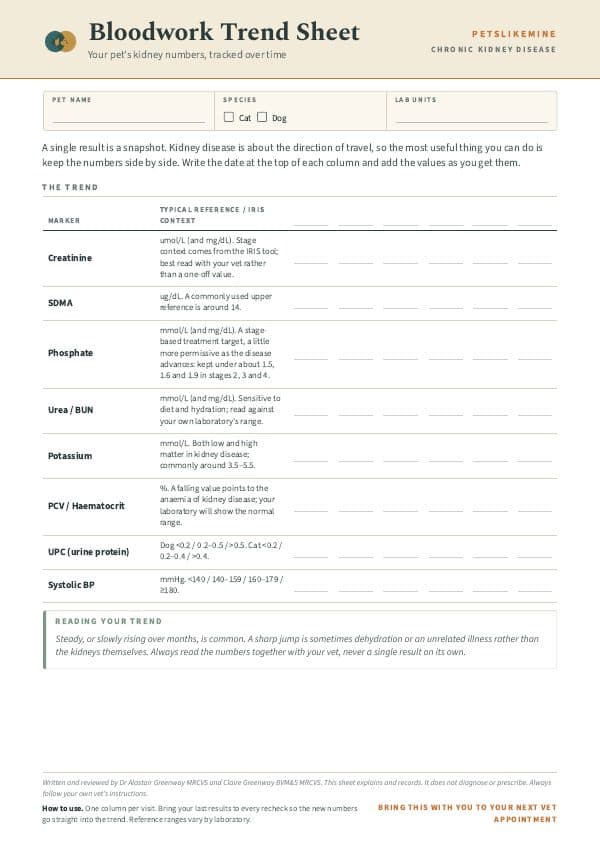
See where your pet stands today
Tracking is the other half of managing kidney disease. Drop in the latest bloods to see the IRIS stage, then follow the trend as treatment settles in.
Check the IRIS stageYou're not doing this alone
Compare treatment journeys and talk to owners managing kidney disease. Free to join.
Join PetsLikeMine