


Chronic Kidney Disease in Cats: What Every Owner Needs to Know
Alastair Greenway
BVM&S MRCVS
A diagnosis of chronic kidney disease is not the end of your cat's good life. That needs saying first, because the word "kidney" lands heavily and the internet fills in the rest. The disease is usually not curable, and there is no point pretending otherwise, but it is one of the most manageable serious conditions a cat can have. A great many cats go on to live well, and happily, for years after the words are first spoken.
I am not going to pretend the disease away or promise things that are not true. What I will show you is that there is a great deal that can be done, much of it within your control, and that "kidney disease" is a diagnosis to manage rather than a sentence to dread. Let us walk through it together.
Sitting with the news
The fear that comes with this diagnosis is real, and it usually has a particular shape. The word "kidney" sounds final, the internet is full of frightening worst cases, and your cat may seem barely any different from yesterday, which makes it all feel unreal. The fact that you are here, learning, means your cat already has the thing that matters most, an owner paying attention.
Chronic kidney disease in cats is common, it is gradual, and it is manageable. Unlike many serious diagnoses, it usually progresses slowly, over months and years rather than days, and that slowness is your ally: it gives you time to act, to adjust, and to give your cat many more good days. The goal of management is not to cure the kidneys, which we cannot do, but to slow the disease, ease its effects, and keep your cat comfortable and happy for as long as possible. At that, modern veterinary medicine is genuinely good.
What the kidneys do, and what "chronic" means
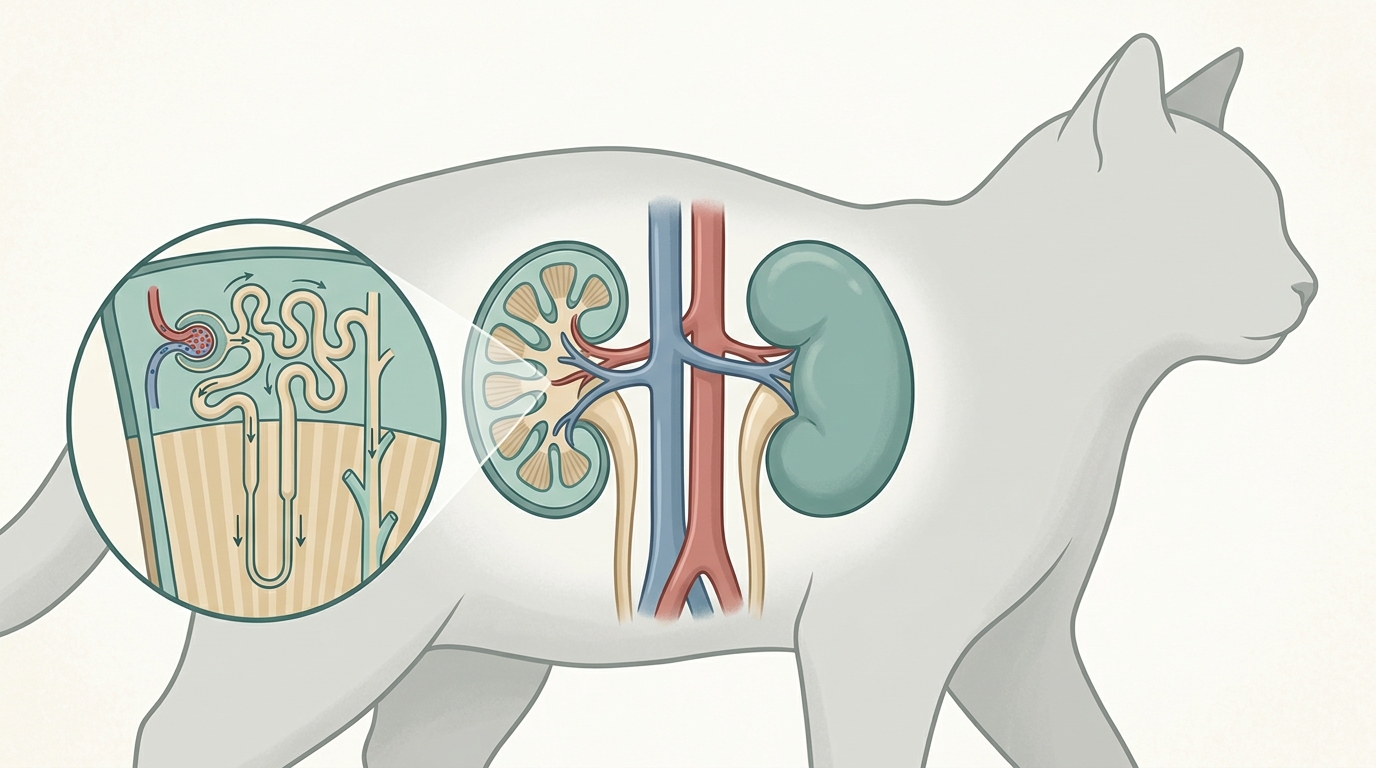
To understand the disease, it helps to understand the organ. The kidneys are quietly among the hardest-working organs in the body. They filter waste products out of the blood and pass them into the urine; they manage the body's water balance and concentrate the urine; they help regulate blood pressure; they keep the body's salts and minerals in balance; and they send a signal that tells the body to make red blood cells. When the kidneys struggle, all of those jobs are affected, which is why kidney disease causes such a wide range of effects.
The work is done by around a million tiny filtering units in each kidney, called nephrons. The crucial thing to understand about "chronic" kidney disease is that these nephrons are lost gradually and permanently; they do not grow back. As some are lost, the remaining ones work harder to compensate, and this is why cats hide the disease so well for so long: by the time the outward signs appear, a cat has often already lost a large proportion of kidney function, because the survivors masked the loss until they could no longer keep up. This is not a failing of your attention. It is simply the nature of the disease, and it is exactly why the early detection we will come to matters so much.
How common it really is
If this diagnosis makes you feel singled out, it should not, because chronic kidney disease is one of the most common conditions of older cats. Its frequency climbs steeply with age, and when researchers screen groups of cats for it, they tend to find it more often than people expect: in one study, around half of a randomly selected group of cats were found to have some degree of chronic kidney disease, and among older cats being assessed for arthritis the figure was higher still, at nearly seven in ten. In other words, if you have an older cat, this is among the conditions they are most likely to face, and vets see and manage it every single day. You are in very large company, and that means the path ahead is extremely well trodden.
Why cats hide it, and the signs owners do notice
Cats are masters at concealing illness, and because kidney disease comes on slowly, its early signs are easily mistaken for ordinary ageing. Knowing what to look for helps you catch changes early and monitor your cat well.
The signs owners most often notice are increased drinking and increased urination, often the earliest outward clue, as failing kidneys can no longer concentrate the urine, so the cat loses more water and drinks more to keep up. You may find yourself refilling the water bowl more often, or noticing larger clumps in the litter tray. Alongside that, owners commonly see gradual weight loss, a reduced or unusually fussy appetite, a duller or more unkempt coat as the cat grooms less, occasional vomiting, and sometimes bad breath with an unpleasant, almost chemical edge. None of these is dramatic, and any one of them is easy to put down to "he's just getting old," which is precisely why kidney disease is so often caught later than it could be. If you have noticed any of these in your cat, you were right to take it seriously.
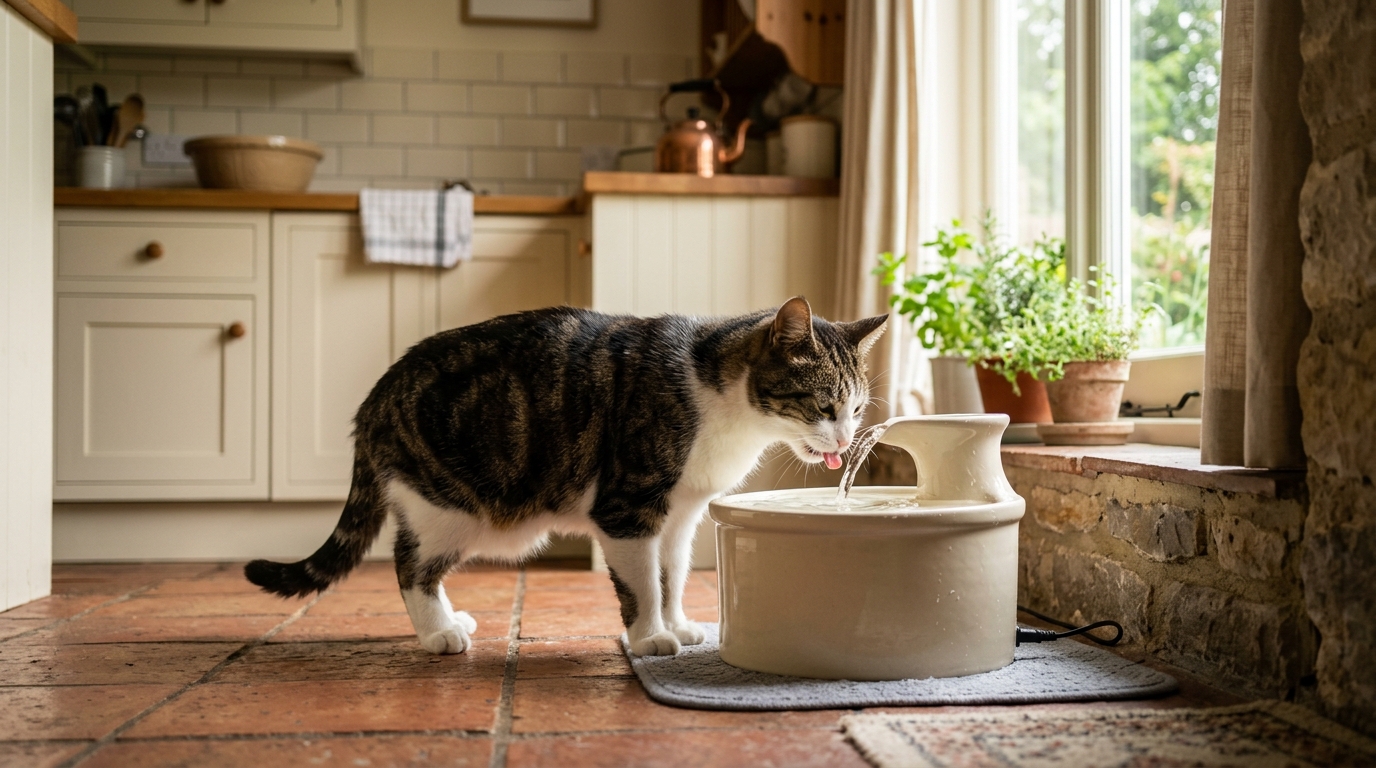
A vital practical point: never restrict your cat's water to manage the increased drinking. The extra thirst is the body compensating, and fresh water should always be freely available.
Getting to a diagnosis
Diagnosis is made from blood and urine tests rather than a single result, and I will keep this brief here, since we cover it fully in our dedicated article on diagnosis. Your vet will typically look at blood markers of kidney function, chiefly creatinine, a newer marker called SDMA, and urea; at how concentrated the urine is, its specific gravity; and at blood pressure, since high blood pressure often accompanies kidney disease.

One development worth understanding, because it is genuinely good news, is SDMA. This blood marker can flag kidney disease earlier than creatinine can. Creatinine tends not to rise until a cat has lost around three quarters of kidney function, whereas SDMA can pick up trouble when roughly 40 percent of function is lost. In one longitudinal study, SDMA rose above normal on average around 17 months before creatinine did. SDMA is also less affected by a cat's muscle mass, which matters in thin older cats whose creatinine can read deceptively low. Earlier detection means earlier action, when management does the most good.
What the stages mean
You may hear your vet refer to your cat's kidney disease by a stage. Vets use a system from the International Renal Interest Society, or IRIS, which grades the disease from stage 1, the earliest and mildest, through to stage 4, the most advanced, based mainly on blood markers measured when the cat is stable and well hydrated. The stage is then sub-staged according to how much protein is leaking into the urine and what the blood pressure is doing. We explain the stages and what each means for day-to-day life in our dedicated staging article; for now, the useful point is that the stage helps your vet tailor treatment and monitoring to exactly where your cat is, and that many cats are diagnosed at earlier stages where there is the most to gain.
What can actually be done
There is a real, evidence-backed toolkit for managing feline kidney disease, and the biggest single lever is one you control directly: diet.
A prescription renal diet, one specially modified for kidney disease, has the strongest evidence of anything in CKD management for extending good-quality life, and the evidence is genuinely striking. In a carefully conducted randomised trial, cats with stage 2 to 3 kidney disease fed a renal diet had no uraemic crises and no kidney-related deaths over the two-year study, while a quarter of the cats on a normal diet had a uraemic crisis and around one in five died of kidney-related causes. In another study, cats on a renal diet lived a median of 633 days compared with 264 days for cats on a maintenance diet, more than doubling median survival. Few interventions in any disease show numbers like that, and this is something you can do at the food bowl. We devote a whole article to the renal diet, because it matters this much.
Diet leads, but it does not work alone. The rest of the toolkit includes controlling phosphate, often through the diet and sometimes with phosphate binders, since phosphate control is closely tied both to survival and to how well a cat feels; managing blood pressure, which is common in kidney disease and can be treated; supporting hydration, sometimes including fluids given under the skin at home in more advanced cases, which we cover in its own beginner's guide; and comfort medications to manage nausea, protect the appetite, and treat anaemia where it develops. Each piece is aimed at the same goal: slowing the disease and keeping your cat feeling well. Not every cat needs every element, and your vet will build the plan around your individual cat and stage.
What to expect
Let me be straight about the trajectory. Chronic kidney disease usually progresses over time, and it cannot be reversed. But "progresses over time" is the important phrase: for many cats this unfolds slowly, over months and often years, and good management can meaningfully slow it and keep quality of life high along the way. Many cats diagnosed at an earlier stage live for years of comfortable life with diet and monitoring.
Monitoring is the quiet engine of all this. Regular rechecks let your vet see how the disease is behaving and adjust the plan before problems take hold, which is far better than reacting to crises. The rhythm of management becomes a steady, manageable routine rather than a constant emergency. And yes, there is a further part of the journey, the point much later when the question becomes one of comfort and quality of life above all, which we handle gently and fully in our long-view content for when, and only when, you need it. That is for the future. The work now is the hopeful work of managing well.
Your first week
Here are concrete next steps for the days right after diagnosis.
First, make sure you understand your cat's stage and their key numbers, the creatinine, SDMA, and phosphate, and ask your vet to write them down, so you have a baseline to measure against. Second, talk to your vet about starting the transition to a prescription renal diet, since this is the highest-impact thing you can begin, and ask specifically how to introduce it slowly so your cat actually accepts it; our renal-diet article walks through this. Third, make sure fresh water is freely and easily available around the home, ideally in several places, and consider a pet water fountain, as many cats drink more from running water. Fourth, agree a monitoring plan with your vet, when the next recheck should be and what it will involve, so the road ahead has a clear shape.
Do those four things in the first week and you have a clear baseline, a diet plan underway, and a monitoring schedule agreed with your vet. Chronic kidney disease asks a lot of an owner, but with attentive care, most cats with this diagnosis have many good days still ahead of them.
References
- Marino CL, Lascelles BDX, Vaden SL, Gruen ME, Marks SL. Prevalence and classification of chronic kidney disease in cats randomly selected from four age groups and in cats recruited for degenerative joint disease studies. Journal of Feline Medicine and Surgery, 2014.
- Hall JA, Yerramilli M, Obare E, Yerramilli M, Jewell DE. Comparison of serum concentrations of symmetric dimethylarginine and creatinine as kidney function biomarkers in cats with chronic kidney disease. Journal of Veterinary Internal Medicine, 2014.
- Ross SJ, Osborne CA, Kirk CA, Lowry SR, Koehler LA, Polzin DJ. Clinical evaluation of dietary modification for treatment of spontaneous chronic kidney disease in cats. Journal of the American Veterinary Medical Association, 2006.
- Elliott J, Rawlings JM, Markwell PJ, Barber PJ. Survival of cats with naturally occurring chronic renal failure: effect of dietary management. Journal of Small Animal Practice, 2000.
- Sparkes AH, Caney S, Chalhoub S, et al. ISFM Consensus Guidelines on the Diagnosis and Management of Feline Chronic Kidney Disease. Journal of Feline Medicine and Surgery, 2016.
- International Renal Interest Society (IRIS). IRIS Staging of CKD (modified 2023).
See where your pet stands today
Tracking is the other half of managing kidney disease. Drop in the latest bloods to see the IRIS stage, then follow the trend as treatment settles in.
Check the IRIS stageYou're not doing this alone
Compare treatment journeys and talk to owners managing kidney disease. Free to join.
Join PetsLikeMine