


When Kidney Disease Progresses: Late-Stage Care and Comfort
Alastair Greenway
BVM&S MRCVS
There comes a point in kidney disease where the condition you have managed so well for so long starts to ask more of you both. What follows is straightforward and practical, written to help you keep your pet comfortable and to know what to expect, with care rather than alarm. Late-stage kidney disease is a tender time, but there is a great deal you can still do, and your pet does not have to be uncomfortable.
What the advanced stage tends to look like
In the advanced stage of the disease, what vets call IRIS stage 4, the kidneys are doing much less of their work, and the signs tend to become more noticeable than in the steady years before. Appetite often turns poor and fragile, a pet picking at food, eating well one day and refusing the next. Weight and muscle slip away, so a pet can feel bonier under your hand even when the scales move slowly. Nausea is common and easily missed, showing as lip-licking, drooling, turning away from the bowl, or a slightly hunched, uncomfortable look. There is often more sleeping and less interest in things, more thirst and more urination, and a tendency to become dehydrated. The supporting-cast problems we manage all along, anaemia, which can show as pale gums and tiredness, and high blood pressure, frequently become more prominent now and need closer attention.

I list these not to frighten you but so that you recognise them, because almost every one of them is something we can ease. Knowing what you are looking at is the first step to softening it.
When the goal shifts from slowing to comfort
For most of the journey, the aim of treatment is to slow the disease and protect the future. There comes a point, in advanced disease, where that emphasis gently shifts, away from adding length to the life and toward making each remaining day as comfortable and good as it can be. This is what palliative care means, and for a pet it is not giving up; it is changing the goal from cure or control, which is no longer fully possible, to comfort, which very much still is.
Your vet is your partner in this, and the change is rarely sudden. It is more a gradual rebalancing: easing off anything that has become a burden for little return, and leaning into everything that helps your pet feel well today. The veterinary profession has formal end-of-life and hospice care guidelines that describe exactly this approach, so it is well-trodden ground, and a good vet will talk it through with you plainly and without rush.
The comfort tools that help most now
This is the practical heart of it, and the encouraging part, because the toolkit for comfort is genuinely effective. The most useful tools at this stage are these.
Anti-nausea and appetite support. Modern anti-sickness medicines such as maropitant, and appetite stimulants such as mirtazapine, can transform how a pet feels and eats, and they are among the most valuable things we have at this stage. Our article on comfort medications covers them in more depth.
Fluids for hydration. Subcutaneous fluids given at home can ease the dehydration that makes a pet feel so washed-out and unwell, and many owners come to see them as one of the kindest things they can do; our beginner's guide to subcutaneous fluids at home walks through it gently.
Warmth and easy comfort. A late-stage pet feels the cold, and a warm, soft, easily reached bed, out of draughts and not too far from food, water and the litter tray, matters more than it sounds.
Tempting food, on their terms. Warming food to release its aroma, offering whatever they will eat with enthusiasm, hand-feeding a little, and not fighting over the perfect diet when appetite itself has become the priority. At this stage, the calories a pet will actually eat usually matter more than the ideal renal formulation, but do check with your vet on the right balance for your pet.
Comfort for everything else. Older pets in late-stage kidney disease often carry other aches too, arthritis especially, and keeping those eased matters just as much; our article on managing kidney disease alongside other conditions covers the careful choices involved.
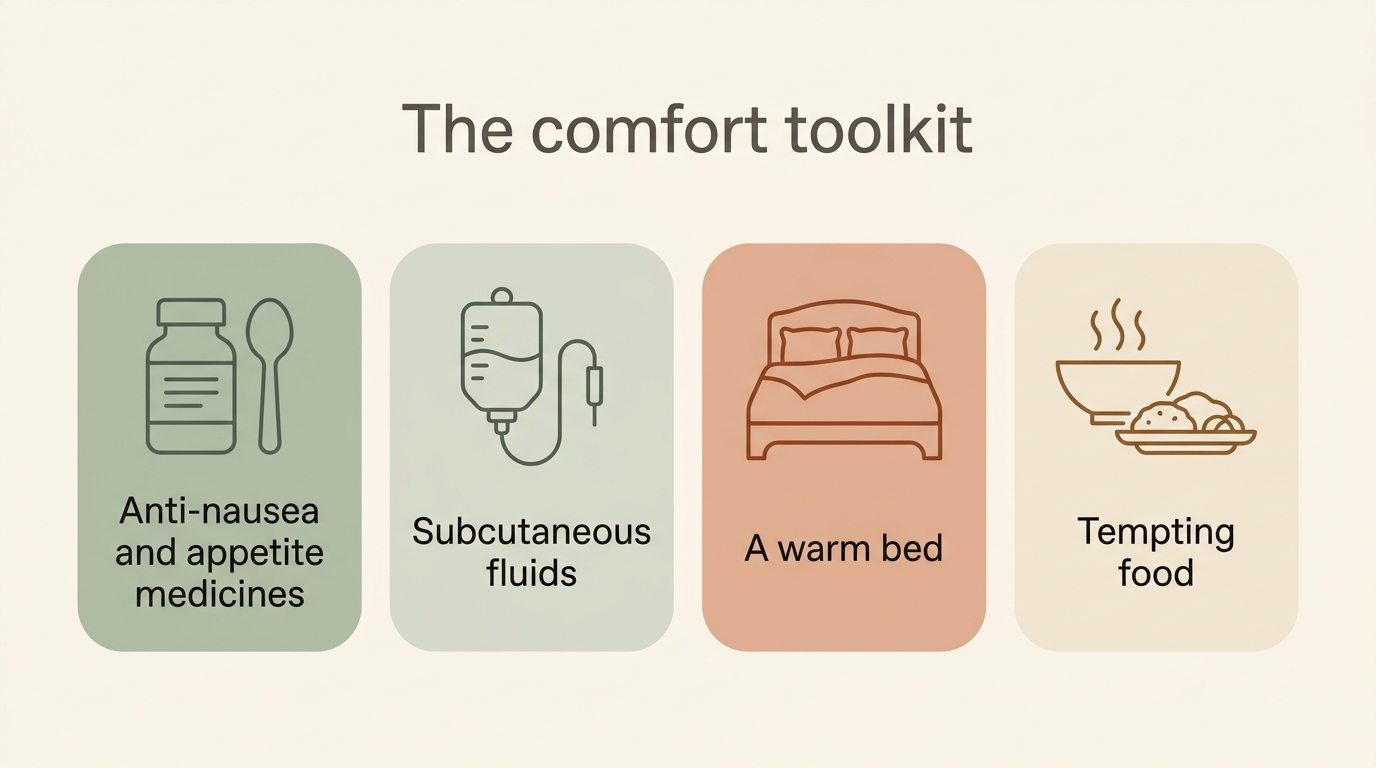
Used together, and adjusted by your vet, these can keep a pet genuinely comfortable and engaged well into advanced disease.
Assisted feeding, without the flinch
There is one option owners often recoil from at first, and I want to put it before you plainly, because it is far kinder than it sounds: a feeding tube. For some pets, particularly those whose main problem has become simply not eating enough, a soft tube placed in the side of the neck, an oesophagostomy tube, can take the daily battle out of nutrition and medicine entirely.
I understand the instinct that this is a step too far. But in the right pet it is not a failure, and it is not a prolonging of suffering; it is very often the opposite. It lets you feed and medicate your pet calmly, without forcing or stress, frequently makes them feel markedly better as their nutrition improves, and can be removed at any time. It is not right for every pet or every family, and it is a conversation to have openly with your vet about whether it would genuinely help in your particular case. But please do not dismiss it out of hand, because for some pets it buys a stretch of genuinely good, comfortable time.
Watching quality of life, day by day
As the disease advances, the most important thing you do quietly changes. It becomes less about the numbers and more about closely watching your pet's quality of life, day by day. The simplest and most reliable measure is the balance of good days against hard days, and the direction in which it is moving.

A good day is one where your pet is comfortable, eats something willingly, and still does a little of what they enjoy. A hard day is one dominated by nausea, refusal, discomfort or withdrawal. No pet has all good days, and a single hard day is not a verdict; what matters is the balance over a week or two, and whether the good days are still winning. Keeping a simple, candid record, rather than trusting memory, which tends to round kindly upward, helps you see the true picture. Our quality-of-life assessment for kidney patients gives you a gentle structure for this, and the next article in this stage walks through the harder questions it can eventually raise.
Preparing, gently
None of us wants to think ahead at a time like this, but a little quiet preparation is a kindness, both to your future self and to your pet. It is worth having the frank conversation with your vet before it becomes urgent: what to expect, what would signal that comfort is genuinely slipping, and what your own wishes are. Know who to call out of hours, and keep the number somewhere easy to find, so that a difficult evening does not become a frightening one. If being at home matters to you, should it ever come to a final decision, it is worth knowing in advance whether your practice or a local service can offer that. Having these things gently settled ahead of time means that, if a hard moment comes, you can be fully present for your pet rather than scrambling.
You cannot stop this disease, and I will not pretend otherwise. But you can do something that matters just as much: you can make this chapter a kind one. Comfort, warmth, the easing of nausea, a tempting meal, your familiar hands and voice; these are not small things to a pet who feels unwell, they are very nearly everything. The medicine at this stage is mostly love, made practical, and you are far more capable of giving it than you know. Whatever time is left can be gentle, and it can be good.
References
- International Renal Interest Society (IRIS). IRIS Treatment Recommendations for CKD in Cats and Dogs (2023).
- Sparkes AH, Caney S, Chalhoub S, Elliott J, Finch N, Gajanayake I, Langston C, Lefebvre HP, White J, Quimby J. ISFM Consensus Guidelines on the Diagnosis and Management of Feline Chronic Kidney Disease. Journal of Feline Medicine and Surgery, 2016.
- Quimby JM. Update on Medical Management of Clinical Manifestations of Chronic Kidney Disease. Veterinary Clinics of North America: Small Animal Practice, 2016.
- Bishop G, Cooney K, Cox S, Downing R, Mitchener K, Shanan A, Soares N, Stevens B, Wynn T. 2016 AAHA/IAAHPC End-of-Life Care Guidelines. Journal of the American Animal Hospital Association, 2016.