


Chronic Kidney Disease in Dogs: The Owner's Complete Guide
Alastair Greenway
BVM&S MRCVS
Go looking for information after your dog is diagnosed with chronic kidney disease, or after a vet mentions "borderline kidney values," and you'll hit something frustrating fast: almost everything written about pet kidney disease is about cats. Page after page assumes a feline patient. Dogs get kidney disease too, it matters just as much, and in important ways it behaves differently. This guide is for you and your dog.
What I want to do is give you, in one place, the dog-specific picture that's so hard to find: what canine kidney disease is, how it differs from the feline version, what causes it, how it's diagnosed and staged, and what can actually be done. As with everything in this space, the tone is straight but hopeful. Canine kidney disease is generally more serious than the feline form, and I won't pretend otherwise, but there's real, evidence-based management that can slow it and keep your dog feeling well, and a great deal of it is in your hands.
A disease that's real, and under-served
Let me name the gap directly, because it matters. Most kidney-disease advice online is written for cats, for the simple reason that the disease is more common in cats and gets more attention. The result is that owners of dogs with kidney disease often feel stranded, reading cat-focused material and trying to work out what applies. Some of it does carry across; much of the day-to-day management is shared. But the canine disease has its own causes, its own behaviour, and its own emphases, and assuming a dog is just a large cat in this respect can mislead you.
Canine chronic kidney disease is less common than the feline form overall. In a large study of UK first-opinion practice, it was recorded in roughly two to four dogs in every thousand, so in plain terms it's an uncommon diagnosis, though certain breeds are more prone and it becomes more likely with age. Uncommon, though, is not the same as unimportant: it's real, it's manageable, and it deserves proper dog-specific information.
What the kidneys do, and what "chronic" means
A quick grounding, since understanding the organ makes the rest make sense. The kidneys filter waste from the blood into the urine, manage the body's water balance, help regulate blood pressure, keep salts and minerals balanced, and signal the body to make red blood cells. The work is done by around a million tiny filtering units, called nephrons, in each kidney.
"Chronic" kidney disease means these nephrons are lost gradually and permanently, over months or years; they don't regenerate. As nephrons are lost, the survivors work harder to compensate, which is why outward signs often appear only once a substantial amount of function is already gone. We cover the shared biology more fully in our feline guide; here we concentrate on what's different and important about dogs.
How canine CKD differs from feline
This is the heart of why dogs need their own guide, so it's worth understanding properly. There are several genuine differences.
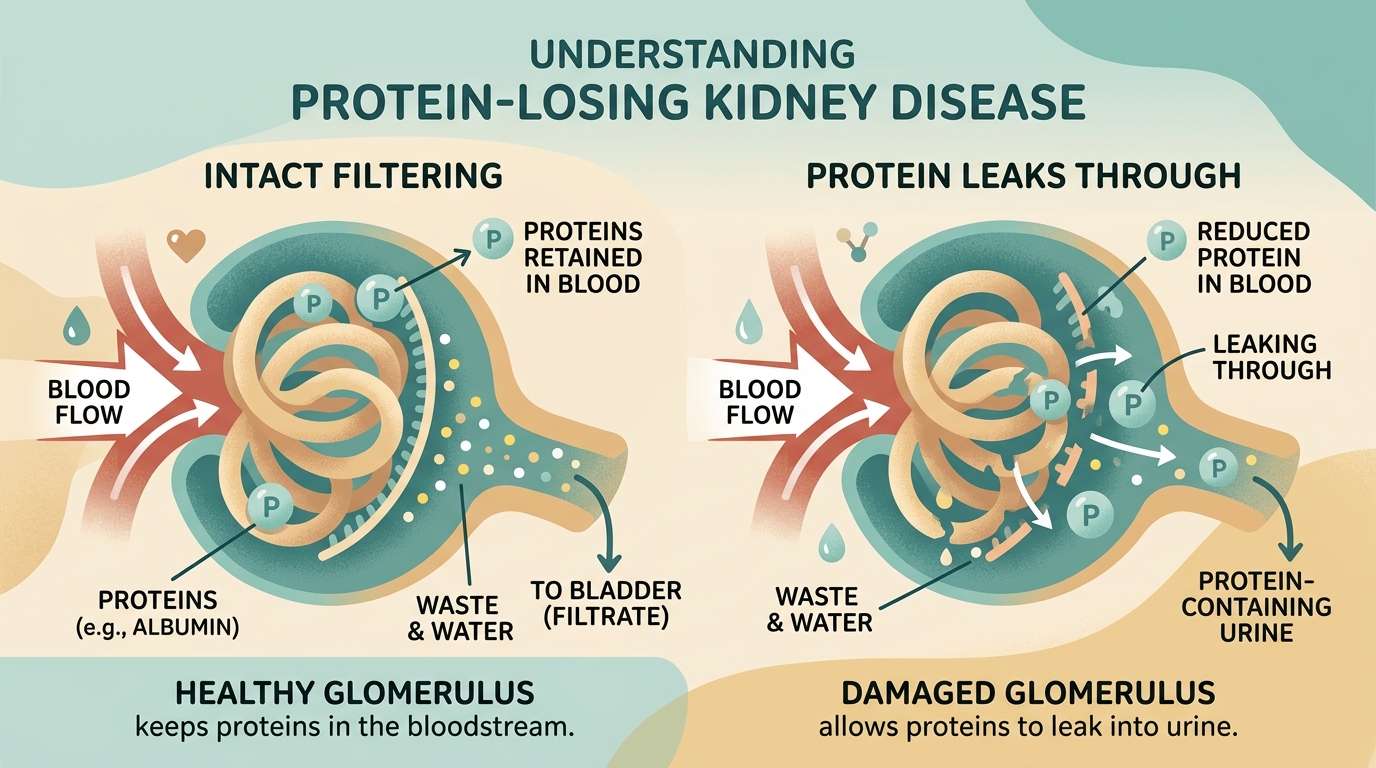
The most important is where the damage tends to be. Feline kidney disease is most often a slow, age-related wearing-out of the kidney's filtering tissue. Canine kidney disease, by contrast, more often involves the glomeruli, the tiny filters themselves, becoming leaky, a pattern called glomerular or protein-losing disease. This is why, as we'll see, protein in the urine takes centre stage in dogs in a way it doesn't in cats.
Second, hereditary and congenital forms matter more in dogs. A number of breeds carry inherited kidney conditions, and some dogs are born with abnormally formed kidneys, so canine kidney disease isn't purely a disease of old age. Third, and connected, some affected dogs are young; inherited forms can cause kidney failure in dogs only a year or two old, which is almost unheard of in cats. Fourth, and most soberingly, canine kidney disease tends to progress faster and carries a generally worse prognosis than the feline form, particularly when significant protein loss is present, and it's often diagnosed later, at a more advanced stage.
None of this is meant to frighten you. It's meant to arm you, because these differences shape what to watch for, how the disease is monitored, and why your vet may emphasise different things than the cat-focused articles do.
What causes it in dogs
Canine kidney disease has a wider range of causes than the feline form, and knowing them helps the picture make sense. They include:
- Hereditary and familial kidney conditions in predisposed breeds, and renal dysplasia, where the kidneys form abnormally. Breeds reported to carry inherited kidney disease include the Cavalier King Charles Spaniel, Bull Terrier, Boxer, English Cocker Spaniel, English Springer Spaniel, Samoyed, Lhasa Apso and Shih Tzu, and Bernese Mountain Dog, among others, with the Shar Pei prone to a distinct form called renal amyloidosis. The underlying fault isn't the same in each: some breeds inherit a weakness in the kidney's tiny filter membranes, some are born with malformed kidneys, and the Shar Pei's is that separate amyloid problem.
- Glomerulonephritis, inflammation of those tiny filters, often immune-related.
- Pyelonephritis, a kidney infection.
- Certain infectious diseases where relevant, such as leishmaniasis and, in some regions, Lyme nephritis.
- Acute kidney injuries, for example from leptospirosis or from toxins, that damage the kidney and tip into chronic disease.
The practical message is that canine kidney disease isn't one thing with one cause, and your vet may investigate to understand what's driving it in your individual dog, because the cause can influence both treatment and outlook.
What you might notice
The outward signs of kidney disease in dogs are broadly similar to those in cats, and knowing them helps you monitor your dog. The common ones are increased drinking and increased urination, often among the earliest signs, as the failing kidneys cannot concentrate the urine; gradual weight loss; a reduced or poor appetite; vomiting; a dull or poor coat; bad, almost chemical-smelling breath; and lethargy or reduced energy.
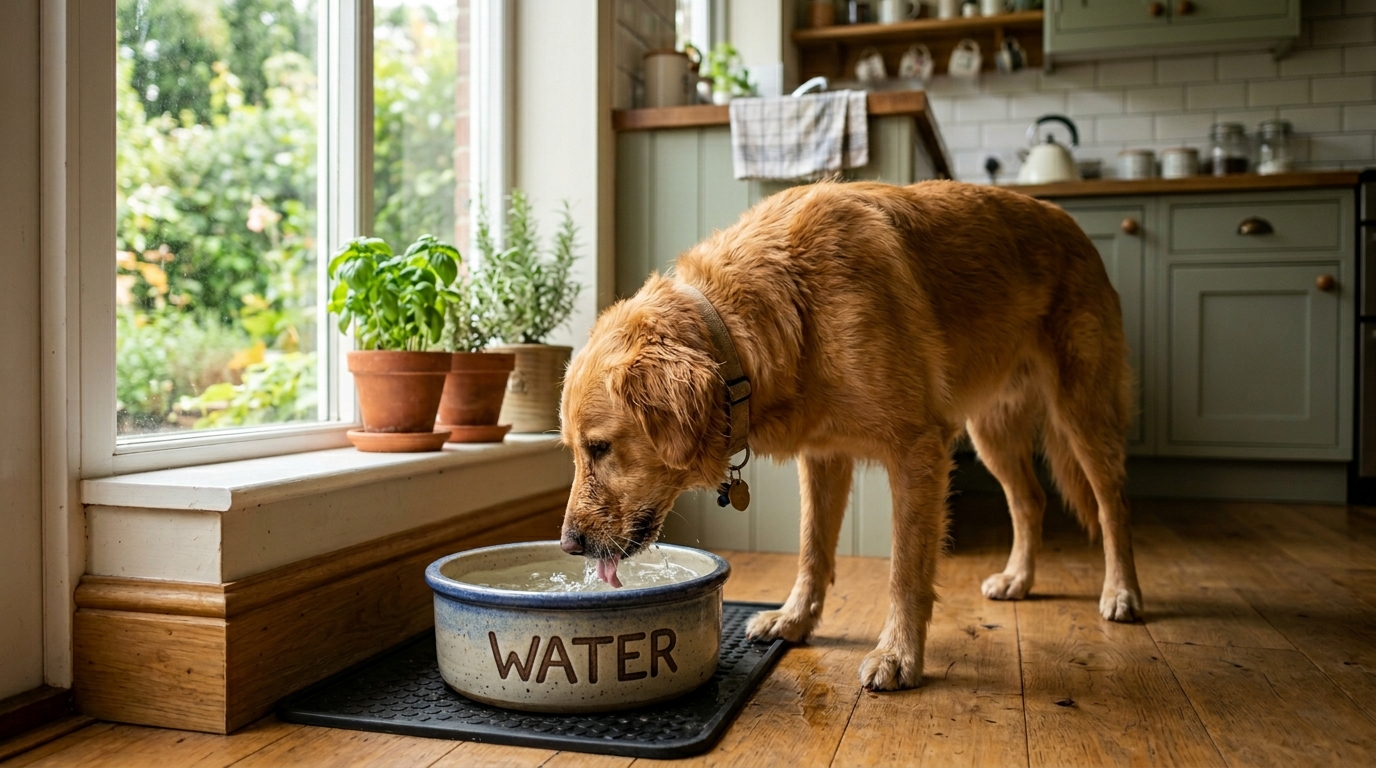
As in cats, these can come on slowly and be mistaken for ageing, and a dog can lose considerable kidney function before they appear. One important rule applies just as it does for cats: never restrict your dog's water to manage the increased drinking. The extra thirst is the body compensating for water it cannot hold onto, and fresh water must always be freely available.
Diagnosis, with the canine emphasis
Kidney disease is diagnosed from blood and urine tests, and we cover the full detail in our dedicated diagnosis article. In dogs your vet will look at blood markers, chiefly creatinine, the newer marker SDMA, and urea; at how concentrated the urine is; and at blood pressure. But there's one test that deserves special emphasis in dogs, more than in cats.
That test is the urine protein-to-creatinine ratio, or UPC. Because canine kidney disease so often involves protein leaking through damaged filters, measuring how much protein is in the urine is central to diagnosing and monitoring it in dogs. The UPC puts a number on that protein loss, and as we'll see, that number matters enormously for prognosis. If your dog's kidneys are under investigation, expect the UPC to feature prominently; it's one of the clearest examples of how the canine disease differs from the feline.
Staging, and why proteinuria matters so much
As with cats, vets stage canine kidney disease using the IRIS system, from stage 1 (earliest) to stage 4 (most advanced), based on blood markers in a stable, well-hydrated dog, then sub-staged by blood pressure and, crucially in dogs, by the amount of protein in the urine. We explain the stages in our dedicated staging article.
Here's the point to take away, because it's one of the most important in canine kidney disease: proteinuria is a powerful prognostic marker. In a study of dogs with naturally occurring kidney disease, those with a UPC of 1.0 or above at diagnosis had roughly three times the risk of a uraemic crisis or death compared with dogs whose UPC was below 1.0, and the risk rose further with every increase in the ratio. This is why your vet takes protein loss so seriously in dogs, and why reducing it is a specific treatment goal, as we'll come to. The good news hidden in that sobering statistic is that proteinuria is something that can often be measured, tracked, and treated.
What can be done
The encouraging part: there's a real, evidence-based toolkit for canine kidney disease, much of it shared with the feline approach but with some dog-specific emphases.
Diet leads here too, and the evidence in dogs is genuinely striking. In a carefully conducted randomised trial, dogs with kidney disease fed a prescription renal diet were far less likely to suffer a uraemic crisis over the following two years than dogs kept on a normal diet, around a third compared with two thirds, and far fewer died of kidney-related causes, around half compared with almost all of the dogs on the ordinary food. Few interventions in any disease show numbers like that, and it's something you act on at the food bowl. We devote a whole article to the renal diet, because it's the biggest lever you personally control.
What stands out as distinctively canine is the emphasis on protecting the kidney by reducing protein loss. Because proteinuria both signals and drives damage in dogs, medications that reduce it, principally ACE inhibitors such as benazepril and the related drug telmisartan, are a key part of canine treatment, and we cover these in their own article. Alongside diet and anti-proteinuric medication, the toolkit includes controlling blood pressure, which is common in canine kidney disease, affecting up to around two-thirds of cases; managing phosphate; and comfort medications for nausea and appetite.
One more dog-specific point worth knowing: maintaining good body condition matters. Dogs that keep a healthier body condition tend to do better, so keeping weight and muscle on a dog with kidney disease, rather than letting them waste, is part of good management, and another reason the diet has to be one your dog will actually eat well.
Prognosis, and where to begin
Let me give it to you straight on prognosis, because you deserve plain talk. Canine kidney disease is generally more serious and faster-moving than the feline form, especially when there's significant protein loss, and it's often found later. But "generally" and "tends to" are not "always": the picture varies enormously with the cause, the stage at diagnosis, and crucially the degree of proteinuria, and many dogs, particularly those caught earlier or with well-controlled protein loss, live well for a good time with proper management. The aim, as ever, is to slow the disease and keep your dog feeling well, and there's real power to do both. Monitoring is central, because tracking the kidney values, the protein loss, and the blood pressure lets your vet adjust the plan and stay ahead of problems.
Here are concrete next steps for the days after diagnosis, rather than a vague sign-off:
First, ask your vet for your dog's key numbers, the creatinine, SDMA, and especially the UPC and blood pressure, written down, so you have a baseline. Second, ask specifically whether your dog is proteinuric and, if so, whether an ACE inhibitor or telmisartan is appropriate, since reducing protein loss is a dog-specific priority. Third, talk about starting the transition to a prescription renal diet, and how to do it gradually so your dog accepts it; our renal-diet article walks through this. Fourth, make sure fresh water is always freely available around the home. Fifth, agree a monitoring plan, when the next recheck is and what it will track.
Do those five things and you have a baseline, a treatment plan tailored to your dog's proteinuria, and a monitoring schedule agreed with your vet. Canine kidney disease is a serious diagnosis, but it's one you can meet with real tools, clear priorities, and a great deal of good care still to give.
References
- O'Neill DG, Elliott J, Church DB, McGreevy PD, Thomson PC, Brodbelt DC. Chronic kidney disease in dogs in UK veterinary practices: prevalence, risk factors, and survival. Journal of Veterinary Internal Medicine, 2013.
- Littman MP. Protein-losing nephropathy in small animals. Veterinary Clinics of North America: Small Animal Practice, 2011.
- Jacob F, Polzin DJ, Osborne CA, et al. Evaluation of the association between initial proteinuria and morbidity rate or death in dogs with naturally occurring chronic renal failure. Journal of the American Veterinary Medical Association, 2005.
- Jacob F, Polzin DJ, Osborne CA, et al. Clinical evaluation of dietary modification for treatment of spontaneous chronic renal failure in dogs. Journal of the American Veterinary Medical Association, 2002.
- Brown S, Elliott J, Francey T, Polzin D, Vaden S; IRIS Canine GN Study Group. Consensus recommendations for standard therapy of glomerular disease in dogs. Journal of Veterinary Internal Medicine, 2013.
- Lourenço BN, Coleman AE, Brown SA, et al. Efficacy of telmisartan for the treatment of persistent renal proteinuria in dogs: a double-masked, randomized clinical trial. Journal of Veterinary Internal Medicine, 2020.
- Jacob F, Polzin DJ, Osborne CA, et al. Association between initial systolic blood pressure and risk of developing a uremic crisis or of dying in dogs with chronic renal failure. Journal of the American Veterinary Medical Association, 2003.
- Parker VJ, Freeman LM. Association between body condition and survival in dogs with acquired chronic kidney disease. Journal of Veterinary Internal Medicine, 2011.
- International Renal Interest Society (IRIS). IRIS Staging of CKD (modified 2023).
See where your pet stands today
Tracking is the other half of managing kidney disease. Drop in the latest bloods to see the IRIS stage, then follow the trend as treatment settles in.
Check the IRIS stageYou're not doing this alone
Compare treatment journeys and talk to owners managing kidney disease. Free to join.
Join PetsLikeMine