

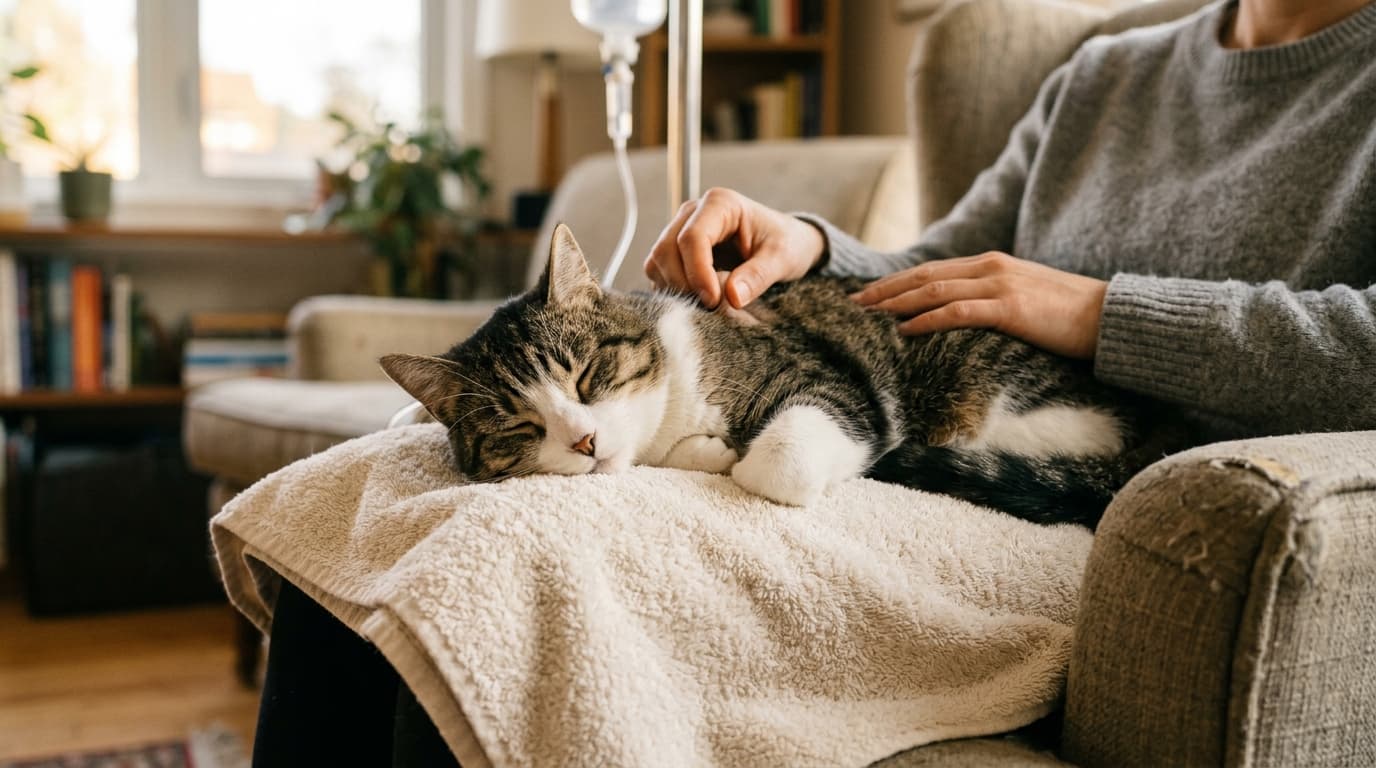
Subcutaneous Fluids at Home: A Complete Beginner's Guide
Alastair Greenway
BVM&S MRCVS
A needle, at home, given by me? Is that cruel? Could I actually do it? When a vet first suggests giving fluids under the skin at home, most owners feel some mix of alarm and doubt, and those are the questions that surface. Thousands of ordinary owners, with no medical background, learn to do this every year, most pets tolerate it well, and almost everyone who is nervous at the start finds they get the hang of it quickly. This guide will walk you through it.
I also want to be straight with you about something. The detailed protocols for home fluids, exactly how much and how often, rest largely on the accumulated clinical experience of vets and on expert consensus rather than on large clinical trials. That does not mean it does not help, clinical experience strongly suggests it does for the right patients, but you deserve to know the evidence base, and to know that your own vet's specific instructions, tailored to your pet, are what you should follow throughout.
You can do this
Anxiety is the biggest barrier and it is usually misplaced. Giving subcutaneous fluids, "sub-Q" or "sub-cut" fluids, means delivering fluid under the loose skin, where it forms a soft pocket that the body absorbs over the following hours. It is a well-established, routine part of managing kidney disease, and it is something a great many owners do at home.
The evidence on how owners and pets actually experience it is genuinely encouraging. In a survey of nearly 400 owners who gave their cats fluids under the skin at home, 85 percent described it as easy, low stress, or at least okay for themselves, and 89 percent said the same for their cats. In other words, the thing you are dreading is something most people and most pets settle into. It is not cruel; done gently, it causes brief, minor discomfort at most, and it can make a pet who was flat and dehydrated feel considerably better. You will likely feel clumsy the first few times, that is completely normal, and you will improve faster than you expect; owners in that same survey who had done it before reported easier sessions than first-timers, which is simply to say it gets easier with practice.
What sub-Q fluids do, and don't
Understanding what the fluids are for helps the whole thing make sense. In kidney disease, the failing kidneys struggle to conserve water, so a pet can become dehydrated even while drinking more. Subcutaneous fluids top up that hydration, which helps the kidneys flush waste products through, and that in turn can ease the nausea, lethargy, and poor appetite that dehydration worsens, and help with problems like constipation.
Two qualifications matter. First, fluids are supportive, not curative: they help a pet feel better and maintain hydration, but they do not repair the kidneys or stop the disease. Second, they are not right for every patient, and they are emphatically a vet-directed treatment, the decision to start, what fluid to use, and how much and how often are all your vet's to make, based on your individual pet. This is not something to begin, adjust, or escalate on your own.
When your vet might recommend them
Fluids are not for every pet with kidney disease, and certainly not from the moment of diagnosis. They tend to come into the picture as the disease becomes more advanced, or when a pet is struggling to stay hydrated.
In practice, vets most often recommend home fluids in the more advanced stages of kidney disease, IRIS stages 3 and 4, and when there are signs of dehydration, a reduced appetite, or a pet who simply is not taking in enough water to keep up. But the decision is always individual, made case by case, weighing whether the fluids are likely to help this particular pet and whether the pet will tolerate them. Your vet will judge the timing, and will only suggest fluids when they expect a genuine benefit. If they have raised it, it is because they think your pet has reached the point where it would help.
What's in your kit
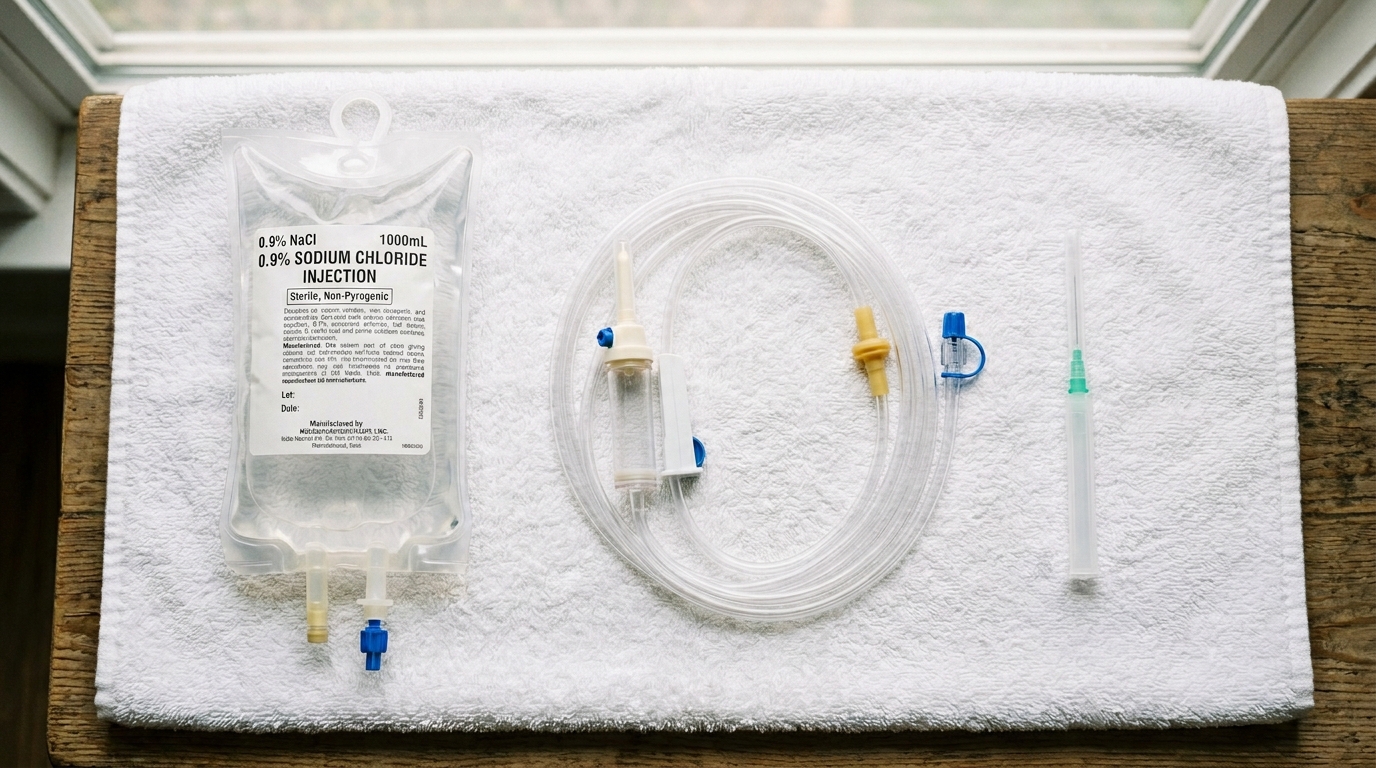
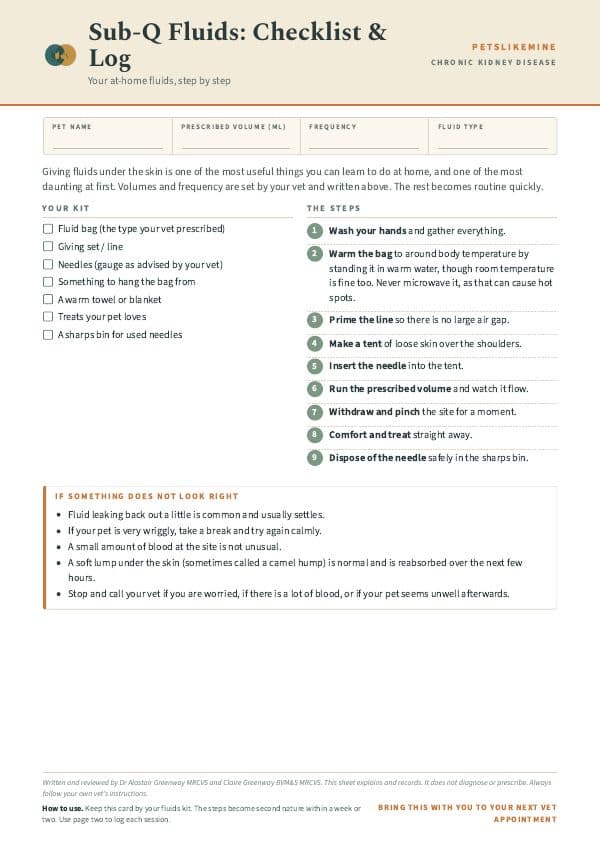
Once your vet prescribes fluids, you will be set up with the equipment, and it helps to know what each piece is. You will have a bag of fluid, of the type your vet prescribes, often a sterile saline or balanced electrolyte solution; a giving set, the line that runs from the bag; needles of the gauge your vet recommends, the gauge being the needle's thickness, which affects how fast the fluid runs and how it feels; and a way to warm the fluid to body temperature.
One practical and legal point is worth flagging: in the UK these are prescription items, supplied through your vet. The fluid, the giving set, and the needles are all obtained via your veterinary practice as part of your pet's prescribed treatment, not bought casually off a shelf, and your vet or a veterinary nurse will show you how to assemble and use them before you start. That hands-on demonstration is invaluable, and you should feel free to ask for it more than once until you are confident.
How a session goes
I will describe the general shape of the procedure so it is familiar, but please treat your own vet's demonstration and instructions as the real guide, since the specifics, especially how much fluid and how often, are set individually for your pet.
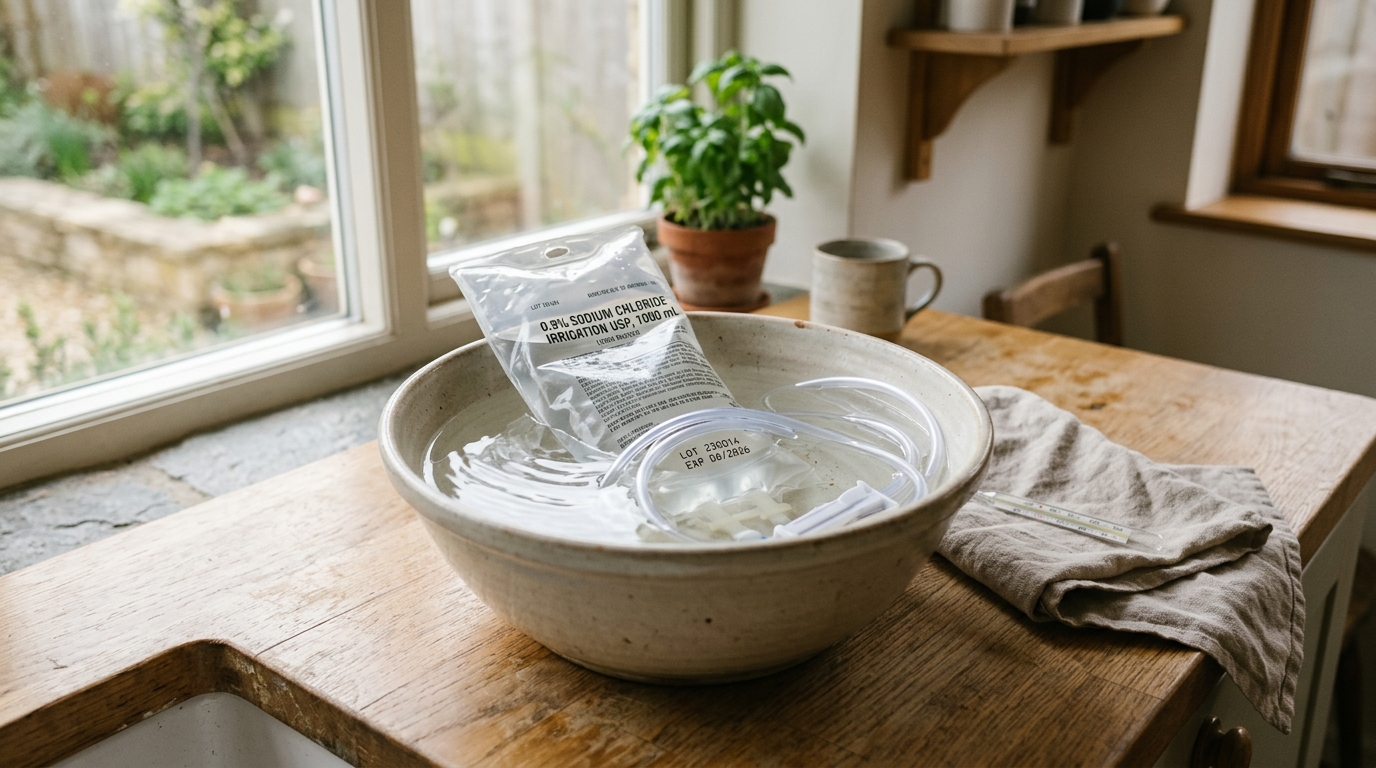
In broad outline, the process runs like this. You warm the bag of fluid to body temperature, since fluid that is cold going under the skin is uncomfortable and off-putting; many owners stand the bag in warm water beforehand.
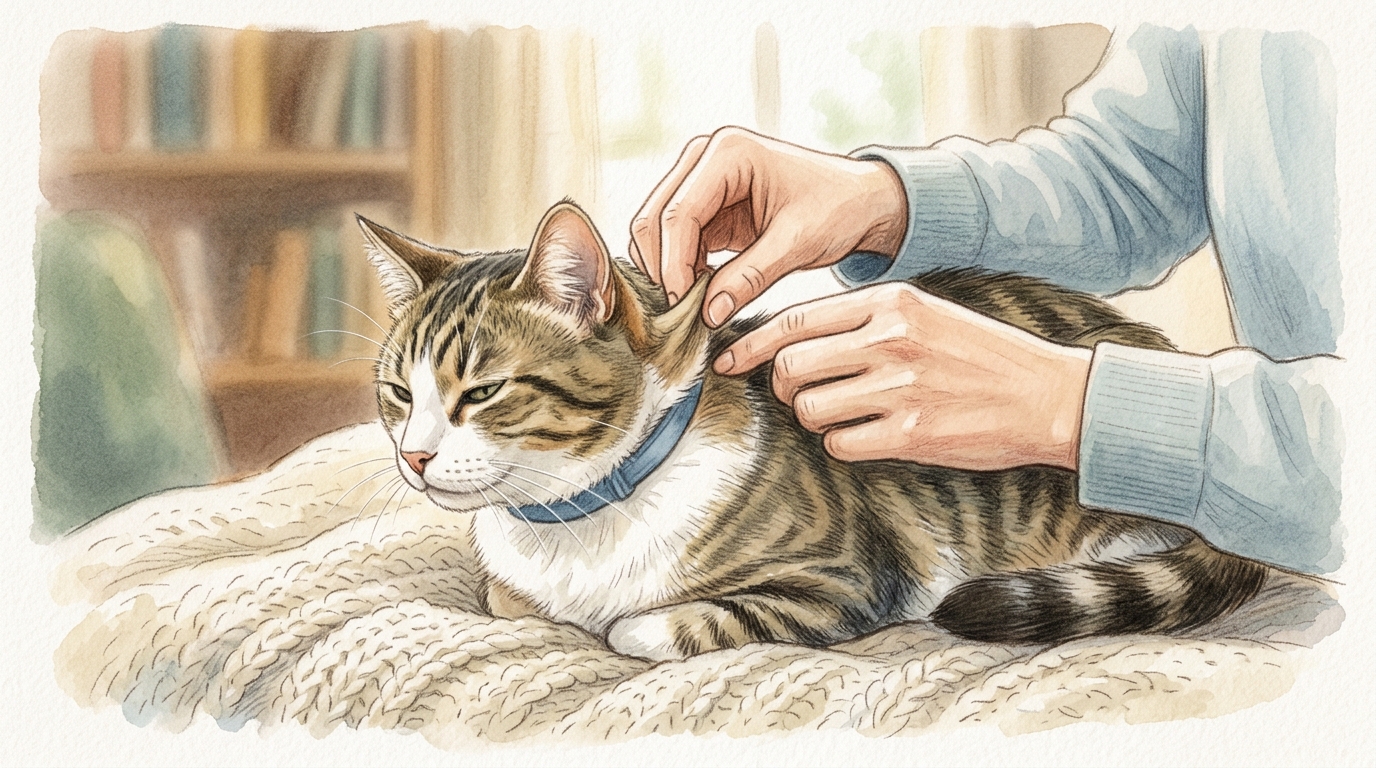
You hang the bag up high, so gravity drives the fluid down the line. You settle your pet somewhere comfortable, then gently lift the loose skin over the scruff or back into a "tent." You insert the needle into the base of that tent, under the skin rather than into muscle, and let the fluid run in. The fluid forms a soft swelling under the skin, which is normal and expected. The volume to give, and how frequently, are exactly what your vet prescribes for your pet, and you should follow those numbers rather than any general figure.
It sounds more daunting written down than it is in practice. After a few sessions, most owners find it becomes a quick, calm routine.
Keeping it calm
The difference between a stressful experience and an easy one is usually in the small touches that keep your pet relaxed, and owners who do this successfully have plenty of tips.
Many find a treat afterwards, or even during, helps; in the owner survey, well over half gave their cat a treat as positive reinforcement, and more than half of those who did felt it made their cat easier to manage. A quiet, consistent routine, the same comfortable spot, the same time of day, the same calm manner, helps a pet know what to expect. A towel can gently help keep a wriggly pet settled. Some owners manage easily alone; others find it far easier with two people, one to comfort and one to handle the line, so do enlist help if you can. And the speed matters: in that same survey, around three-quarters of owners felt the time it took affected how well their cat tolerated it, and about half felt the needle size did too, so getting the fluid in reasonably promptly, with the warmed fluid and the needle gauge your vet advised, tends to make for a calmer, shorter session. Above all, stay calm yourself, pets read our tension, and a relaxed handler makes for a relaxed patient. Reward generously afterwards, every time.
When something looks odd
A few things will happen that look alarming the first time but are usually entirely normal, and knowing them in advance saves a lot of worry.
You may notice a soft fluid lump where you gave the fluids, which can gravitate downward over the next few hours, sometimes travelling down a leg or to the lowest point of the body. This is normal; the body is absorbing it, and it reabsorbs over the hours that follow. You might see a small spot of blood at the needle site, which is usually nothing to worry about. Your pet may move partway through, the needle may come out, or the flow may slow, all common and manageable, you simply reposition or, if needed, pause and start again. A bent needle should be replaced, never reused or forced. And a little leakage of fluid can occur, especially if the needle is not quite fully under the skin or the pet shifts. None of these is an emergency; they are the ordinary hiccups of a routine that you and your pet will both get smoother at.
If any of these happen repeatedly, or you are unsure, your vet or a veterinary nurse can troubleshoot your technique, often a small adjustment solves it.
When to stop and call the vet
While the routine is generally very safe, there are some situations that warrant caution or a prompt call, and you should know them.
Take particular care if your pet has heart disease, because in some pets, especially those with cardiac problems, too much fluid can overload the circulation, so fluids must be used cautiously and exactly as the vet directs in these cases. Watch for signs of overhydration or fluid overload, in particular any difficulty breathing, rapid or laboured breathing, or sudden distress, and treat breathing trouble as urgent. Stop and contact your vet if your pet is in real distress during a session, if there is significant pain, if a swelling looks abnormal rather than the usual soft pocket, or if you are simply worried. Never push through a pet's genuine distress to "get the fluids in"; their wellbeing in the moment matters more than completing the session, and your vet can always adjust the plan. As ever, your own instinct that something is wrong is reason enough to call.
Keeping a record
A simple record makes the whole thing more useful and helps your vet fine-tune the plan. Each time, jot down how much fluid you gave, where on the body you gave it, and how your pet coped. Over time this shows the pattern, confirms you are keeping to the prescribed routine, and gives your vet concrete information to adjust the volume or frequency if needed. It ties in directly with the home tracking we describe elsewhere in this space, and it turns each session from an isolated task into part of a clear, shared picture of how your pet is doing.
That is the whole of it. What looks, at first, like a frightening medical procedure becomes, with a little practice, a manageable and even calm part of caring for a pet with kidney disease, one that can genuinely help them feel better. Lean on your vet and veterinary nurses for the hands-on teaching, follow their specific instructions on what and how much, go gently, reward generously, and trust that, like the great majority of owners before you, you will find your rhythm. Your willingness to do this is a real act of care, and your pet benefits from it.
References
- Cooley CM, Quimby JM, Caney SMA, Sieberg LG. Survey of owner subcutaneous fluid practices in cats with chronic kidney disease. Journal of Feline Medicine and Surgery, 2018.
- Sparkes AH, Caney S, Chalhoub S, Elliott J, Finch N, Gajanayake I, Langston C, Lefebvre HP, White J, Quimby J. ISFM Consensus Guidelines on the Diagnosis and Management of Feline Chronic Kidney Disease. Journal of Feline Medicine and Surgery, 2016.
- Quimby JM. Update on Medical Management of Clinical Manifestations of Chronic Kidney Disease. Veterinary Clinics of North America: Small Animal Practice, 2016.
- Polzin DJ. Evidence-based step-wise approach to managing chronic kidney disease in dogs and cats. Journal of Veterinary Emergency and Critical Care, 2013.
- Pardo M, Spencer E, Odunayo A, Ramirez ML, Rudloff E, Shafford H, Weil A, Wolff E. 2024 AAHA Fluid Therapy Guidelines for Dogs and Cats. Journal of the American Animal Hospital Association, 2024.
- International Renal Interest Society (IRIS). IRIS Treatment Recommendations for CKD in Cats and Dogs (2023).
Free downloads
Companion worksheets to put what you've read into practice. Free PDFs, print at home.
See where your pet stands today
Tracking is the other half of managing kidney disease. Drop in the latest bloods to see the IRIS stage, then follow the trend as treatment settles in.
Check the IRIS stageYou're not doing this alone
Compare treatment journeys and talk to owners managing kidney disease. Free to join.
Join PetsLikeMine