


The Renal Diet: The Single Most Important Treatment You Control
Alastair Greenway
BVM&S MRCVS
Of everything in the kidney-disease toolkit, the prescription renal diet has the best evidence for extending your pet's good-quality life. And it is the one big lever you control directly, at the food bowl, every day. So when your vet tells you to switch a dog or cat to a "kidney diet," and you find yourself wondering whether it really matters, or bracing for the job of persuading a stubborn pet to eat something new, that is the fact to hold on to.
It is worth sitting with. Many parts of kidney-disease management belong to your vet: the tests, the medications, the monitoring. The diet is the part that is genuinely yours. Get it right, and you are doing something with better evidence behind it than almost any pill. This article explains why it matters so much, what actually makes a renal diet different, and, just as importantly, how to win the palatability battle, because a perfect diet your pet refuses helps no one.
Why diet is the biggest lever
Let me set the expectation clearly at the outset, because owners often underestimate this. Among everything that can be done for a pet with chronic kidney disease, the prescription renal diet stands almost alone in having been tested in randomised controlled trials, the most rigorous kind of evidence, and shown to reduce uraemic crises and kidney-related deaths. That is a rare thing in this field, and it is why leading veterinary nutritionists treat the therapeutic renal diet as the cornerstone of management, the best-evidenced single step for improving survival and quality of life in dogs and cats with kidney disease. This is not a gentle suggestion or an optional extra. It is the foundation of management, and it is the thing you personally do.
What the numbers actually show
Let me show you the figures, because they are genuinely persuasive and you deserve to see why vets push the diet so hard.
In cats, a carefully conducted randomised trial found that cats with kidney disease fed a renal diet had no uraemic crises and no kidney-related deaths over the two-year study, while a quarter of the cats on a normal diet had a uraemic crisis and around one in five died of kidney-related causes. A separate, observational study pointed the same way: cats on a renal diet lived a median of 633 days, against 264 days for cats that stayed on a normal diet, more than doubling median survival.
In dogs, the picture is the same. A randomised trial found that dogs with kidney disease fed a renal diet had markedly fewer uraemic crises and renal-related deaths over two years than dogs on a maintenance diet, roughly a third suffering a uraemic crisis against two thirds, and about half dying of kidney-related causes against almost all. Across both species, the message from the evidence is consistent and strong: the renal diet works, and it works on the outcomes that matter most, crises avoided, life extended, comfort preserved.
What's actually different about a renal diet
A renal diet is not simply "less of the normal food." It is a specific reformulation, and understanding what is changed helps you see why ordinary food, however premium, is not the same thing. The main features are:
Restricted phosphorus, the headline change and the one most tied to survival, which we will come to in its own section. Moderated but still good-quality protein, reduced from typical levels but emphatically not starvation-level, which we will also discuss properly because the protein question worries owners. Added omega-3 fatty acids, the EPA and DHA found in fish oils, which support kidney health. Controlled sodium. Added potassium, because kidney disease can deplete it, and B vitamins, which are lost in the increased urine. An alkalinising formulation, since kidney disease tends to make the body too acidic. And the food is made calorie-dense, so a pet eating less can still take in enough energy.
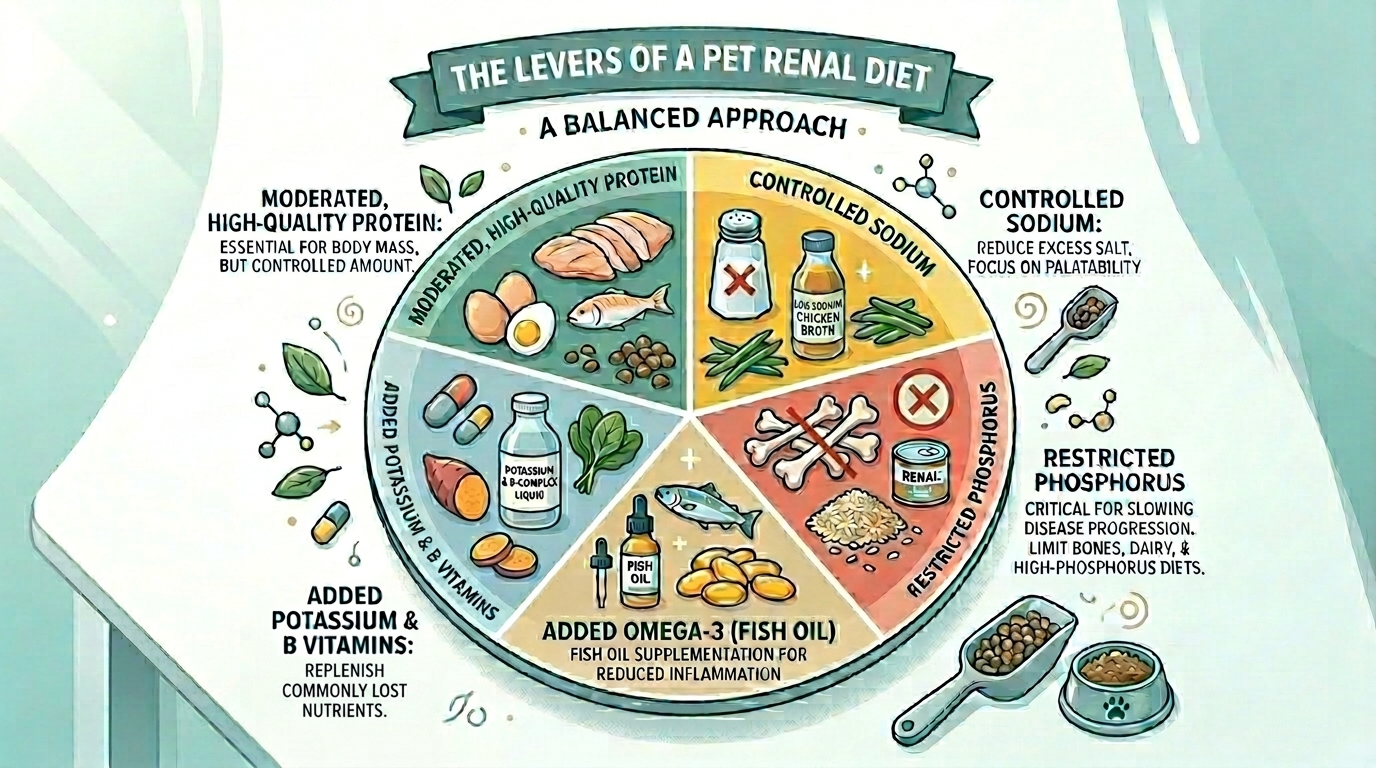
Every one of those changes is deliberate and aimed at easing the load on the kidneys, reducing the waste products that make a pet feel ill, and slowing the disease. It is, in a real sense, medicine served in a bowl.
Phosphorus: the star of the show
If one ingredient deserves top billing, it is phosphorus, because controlling it drives both how long a pet lives and how well they feel. Here is why it matters so much, in plain terms.
Healthy kidneys clear excess phosphorus from the body. Failing kidneys cannot, so phosphorus builds up in the blood. That rising phosphorus sets off a damaging chain: it disturbs calcium balance and drives up a hormone called parathyroid hormone, a condition called renal secondary hyperparathyroidism, and it raises a phosphate-regulating hormone called FGF-23. Over time this chain harms the body in several ways, contributing to mineral and bone problems and, importantly, to the progression of the kidney disease itself. The link to outcome is direct: in one study of cats, every increase of 1 mg/dL in blood phosphorus was associated with around a 12 percent higher risk of death.
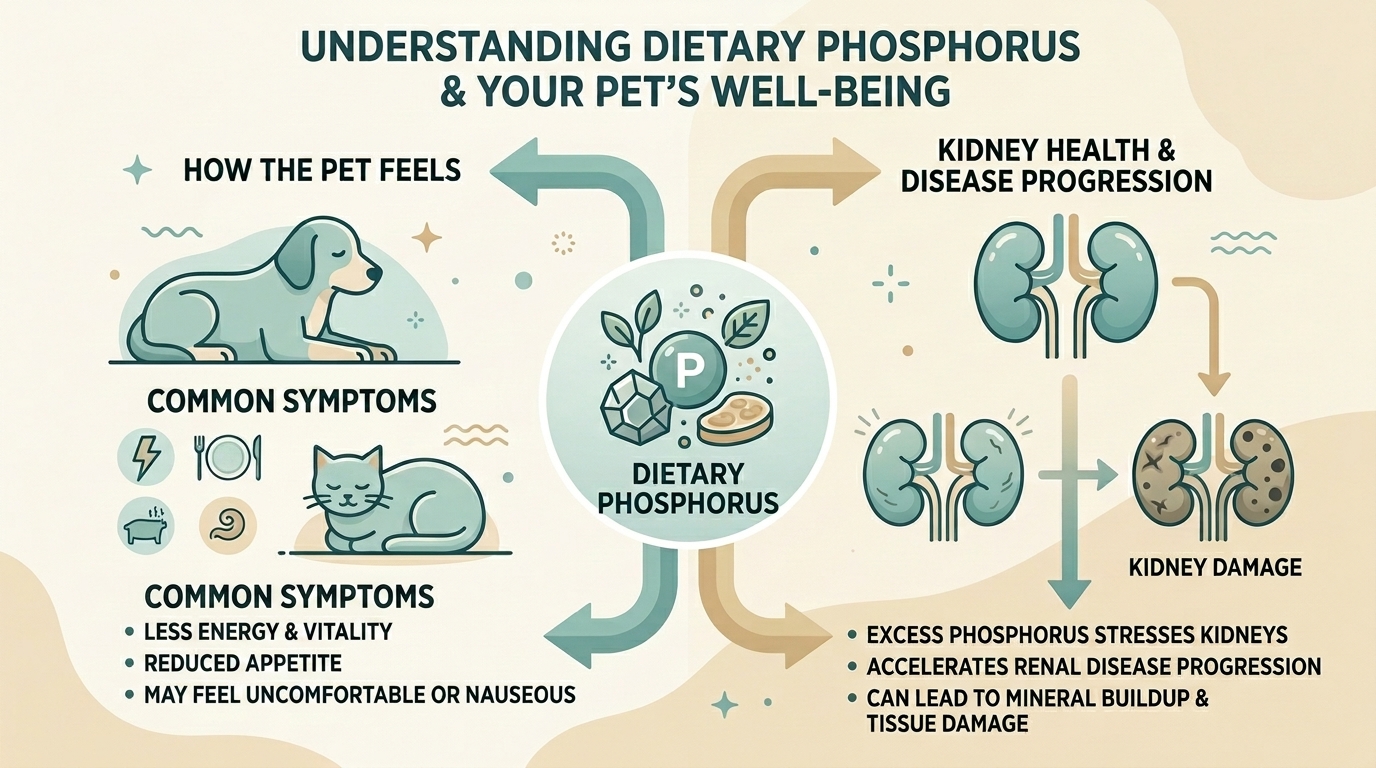
This is exactly why renal diets restrict phosphorus, and why phosphate control is such a central goal. The international kidney guidelines set target blood phosphate ranges for each stage of disease, which your vet will aim for, using the diet first and adding phosphate binders if diet alone is not enough. When you feed the renal diet faithfully, you are, above all, controlling phosphorus, and that is doing real work.
Does cutting protein harm them?
Now to the question that worries owners most, often because they have read something alarming online: does restricting protein harm my pet, or "starve" them? This deserves a careful, candid answer.
The modern, nuanced view is this: a renal diet moderates protein to a sensible degree, using good-quality protein, and does not slash it to starvation levels. There are two reasons protein is moderated at all. First, protein is the major dietary source of phosphorus, so moderating it helps achieve the phosphorus control that matters so much. Second, the breakdown of excess protein produces the waste products that make a pet with kidney disease feel nauseous and unwell, so moderating it helps them feel better.
But, and this is crucial, the goal is moderation, not severe restriction, because too little protein causes a pet to lose muscle and body condition, which is genuinely harmful, especially in older animals and in dogs, where keeping good body condition is linked to better outcomes. Cats in particular are obligate carnivores with a high protein requirement, and their diets are formulated with that in mind. So the "low protein damages them" claim gets it wrong by missing the nuance: well-formulated renal diets provide adequate, high-quality protein, just less of the excess, and preserving your pet's muscle and weight is an explicit aim, not something the diet sacrifices. If your pet is losing condition, that is a conversation to have with your vet, not a reason to abandon the diet.
When to start, and species nuance
Renal diets are generally introduced from IRIS stage 2 onward, the point at which the evidence for benefit is clearest, though the timing is individual and your vet will advise on your pet's situation. There are some species nuances in exactly how and when, and in advanced disease or where a pet has other conditions the picture can be more complicated, which is again where your vet's judgement comes in. The broad rule, though, is that once kidney disease is established, the diet becomes a cornerstone, and starting it well is one of the most valuable things you can do.
Making it actually happen
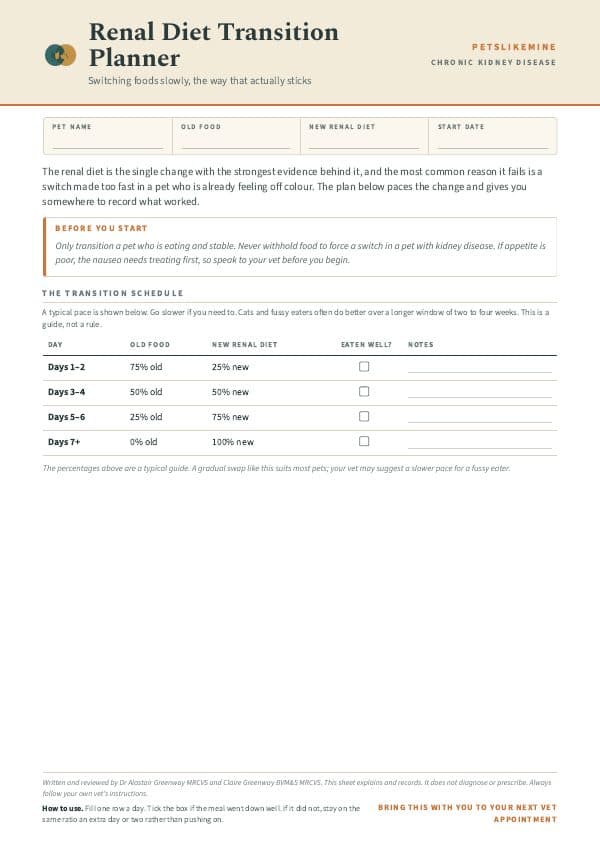
Here is where many owners struggle, and where a little strategy makes all the difference, especially with cats, who are famously particular. The single most important principle is this: transition slowly. A renal diet introduced gradually is far more likely to be accepted than one switched abruptly. The veterinary consensus is that most cats can be brought onto a renal diet successfully when the change is made very gradually, over weeks rather than days.

Practical tactics that genuinely help: make the change over a couple of weeks or longer, mixing increasing proportions of the new food into the old. Warm wet food gently to body temperature to release its aroma, which matters enormously to a pet whose appetite is reduced. Offer different flavours and textures, since the major brands make several, and your pet may strongly prefer one. Consider wet over dry, which is more palatable to many pets and adds valuable water for hydration. And here is a vital one that owners rarely know: never try to switch a pet onto a new diet while they are in hospital or feeling acutely unwell, because they can develop a lasting aversion to whatever they are offered when they feel ill, which can poison their acceptance of the very diet they need long-term. Make the switch at home, when they are stable. We cover appetite and feeding challenges in more depth in our dedicated article.
What's available in the UK
You do not need to choose a product yourself, your vet will guide you, but it helps to know the landscape. Several manufacturers make prescription renal diets, available in the UK in both wet and dry forms, and the main ranges include Royal Canin Renal, Hill's Prescription Diet k/d, Purina Pro Plan Veterinary Diets NF Renal Function, Specific Kidney Support, and Virbac's renal range. These are veterinary diets that require your vet's authorisation, and several come in multiple flavours and textures specifically because palatability matters so much, some ranges offer different aromatic versions designed to tempt a reluctant eater. This is a neutral overview, not an endorsement of any one product; the best diet is the appropriate one your individual pet will actually eat, and your vet can help you find the right fit.
If they simply won't eat it
Finally, the pragmatic rule, because sometimes, despite everything, a pet refuses the ideal diet. Here it is: a slightly less ideal diet that your pet will reliably eat is better than a perfect diet they refuse. A pet that stops eating is in immediate trouble, particularly cats, for whom going off food carries its own serious dangers, so maintaining adequate intake takes priority over dietary perfection.
That does not mean giving up at the first refusal. It means working with your vet to find a workable answer: trying the different brands and textures, persisting with gradual transitions, accepting that even a partial switch still helps, and, if phosphorus stays high despite the best dietary efforts, discussing phosphate binders, which let a pet gain phosphorus control even on a less restricted diet, and which we cover in their own article. The goal is the best achievable phosphorus control and nutrition that your pet will actually accept, sustained over the long term, not a theoretical ideal that ends with a pet who will not eat. Work with your vet, be patient and flexible, and keep your eye on the real prize: a pet who is eating, comfortable, and getting the benefit of the most powerful tool you hold.
References
- Ross SJ, Osborne CA, Kirk CA, Lowry SR, Koehler LA, Polzin DJ. Clinical evaluation of dietary modification for treatment of spontaneous chronic kidney disease in cats. Journal of the American Veterinary Medical Association, 2006.
- Jacob F, Polzin DJ, Osborne CA, Allen TA, Kirk CA, Neaton JD, Lekcharoensuk C, Swanson LL. Clinical evaluation of dietary modification for treatment of spontaneous chronic renal failure in dogs. Journal of the American Veterinary Medical Association, 2002.
- Elliott J, Rawlings JM, Markwell PJ, Barber PJ. Survival of cats with naturally occurring chronic renal failure: effect of dietary management. Journal of Small Animal Practice, 2000.
- Boyd LM, Langston C, Thompson K, Zivin K, Imanishi M. Survival in cats with naturally occurring chronic kidney disease (2000-2002). Journal of Veterinary Internal Medicine, 2008.
- Geddes RF, Finch NC, Elliott J, Syme HM. Fibroblast growth factor 23 in feline chronic kidney disease. Journal of Veterinary Internal Medicine, 2013.
- Sparkes AH, Caney S, Chalhoub S, Elliott J, Finch N, Gajanayake I, Langston C, Lefebvre HP, White J, Quimby J. ISFM Consensus Guidelines on the Diagnosis and Management of Feline Chronic Kidney Disease. Journal of Feline Medicine and Surgery, 2016.
- Quimby JM. Update on Medical Management of Clinical Manifestations of Chronic Kidney Disease. Veterinary Clinics of North America: Small Animal Practice, 2016.
- Polzin DJ. Evidence-based step-wise approach to managing chronic kidney disease in dogs and cats. Journal of Veterinary Emergency and Critical Care, 2013.
- Parker VJ, Freeman LM. Association between body condition and survival in dogs with acquired chronic kidney disease. Journal of Veterinary Internal Medicine, 2011.
- International Renal Interest Society (IRIS). IRIS Treatment Recommendations for CKD in Cats and Dogs (2023).
Free downloads
Companion worksheets to put what you've read into practice. Free PDFs, print at home.
See where your pet stands today
Tracking is the other half of managing kidney disease. Drop in the latest bloods to see the IRIS stage, then follow the trend as treatment settles in.
Check the IRIS stageYou're not doing this alone
Compare treatment journeys and talk to owners managing kidney disease. Free to join.
Join PetsLikeMine