

What Causes Chronic Kidney Disease in Cats and Dogs?
Alastair Greenway
BVM&S MRCVS
After a kidney diagnosis, owners almost always ask the same thing, often with a catch in their voice: why? Why did this happen, and, just beneath that, did I cause it? It is one of the most natural questions in the world, and it deserves a straight answer. So here it is, up front: sometimes there is a clear cause, often there is not, and neither of those means you did something wrong. Let me walk you through what actually causes chronic kidney disease in cats and in dogs, because understanding the why, even when the why turns out to be "we cannot say for certain," tends to ease the guilt and help the road ahead make sense.
One note before we start. Cats and dogs arrive at kidney disease by genuinely different routes, so this guide keeps the two separate rather than blurring them into one. If you have a cat, the feline section is your map; if you have a dog, the canine one is. Both are worth a glance, though, because the contrast itself is illuminating.
Cats: usually wear, sometimes a named cause
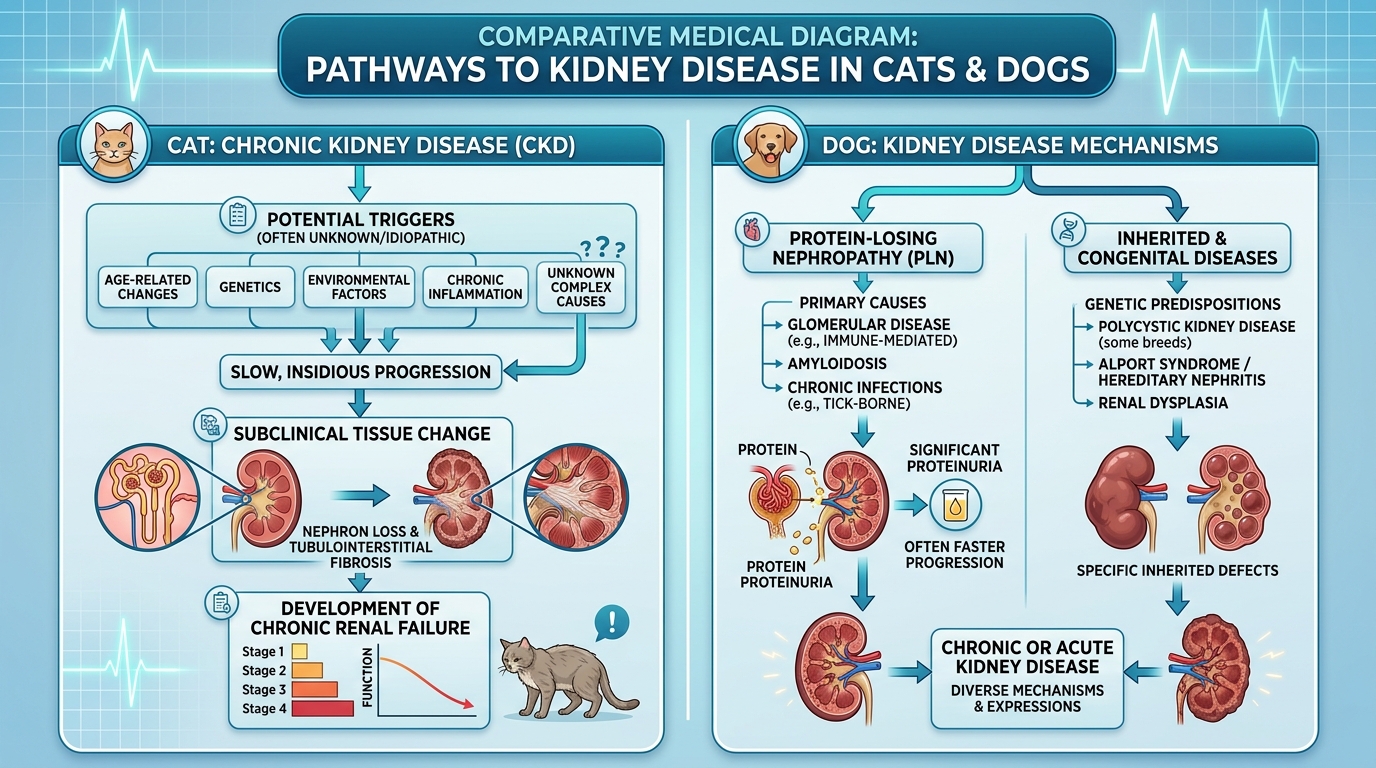
In cats, the single commonest form of chronic kidney disease is a slow, smouldering change in the kidney tissue that vets call chronic tubulointerstitial nephritis, and in the majority of cases there is no identifiable single cause behind it. The kidney's working tissue is gradually replaced by scar tissue over months and years, the cause unknown, the process simply one of long, slow wear. The medical word for "cause unknown" is idiopathic, and I want to frame that plainly rather than dismissively: it is not that your vet has failed to look, it is that, with current knowledge, most feline kidney disease genuinely does not have a single pinpointable trigger. It is, in large part, a disease of ageing cats, and that is no one's fault.
That said, there are named causes worth knowing, because some of them change the plan. Polycystic kidney disease, or PKD, is an inherited condition in which fluid-filled cysts form in the kidneys from birth and gradually crowd out the working tissue, eventually causing kidney failure, usually in middle age. It is autosomal dominant, caused by a fault in a gene known as PKD1, and is seen above all in Persians and Persian-related breeds such as the Exotic Shorthair, with a gene test now available to identify it. Beyond PKD, the named causes include glomerulonephritis, where the kidney's tiny filters become inflamed; lymphoma and other tumours affecting the kidney; obstruction by stones in the ureters, the tubes draining the kidneys; and pyelonephritis, a kidney infection. There is also an important interaction with an overactive thyroid, common in older cats, which our article on the thyroid connection covers, because treating one affects the other.
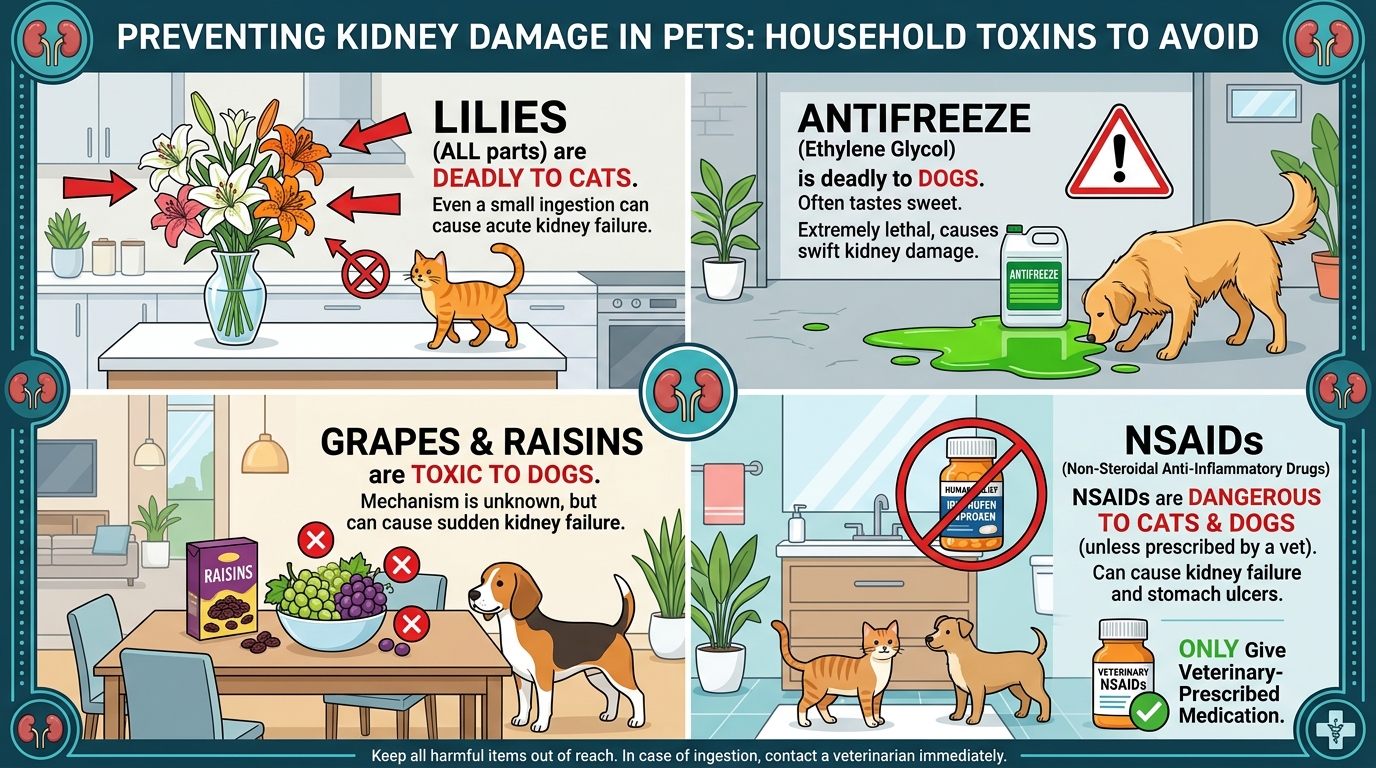
Finally, some feline kidney disease begins as a sudden, acute injury that then leaves lasting damage. The most important of these to know, because it is both common and an outright emergency, is lily poisoning: many lilies are severely toxic to cats, and even small exposures, a nibbled leaf, pollen groomed from the coat, can cause devastating kidney injury. We will return to toxins shortly, but if you have a cat, treat lilies as something to keep out of your home entirely.
Dogs: more often a leak or an inheritance
Dogs tell a different story, and it is the part of the kidney-disease picture that the internet, so focused on cats, tends to under-tell. While dogs certainly get age-related kidney wear too, a larger share of canine kidney disease involves the kidney's filters, the glomeruli, becoming leaky, a pattern called glomerular or protein-losing disease, which is proportionally more important in dogs than in cats. This is why, as our article on proteinuria explains, protein in the urine takes centre stage in canine kidney disease in a way it does not for most cats.
Inheritance also looms larger in dogs. A number of breeds carry familial kidney conditions, and these are the dog-specific causes most worth knowing, though I will flag that the precise breed associations are exactly the kind of detail that should be confirmed against current sources rather than taken as folklore. Inherited glomerular and filtering diseases have been described in the English Cocker Spaniel and English Springer Spaniel, which carry recessive forms, and in the Samoyed, which carries an X-linked form that is severe in males. Bull Terriers and Dalmatians carry a hereditary nephritis too, and a protein-losing kidney disease is associated with the Soft-Coated Wheaten Terrier, while the Shar Pei is prone to a kidney problem linked to amyloid protein deposits, and the Bernese Mountain Dog to a form of filter inflammation. Some dogs are also simply born with abnormally formed kidneys, a condition called renal dysplasia. The practical point is that in a younger dog, or a breed with a known predisposition, an inherited cause is genuinely on the table, which is unusual in cats.
The remaining canine causes include pyelonephritis and ascending infections travelling up from the lower urinary tract; and, importantly in some regions, leptospirosis, a bacterial infection that can severely damage the kidneys and which is one of the diseases routine vaccination aims to prevent. As in cats, an acute injury can also tip a dog into lasting kidney disease, which brings us to toxins.
When a sudden event becomes a lasting problem
Not all kidney disease creeps in slowly. Sometimes a single acute injury damages the kidneys badly enough to leave permanent, chronic disease behind, what vets call acute-on-chronic, and a number of these acute insults are poisonings that are, crucially, preventable. This is the most actionable part of the whole article, so it is worth your attention.
For cats, the standout is lilies, as already mentioned, severely toxic and an emergency. For dogs, the common household nephrotoxins include antifreeze, which contains ethylene glycol and is intensely poisonous to the kidneys, and grapes, raisins, and currants, which can cause kidney injury in dogs through a mechanism still not fully understood. For both species, the non-steroidal anti-inflammatory drugs, the NSAIDs, can damage the kidneys if given inappropriately, which is exactly why human painkillers should never be given to a pet and why prescribed veterinary NSAIDs are used with care, especially where the kidneys are already vulnerable. Our articles on prevention and on toxins go into this in more depth, but the headline is simple and empowering: a meaningful slice of kidney damage is preventable, and keeping these specific things away from your pet is something entirely within your control.
Why the cause sometimes changes the plan
You might reasonably ask why any of this matters, if the management of kidney disease is broadly similar whatever the cause. The answer is that the cause sometimes genuinely changes what your vet does, which is why chasing it down early can be worth the effort.
If the disease is protein-losing, the kind more common in dogs, that shifts the focus toward measuring the urine protein, the UP/C, and toward the kidney-protecting medicines that reduce the leak, which our article on proteinuria covers. If there is an infection such as pyelonephritis, or an obstruction by a stone, those may be directly treatable in a way that idiopathic age-related wear is not, and treating them can change the course markedly. And if an inherited condition is identified, that has implications not just for your pet's monitoring but, for breeders, for future litters. So while much of kidney-disease care is shared regardless of cause, the cause can open up specific, sometimes more hopeful, avenues, and that is the case for not simply shrugging at the "why."
What you can and cannot control
What most owners really want to know is a clear accounting of what is and is not within your power, guilt included.
The plain truth is that most feline idiopathic kidney disease, the slow age-related kind, is not currently preventable. You did not cause it, and there was very likely nothing you could have done to stop it. The same goes for inherited forms in both species: a dog or cat born with the genes for a kidney condition was always going to be at risk, through no failing of their owner. Carrying that fact clearly can lift a real weight, so I want to state it plainly: in the great majority of cases, this is not something you brought about.
But there are real levers in your hands, and they are worth knowing. Keeping the specific toxins away from your pet, lilies for cats, antifreeze and grapes and raisins for dogs, and never giving human painkillers, prevents a genuine share of acute kidney damage. Good dental care matters, because chronic mouth infection is thought to place a burden on the kidneys over time. Keeping your pet well hydrated supports kidney health. And, above all, early detection, through senior health checks and the SDMA blood test our other articles describe, catches kidney disease at the stage where management does the most good. So the balance is this: you cannot undo the genetics or reverse the slow wear of ageing, but you can avoid the avoidable injuries and catch the disease early, and those are not small things.
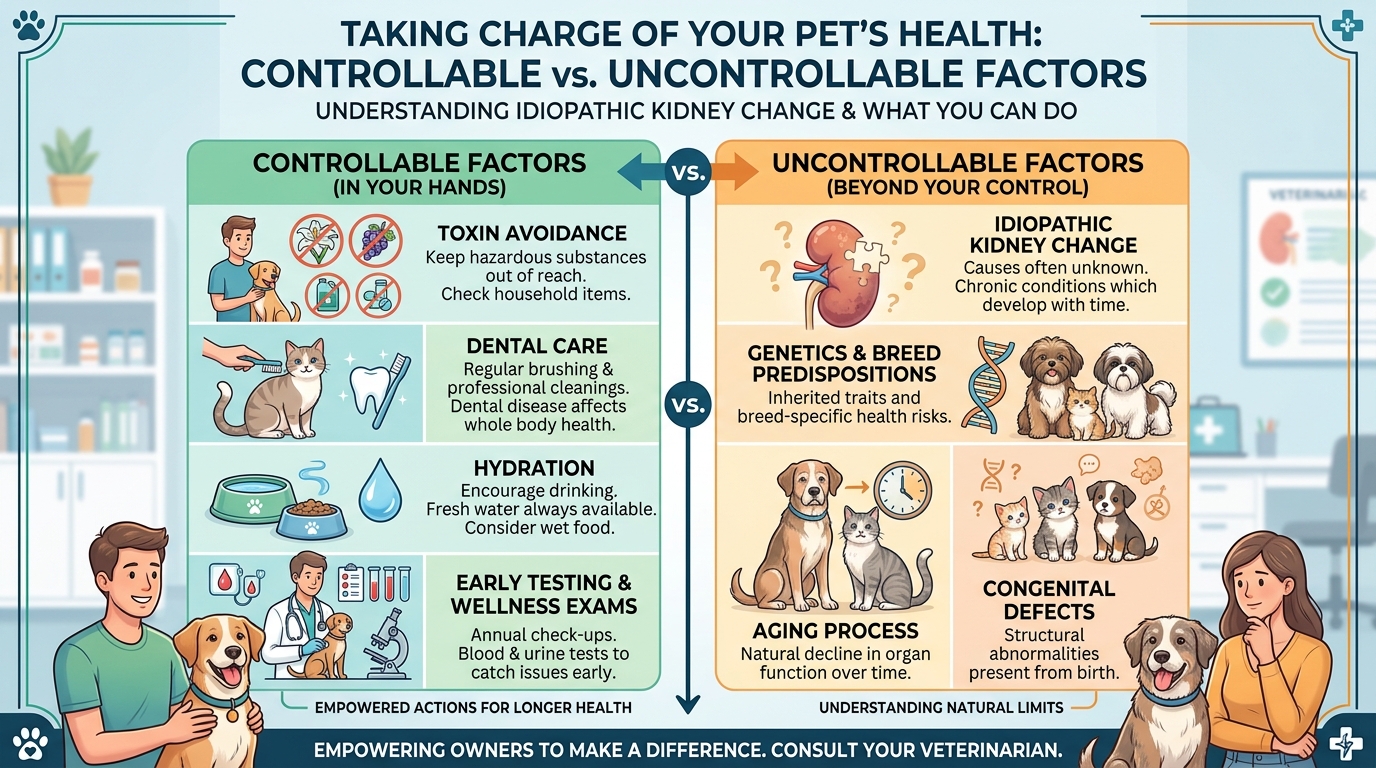
Keep a short mental checklist of the avoidable risks: no lilies in a cat household, antifreeze and grapes and raisins kept well away from dogs, no human painkillers ever, dental care kept up, water always available, and senior pets screened. That list will not change the cause of the disease your pet already has, but it is the genuine, useful answer to the deeper question hiding inside "why did this happen," which is "and what can I actually do?" The answer is: more than you might think, and none of it requires blaming yourself for what came before.
References
- International Renal Interest Society (IRIS). IRIS Staging of CKD (modified 2023).
- Sparkes AH, Caney S, Chalhoub S, et al. ISFM Consensus Guidelines on the Diagnosis and Management of Feline Chronic Kidney Disease. Journal of Feline Medicine and Surgery, 2016.
- O'Neill DG, Elliott J, Church DB, McGreevy PD, Thomson PC, Brodbelt DC. Chronic kidney disease in dogs in UK veterinary practices: prevalence, risk factors, and survival. Journal of Veterinary Internal Medicine, 2013.
- Littman MP. Protein-losing nephropathy in small animals. Veterinary Clinics of North America: Small Animal Practice, 2011.
See where your pet stands today
Tracking is the other half of managing kidney disease. Drop in the latest bloods to see the IRIS stage, then follow the trend as treatment settles in.
Check the IRIS stageYou're not doing this alone
Compare treatment journeys and talk to owners managing kidney disease. Free to join.
Join PetsLikeMine