


Living Well With Kidney Disease: Pets Who Thrive for Years
Alastair Greenway
BVM&S MRCVS
The word "kidney disease" lands like a countdown for most owners. It sounds final, the mind leaps to the worst, and a frightened search online rarely helps. Having looked after a great many kidney patients over the years, I can tell you this: for a great many pets, especially those caught early, kidney disease is not a countdown at all. It is a chapter, often a long and steady one, measured in years rather than weeks, and lived for the most part as an ordinary, contented life.
That is the hopeful counterweight to all the worry, and it is a truthful one. Kidney disease is serious and it is progressive, and I will not pretend otherwise. But serious is not hopeless, and progressive does not mean fast. Let me show you what the years ahead can really look like.
What the survival data actually says
I will give it to you straight, because false comfort helps no one and you deserve the real picture. How long a pet lives with kidney disease varies a great deal, and it depends most of all on how advanced the disease is when it is found. Even within that sober framing, there is a lot of room for hope.
In cats, the evidence is genuinely encouraging. A study following cats on a prescription renal diet found they lived a median of around 633 days, more than double the 264 days of cats kept on an ordinary diet, and many individual cats live well beyond that. Cats diagnosed at the earlier stages frequently go on to have several good years; it is mainly the most advanced stage, often found late, that carries a short outlook. The single biggest predictor is not bad luck or breed, it is the stage at which the disease is caught and how well it is managed from there.
In dogs the picture is more variable, and harder to put a single number on, because canine kidney disease has more different underlying causes. The same principles hold firmly, though: earlier diagnosis, good control of the things that can be controlled, and keeping good body condition all tilt the odds toward more time, and better time.
Two things are worth holding onto. First, these are ranges and medians, not promises or sentences; your pet is an individual, not a statistic, and plenty live beyond the averages. Second, the diet and the management genuinely move these numbers, which means a real part of your pet's outlook sits in your hands and your vet's, rather than being fixed at diagnosis.
Why the stage at diagnosis matters most
If one theme runs through all of that, it is this: the earlier kidney disease is found, the longer and better the outlook tends to be. That is the whole argument for early detection, and it is why your vet may have picked this up on a routine senior blood test before your pet seemed unwell at all.
A central part of modern early detection is a blood marker called SDMA, which can flag failing kidney function earlier than the older creatinine measurement alone, sometimes well before any outward signs appear. If your pet was diagnosed early, perhaps to your surprise, that is genuinely good news, because it means you are starting management with more kidney function still in reserve. Understanding exactly what stage your pet is at, and what that means, is worth doing properly: our guide to understanding IRIS staging walks through it, and our plain-English guide to reading your pet's kidney bloods explains the numbers behind it.
What thriving actually looks like
It helps to know what you are aiming for, because it is not quite what many owners assume. Thriving with kidney disease does not mean perfect blood results. It means a pet who, on most days, eats with interest, holds their weight, moves about and rests comfortably, and still takes evident pleasure in the things that make up their particular life: the sunny windowsill, the morning walk, the lap at the end of the day.

Numbers matter, and your vet will watch them closely, but they serve quality of life rather than the other way around. A cat whose creatinine is a little higher than last time but who is bright, eating well and clearly happy is doing better, in every way that matters to them, than a pet with prettier numbers who is miserable. Keep your eye on the animal in front of you, not only the printout.
Your part in buying the good years
Here is the genuinely empowering part. A real share of how well your pet does comes down to consistent, unglamorous, everyday management, and that part is yours to give. The proven levers are not complicated, and we cover each in its own article, but they are worth recapping here, because together they are what buys the good years.
The renal diet is the single best-evidenced step, controlling phosphorus and easing the load on the kidneys. Good hydration helps enormously, through wet food, water encouragement and, where your vet advises, subcutaneous fluids given at home. Phosphate control matters, with the diet first and binders added if it is not enough. Blood-pressure control protects the kidneys from further quiet damage. The comfort medicines keep nausea away and appetite up. And regular monitoring catches changes while they are still small and easy to act on.
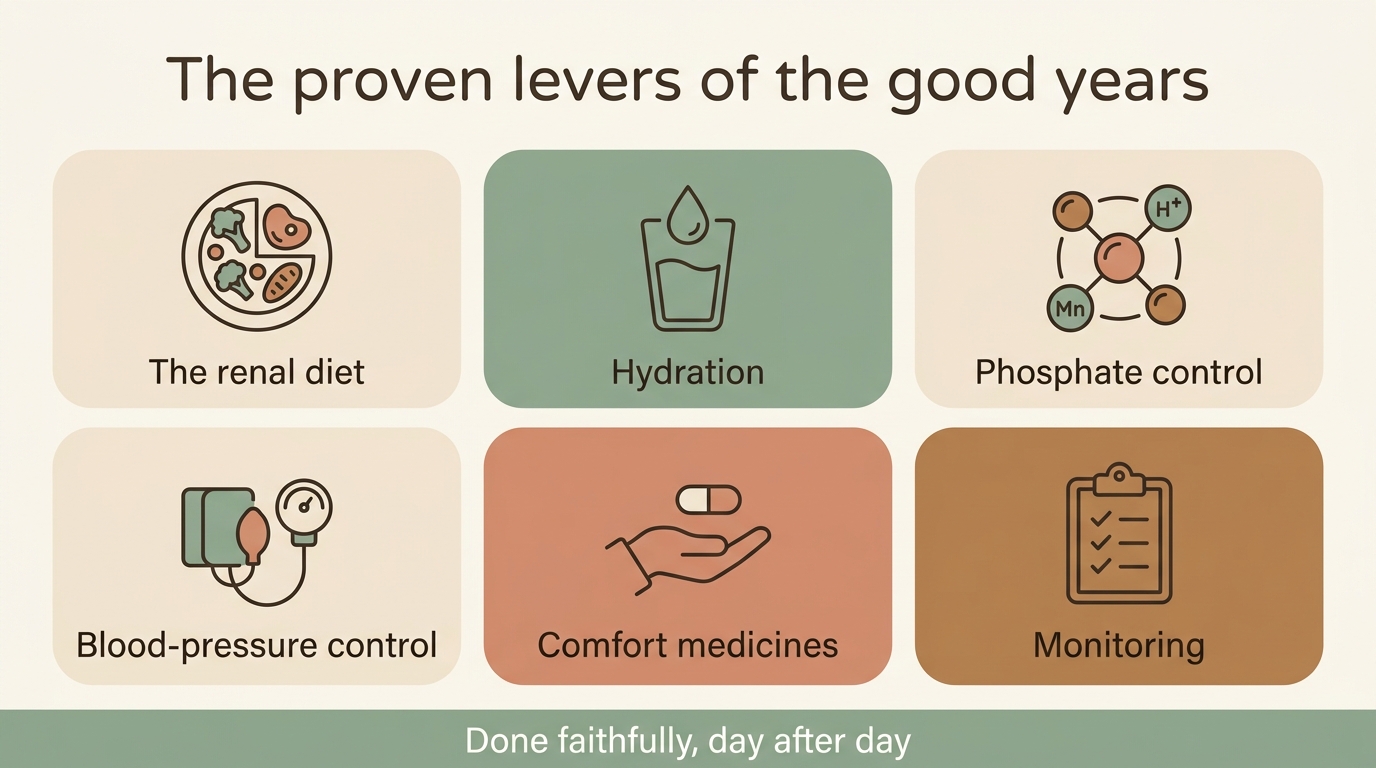
None of these is heroic on its own. What makes them work is doing them faithfully, day after day, month after month. Consistency genuinely beats heroics here. The owner who feeds the diet reliably, keeps up the hydration, gives the medicines and turns up for the rechecks is doing more for their pet's survival than any single dramatic intervention could.
The shapes the road can take
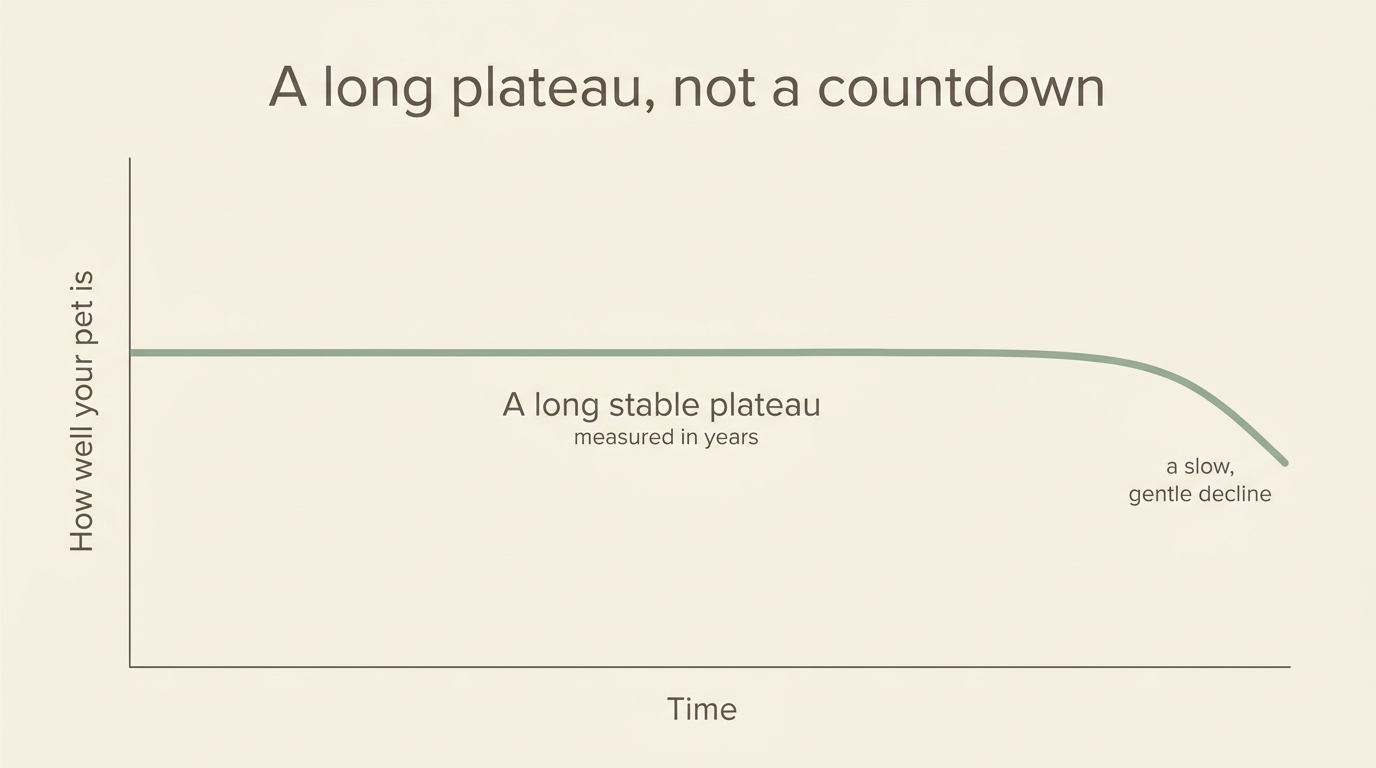
Kidney disease does not follow one script, and it helps to know the common shapes it can take so that nothing blindsides you. For many pets there is a long, stable plateau, months or years in which, with good management, things hold remarkably steady and life carries on much as before. For others the path is a slow, gentle downhill, a gradual drift over a long time that good management softens. And sometimes it comes in steps: a stable stretch, then a drop to a new lower level, then stability again at that level.
Knowing this lets you hold two true things at once. Realistic expectations, because the disease is progressive and the long-term trend is, eventually, downward. And genuine hope, because the plateau can be long, the decline can be slow, and the good stretches can be very good indeed. Most pets, most of the time, are somewhere on a stable or slowly changing part of that curve, not in crisis.
Looking after yourself, too
One last thing. Caring for a pet with a chronic condition is a marathon, not a sprint, and it can quietly wear you down: the daily medicines, the watching and the worrying, the cost, and the emotional weight of loving an animal you know you will one day lose. All of that is normal, and it matters, because a depleted carer cannot give their best.
So be as kind to yourself as you are to your pet. Lean on your vet, who would far rather you asked than struggled in silence. Share the load with the people around you, and with others walking the same path, in the PetsLikeMine community and beyond, who understand it in a way few others can. Pace yourself for the long run. The later parts of this stage, when things do eventually get harder, are far easier to meet from a place of support than from exhaustion, and we have written about them gently, for whenever you need them.
References
- Ross SJ, Osborne CA, Kirk CA, Lowry SR, Koehler LA, Polzin DJ. Clinical evaluation of dietary modification for treatment of spontaneous chronic kidney disease in cats. Journal of the American Veterinary Medical Association, 2006.
- Elliott J, Rawlings JM, Markwell PJ, Barber PJ. Survival of cats with naturally occurring chronic renal failure: effect of dietary management. Journal of Small Animal Practice, 2000.
- Jacob F, Polzin DJ, Osborne CA, Allen TA, Kirk CA, Neaton JD, Lekcharoensuk C, Swanson LL. Clinical evaluation of dietary modification for treatment of spontaneous chronic renal failure in dogs. Journal of the American Veterinary Medical Association, 2002.
- Boyd LM, Langston C, Thompson K, Zivin K, Imanishi M. Survival in cats with naturally occurring chronic kidney disease (2000-2002). Journal of Veterinary Internal Medicine, 2008.
- Parker VJ, Freeman LM. Association between body condition and survival in dogs with acquired chronic kidney disease. Journal of Veterinary Internal Medicine, 2011.
- International Renal Interest Society (IRIS). IRIS Treatment Recommendations for CKD in Cats and Dogs (2023).
See where your pet stands today
Tracking is the other half of managing kidney disease. Drop in the latest bloods to see the IRIS stage, then follow the trend as treatment settles in.
Check the IRIS stageYou're not doing this alone
Compare treatment journeys and talk to owners managing kidney disease. Free to join.
Join PetsLikeMine