


Concurrent Conditions: When Kidney Disease Doesn't Travel Alone
Alastair Greenway
BVM&S MRCVS
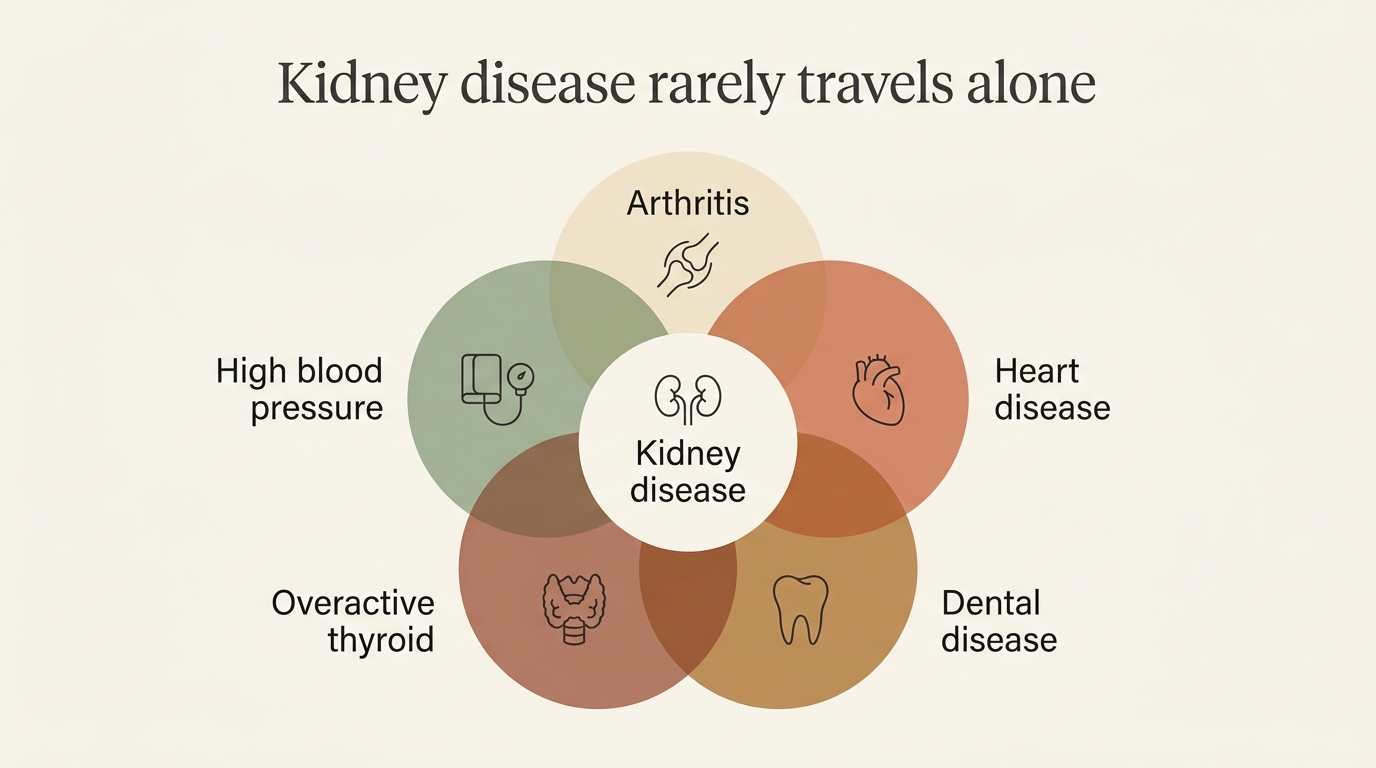
Older bodies rarely have just one thing wrong with them, and kidneys are no exception. By the time a cat or dog is old enough to develop chronic kidney disease, they are often old enough to be carrying one or two other conditions as well, and those conditions do not sit in tidy, separate boxes. They interact. Treating one can move another. A medicine that helps the joints can lean on the kidneys. A treatment that fixes the thyroid can reveal a kidney problem that was hiding all along. This is the part of kidney care that single-condition advice handles worst, and it's where the whole picture has to be managed together rather than disease by disease. This guide is about those interactions: how kidney disease behaves alongside its most common neighbours, and how the pieces are balanced as a whole.
A word on what this article is and is not. Each of the neighbouring conditions, and each of the kidney treatments, has its own fuller guide elsewhere in this space, and I'll point you to them rather than repeating them here. The job of this piece is the joins, the way the conditions pull on one another, because that's the bit that's hard to find and easy to get wrong.
Arthritis and CKD: the pain-relief tightrope
This is the overlap I'm asked about most, and the one that causes owners the most distress, so it's the one to get right. Arthritis and kidney disease are both extremely common in older pets, so a great many animals have both, and that combination creates a genuine dilemma: the most familiar arthritis painkillers are exactly the drugs we have to be most careful with when the kidneys are compromised.
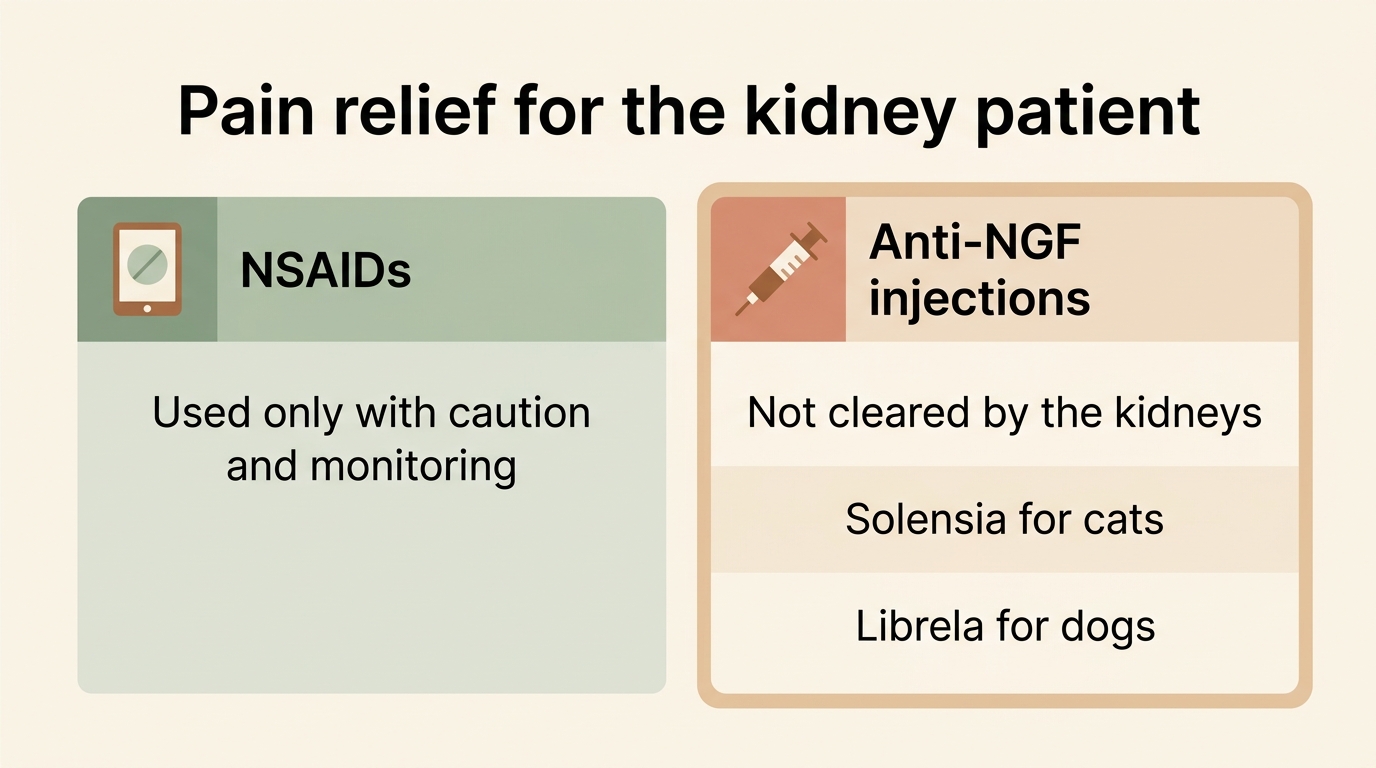
The drugs in question are the non-steroidal anti-inflammatory drugs, the NSAIDs, the mainstay of arthritis pain relief. They work well, but they can reduce blood flow to the kidneys, which is a real concern in a patient whose kidneys are already struggling. What matters to understand, though, is that this isn't a simple, flat ban. The current position is more nuanced: NSAIDs are used with real caution in kidney patients, and where they are used it's at the lowest effective dose, with careful veterinary supervision and monitoring of kidney values, and the decision depends on the individual pet, how stable and what stage their kidney disease is, and what else is going on. This is very much a conversation for your own vet, who can weigh the comfort your pet needs against the caution their kidneys demand, and our dedicated article on treating arthritis pain when the kidneys are struggling goes into that balance in depth.
There is genuinely good news here, though, because the picture is far more hopeful than it was a few years ago. A class of arthritis treatment now sidesteps the kidney problem in an elegant way: the anti-nerve-growth-factor monoclonal antibodies, given as a monthly injection, frunevetmab for cats, sold as Solensia, and bedinvetmab for dogs, sold as Librela. These are antibody treatments, and crucially they are cleared from the body by the normal processes that handle proteins, rather than being processed by the kidneys, so they do not place the same demand on the kidneys that NSAIDs do. That makes them a particularly valuable option for the arthritic pet with kidney disease, and for many such pets they have changed what good pain relief looks like. Our article on Solensia covers the feline version, and our complete arthritis medication guide covers the wider picture including Librela, with the full arthritis hub at our arthritis section. The essential message for the kidney patient is this: an arthritic pet with kidney disease can very often still be made comfortable, safely, so don't let a fear about painkillers leave your pet in pain. Talk to your vet about the options, because there are good ones.
When treating the thyroid uncovers a kidney problem (cats)
This overlap, specific to cats, produces one of the most confusing and upsetting situations owners meet, and understanding it in advance takes the fear out of it. An overactive thyroid, hyperthyroidism, is common in older cats, and it has a hidden effect on the kidneys: the excess thyroid hormone drives more blood through the kidneys than normal, which artificially flatters the kidney blood results and can hide underlying kidney disease completely.
The confusing part comes with treatment. When the thyroid is treated and brought back to normal, that artificial boost to kidney blood flow falls away, and the kidney values that were being masked can rise into view, sometimes revealing a chronic kidney disease that was there all along but hidden. To an owner, this looks alarming and unfair: I treated the thyroid as advised, and now my cat has kidney disease, so the treatment must have caused it. But that is not what has happened. The treatment did not cause the kidney disease. It unmasked a problem that the thyroid was concealing, and that kidney disease was present, and would have declared itself, regardless. This is precisely why your vet manages the two together as a careful balance rather than a race, often choosing a reversible thyroid medication first so the effect on the kidneys can be watched and the approach adjusted, and why they will check the kidney values after starting thyroid treatment. It's also why avoiding over-treatment of the thyroid matters, since pushing the thyroid too low has its own downsides for the kidneys. Managed well, with both conditions kept in view, most of these cats do perfectly well, but the key is knowing in advance that the kidney values appearing after thyroid treatment is an unmasking to be managed, not a catastrophe the treatment created.
Blood pressure: the thread that runs through everything
High blood pressure deserves a brief mention here not because it is a separate topic, we cover it fully in our article on high blood pressure and kidney disease, but because it is the thread that ties so many of these conditions together. Hypertension can accompany kidney disease, an overactive thyroid, and heart disease alike, and it silently damages the kidneys, the eyes, and the brain while giving no outward sign. That makes it a common thread running through the whole comorbidity picture, and one more reason every pet with any of these conditions should have its blood pressure measured and monitored, as that article explains. Where several conditions overlap, controlling the blood pressure is often one of the most valuable things that can be done for all of them at once.
Diabetes and CKD
When diabetes and kidney disease occur together, the main difficulty is that their ideal diets pull in different directions: managing diabetes calls for one kind of dietary approach, while managing kidney disease calls for the renal diet our nutrition guides describe, and the two priorities can conflict. There is also a heavier monitoring load, since both conditions need regular checks and both affect the body's fluid balance, so the two have to be watched together. The message here is one of coordination: when a pet has both, the two management plans must be set and balanced by one vet who sees the whole picture, rather than each condition being managed in isolation, because a change made for one can unsettle the other. With that coordination, both can be managed, but it takes a single coordinating hand.
Heart disease and the fluid dilemma
The combination of kidney disease and heart disease creates a particular tension that vets call the cardiorenal problem, and it centres on fluid. A kidney patient often benefits from extra fluid to stay well hydrated, including, in more advanced cases, the fluids given under the skin that our subcutaneous-fluids guide describes. A heart patient, by contrast, can be tipped into trouble by too much fluid, because a struggling heart cannot cope with fluid overload. So when a pet has both conditions, the fluid support that helps the kidneys has to be weighed against the load it places on the heart, and any fluid plan is individualised, and sometimes deliberately limited, when the heart is involved. This is firmly a balance for your vet to strike for your individual pet, and it is a good example of why the whole body, not just the kidneys, has to be kept in view.
Don't overlook the teeth
Dental disease is the comorbidity owners least expect to matter for the kidneys, but it does, in two ways. First, chronic pain and infection in the mouth sap a pet's appetite, and a poor appetite is a serious problem in a kidney patient you are already working hard to keep eating well, as our guides on diet and on comfort medications discuss. Second, treating dental disease usually requires an anaesthetic, and anaesthesia in a kidney patient needs extra care, because the kidneys are sensitive to changes in blood flow and pressure. Reassuringly, this risk is manageable: modern, kidney-conscious anaesthetic protocols, with attention to fluid support and blood pressure, allow many kidney patients to undergo necessary dental treatment safely, and the decision is a considered weighing of the risk of the anaesthetic against the real benefit of removing a source of pain and infection. So dental care should not be written off as too risky out of hand. It's a risk-versus-benefit judgement to make with your vet, and often the benefit to a struggling appetite is well worth it.
Treat the pet, not the lab value
Step back from the individual overlaps and a single principle emerges, and it is the heart of managing a pet with more than one condition: treat the pet, not the lab value. When several conditions and their treatments are pulling in different directions, the goal is not to perfect any one number on any one blood test, but to keep the whole animal feeling well and living a good life, which sometimes means accepting a less-than-perfect figure in one area to keep another in check. This is why having one vet conducting the whole orchestra matters so much, someone who sees every condition and every medicine together and can balance them as a whole, rather than several separate plans that do not know about each other.
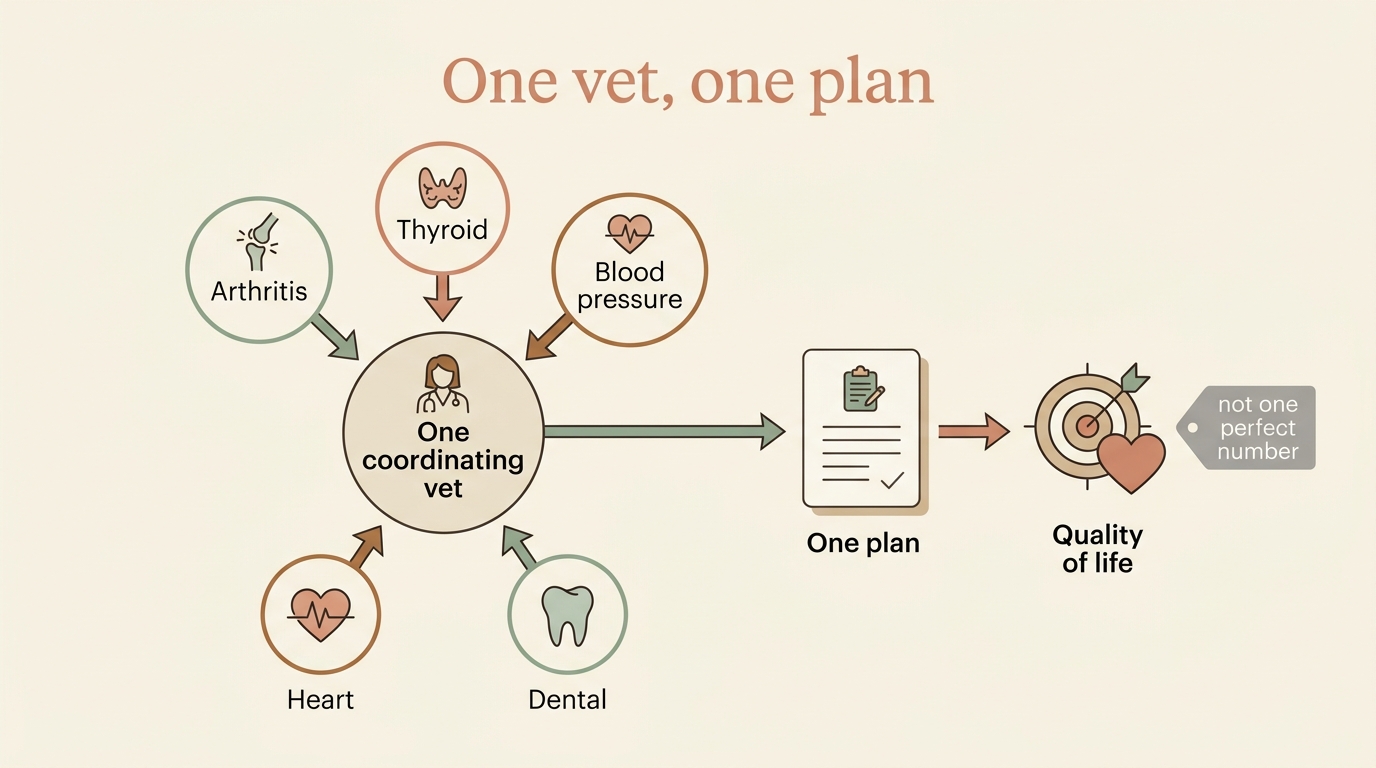
And that points to the one job that is squarely yours as the owner, the thing that makes the whole coordinated approach possible: make sure every clinician who sees your pet knows about every condition they have and every medicine and supplement they are on. If your pet sees more than one vet, or an out-of-hours service, or a specialist, carry that information with you, our medication and supplement schedule download is made for exactly this, so that no one treats one condition without knowing about the others. Comorbidities are managed best together, never in silos, and you are the thread that connects every part of your pet's care. Tell every vet everything, and you make it possible for them to treat the whole pet well.
References
- International Renal Interest Society (IRIS). IRIS Staging of CKD (2023).
- Sparkes AH, Caney S, Chalhoub S, Elliott J, Finch N, Gajanayake I, Langston C, Lefebvre HP, White J, Quimby J. ISFM Consensus Guidelines on the Diagnosis and Management of Feline Chronic Kidney Disease. Journal of Feline Medicine and Surgery, 2016.
- Taylor S, Gruen M, KuKanich K, Lascelles BDX, Monteiro BP, Sampietro LR, Robertson S, Steagall PV. 2024 ISFM and AAFP consensus guidelines on the long-term use of NSAIDs in cats. Journal of Feline Medicine and Surgery, 2024.
- European Medicines Agency. Solensia (frunevetmab): summary of product characteristics.
- European Medicines Agency. Librela (bedinvetmab): summary of product characteristics. Marketing authorisation, 2020.
- Williams TL, Peak KJ, Brodbelt D, Elliott J, Syme HM. Survival and the development of azotemia after treatment of hyperthyroid cats. Journal of Veterinary Internal Medicine, 2010.
- Williams TL, Elliott J, Syme HM. Association of iatrogenic hypothyroidism with azotemia and reduced survival time in cats treated for hyperthyroidism. Journal of Veterinary Internal Medicine, 2010.
- Pouchelon JL, Atkins CE, Bussadori C, et al. Cardiovascular-renal axis disorders in the domestic dog and cat: a veterinary consensus statement. Journal of Small Animal Practice, 2015.
See where your pet stands today
Tracking is the other half of managing kidney disease. Drop in the latest bloods to see the IRIS stage, then follow the trend as treatment settles in.
Check the IRIS stageYou're not doing this alone
Compare treatment journeys and talk to owners managing kidney disease. Free to join.
Join PetsLikeMine