

Chronic Kidney Disease
Progressive loss of kidney function over months to years.
5
Pets tracked
28
Expert guides
14
Members
Expert guides
Chronic Kidney Disease in Dogs: The Owner's Complete Guide
Go looking for information after your dog is diagnosed with chronic kidney disease, or after a vet mentions "borderline kidney values," and you'll hit something frustrating fast: almost everything written about pet kidney disease is about cats. Page after page assumes a feline patient. Dogs get kidney disease too, it matters just as much, and...
Chronic Kidney Disease in Cats: What Every Owner Needs to Know
A diagnosis of chronic kidney disease is not the end of your cat's good life. That is the single most important thing to say, before any of the detail, because the word "kidney" lands heavily and the internet fills in the rest. The disease is usually not curable, and there is no point pretending otherwise,...
Is Your Pet at Risk of Kidney Disease? Breeds and Early Signs
Kidney disease is at its most manageable when it's caught early, and yet the early signs are precisely the ones owners are most likely to wave away as "just getting older." A cat drinking a bit more from the tap. A dog that has lost a little weight without anyone quite noticing when. A coat...
What Causes Chronic Kidney Disease in Cats and Dogs?
After a kidney diagnosis, owners almost always ask the same thing, often with a catch in their voice: why? Why did this happen, and, just beneath that, did I cause it? It is one of the most natural questions in the world, and it deserves a straight answer. So here it is, up front: sometimes...
Your Pet Has Kidney Disease: The First 30 Days
A kidney disease diagnosis lands hard. One moment your pet is just a bit off, drinking a little more, perhaps a touch thinner, and the next a vet is using words like "chronic" and "kidney" and "stages," and the floor tilts. Then you get home, type it into a search engine, and within about ninety...
Reading Your Pet's Kidney Bloods: A Plain-English Guide
A printout of your pet's kidney bloods is a wall of abbreviations and numbers that mean very little at first glance. Creatinine, SDMA, urea, phosphate, a thing called specific gravity, each with a value and a reference range, some perhaps flagged high. The natural pull is to scan for the scariest number and brace. There...
Understanding IRIS Staging: What Your Pet's Stage Actually Means
Your vet has used a word that sounds clinical and a little frightening: your dog or cat is at "stage 2", or "stage 3", kidney disease. It is natural to hear that as a verdict, a fixed position on a countdown. It is not. A stage is a map reference. It tells you and your...
Potassium, Anaemia and Acidosis: The Supporting Cast of Kidney Disease
Behind the headline kidney numbers, the creatinine and SDMA and phosphate, sit a handful of supporting problems that kidney disease can cause: low potassium, anaemia, and a gradual acidity in the blood. Each one sounds alarming when it appears as an unfamiliar word on a results sheet, and each can feel like a fresh disaster...
Helping Your Pet Feel Better: Comfort Medications for Kidney Disease
Some kidney medicines slow the disease. The ones in this article do something just as precious, and more immediate: they make your pet feel better today. Nausea, a fading appetite, and a low-grade, persistent queasiness are common in kidney disease, they are genuinely miserable for a pet, and they are deeply treatable. Yet time and...
Protein in the Urine: Why the UP/C Ratio Matters, Especially in Dogs
Protein in the urine sounds like a minor footnote on a results sheet, and it is anything but. A kidney filter that leaks protein is both a sign that damage has occurred and, it appears, something that helps drive the damage faster. It is also one of the more treatable parts of kidney disease, which...
High Blood Pressure and Kidney Disease: The Silent Risk
High blood pressure travels alongside kidney disease far more often than most owners realise, and it is dangerous for one particular, unsettling reason: it is silent. There is usually nothing to see and no symptom to notice, right up until something breaks, and in pets the first visible sign can be sudden blindness. That is...
Phosphate Binders: When the Renal Diet Isn't Enough
Phosphate is the number the whole renal diet is quietly chasing, as our guide to that diet explains. Controlling it is one of the few things genuinely shown to change the course of kidney disease, as well as how well your pet feels day to day. The renal diet is the first and most important...
The Renal Diet: The Single Most Important Treatment You Control
Of everything in the kidney-disease toolkit, the prescription renal diet has the best evidence for extending your pet's good-quality life. And it is the one big lever you control directly, at the food bowl, every day. So when your vet tells you to switch a dog or cat to a "kidney diet," and you find...
Getting a Cat to Eat the Renal Diet: The Owner's Battle Plan
Getting a cat onto a prescribed kidney diet is one of the genuinely hard parts of managing kidney disease, and almost every owner struggles with it. If your cat has turned its nose up at the food your vet prescribed and is sitting by an untouched bowl, you are not failing, and your cat is...
Everyday Life with a Kidney Patient: Litter, Comfort and Routine
A kidney diagnosis can feel as though it is about to take over your whole house, turning your home into a clinic and your days into a timetable of treatments. It does not have to be that way. A handful of small, sensible changes to your pet's environment and your daily routine make caring for...
Weight and Muscle: The Home Signs That Matter Most
When an older pet slowly loses weight, it is the easiest thing in the world to put it down to age. "She's just getting on," we tell ourselves, "they get a bit lighter as they age." Sometimes that is true. But in a pet with kidney disease, gradual weight loss and the quiet wasting of...
Keeping Your Pet Hydrated: A Water Strategy for Kidney Disease
Here is a quiet paradox at the heart of kidney disease: a pet can be drinking more than ever and still be running closer to dehydration than a healthy animal. That is because failing kidneys lose the ability to hold onto water, so they pour it out in dilute urine faster than drinking can quite...
Subcutaneous Fluids at Home: A Complete Beginner's Guide
A needle, at home, given by me? Is that cruel? Could I actually do it? When a vet first suggests giving fluids under the skin at home, most owners feel some mix of alarm and doubt, and those are the questions that surface. So let me reassure you straight away. Thousands of ordinary owners, with...
Concurrent Conditions: When Kidney Disease Doesn't Travel Alone
Older bodies rarely have just one thing wrong with them, and kidneys are no exception. By the time a cat or dog is old enough to develop chronic kidney disease, they are often old enough to be carrying one or two other conditions as well, and those conditions do not sit in tidy, separate boxes....
Complementary and Unproven Kidney Treatments: What the Evidence Says
Within minutes of a diagnosis, the internet fills with products promising to help: kidney "support" supplements, "natural" remedies, "detox" cures, each pitched at exactly the worried, loving owner you have just become. Some of these products have genuine, if modest, evidence behind them. Many have none. A few are simply exploitative, selling false hope to...
Advanced Kidney Treatments: Dialysis, Transplant and What's on the Horizon
Most owners of a pet with kidney disease eventually ask the same hopeful questions. Is there a transplant? A dialysis machine, like people have? A new drug just around the corner? They're completely natural questions, and you deserve a straight, UK-grounded answer to each one, an answer that neither crushes your hope nor sells you...
Acute-on-Chronic: Recognising and Responding to a Kidney Crisis
Chronic kidney disease is usually a slow story, a gentle drift measured in months and years, and most days with a kidney patient are quiet ones. But it can flare hard and fast, and when it does, the question a worried owner most needs answered is "is this an emergency?" The short answer is that...
What CKD Care Actually Costs in the UK: An Honest Breakdown
Money is part of the picture with kidney disease, a real and often heavy part, and almost nobody talks about it openly. Owners are left to discover the costs piecemeal, at the worst moments, with no sense of what the year ahead might hold. That silence helps no one, so this guide does the opposite....
The CKD Monitoring Schedule: What to Check and How Often, by Stage
A pet with kidney disease gets called back to the vet a lot, and then called back again, with a regularity that can start to feel like a lot. Plenty of owners quietly wonder the same thing at this point: is all this rechecking really necessary, or is the practice "milking it"? Let me answer...
Getting the Most From Your Vet Appointments With a Kidney Patient
Managing a pet with kidney disease is a partnership, and a slightly unusual one, because you and your vet each hold half of what is needed. You are the expert on your pet at home, how they are eating, drinking, moving, and behaving day to day, and your vet is the expert on the medicine,...
Living Well With Kidney Disease: Pets Who Thrive for Years
The word "kidney disease" lands like a countdown for most owners. It sounds final, the mind leaps to the worst, and a frightened search online rarely helps. So here is the thing I most want you to take from this article, having looked after a great many kidney patients over the years: for a great...
Quality of Life and Saying Goodbye: The Honest Conversation
This is the hardest article in our kidney guide, and there is no way to make the subject easy, so I will simply be gentle with it, and with you. Owners come to this question by two roads: some are facing it suddenly, some are quietly preparing for a day they can feel coming. Either...
When Kidney Disease Progresses: Late-Stage Care and Comfort
There comes a point in kidney disease where the condition you have managed so well for so long starts to ask more of you both. What follows is straightforward and practical, written to help you keep your pet comfortable and to know what to expect, with care rather than alarm. Late-stage kidney disease is a...
Breeds prone to Chronic Kidney Disease
Chronic Kidney Disease is seen more often in some breeds than others. If you have one of these, its breed guide covers what to watch for and where to get help.
Free chronic kidney disease downloads
Vet-built worksheets and trackers. Print at home, no signup required.
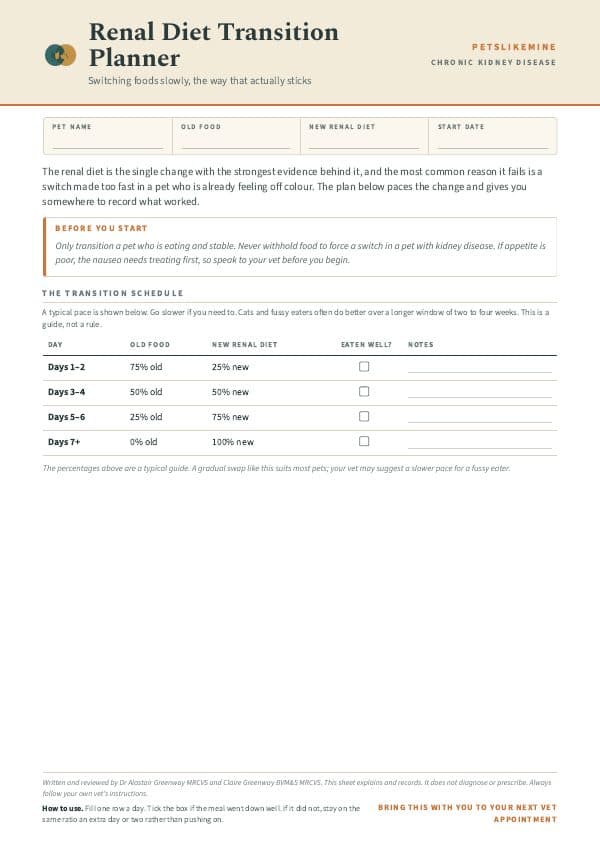
Renal Diet Transition Planner
PDF · 258 KBA day-by-day plan for moving your pet onto a renal diet at a pace that actually sticks. The transition ladder, tricks for winning round a fussy eater, and somewhere to record what worked. The renal diet is the change with the strongest evidence behind it, so it is worth getting right.
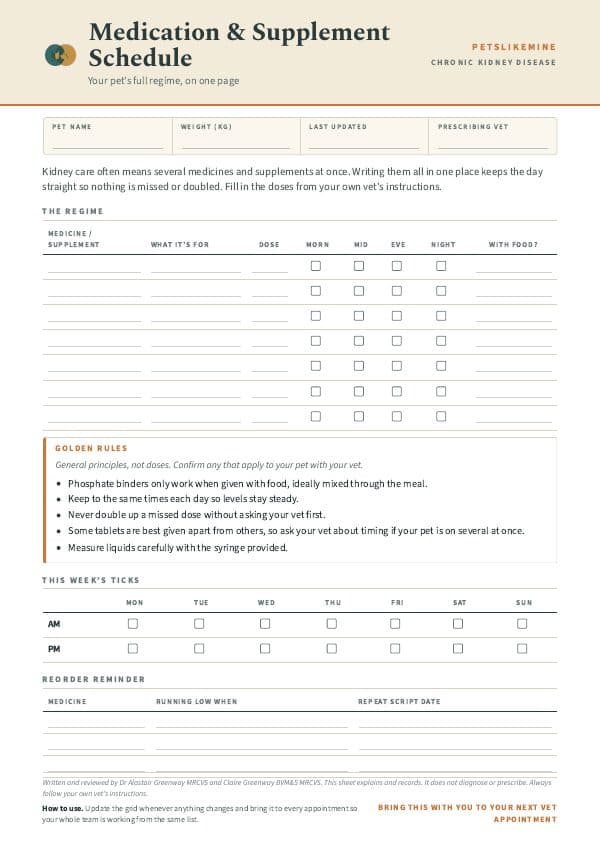
Medication & Supplement Schedule
PDF · 192 KBYour pet's whole kidney regime on one page: every medicine and supplement, what each is for, the dose you fill in from your vet, and a tick grid for the week. Keeps the day straight so nothing is missed or doubled.
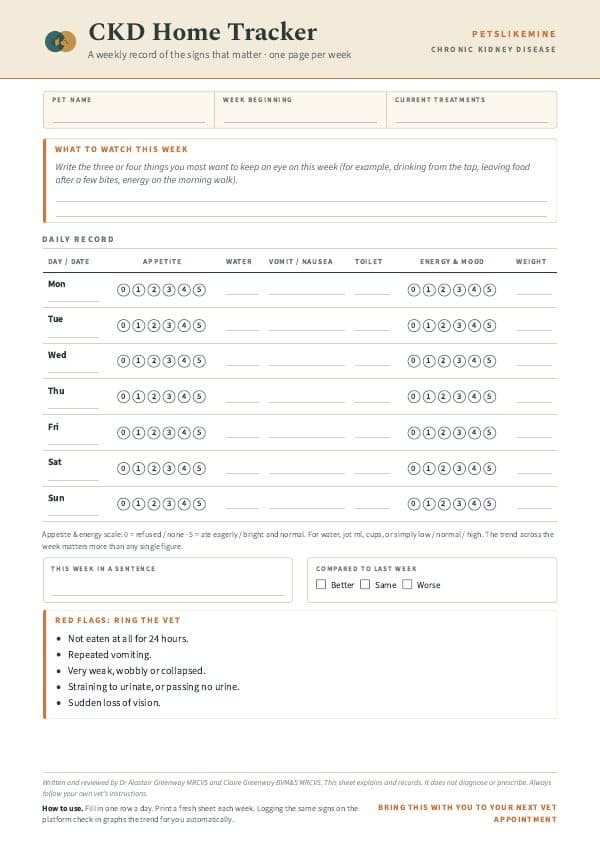
CKD Home Tracker
PDF · 236 KBA weekly record of the signs that matter in kidney disease: appetite, drinking, nausea, energy and weight, one page per week. The trend across the weeks tells you far more than any single day, and the red-flag list shows when to ring the vet.
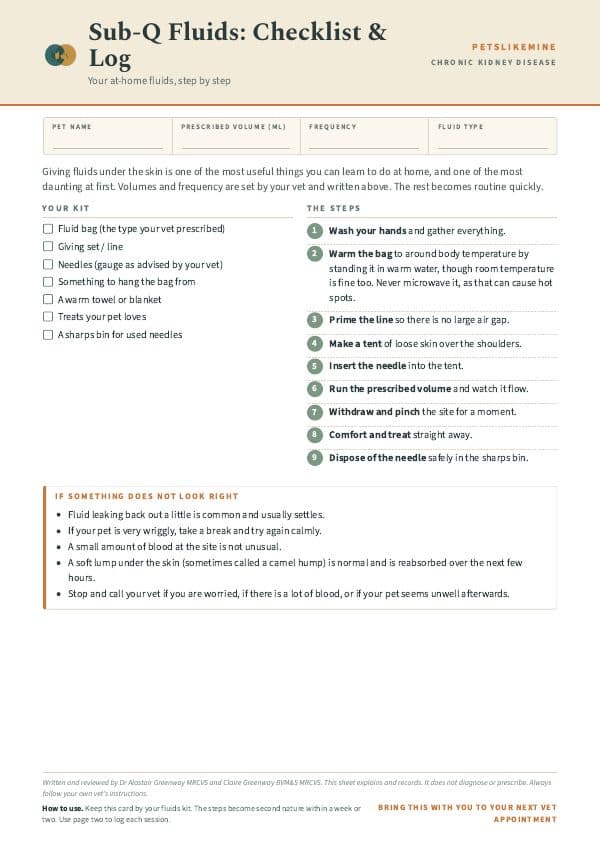
Sub-Q Fluids: Checklist & Log
PDF · 294 KBEverything you need to give fluids under the skin at home with confidence: a kit list, the steps in order, what is normal and what is not, and a running log to bring to rechecks. Daunting at first, routine within a fortnight.

Bloodwork Trend Sheet
PDF · 212 KBYour pet's kidney numbers side by side over time, with plain-English context for each marker: creatinine, SDMA, phosphate, potassium, urine protein and blood pressure. Kidney disease is about the direction of travel, not a single snapshot.

Appointment Question List
PDF · 152 KBThe right questions for where you are right now, from newly diagnosed to reviewing treatment and the longer view. Tick what fits, write the answers on the lines, and leave the consult understanding the plan rather than just nodding along.

UK Cost Planner
PDF · 220 KBPlan the year ahead with clear eyes. Typical UK cost ranges for diet, medicines, monitoring and fluids, room for your own quotes, and the practical ways to make it manageable, from insurance to written prescriptions. Money worries should never quietly steer the medical decisions.
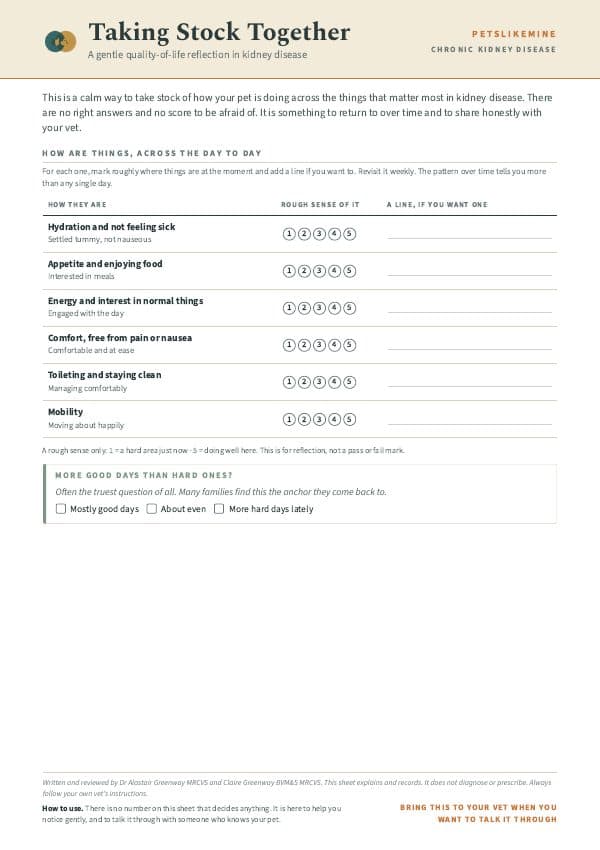
Quality-of-Life Assessment
PDF · 253 KBA gentle way to take stock of how your pet is really doing, across the things that matter most in kidney disease. There is no score to be afraid of here. Something to return to over time, and to share honestly with the people who know your pet.
Connect with others managing Chronic Kidney Disease
- 🐾
Find pets with the same condition and similar treatments
- 📊
Track symptoms, medications, and health trends over time
- 💬
Share experiences and learn from other pet owners
- 🩺
Get expert veterinary insights on community posts
Your community
Join the Chronic Kidney Disease community
Connect with other owners managing Chronic Kidney Disease. Share what is working, ask questions, and follow along day to day.
Visit the communityFind real-world care
When you're ready to take the next step in person, the PetCare Atlas lists internal-medicine specialists across the UK. Search by your postcode to find someone near you.
Find a vet or specialist near youFree includes 1 pet, up to 2 condition spaces, daily tracking, and your top 2 matches