

Why is my pet so itchy? The five things it could be
Alastair Greenway
BVM&S MRCVS
Scratching, licking, chewing, rubbing, a bald patch that has gone from thin to raw: it all comes down to one question owners want answered, which is what is causing it and how do we make it stop. The honest starting point is that itch is not a diagnosis. It is a symptom, and the useful move is not to guess at a product but to work out which of a short list of causes is actually driving it (Hensel et al., 2015). Get to the cause and the itch usually follows. Chase the itch without the cause and you go round in circles.
Itch is a sign, with a finite list behind it
This is the single most important thing to understand before you spend money. Scratching, licking, chewing, rubbing and overgrooming are all the same underlying thing, pruritus, and pruritus has a finite differential. It is not one condition with one cure. It is a sign with a handful of possible causes, and almost the whole job of getting your pet comfortable is sorting which one, or which combination, you are dealing with (Hensel et al., 2015).
The reason owners struggle, and the reason the internet is so unhelpful here, is that the causes overlap heavily in how they look and where they itch. There are no signs that let a vet diagnose the commonest allergy on appearance alone: the diagnosis rests on history, signalment and the exclusion of other pruritic diseases, not on a single test (Hensel et al., 2015). Where a pet itches gives clues, but the pattern alone is not proof (Favrot et al., 2010). So when a website tells you an itchy belly means one thing and itchy paws another, treat it with caution. You genuinely cannot tell by looking.
The five buckets
Almost every itchy pet falls into one or more of five groups. It helps to picture them as overlapping circles rather than separate boxes, because the whole point is that they stack.
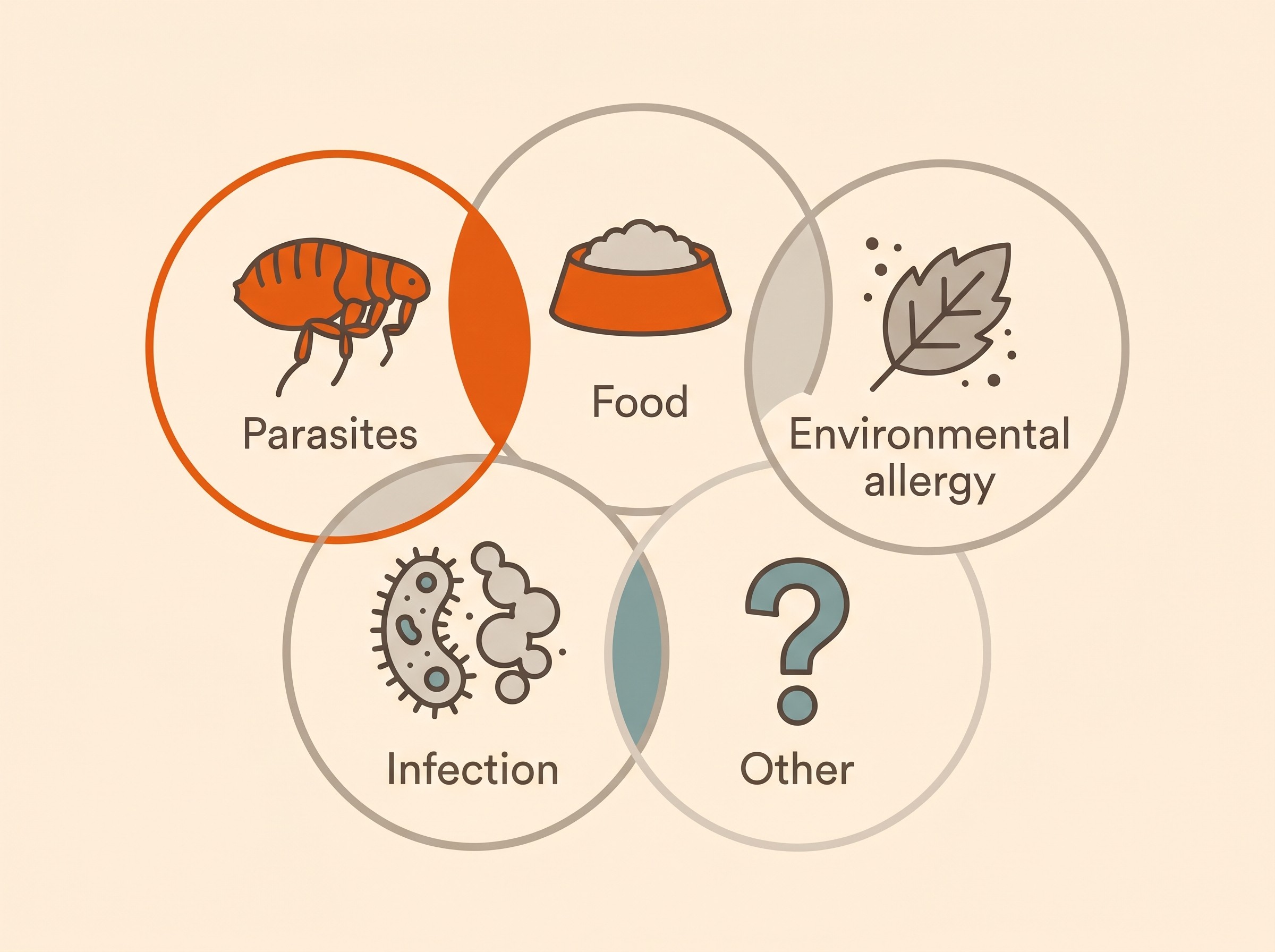
1. Fleas and other parasites. The cheapest cause, the most-missed, and the one a vet always deals with first. In a flea-allergic pet the reaction is to proteins in flea saliva, not to a heavy infestation, so a single bite can set off weeks of itching, and you will often see no fleas at all because the pet grooms them off (especially cats) (MSD Veterinary Manual, Flea Allergy Dermatitis). The pathophysiology and the eradication plan belong to flea-allergy dermatitis and flea control that works. Other parasites sit here too: sarcoptic mange, which is intensely itchy, contagious and favours the ear margins and elbows (Merck Veterinary Manual, Mange), plus Cheyletiella, harvest mites and demodex when things are complicated. The detail lives in mites and mange.
2. Food. A cutaneous adverse food reaction, whether a true allergy or a non-immune intolerance, is less common than most owners assume and is usually driven by a protein rather than by "grain" as such. The most commonly reported culprits are beef, dairy, chicken and wheat in dogs, and beef, fish and chicken in cats (Mueller et al., 2016). The myths around this are dealt with in food allergies explained, and the only reliable way to test for it is covered below.
3. Environmental allergy (atopic dermatitis). This is the inherited tendency to overreact to everyday allergens such as pollens, dust mites and moulds. It is common, affecting somewhere around 10 to 15% of dogs by the most widely cited estimate (Hillier and Griffin, 2001), and it typically starts young, usually before three years of age (Favrot et al., 2010). Importantly, it is a diagnosis of exclusion, the thing left over once the others are ruled out, which is why it sits in the middle of this list rather than at the front. Atopic dermatitis explained is where to read on once you reach it.
4. Infection. Secondary bacterial pyoderma (usually Staphylococcus pseudintermedius) and Malassezia yeast are extremely common in itchy, allergic pets, and they almost always sit on top of one of the other causes rather than starting things off (Hensel et al., 2015; Marsella and Sousa, 2001). An untreated infection is itchy in its own right and muddies the whole picture. The basics of recognising and clearing it belong to skin and ear infections.
5. Other and mimics. A smaller bucket of less common causes: mites that are not fleas, ringworm (which is a fungal infection, not a worm), the occasional immune-mediated skin disease, and, confusingly, some hormonal conditions that cause hair loss without much itch and can be mistaken for an allergy. Hormonal hair loss is signposted onward to the Endocrine and Hormones space via hair loss without itching.
The reason this matters more than it might seem is that these buckets are not mutually exclusive. A single dog very often has atopy, plus a secondary skin infection, plus a few flea bites, all at the same time. That stacking is exactly why one allergic pet copes fine for months and then suddenly flares, and it is the idea behind the itch threshold, which is worth reading next once the basics here make sense.
How a vet actually works it out, in order
Because you cannot tell by looking, and because the causes stack, a vet does not guess. There is an internationally recommended sequence for an itchy dog, and it runs in a deliberate order (Hensel et al., 2015).
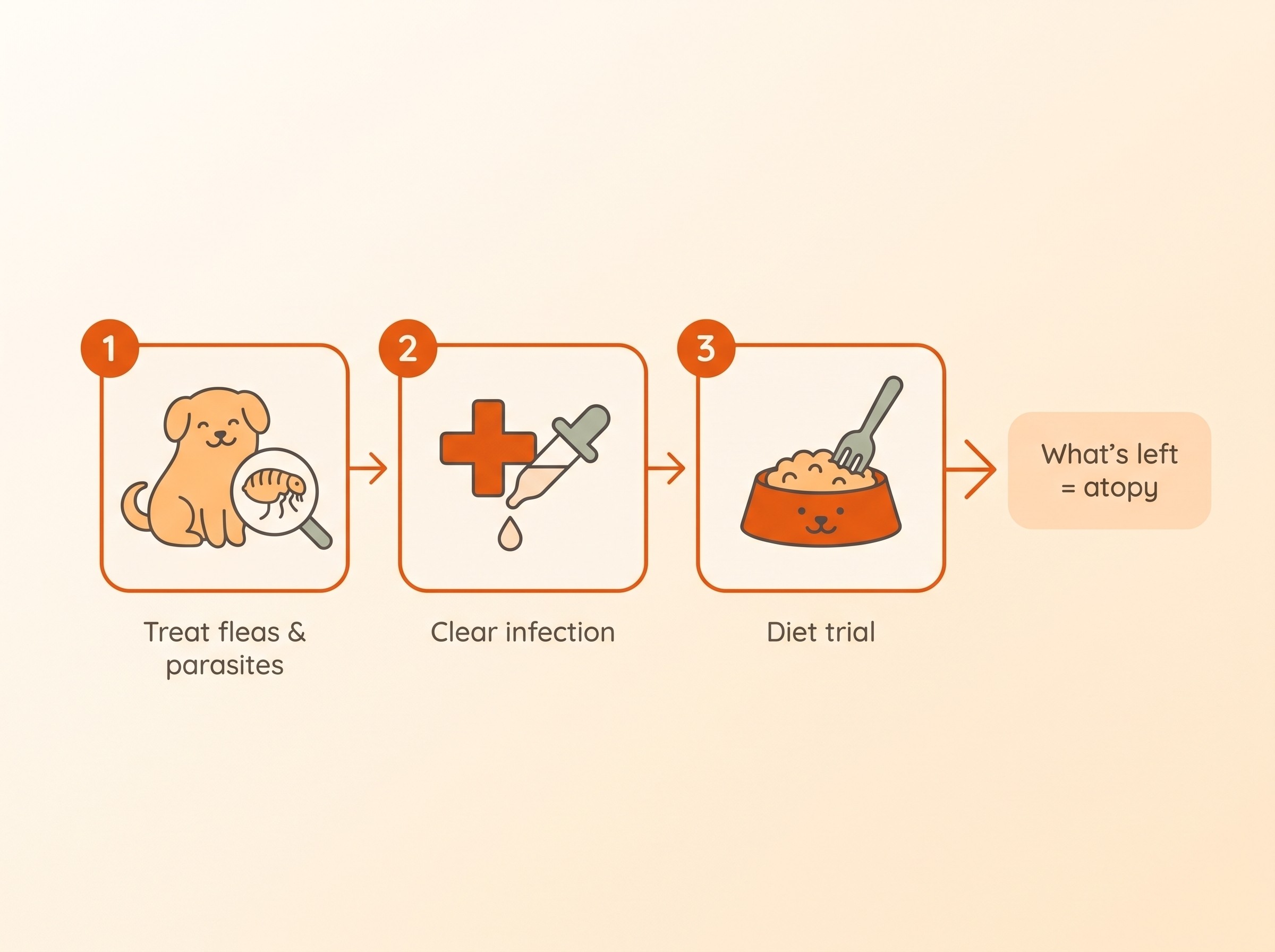
First, rule out fleas and flea-allergy dermatitis, and treat for fleas aggressively whatever you find, because flea control is always indicated, cheap, and you so often cannot see the evidence (MSD Veterinary Manual, Flea Allergy Dermatitis). Second, rule out the other parasites, sarcoptic mange in particular, with skin scrapes and, because scrapes miss many cases, sometimes a trial of treatment (Merck Veterinary Manual, Mange). Third, find and clear any secondary infection, confirmed on cytology, because you cannot judge whether the underlying cause is controlled while an infection flares on top of it (Hensel et al., 2015). Fourth, run a proper elimination diet trial to rule food in or out. And only then, fifth, what is left, fitting the clinical picture, is atopic dermatitis (Hensel et al., 2015; Favrot et al., 2010).
The logic of leaving atopy for last is simple: it is the one cause that cannot be confirmed by a single test, so it only becomes the answer once everything testable has been excluded (Hensel et al., 2015). A vet may use a pattern-recognition aid such as Favrot's criteria to raise or lower their suspicion (those criteria run at around 80 to 85% sensitivity and 79 to 85% specificity, useful but not a diagnosis), and the detail of that sits in atopic dermatitis diagnosis (Favrot et al., 2010).
Two things follow from this, and both are better faced squarely. First, the only reliable food test is the diet trial itself; there is no valid blood, saliva or hair test for food allergy, full stop (Hensel et al., 2015). If you are at that stage, the elimination diet article and the Elimination-Diet Companion walk you through doing it properly, because a trial done loosely tells you nothing. Second, allergy "tests" are not a diagnostic step at all. Serum IgE and intradermal tests are for choosing which allergens to put into immunotherapy once atopy is already diagnosed, not for making the diagnosis, and the hair and saliva kits sold direct to owners do not work. That whole myth is dealt with in allergy tests that work and the ones that waste your money.
This is where the field gets oversold, so it is worth saying plainly. There is no quick kit for the two big causes, atopy and food, and the marketing that implies otherwise is selling false reassurance. The value is in the work-up, not in a test you can buy. And the work-up earns its keep because it tells you which treatment will actually help, which is the whole point of getting to a diagnosis rather than rotating through products. If you want the treatment map itself, the treatments compared article lays them out, but the route to it runs through the steps above.
Two things worth doing while you wait
While you wait for an appointment, two actions are worth doing now, and both genuinely move things forward.
The first is to flea-treat every animal in the household, properly. Not just the itchy one. Because one bite is enough in an allergic pet and the fleas are so often invisible, "but I never see fleas" does not rule them out (MSD Veterinary Manual, Flea Allergy Dermatitis). This is the cheapest, most reversible thing on the whole list, so there is no reason to wait, and the plan for doing it thoroughly is in flea control that works.
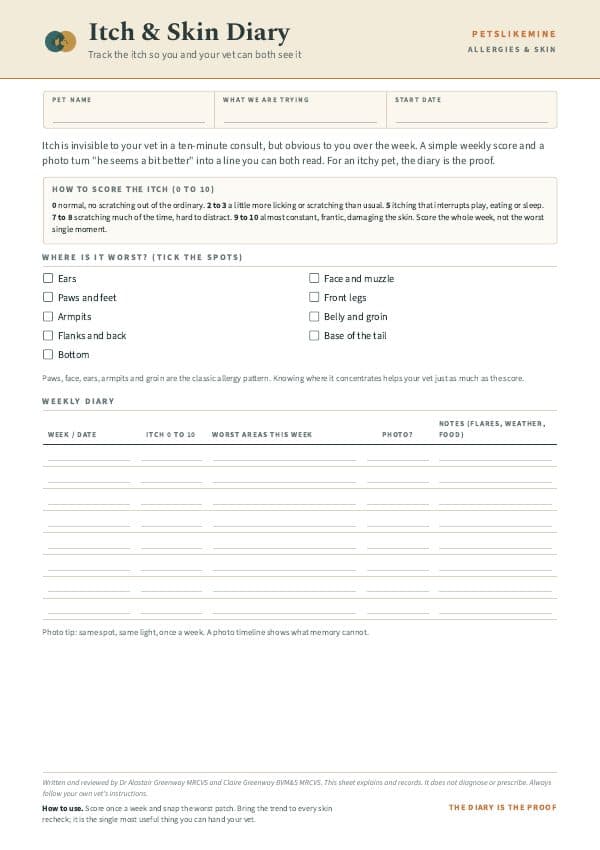
The second is to start scoring the itch. A simple sense of how bad it is, recorded over time on a 0 to 10 scale, is more useful than it sounds. The owner-reported pruritus scale is validated in dogs, with a normal range of about 0 to 1.9 drawn from 713 owners, and it is the standard way a pet's itch is tracked over time (Rybnicek et al., 2009). One practical tip from that same work: judge the position on the scale by the plain-language descriptions of severity, not by fixating on the number, which is exactly how the tracker is built. A baseline taken before you change anything is what later tells you whether a treatment, a diet or a flea product is actually working, rather than leaving you to guess. The Skin and Itch Tracker does this for you and plots the trend. One caveat, in fairness: it is a subjective owner scale, brilliant for tracking change in your own pet but not for diagnosing the cause. It tells you whether things are getting better, not why.
When to skip the home steps and see a vet now
Most itch is miserable but not urgent, and the work-up above is the right path for it. A few situations are different and need a vet straight away: facial or muzzle swelling, widespread hives, or any collapse, vomiting or pale gums after a vaccine, sting, new food or new drug; a hot, painful, fast-spreading patch; sudden severe ear pain with a head tilt or loss of balance; or a pet hurting itself so badly the skin is breaking. If any of those apply, do not wait. The detail on telling the genuinely urgent from the merely miserable is owned by is this a skin emergency, and the quick itchy pet triage check will point you the right way in under a minute.
For everything else, the message is calmer than it might feel in the small hours. Itch nearly always has more than one driver at once, the causes stack, and no single villain explains the whole picture. So treat the fleas, get a baseline itch score in the Skin and Itch Tracker before you change anything, and let the work-up do its job. Getting to the diagnosis, not guessing at the next product, is what actually settles the scratching.
References
- Favrot, C., Steffan, J., Seewald, W., & Picco, F. (2010). A prospective study on the clinical features of chronic canine atopic dermatitis and its diagnosis. Veterinary Dermatology, 21(1), 23-31.
- Hillier, A., & Griffin, C. E. (2001). The ACVD task force on canine atopic dermatitis (I): incidence and prevalence. Veterinary Immunology and Immunopathology, 81(3-4), 147-151. )00296-3.
- Hensel, P., Santoro, D., Favrot, C., Hill, P., & Griffin, C. (2015). Canine atopic dermatitis: detailed guidelines for diagnosis and allergen identification. BMC Veterinary Research, 11, 196. (PMC4531508)
- Marsella, R., & Sousa, C. A. (2001). The ACVD task force on canine atopic dermatitis (XIII): threshold phenomenon and summation of effects. Veterinary Immunology and Immunopathology, 81(3-4), 251-254. )00303-8.
- Rybnicek, J., Lau-Gillard, P. J., Harvey, R., & Hill, P. B. (2009). Further validation of a pruritus severity scale for use in dogs. Veterinary Dermatology, 20(2), 115-122.
- MSD Veterinary Manual (Online). Flea Allergy Dermatitis in Dogs and Cats. Integumentary System. (Also published as the Merck Veterinary Manual in the US.)
- Mueller, R. S., Olivry, T., & Prelaud, P. (2016). Critically appraised topic on adverse food reactions of companion animals (2): common food allergen sources in dogs and cats. BMC Veterinary Research, 12, 9. ; PMC4710035)
- (Optional, for the parasite bucket) Merck/MSD Veterinary Manual (Online). Mange in Dogs and Cats. Integumentary System.
Free downloads
Companion worksheets to put what you've read into practice. Free PDFs, print at home.
Keep track of how your pet is doing
The owners who cope best are the ones who notice changes early. A simple health log shows you what is working, and what is not, before the next vet visit.
Start tracking, freeYou're not doing this alone
Compare treatment journeys and talk to owners managing allergies & skin. Free to join.
Join PetsLikeMine