

Flea allergy: how one bite causes weeks of misery
Alastair Greenway
BVM&S MRCVS
The pet least likely to have visible fleas is often the flea-allergic one, which is exactly why this gets missed. "But I never see any fleas" is the usual line from owners, and it points the wrong way. The allergy drives such frantic licking and grooming that the animal removes the evidence itself, and extremely hypersensitive animals, especially cats, can be virtually free of fleas because of that excessive self-grooming (MSD Veterinary Manual). So a clean comb does not clear fleas. If anything, an itchy pet with no fleas in sight is more suspicious, not less. Before you spend a penny on allergy tests, this is the cause to rule out, because it is the cheapest, the most treatable, and the one a vet always deals with first (why is my pet so itchy; Hensel et al., 2015).
It is the spit, not the swarm
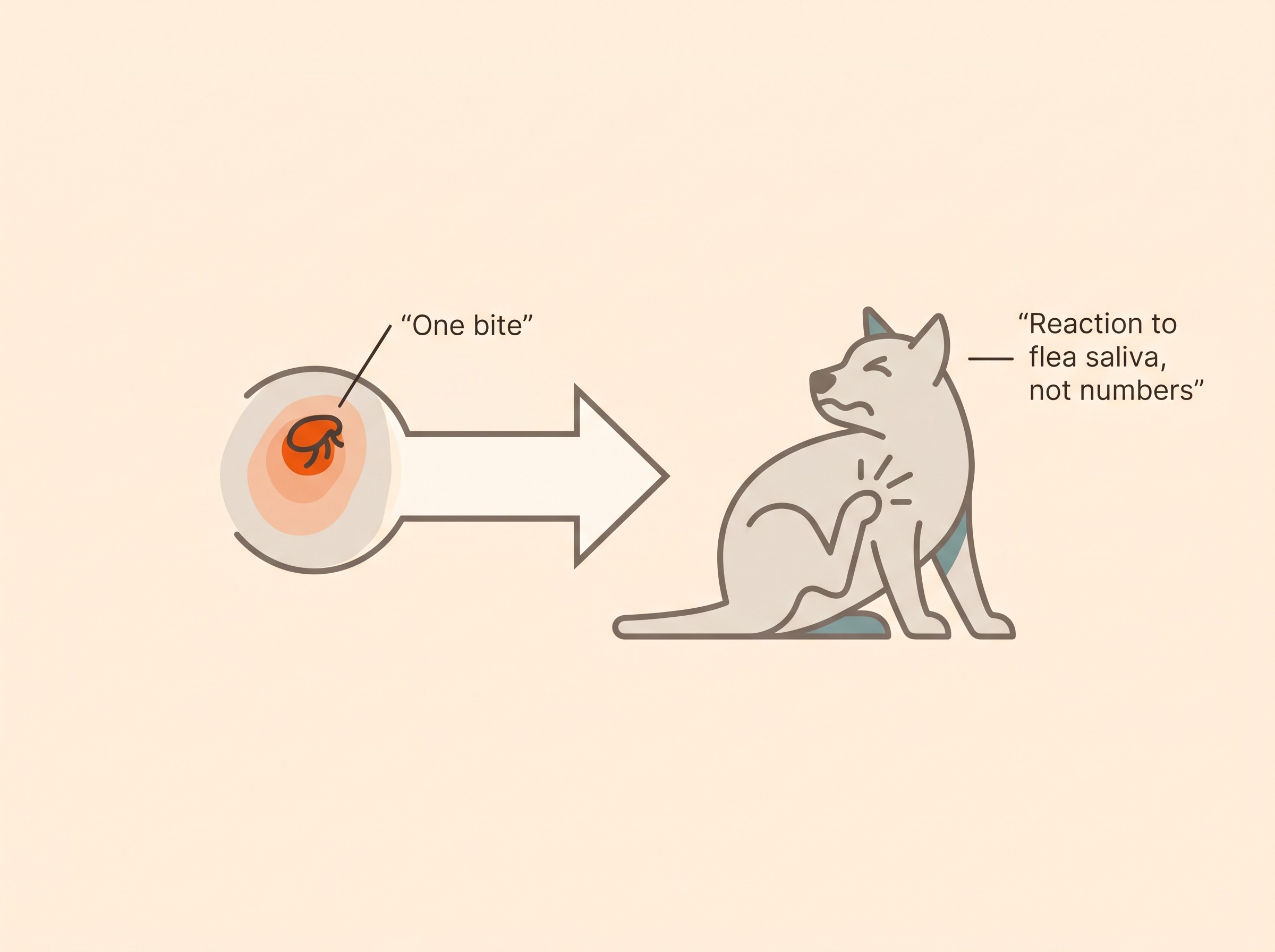
Flea-allergy dermatitis (also called flea-bite hypersensitivity) is an allergy to flea saliva, not a reaction to "lots of fleas" (MSD Veterinary Manual). When a flea feeds, it injects saliva, and that saliva is a cocktail of irritant proteins: a mixture of histamine-like compounds, enzymes and polypeptides ranging from 8 to 150 kilodaltons, most of them under 60 (MSD Veterinary Manual). In an allergic pet, the immune system overreacts to those proteins. The evidence that the trouble really is in the saliva is solid: a major cat-flea salivary allergen, an 18 kilodalton protein called Cte f 1, has been identified and characterised, and it produced a positive skin-test reaction in 100% of experimentally sensitised dogs and around 80% of naturally flea-allergic ones (McDermott et al., 2000). This is why one bite is genuinely enough. It is not the volume of fleas that matters, it is whether the pet is wired to react to their spit.
It also explains why the itch outlasts the flea. This is not a simple immediate, IgE-only reaction: flea saliva drives a mixture of type I (immediate), type IV (delayed, cell-mediated) and late-phase basophil reactions all at once, and intermittently exposed naive dogs develop either immediate reactions within about 15 minutes, or delayed ones at 24 to 48 hours, or both (MSD Veterinary Manual). That mixed mechanism is the whole frustration. The itch can flare almost at once or creep in a day later, and because the delayed and late-phase parts keep inflammation running long after the flea has gone, a single bite can keep a pet itching for days to weeks. That is the basis for the "weeks of misery" in the title, and it is mechanism, not exaggeration.
Reading the map on your pet's body
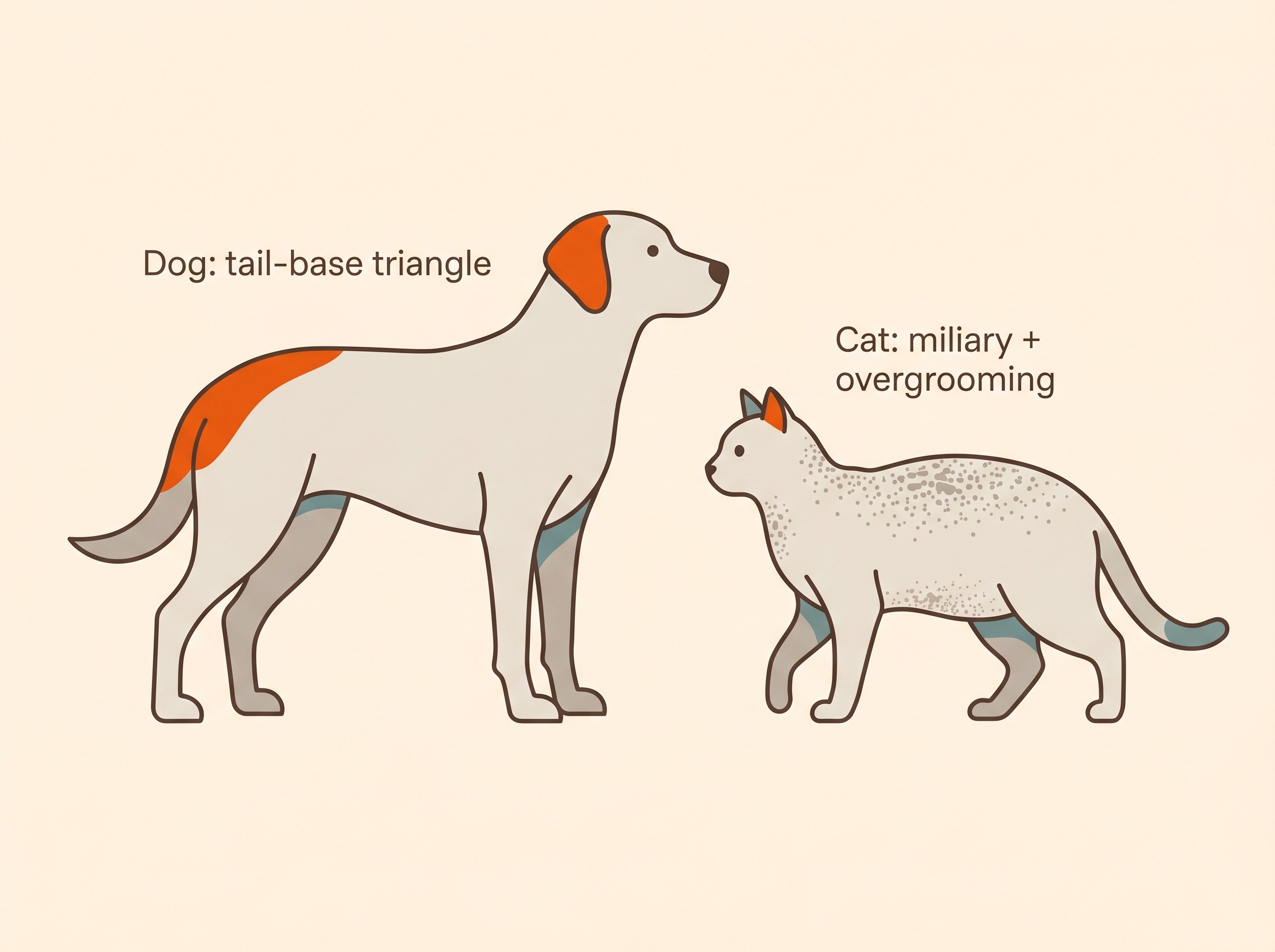
Flea allergy itches in a giveaway place, and learning the map is genuinely useful. In dogs, the itch and the damage sit on the back half of the body: the lower back, the base of the tail, the rump and the backs of the thighs, the zone vets call the tail-base triangle (MSD Veterinary Manual). You will see hair loss, redness, scabs, and over time thickened, darkened skin and hot spots concentrated there (MSD Veterinary Manual). If your dog is chewing at its tail base and back legs while its head and ears stay relatively comfortable, think fleas first.
Cats are far more variable and far sneakier. Flea allergy is a leading cause of the classic feline reaction patterns, most often miliary dermatitis (tiny crusted bumps over the back, neck and tail base that feel like scattered millet seeds) and self-inflicted hair loss from overgrooming, typically down the back, the tail base, the back of the thighs, the belly and the groin (MSD Veterinary Manual). The catch is that cats groom in private, so the only thing you may notice is a neat strip of thinning fur on the belly or back, with no scabs and no obvious scratching. That symmetrical bald patch is the cat doing the damage with its tongue. The fuller feline allergy picture, the four reaction patterns and overgrooming as a behaviour, belongs to feline atopic syndrome; here it is enough to know the flea-driven version exists and to suspect it.
It is worth logging where the itch actually sits. In the Skin and Itch Tracker you can record the location and photograph the same patch each time, because a rump and tail-base bias is one of the clearest pointers towards fleas rather than, say, an environmental allergy that favours the face and feet. And if a flea-allergic pet who usually copes suddenly tips into a summer flare, that is the itch threshold at work, where fleas, pollen and dry skin stack up until the pet can no longer stay below the line.
The cheap home check is the flea-dirt test, and it pairs neatly with a proper skin exam. Comb the rump and tail base with a fine flea comb (around 32 teeth per inch) onto damp white paper or cotton wool. Flea dirt is flea faeces made of digested blood: reddish-black, comma or pellet shaped, and when you crush and wet it, it dissolves into a reddish-brown smear (MSD Veterinary Manual). Find flea dirt and you have confirmed fleas even with no adult in sight. But be clear about the limit: not finding it does not rule fleas out in a fastidiously grooming, allergic pet (MSD Veterinary Manual). The full home-exam and photo routine is owned by checking your pet's skin at home.
One more thing this means for your wallet: do not pay for a flea-allergy blood test to decide whether to treat. In a controlled study, flea-specific IgE was actually highest in the dogs exposed to fleas continuously, and a good share of clinically itchy dogs tested negative on flea-specific IgE or on intradermal flea testing (Wilkerson et al., 2004). A negative test does not clear fleas, and both intradermal and serum-IgE testing for flea salivary antigens have limited sensitivity and specificity and are no longer recommended for diagnosis (MSD Veterinary Manual). The diagnosis is made by the pattern plus the response to rigorous flea control, not by a kit. The wider critique of which tests work and which waste your money lives in allergy testing.
When "I do use a flea treatment" still isn't enough
This is where good owners get caught out, so it deserves saying plainly: treating only the pet you can see is the commonest reason flea control fails (Halos et al., 2014). Most of the flea problem is not on any animal. The cat flea, Ctenocephalides felis, spends most of its life cycle as eggs, larvae and pupae living in your carpets, skirting boards, bedding and garden, and the adults on the pet are only a small slice of the total (Rust and Dryden, 1997; Halos et al., 2014). The widely taught approximation is that roughly 95% of the flea population is in the environment and only around 5% on the pet. That is a rule of thumb rather than a fixed constant, but the mechanism behind it is well proven: around 70% of the eggs a feeding female lays in the fur fall off into the home within about 8 hours (Halos et al., 2014). So even a perfect product on one pet leaves a seeded house quietly restocking itself.
Add the everyday slip-ups, missing one in-contact animal (the untreated cat that reseeds the dog), treating only in summer, stretching the interval, under-dosing, or washing off a spot-on, and the picture is rarely true product failure. It is usually a gap in the net (Halos et al., 2014). Pupae make it worse: they are the armoured stage that can sit dormant for months and hatch after you have treated, which is exactly why "I treated and there were still fleas a week later" is expected, not a failure (Rust and Dryden, 1997; Halos et al., 2014). And because the modern oral flea drugs, the isoxazolines such as fluralaner, sarolaner, afoxolaner and lotilaner, kill the flea only once it bites rather than repelling it, an allergic pet can still catch the odd bite even on excellent treatment (FDA isoxazoline information). That is one more reason flares grumble on, and one more reason the home matters as much as the pet. The full eradication plan (which products, how often, how to treat the environment and the year-round calendar) is owned by flea control that works, and that is the article to read next.
Break the cycle, but don't just mask it
Self-trauma from flea allergy rarely stays "just" flea allergy. The scratching and biting opens the door to secondary problems: acute moist dermatitis (hot spots), bacterial pyoderma (usually Staphylococcus pseudintermedius) and Malassezia yeast, each adding its own itch and smell on top (MSD Veterinary Manual). Those are real complications, confirmed on cytology and treated directly, and they have their own homes: the infection basics in skin and ear infections and the angry overnight patch in hot spots. One has a genuine red flag worth knowing: a hot spot that is spreading fast, hot to the touch and clearly painful is a same-day vet matter, not something to watch overnight, and the urgent-versus-not call is set out in skin emergencies.
The plain line on anti-itch drugs is that they do not fix flea allergy, they only mask it. Medicines like oclacitinib (Apoquel), lokivetmab (Cytopoint, licensed in dogs), ciclosporin (Atopica) and short steroid courses can take the edge off while flea control beds in, but if the fleas keep biting, the pet keeps flaring: you are dampening the alarm without removing the trigger. The straight comparison of those drugs sits in itch treatments compared. And unlike environmental allergy, flea allergy has no established desensitising treatment, the answer is flea control, not a vaccine (consistent with Wilkerson et al., 2004).
Why fleas are step one for every itchy pet
Flea control is cheap, safe and always worth doing, and flea allergy is both common and fully reversible once the bites genuinely stop, which is precisely why ruling it out by treating, not by testing, is the logical first move before any expensive allergy work-up (Hensel et al., 2015). So here is the plan: treat every animal in the home properly and year-round, deal with the house as well as the pet, and take a baseline itch score in the Skin and Itch Tracker today, before you change anything. Over the next few weeks the trend in that score is the real test of whether fleas were the problem, far more reliable than your memory of "is it any better?" If the itch falls, you have your answer cheaply. If you have treated thoroughly for weeks and it genuinely is not budging, that is the cue to think again, towards the other mites that can mimic this, or a diet trial in the Elimination-Diet Companion as the next rule-out on the road to a diagnosis.
References
- MSD Veterinary Manual (Merck Veterinary Manual). "Flea Allergy Dermatitis in Dogs and Cats." Integumentary System.
- McDermott MJ, Weber E, Hunter S, et al. "Identification, cloning, and characterization of a major cat flea salivary allergen (Cte f 1)." Molecular Immunology. 2000;37(7):361-375.
- Wilkerson MJ, Bagladi-Swanson M, Wheeler DW, Floyd-Hawkins K, Craig C, Lee KW, Dryden M. "The immunopathogenesis of flea allergy dermatitis in dogs, an experimental study." Veterinary Immunology and Immunopathology. 2004 Jun;99(3-4):179-192.
- Halos L, Beugnet F, Cardoso L, Farkas R, Franc M, Guillot J, Pfister K, Wall R. "Flea control failure? Myths and realities." Trends in Parasitology. 2014;30(5):228-233.
- Rust MK, Dryden MW. "The biology, ecology, and management of the cat flea." Annual Review of Entomology. 1997;42:451-473.
- Hensel P, Santoro D, Favrot C, Hill P, Griffin C. "Canine atopic dermatitis: detailed guidelines for diagnosis and allergen identification." BMC Veterinary Research. 2015;11:196. (ICADA.)
- ScienceDirect Topics, "Flea Allergy Dermatitis" (overview compiled from veterinary dermatology/parasitology texts)
- FDA, "Fact Sheet for Pet Owners and Veterinarians about Potential Adverse Events Associated with Isoxazoline Flea and Tick Products" / product SPCs.
Keep track of how your pet is doing
The owners who cope best are the ones who notice changes early. A simple health log shows you what is working, and what is not, before the next vet visit.
Start tracking, freeYou're not doing this alone
Compare treatment journeys and talk to owners managing allergies & skin. Free to join.
Join PetsLikeMine