

The itch threshold: why your pet copes with one allergy but not three
Alastair Greenway
BVM&S MRCVS
A pet who is fine all winter and falls apart in July, or whose reliable tablet suddenly does nothing, can look like a run of bad luck. It usually isn't. One idea in veterinary dermatology explains nearly all of it, and once it clicks, allergic skin disease stops being a mystery and starts being something you can manage. It is called the itch threshold, and it is the most clarifying concept in this whole space.
Every pet has a line
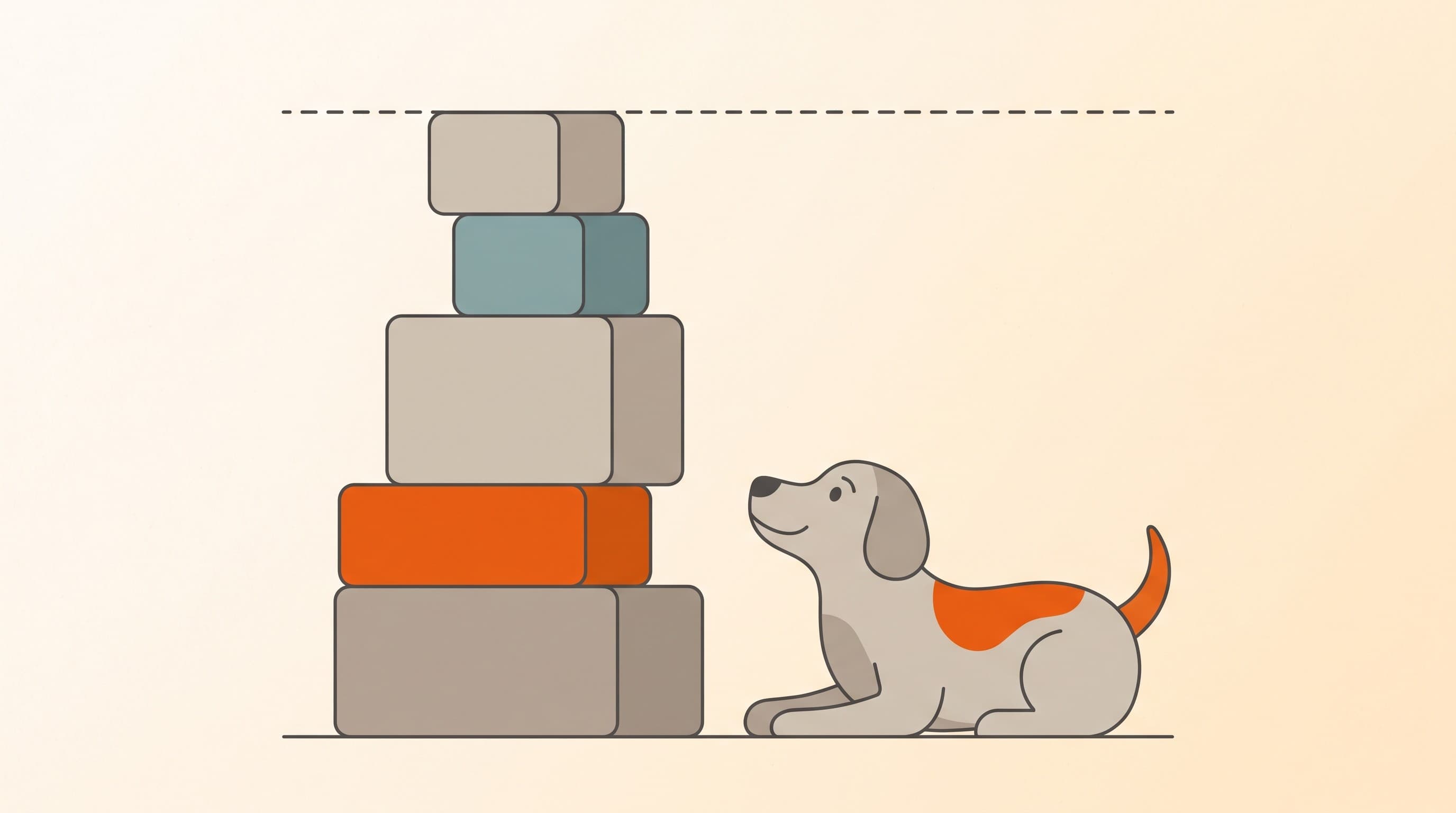
Picture a line. Below it, your pet is comfortable: a little scratch here and there, nothing that bothers anyone. Above it, your pet itches in earnest, the kind of scratching, licking and chewing that breaks skin and ruins sleep. Every individual animal tolerates a certain amount of irritation before it crosses that line and starts to show clinical signs (Ihrke, 2007; Marsella, 2012). This is not a PetsLikeMine metaphor or a piece of wellness folklore. It is standard veterinary dermatology teaching, and dermatologists call it the threshold phenomenon: "an individual may tolerate a certain pruritic load without provoking clinical signs but a small increase in that load may push that individual over the threshold" (Ihrke, 2007).
The line sits in a different place for every pet. One dog can carry a fair amount of irritation and barely scratch; another, with the same conditions, is miserable. That is why two pets in the same household, walking the same fields and sleeping in the same bed, can look so different. They have different thresholds, set partly by genetics and partly by how leaky or resilient their skin barrier happens to be (Marsella, 2012).
The layers stack up
The irritation that pushes a pet over the line almost never comes from one source. It is the sum of several at once. Dermatologists call this the summation of effects: "additive pruritic stimuli from different coexistent skin diseases may raise an animal above its individual pruritic threshold" (Ihrke, 2007), even when no single one of them would have done so alone.
So imagine a dog with a mild, year-round allergy to house dust mites. On its own, that allergy keeps him just under the line. He is fine. Then add a few flea bites in late summer. Then a low-grade skin infection that has crept in under his collar. Then a dry, scurfy coat after weeks of central heating. None of those, by itself, would tip him over. Stacked together, they do (Marsella, 2012; Olivry et al., 2015). The dog has not suddenly become more allergic. The total load has simply climbed past the line.
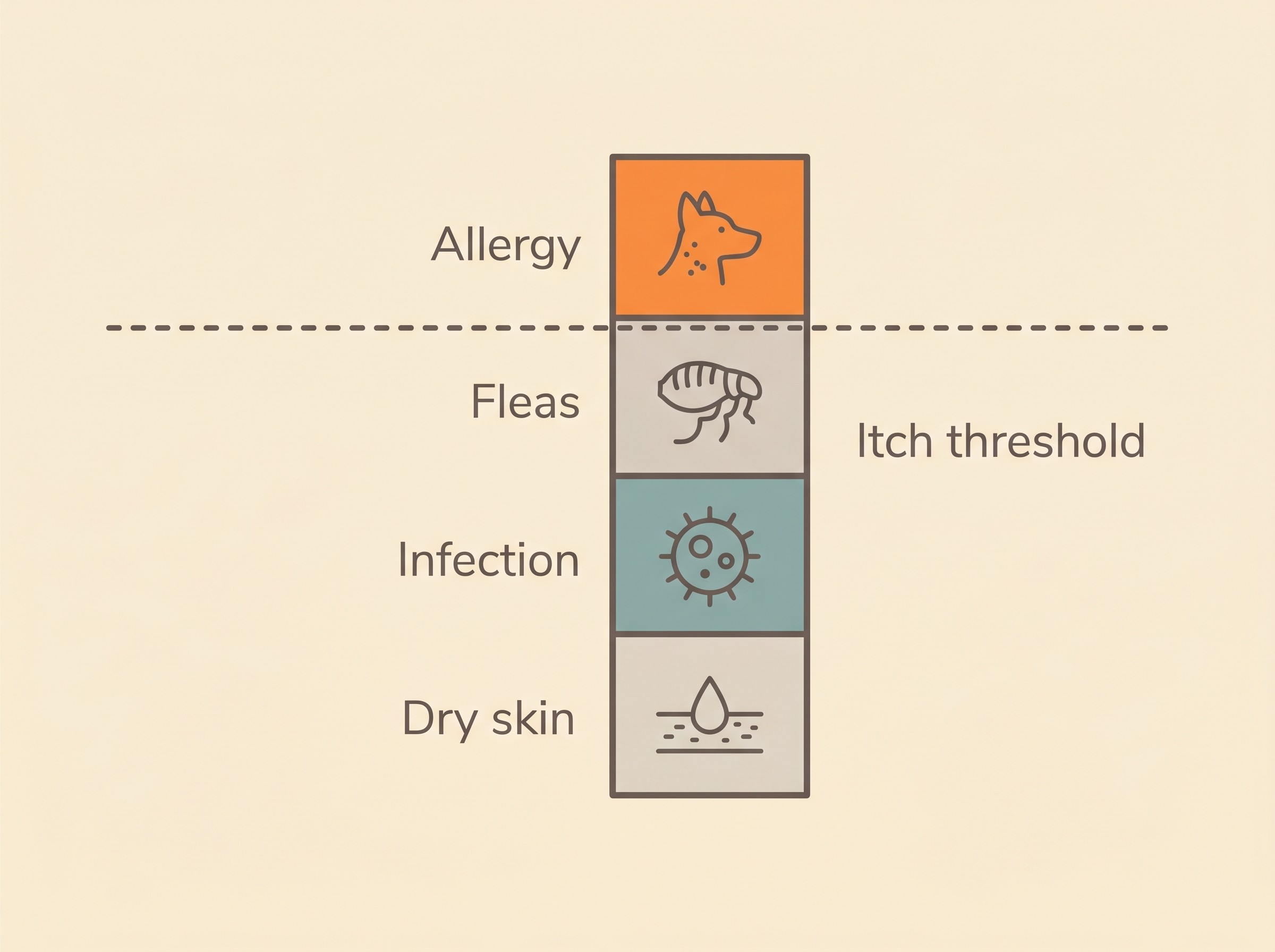
This is precisely why "find the one villain" thinking fails so often. Owners, and plenty of advice online, hunt for the single cause, the one food or allergen to remove, expecting the itch to vanish. But more than one allergy in the same pet is common, not rare. The international consensus is explicit that flare factors arrive together, listing "environmental and/or food allergens, flea bites, infections" in the same breath as the things to find and lower (Olivry et al., 2015), and the classic worked example in the dermatology literature is a pet carrying both a flea allergy and a food-responsive itch at once: remove neither and they are miserable, remove just one and they may drop back under the line (Ihrke, 2007). A substantial proportion of itchy pets carry more than one layer at the same time.
If you have not yet read how a vet sorts those layers into a short list of causes, that groundwork lives in why is my pet so itchy, which owns the five-cause differential and the order of the work-up. This article assumes it and builds on top.
Flares that follow the calendar
The threshold idea explains one of the most common puzzles owners bring to the consulting table: the pet who is comfortable in winter and wretched in summer. Canine atopic dermatitis is frequently a non-seasonal disease, often driven by house dust mites, with flares layered on top during pollen seasons (Hensel et al., 2015). So the baseline allergy ticks along below the line all winter. Then spring and summer add a fresh layer of pollen on top, and the same dog, with the same underlying disease, crosses the line (Olivry et al., 2015).
The pet did not develop a brand new allergy in July. The disease was there all along. The pollen season simply pushed the total over the threshold for a few months. Understanding that saves a great deal of worry and a great many wasted vet trips chasing a "new" problem that is really the old one, surfacing. It also tells you something useful: a pet whose flares track the calendar is showing you one of their layers in plain sight, which is exactly the kind of pattern worth writing down rather than trusting to memory.
When the medication seems to quit
The same logic explains the other classic frustration: the drug that worked, and then seemingly quit. Apparent treatment failure is very often not the drug failing at all. It is an unaddressed layer that has crept in underneath, most commonly an untreated secondary bacterial or yeast infection, or a lapse in flea control (Olivry et al., 2015; Marsella, 2012). Bacterial and yeast infections are themselves common triggers of flares (Olivry et al., 2015).
Think of it this way. The medication was holding the total load just under the line. Then an infection took hold, or the flea treatment ran a week late, and the load climbed past what the drug could hold down. From the outside it looks as though the tablet stopped working. In reality it is doing exactly what it always did; there is simply more load now than it was ever going to cover. This matters because the instinct, understandably, is to ask for a stronger drug or a higher dose, when the fix is usually to find and lower the new layer instead. The detail of those infections, the smell, the redness, the greasy or crusted skin that gives them away, belongs to skin and ear infections; the point here is just that an infection is the usual reason control unravels, and it is worth checking the skin before you blame the prescription.
The part the adverts leave out
This is where the threshold model is not just clarifying but corrective. A lot of marketing pushes single-product answers, the one thing that "stops the itch". And it is true that there are excellent fast itch-relievers: oclacitinib (Apoquel), the newer once-daily ilunocitinib (Zenrelia) and lokivetmab (Cytopoint, an injectable monoclonal antibody licensed in dogs only) can quieten an itchy dog impressively quickly. But a fast itch-stopper can mask a rising load. It quietens the signs while the fleas and the infection underneath carry on building, and when the masking is outpaced, control comes apart (Olivry et al., 2015). That is not an argument against these drugs, which are genuinely useful and often the kind thing to do while you sort the rest out; it is an argument against using them as the whole plan. No single product cures allergic skin disease, and the durable wins come from lowering the total load rather than leaning on one tablet to carry all of it. We say that plainly because the field is genuinely oversimplified here. The evidence-based position is that the approach "has to be multi-modal" (Marsella, 2012), and that treatment is "clearly multifaceted", with interventions "combined" rather than used alone (Olivry et al., 2015). The full, fair comparison of those drugs, what each does, how fast, roughly what it costs, and that none cures, lives in the treatments compared.
The practical upshot: subtract, do not search
If the layers add up, then control comes from taking layers away. Not from finding the one cause, but from attacking every layer you can reach to drag the total back under the line. The dermatology literature puts it bluntly: "one must manage ALL allergic skin diseases present to be successful, thus reducing the animal below threshold" (Ihrke, 2007), and the international consensus agrees that identifying and avoiding flare factors is the cornerstone of management, with the various treatments combined rather than used in isolation (Olivry et al., 2015).
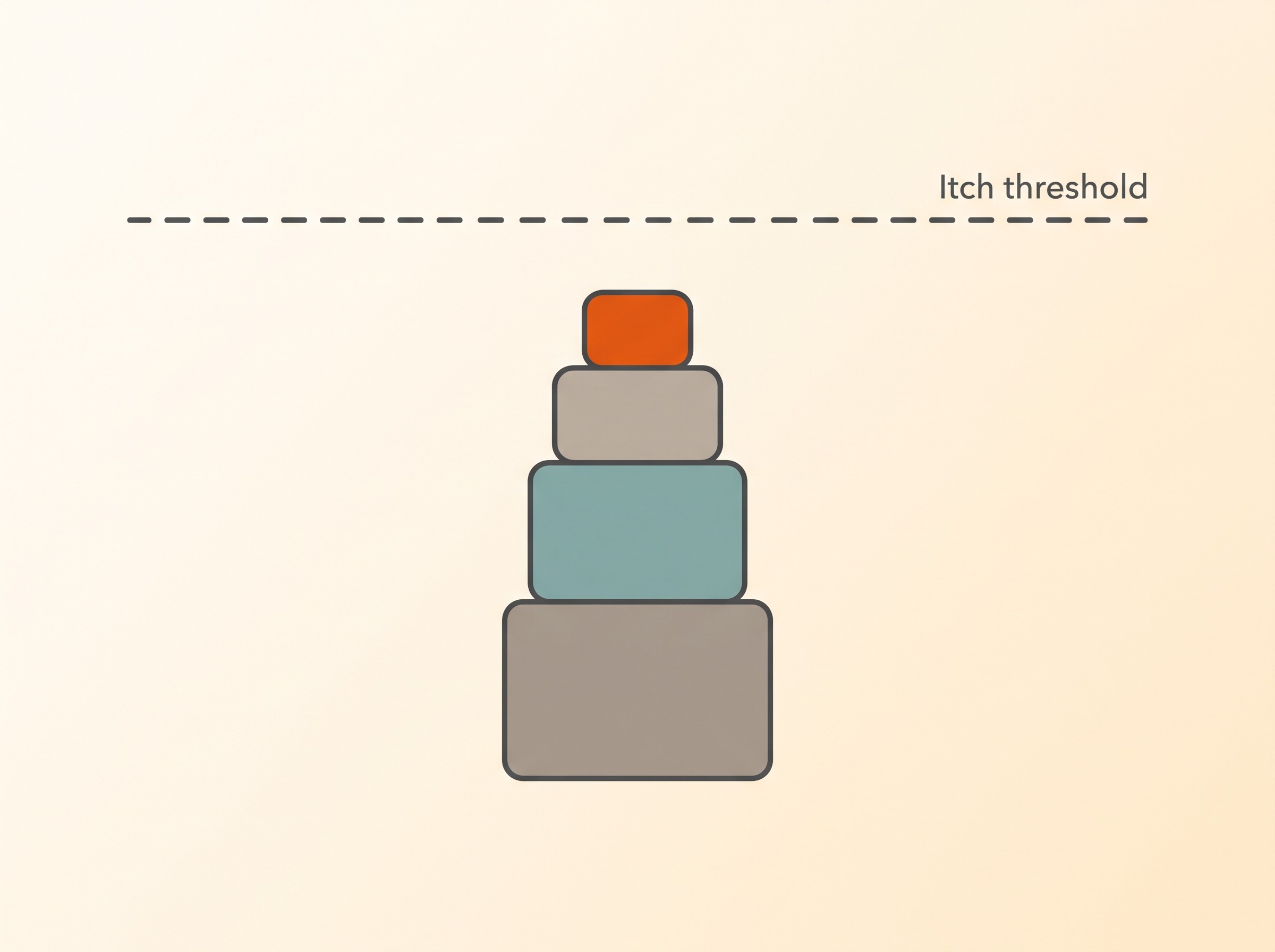
In practice that means working through the layers you can actually shift:
- Fleas. For almost every itchy pet this is the cheapest, highest-yield layer to remove. Once a pet is flea-allergic, a single bite is enough to set off signs, so you do not need to see fleas for them to matter (Merck Veterinary Manual). Why one bite does so much, and the eradication that actually works, are owned by flea allergy dermatitis; the message here is simply to treat every animal in the home, all year, before you spend money chasing anything more exotic.
- Infection. Clear the bacterial or yeast overgrowth that so often rides on allergic skin, because it is a heavy layer in its own right and a common reason a flare will not settle (Olivry et al., 2015).
- The skin barrier. Atopic skin has a leaky, defective barrier that lets allergens in and dries out, and a harsh winter coat or over-bathing adds to the load; supporting the barrier is a genuine layer you can lower (Marsella, 2012; Olivry et al., 2015). The daily routine for that, the omega-3s, the bathing, the skin care, belongs to living with an atopic pet.
- The allergens themselves. Some you can reduce: a strict diet trial removes the food layer, and the mechanics of running one without ruining it belong to the Elimination-Diet Companion and the elimination diet article. Others, like grass pollen on a summer walk, you mostly cannot, and pretending otherwise sets owners up to feel they have failed.
The full plan that stitches all of this together for an atopic pet lives in atopic dermatitis treatment. The goal it works towards is worth stating plainly: not zero allergens, which is rarely possible, but under threshold and comfortable. You can seldom make a dog un-allergic to pollen. You can lower enough of the other layers that the remaining load sits below the line, and the pet feels well. It is also worth setting expectations on time. Subtraction is rarely a same-week transformation; a diet trial alone runs for weeks, and you are often lowering two or three layers in sequence, judging each before you move on. Slow and deliberate beats fast and muddled, because the whole point is to know which layer did the work.
One more note: the load is not a single dial
It would be neat if you could measure the amount of one allergen in the house and read off how itchy your pet will be. You cannot. One study that measured indoor house dust mite levels in the homes of atopic dogs found no reliable correlation between how much allergen was present and how severe the signs were (Kim et al., 2023). That sounds like a problem for the threshold idea, but it is actually the point: itch is the sum of many layers, not the reading on one gauge. It is why "I cleaned the house and he is still scratching" is so common, and why the answer is almost always another layer, often fleas or a quiet infection, rather than more cleaning.
Cats sit under the same line
None of this is dog-specific. Cats follow exactly the same summation logic. Before a vet will settle on feline atopic skin syndrome, flea allergy, other parasites, infection and food allergy must all be excluded first, because each can produce the same non-specific itch and any of them can be sitting in the stack (Santoro et al., 2021; Halliwell et al., 2021). Flea allergy in particular tends to be a heavy layer in cats, which is part of why year-round flea control is non-negotiable in an itchy cat even when no fleas are found. How feline allergy actually looks, the overgrooming, the miliary rash and the rest, is owned by feline atopic syndrome; the point here is only that the threshold is species-general. The same line, the same stacking, the same need to subtract before you judge what is left.
Finding your own pet's line
Because the threshold is individual and the layers are several, the only way to learn what tips a particular pet over, and whether a change you made actually helped, is to score the itch consistently over time and note what was going on around it. This is not guesswork dressed up. A validated owner-completed pruritus scale, scored from 0 to 10, has been developed and tested on hundreds of dogs across the full range of skin disease, and it is reliable enough to track real change (Hill et al., 2007; Rybnicek et al., 2009).
That is exactly what the Skin & Itch Tracker is built on. Score the itch the same way each week, jot down the context (a new pollen month, a missed flea dose, a fresh patch of red skin, a new bag of food), and the line stops being invisible. You can watch the total climb across the threshold during pollen season, and drop back under when you clear an infection or tighten the flea control. A worked example makes it concrete: a dog who reliably sits at a 3 jumps to a 7 in the same week you notice a damp, smelly armpit, you treat the infection, and over the next fortnight the score walks back down to 3. That is the threshold made visible, and it tells you the infection, not a failing drug, was the new layer. The technique of examining your pet and scoring consistently is set out in checking your pet's skin at home; the reason it matters so much is everything you have just read. A consistent score is how the threshold, and your pet's own triggers, finally become something you can see rather than something you argue about from memory.
So start an itch score today, even if things are quiet, because a baseline taken on a good day is worth more than any number taken in a crisis. The next flare is not a mystery to dread; it is information. With a baseline already on record, you will be able to see which layer pushed your pet over, lower it, and watch the number come back down.
References
- Ihrke PJ. Distinguishing Between Allergies. WSAVA 2007 World Congress Proceedings. Hosted on VIN.
- Marsella R. An update on the treatment of canine atopic dermatitis. Veterinary Medicine: Research and Reports. 2012;3:85-91.
- Olivry T, DeBoer DJ, Favrot C, Jackson HA, Mueller RS, Nuttall T, Prelaud P; for the International Committee on Allergic Diseases of Animals (ICADA). Treatment of canine atopic dermatitis: 2015 updated guidelines from the ICADA. BMC Veterinary Research. 2015;11:210.
- Hensel P, Santoro D, Favrot C, Hill P, Griffin C. Canine atopic dermatitis: detailed guidelines for diagnosis and allergen identification. BMC Veterinary Research. 2015;11:196.
- Merck (MSD) Veterinary Manual. Flea Allergy Dermatitis in Dogs and Cats. Integumentary System.
- Hill PB, Lau P, Rybnicek J. Development of an owner-assessed scale to measure the severity of pruritus in dogs. Veterinary Dermatology. 2007;18(5):301-308.
- Rybnicek J, Lau-Gillard PJ, Harvey R, Hill PB. Further validation of a pruritus severity scale for use in dogs. Veterinary Dermatology. 2009;20(2):115-122.
- Mueller RS, Olivry T, Prelaud P. Critically appraised topic on adverse food reactions of companion animals (2): common food allergen sources in dogs and cats. BMC Veterinary Research. 2016;12:9.
- Halliwell R, Pucheu-Haston CM, Olivry T, Prost C, Jackson H, Banovic F, Nuttall T, Santoro D, Bizikova P, Mueller RS. Feline allergic diseases: introduction and proposed nomenclature. Veterinary Dermatology. 2021;32(1):8-e2.
- Santoro D, Pucheu-Haston CM, Prost C, Mueller RS, Jackson H. Clinical signs and diagnosis of feline atopic syndrome: detailed guidelines for a correct diagnosis. Veterinary Dermatology. 2021;32(1):26-e6.
- VMD (UK Veterinary Medicines Directorate) Summary of Product Characteristics, Apoquel (oclacitinib). Supports: oclacitinib/Apoquel is licensed in dogs for pruritus/atopic dermatitis. Web-verified: yes (VMD SPC PDF located). URL: (search "Apoquel"). Confidence: high.
- European Medicines Agency, Cytopoint (lokivetmab) EPAR, 2017. Supports: lokivetmab/Cytopoint is an anti-IL-31 monoclonal antibody licensed in dogs only. Web-verified: yes (EMA EPAR page and EU register PDF located). URL: Confidence: high. ### Source NOT used (recording the dead end so no one re-cites it)
Keep track of how your pet is doing
The owners who cope best are the ones who notice changes early. A simple health log shows you what is working, and what is not, before the next vet visit.
Start tracking, freeYou're not doing this alone
Compare treatment journeys and talk to owners managing allergies & skin. Free to join.
Join PetsLikeMine