


The elimination diet, done properly: the only reliable test there is
Alastair Greenway
BVM&S MRCVS
A food trial asks a lot. Weeks of policing every morsel, no treats, and a wary eye on the dog-walker. It is one of the more demanding things we ask of owners, so it helps to know why we ask. The elimination diet is not one option among several for diagnosing a food allergy. It is the only test that actually works, and everything sold as a shortcut is, at best, a guess. This article is about doing the trial properly, so that at the end of it you have a real answer rather than a wasted couple of months.
Why nothing else gives you a real answer
Let us deal with the elephant first. There is no blood test, no saliva test, no hair test, no patch test and no skin-prick test that can reliably tell you whether your pet is allergic to a food. The dietary elimination trial, followed by a deliberate re-challenge, is the reference standard against which everything else is measured, and the in-vivo and in-vitro tests that have been investigated or marketed do not give consistent enough results to be recommended for diagnosis (Mueller and Olivry, 2017; Pucheu-Haston et al., MSD Veterinary Manual, 2025). The reason is not laziness on the profession's part. Food allergy in dogs and cats involves immune mechanisms that are still only partly understood, and that is precisely why no dependable laboratory test has ever been developed for it (Hensel and Santoro, 2023).
So when an online kit promises to read your pet's food triggers from a fur clipping or a saliva swab, treat that promise with the scepticism it deserves. The full case against those kits is laid out in allergy tests that work and the ones that waste your money; the short version is that there is no shortcut. To know whether food is part of the problem you have to remove the suspect foods, see if the signs settle, and then prove it. If you are not yet sure food is even the right thing to chase, the whole work-up order (fleas first, then infection, then the diet trial) is owned by why is my pet so itchy, and what a food allergy actually is, versus an intolerance, lives in food allergies explained. This piece assumes those and gets on with the method.
Choosing the trial food: where most trials are won or lost
This single decision matters more than almost anything else you do, and it is where a startling number of trials are quietly sabotaged before they begin. There are three valid diagnostic diets, plus a fourth for difficult cases (Pucheu-Haston et al., MSD Veterinary Manual, 2025; Freeman, Tufts Petfoodology, 2022).
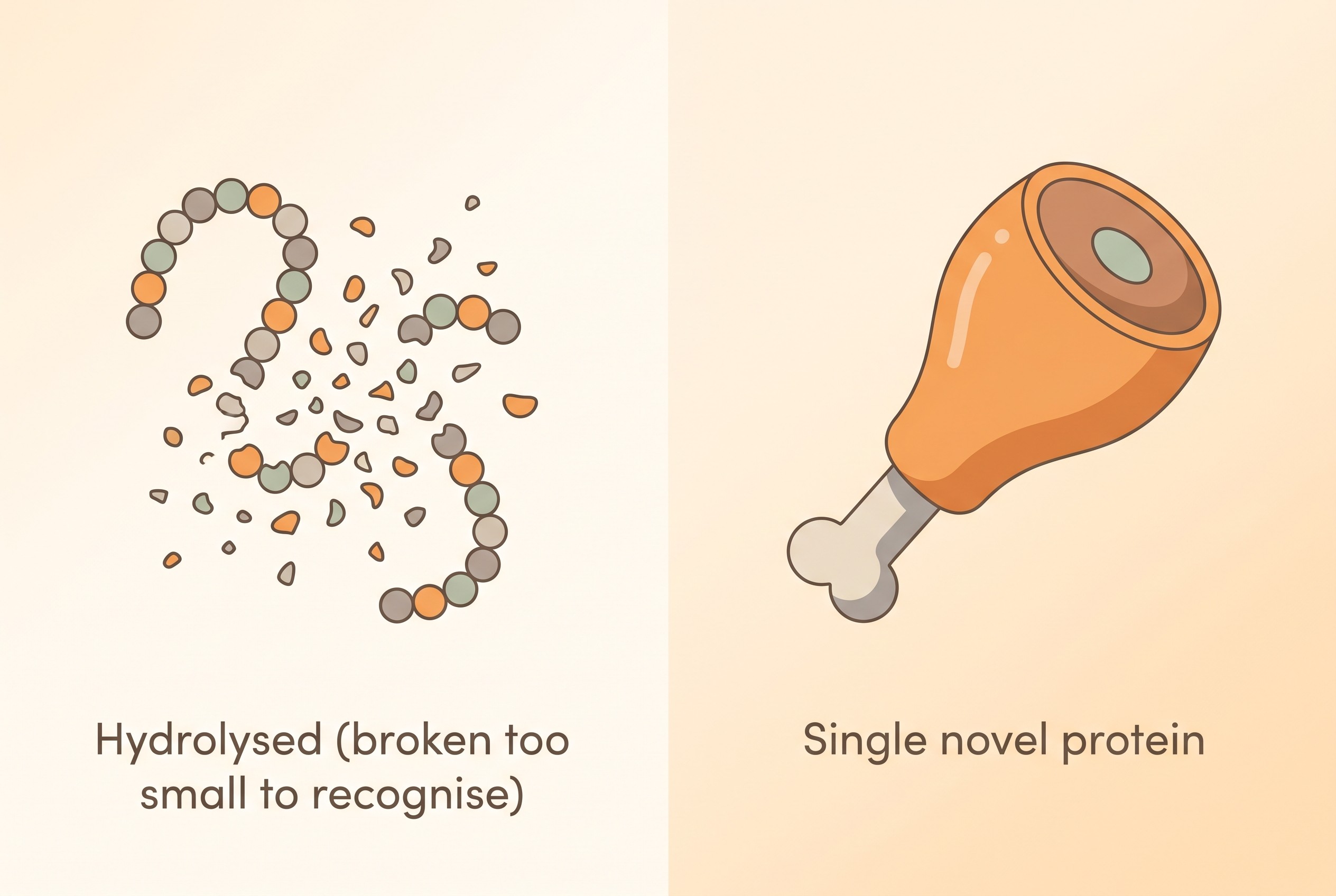
The first is an extensively hydrolysed diet, in which the protein has been broken down into fragments so small that the immune system can no longer recognise them, so even a sensitised pet should not react. The second is a single novel protein: one protein source the pet has genuinely never eaten, with nothing else animal-derived in the bowl. The third is a properly balanced home-cooked novel-protein diet formulated by a veterinary nutritionist, the more rigorous route when commercial foods have not given a clear answer. (A fourth, an amino-acid or "elemental" diet, exists for the hardest cases.)
What is not on that list is the supermarket "hypoallergenic", "limited ingredient" or "novel protein" bag. Those phrases are marketing, not a diagnostic guarantee, and the evidence is published and unambiguous. When researchers tested twelve over-the-counter canine limited-antigen diets, ten of the twelve contained animal proteins not declared on the label, including poultry, fish and mammalian material found by microscopy and DNA testing (Ricci et al., 2013). A separate study of four off-the-shelf venison diets found three positive for soy and one for beef, none of which appeared on the packet, and concluded that not one of the four was suitable for a diagnostic trial (Raditic et al., 2011). If the food you are feeding to exclude beef secretly contains beef, the trial cannot work, and you get a false "it is not food" answer through no fault of your own.
This contamination is also the evidence-based reason hydrolysed diets are often the cleaner choice. A larger study using microarray analysis looked at 31 novel-protein and 9 hydrolysed diets and found undeclared species in 77% of the novel-protein foods versus 67% of the hydrolysed ones, with notably fewer contaminating species in the hydrolysed group; dry novel-protein foods were the main offenders (Ricci et al., 2018). So use a veterinary prescription diet rather than a supermarket one, and lean towards hydrolysed unless there is a good reason not to. "Novel" only counts if the protein is novel to your individual pet, which is why a careful diet history matters; and if a pet does not respond to a commercial regimen but food is still suspected, a vet-formulated home-cooked diet is the more rigorous next step (Ricci et al., 2013).
A caveat worth naming, because you should hear it from us rather than feel let down later: even prescription diets are not perfectly clean (that 67% figure includes them), and very occasionally a hydrolysed food still provokes a pet that is strongly sensitised to the parent protein (Pucheu-Haston et al., MSD Veterinary Manual, 2025). These are good diets, and far better than the alternatives. They are simply not the cast-iron guarantee the glossy packaging implies.
Strict means strict, and that is the whole method
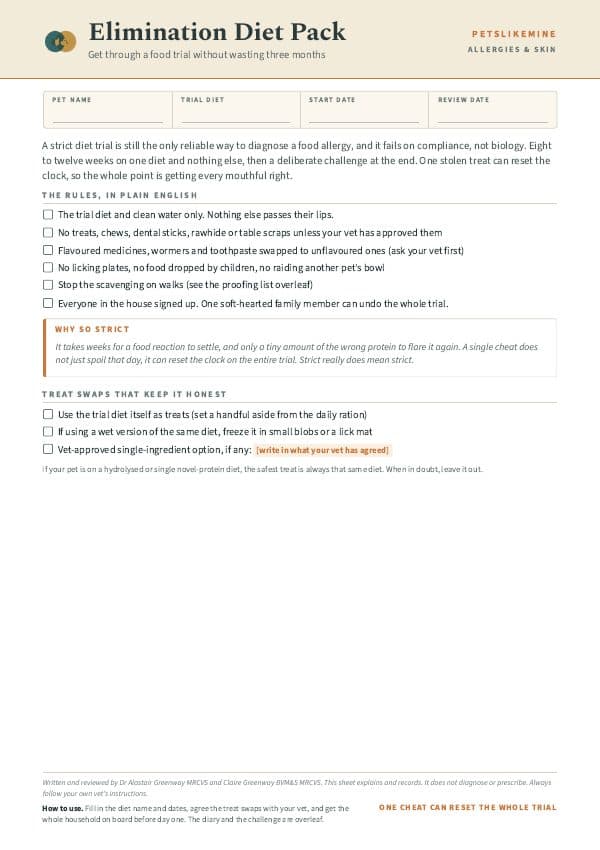
A diagnostic trial only works if the chosen diet controls absolutely everything that goes into your pet's mouth. That means no treats, no rawhides, no dental chews, no flavoured toothpaste, no table scraps, no flavoured supplements, no flavoured medications, and no access to another pet's bowl or to scavenged scraps on a walk (Freeman, Tufts Petfoodology, 2022). One beef-flavoured worming tablet or a single stolen biscuit can undo eight weeks of effort, because the immune system does not grade slips on a curve. Flavoured medication catches people out more than anything else, so it deserves a specific flag: a chewable flea-and-worm tablet or a flavoured anti-inflammatory is, for the purposes of this trial, food.
Strictness is not a bonus you add if you can manage it. It is the method itself. That is why so many trials fail, not because the biology is uncertain but because in real homes with children, other pets and well-meaning neighbours, total control is genuinely hard. The tactics for pulling it off, the treat swaps, getting the household and dog-walker on side, the multi-pet and outdoor-cat realities, are a subject in themselves and are owned by surviving the food trial. This is where the Elimination-Diet Companion earns its place: it holds the timeline, lets you log everything that goes in the mouth, flags slips, and tells you when the clock has actually run.
How long to run it, and why week two tells you nothing
The trial must run long enough, and "long enough" is considerably longer than most owners expect. To diagnose a cutaneous food reaction in at least 80% of patients, a restriction diet should run a minimum of five weeks in dogs and six weeks in cats, and extending it to eight weeks lifts diagnostic sensitivity above 90% in both species (Olivry, Mueller and Prélaud, 2015). The rule almost every dermatologist teaches follows from that: run a skin trial for at least eight weeks before you decide it has not worked.
Opinions vary a little at the margins, and we would rather be straight about that than pretend there is one tidy number. Tufts advises eight to twelve weeks for skin signs, with tummy signs often settling faster, in three to four weeks (Freeman, Tufts Petfoodology, 2022). The MSD Veterinary Manual notes that around ten weeks may be needed to catch 95% of cases, while a short concurrent course of an anti-itch drug, or two to three weeks of prednisolone at the start, can shorten the trial to as little as four weeks (Pucheu-Haston et al., MSD Veterinary Manual, 2025). Treat eight weeks as the practical floor, not the ceiling.
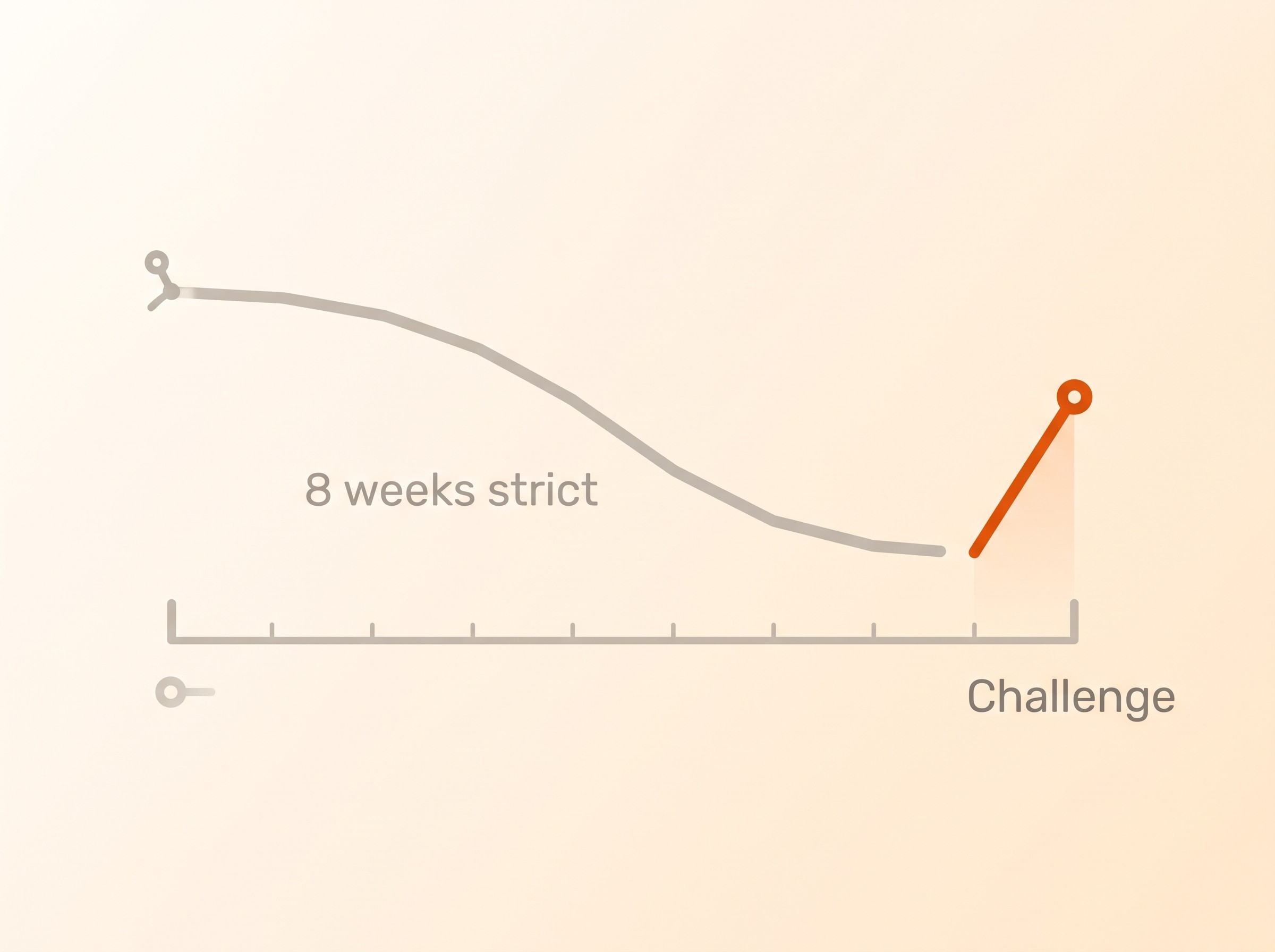
Here is the single most useful point for getting a clean result. Improvement on a food trial is usually gradual, and often not obvious until you are weeks in, so the real measure is a tracked itch score across the whole trial, not a gut feeling at week two. A pet who is "maybe a bit better" at day fourteen tells you almost nothing; the same pet, scored 0 to 10 every few days, may show a clear downward line by week six that you would never have spotted by eye. This is exactly what the Skin and Itch Tracker is for, making a slow change visible, and paired with the Companion it turns a fuzzy "I think so" into a readable answer.
The proof step everyone skips: the provocation challenge
Improvement on the diet alone is suggestive. It is not proof. A pet might have settled because the pollen season ended, or simply because you were both willing it to work. Food allergy is only confirmed when the pet improves on the diet and then flares again when the original food is reintroduced, which is called the provocation challenge (Pucheu-Haston et al., MSD Veterinary Manual, 2025; Olivry and Mueller, 2020). Skipping it is the commonest way owners end up unsure for life.
For reassurance on timing: most pets that are going to react do so quickly, with roughly half of dogs flaring within five days of the challenge and 90% by fourteen days, and cats faster still (Olivry and Mueller, 2020). The full how-to of the challenge, then pinning down the exact trigger and building a diet for life, is owned by after the trial. Name it now, and let that article walk you through it.
Four fixable reasons a trial "fails" when it shouldn't
Most "it's not food" verdicts that turn out to be wrong come down to four fixable things. The trial was too short, abandoned at week two or three when it needed eight. There was a slip: a treat, a flavoured tablet, a scavenged kebab or the cat's bowl. The food was an OTC "hypoallergenic" bag contaminated with the very protein being avoided (Ricci et al., 2013; Raditic et al., 2011). Or there was an untreated concurrent cause masking the response, classically active fleas or a secondary skin or ear infection that needed treating alongside the diet (Hensel and Santoro, 2023). That last one connects to the idea that a pet can be pushed over its itch line by several things at once, so clearing the food may not fully settle them, which is explained in the itch threshold.
The diet trial is hard. There is no pretending otherwise. But it is the one test that genuinely answers the question, and a clean trial saves you years of guesswork and rotated products. Set it up properly, run the Companion and the Skin and Itch Tracker alongside it, hold your nerve to the eight-week mark, and do the challenge at the end. Do that, and you finish with a real answer instead of a wasted spring.
References
- Olivry T, Mueller RS, Prélaud P. (2015). Critically appraised topic on adverse food reactions of companion animals (1): duration of elimination diets. BMC Veterinary Research, 11: 225.
- Ricci R, Granato A, Vascellari M, Boscarato M, Palagiano C, Andrighetto I, Diez M, Mutinelli F. (2013). Identification of undeclared sources of animal origin in canine dry foods used in dietary elimination trials. Journal of Animal Physiology and Animal Nutrition, 97(Suppl 1): 32–38.
- Raditic DM, Remillard RL, Tater KC. (2011). ELISA testing for common food antigens in four dry dog foods used in dietary elimination trials. Journal of Animal Physiology and Animal Nutrition, 95(1): 90–97.
- Ricci R, Conficoni D, Morelli G, Losasso C, Alberghini L, Giaccone V, Ricci A, Andrighetto I. (2018). Undeclared animal species in dry and wet novel and hydrolyzed protein diets for dogs and cats detected by microarray analysis. BMC Veterinary Research, 14(1): 209.
- Mueller RS, Olivry T. (2017). Critically appraised topic on adverse food reactions of companion animals (4): can we diagnose adverse food reactions in dogs and cats with in vivo or in vitro tests? BMC Veterinary Research, 13(1): 275.
- Hensel P, Santoro D. (2023). Food allergy in dogs and cats; current perspectives on etiology, diagnosis, and management. Journal of the American Veterinary Medical Association (JAVMA), 261(S1): S23–S29.
- Pucheu-Haston CM, et al. Cutaneous Food Allergy in Animals. MSD Veterinary Manual (Merck Veterinary Manual), reviewed/revised 2025.
- Freeman LM. (2022). Think Your Pet has a Food Allergy? Eliminating Mistakes in Elimination Diet Trials. Petfoodology, Cummings School of Veterinary Medicine at Tufts University. (Lisa M. Freeman DVM, PhD, DACVIM (Nutrition).)
- Olivry T, Mueller RS. (2020). Critically appraised topic on adverse food reactions of companion animals (9): time to flare of cutaneous signs after a dietary challenge in dogs and cats with food allergies. BMC Veterinary Research, 16(1): 158.
Free downloads
Companion worksheets to put what you've read into practice. Free PDFs, print at home.
Keep track of how your pet is doing
The owners who cope best are the ones who notice changes early. A simple health log shows you what is working, and what is not, before the next vet visit.
Start tracking, freeYou're not doing this alone
Compare treatment journeys and talk to owners managing allergies & skin. Free to join.
Join PetsLikeMine