

Surviving the food trial: treats, family, scavenging and staying strict
Alastair Greenway
BVM&S MRCVS
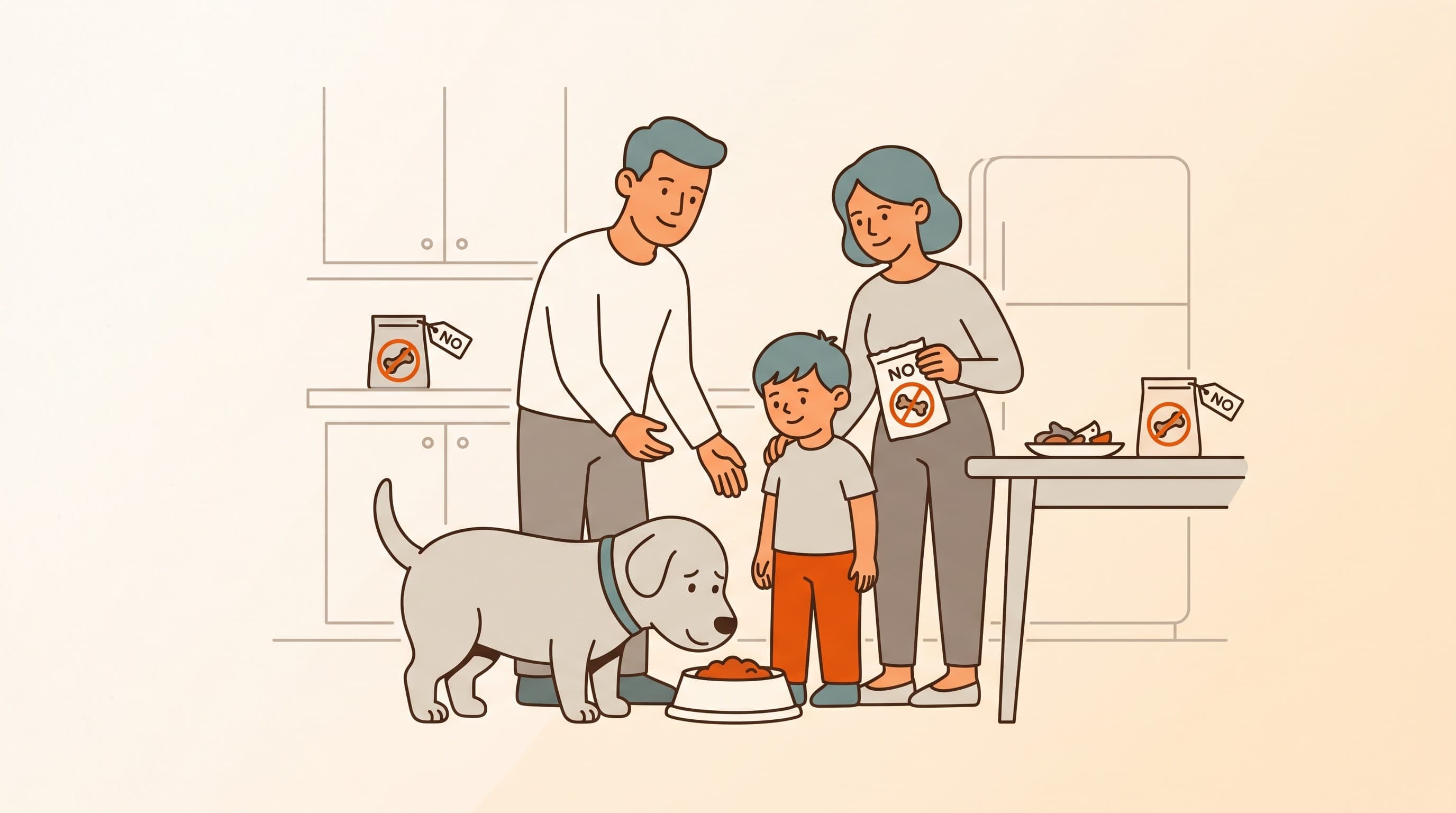
The diet is chosen, the bag is in the cupboard, and now eight weeks or more of living it stretch out ahead. This is the part nobody warns you about properly. The food trial is not hard because your dog or cat has tricky biology. It is hard because life is full of small kindnesses: a biscuit slipped under the table, a flavoured worming tablet, a neighbour who adores your spaniel, and any one of them can quietly undo weeks of effort. The single most important thing to grasp is this: whether the trial gives you a clean answer is decided almost entirely by how strictly the household holds the line, not by the pet (Tham, 2024).
If you have not chosen a diet yet, or want to know why the trial is the only test that works and how hydrolysed and novel-protein foods differ, start with the elimination diet itself. This piece assumes you are past that and now need to survive the weeks. It also assumes nobody has told you a blood, saliva or hair test could shortcut it, because none of them can, and allergy testing explains why.
One rule: nothing past the lips
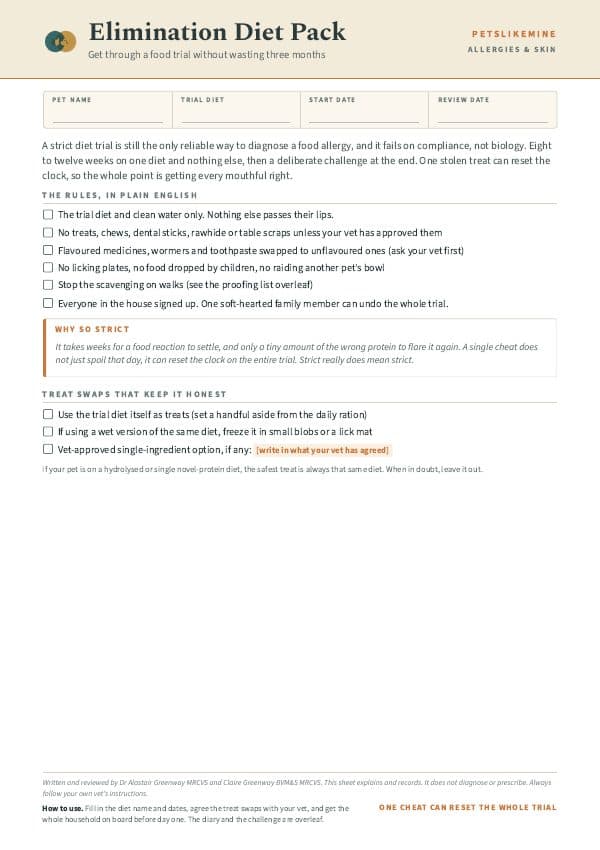
The whole trial fits in a single sentence. For the entire trial period, your pet eats the chosen diet and nothing else: not a different treat, not a dental chew, not a lick of yoghurt, not a flavoured supplement, not table scraps (MSD Veterinary Manual; Tham, 2024). "Exclusive" is not a polite word for "mostly". It is absolute.
Owners almost always under-rate how little it takes to wreck things. A small piece of cheese, a smear of peanut butter, half a biscuit from a toddler: any of these can be enough to provoke a reaction and invalidate weeks of patience (Tham, 2024). There is no "just a little" on a food trial. The most common food triggers in pets are the everyday proteins (beef, dairy, chicken and wheat in dogs, and beef, fish and chicken in cats) (Mueller, Olivry and Prélaud, 2016), which is precisely what fills most treats, dental sticks and human snacks. So the answer to "what can I give as a treat" is not a different packet. It is the trial food itself, and we come to how.
A single slip is costly, and nearly invisible
If a slip caused an obvious flare the next morning, owners would take the rule far more seriously. The cruelty of a food reaction is that it is delayed. After a pet is re-exposed to a trigger food, only about 9% of dogs and 27% of cats flare on the very first day. Half of dogs flare by around day five and half of cats by about day four, and it takes roughly 14 days in dogs and 7 days in cats for 90% to react (Olivry and Mueller, 2020).
So a Tuesday slip may not show until the following week, by which time you have no reason to connect the itch to the biscuit. The flare builds slowly and arrives late, so the cause is invisible. That is exactly why a slip cannot be brushed off with "it probably didn't matter", and why careful logging beats hopeful forgetting.
Saboteurs you would never think of
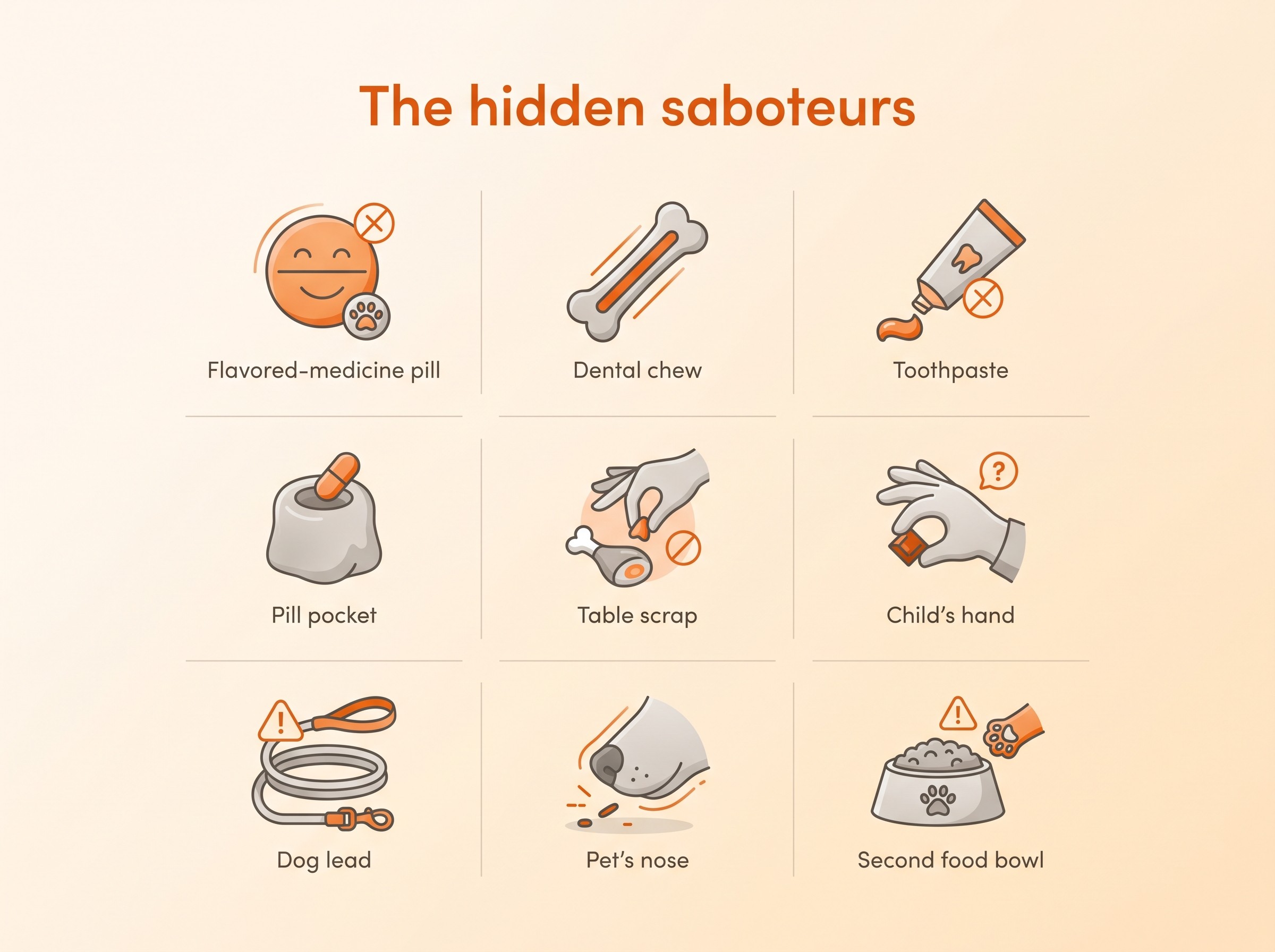
Some of the worst offenders never look like food. The classic is medication. Chewable and flavoured parasiticides (the tasty flea, tick and worming products) and many flavoured tablets commonly contain beef, pork or soy protein, on the label or not, and pets have been seen to flare on the flavouring alone (MSD Veterinary Manual; Tham, 2024). The fix is not to stop the medication. It is to ask your vet to switch any flavoured chewable to a non-flavoured tablet, a spot-on or an injectable for the trial. Let your vet pick the product, because formulations change and the right swap depends on what your pet needs.
One thing must not be sacrificed to the trial: flea control. Do not drop your pet's parasite cover to protect the food trial, because untreated fleas are the commonest stacking trigger underneath an itchy pet, and a few flea bites can make a perfectly run trial look like a total failure. Keep the protection going, just in a non-flavoured form, and flea allergy explains why one bite matters so much.
The rest of the hidden list is mundane, which is exactly why slips happen: flavoured toothpaste, rawhide and dental chews, pill pockets, flavoured vitamin, mineral and joint supplements, and flavoured toys with a coating designed to be licked (MSD Veterinary Manual; Tham, 2024). None of these feel like "feeding the pet", which is the whole problem.
Don't try to solve it by shopping
The intuitive move, when the usual treats are off the table, is to buy a "hypoallergenic", "limited ingredient" or "novel protein" treat instead. Do not. Across studies, a median of around 45% of commercial pet foods contained an animal protein not declared on the label, and even diets marketed as novel or limited-ingredient were mislabelled in roughly a third to four-fifths of products tested (Olivry and Mueller, 2018). A claim on a shelf is not a guarantee, and another packet just adds another uncontrolled variable to your trial. (Why the "hypoallergenic" and grain-free aisle is so misleading belongs to food allergies explained; here the rule is enough: trust the diet you chose, not a new claim.)
Safe swaps that actually work
The trick is to treat and enrich without ever leaving the trial diet. Your pet still gets rewards, fun and comfort. They just all come from the same food.
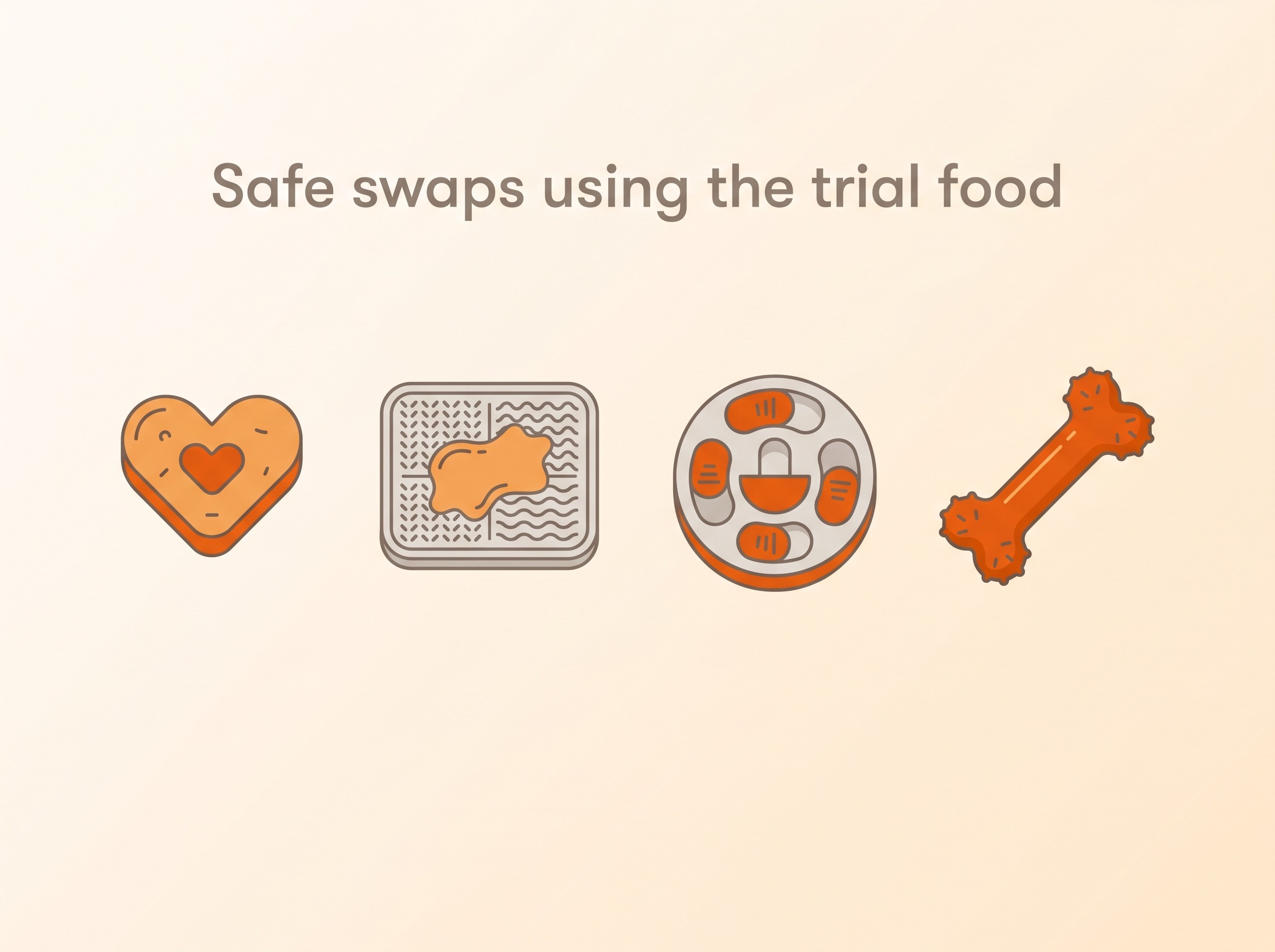
- Use the trial food as the treat. Bake the kibble into little "biscuits" (with water only, not egg, oil or stock, which would reintroduce a protein), freeze the wet form into cubes, smear it on a lick mat, and set aside a portion of the daily ration as training rewards. It still counts as the trial diet, so it is safe.
- Enrich without flavour. A snuffle mat or puzzle feeder loaded with the trial kibble turns dinner into a game. Scent games and plain, uncoated chew toys give a dog something to do that has nothing to do with smuggled food.
- Hide pills in the diet, not a pill pocket. Ask your vet whether tablets can be tucked into a little wet trial food rather than a flavoured pill pocket.
Getting the whole household on side
A food trial is a team sport with a deadline, and it fails the moment one person does not know the rules. Brief every adult and child in the home: to a young child the message is simply "no food from anyone but me", framed as a job they are helping with. Put a note on the fridge so nobody has to remember. Tell the people outside the front door too (the dog-walker, daycare, the boarders, the besotted neighbour) because they cannot follow a rule they have never heard. Frame it as it really is: a strict two months with an end date, not a permanent ban. People hold a line far more willingly when they can see the finish.
Multi-pet homes and the outdoor cat
Shared resources are a structural risk, not a footnote. In a multi-pet home the patient must be fed separately from the others, or every animal in the house fed the same trial diet, and even a shared water bowl can carry enough cross-contamination to matter (MSD Veterinary Manual). In practice that means feeding in separate rooms, picking bowls up between meals so nobody grazes on the wrong one, and watching the water. Feeding everyone the same diet is often the simplest fix if it suits the others.
Scavenging is the next hurdle. A dog who hoovers up everything on a walk needs management, and a well-fitted basket muzzle lets the committed scavenger keep walking safely. The harder case is the cat who roams. A free-roaming cat hunts, scrounges and is fed by half the street, and there is no realistic way to run a strict trial around that. The trade-off, and it is a real one, is that a clean answer may need the cat kept indoors for the trial. That is hard, and worth weighing openly with your vet rather than pretending the trial is valid when the cat is eating who-knows-what next door.
Slipped? Log it and keep going
You will probably slip at least once, and that does not mean starting from zero or giving up. It means three things. Log it accurately, with the date. Carry on with the trial rather than abandoning it. And accept that your reading for the next one to two weeks is clouded, because of that delayed, building flare (Olivry and Mueller, 2020). Then ask your vet whether the trial needs extending to get a clean stretch. A slip you record is a problem you can manage. A slip you hide makes the final result impossible to trust.
This is exactly where the Elimination-Diet Companion earns its place. It is not admin. Strict adherence is the single most important success factor in the whole trial, and structured follow-up, a prompt to check in and keep morale up, helps owners stick to it (Tham, 2024). The Companion runs the eight-week countdown so you know where you are, gives you somewhere to log every slip and household exposure the moment it happens (while you still remember the cause), and keeps the trial on track and finishable. Run the Skin & Itch Tracker alongside it to score the itch through the trial, so genuine improvement, or a post-slip flare, shows up dated against the timeline rather than relying on memory.
Why eight weeks, and how to last them
Eight weeks is the floor, not the target, and knowing the numbers helps you pace yourself. In dogs, more than 95% of food-allergic cases are in remission by week eight, with about half settled by week three and more than 85% by week five. In cats, around 90% are in remission by week eight, about half of them by week four (Olivry, Mueller and Prélaud, 2015). So if your pet is not transformed by week three, that is completely normal: slow responders are common, and stopping early is how owners talk themselves out of an answer that was only a fortnight away.
Compliance fatigue, not biology, is the real enemy over those two months, which is why the swaps, routines and household briefing matter as much as the food. Build the trial into the day so it runs on rails: same feeding spots, treats portioned from the bag each morning, the muzzle or the closed door simply part of the routine.
When you reach a clean, fully completed trial, the work is not quite finished, and that is good news, because a clean run is what makes the answer trustworthy. After the trial walks through the challenge step, confirming food allergy and pinning down the specific protein, which is the moment all this discipline finally pays off.
References
- Tham, H. L. (2024). Elimination diet trials: steps for success and common mistakes. Today's Veterinary Practice, July/August 2024.
- Olivry, T. and Mueller, R. S. (2020). Critically appraised topic on adverse food reactions of companion animals (9): time to flare of cutaneous signs after a dietary challenge in dogs and cats with food allergies. BMC Veterinary Research, 16(1), 158.
- Olivry, T. and Mueller, R. S. (2018). Critically appraised topic on adverse food reactions of companion animals (5): discrepancies between ingredients and labeling in commercial pet foods. BMC Veterinary Research, 14(1), 24.
- Mueller, R. S., Olivry, T. and Prélaud, P. (2016). Critically appraised topic on adverse food reactions of companion animals (2): common food allergen sources in dogs and cats. BMC Veterinary Research, 12(1), 9.
- Olivry, T., Mueller, R. S. and Prélaud, P. (2015). Critically appraised topic on adverse food reactions of companion animals (1): duration of elimination diets. BMC Veterinary Research, 11, 225.
- MSD Veterinary Manual. Cutaneous food allergy in animals. Integumentary System. Merck & Co., Inc. (MSD/Merck Veterinary Manual).
Free downloads
Companion worksheets to put what you've read into practice. Free PDFs, print at home.
Keep track of how your pet is doing
The owners who cope best are the ones who notice changes early. A simple health log shows you what is working, and what is not, before the next vet visit.
Start tracking, freeYou're not doing this alone
Compare treatment journeys and talk to owners managing allergies & skin. Free to join.
Join PetsLikeMine