

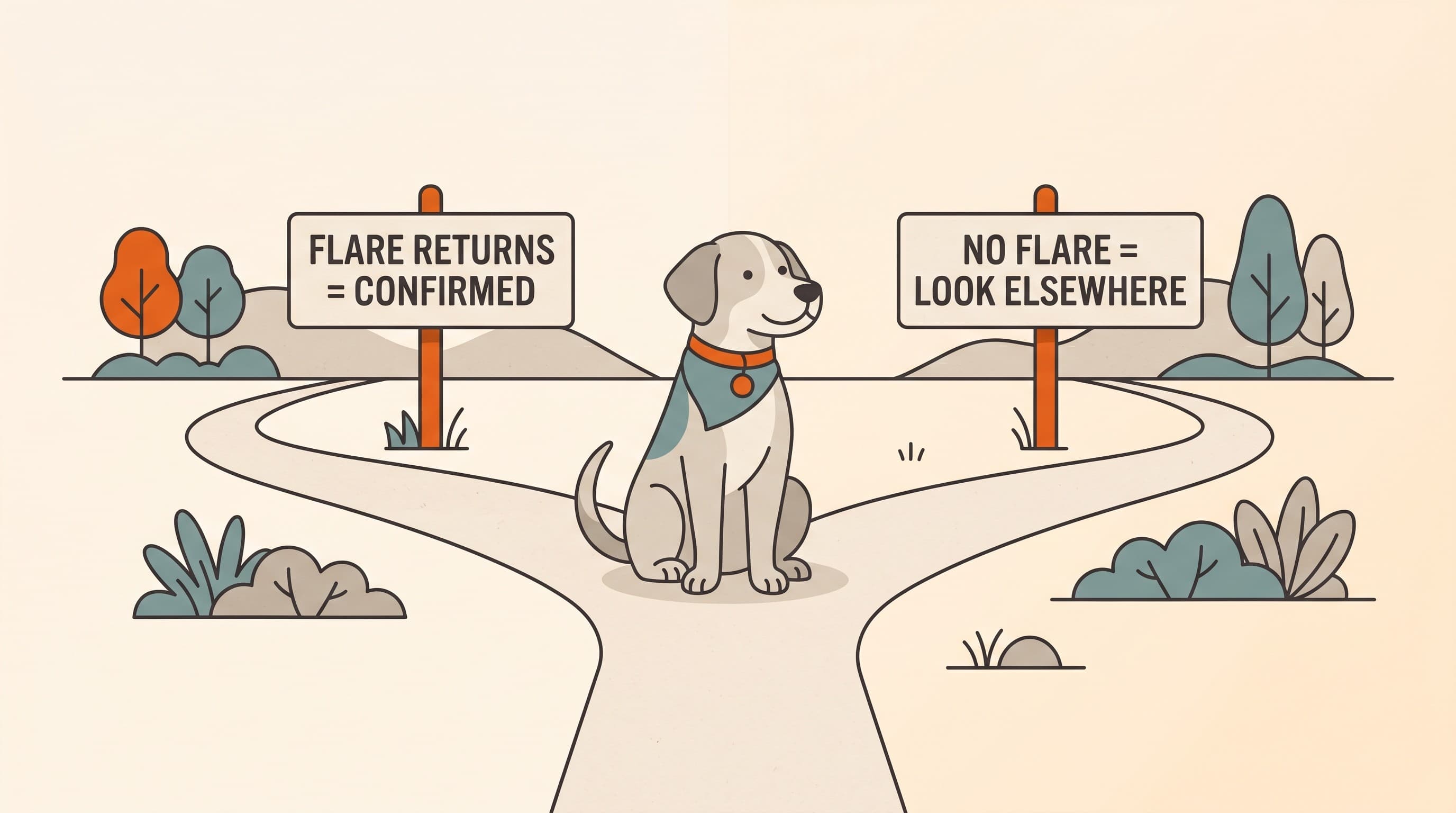
After the trial: the challenge, finding the trigger, and feeding for life
Alastair Greenway
BVM&S MRCVS
Eight strict weeks, no slips, and your pet is visibly more comfortable: less scratching, calmer ears, fewer flares. The hard part is behind you. What most owners do next is entirely understandable: leave well alone, keep feeding the special food, never make them itchy again. But there is one more step, the one that turns "the diet seemed to help" into "we know exactly what to avoid". Most owners skip it, and much of the advice out there calls a food allergy "diagnosed" off improvement alone. This article closes that loop: confirming the diagnosis, finding the specific trigger if you want to, and building a diet your pet can live on for life. If you have not yet run the trial, the how and why of the diet itself (which food, how long, why it is the only valid test) is owned by the elimination diet, done properly; this piece assumes you are through it.
Why improvement is not yet proof
A pet getting better on an elimination diet is suggestive, not diagnostic. To confirm a food allergy you have to elicit a clinical flare by feeding the original diet again (Olivry and Mueller, 2020; Pucheu-Haston et al., MSD Veterinary Manual, 2025). Without that, you cannot tell a true food responder from three impostors: a coincidental seasonal lull (the pollen season ended), a placebo-by-owner effect (you were willing it to work), or improvement that was actually down to the flea and infection treatment given alongside the diet (Olivry and Mueller, 2020).
I know how this lands. Your pet is finally settled and nobody wants to make it itch on purpose. But a short, monitored flare is reversible: the moment signs return you stop the trigger and go back to the diet, and the pet settles again. You are not undoing your work, you are banking it, and it beats a lifetime of wondering whether the diet was doing anything at all.
Re-feed the old food and watch
The challenge is simple. You re-feed the pet's original diet, the food it was on before the trial, because that is the exact mixture you already know used to provoke signs (MSD Veterinary Manual, 2025), and you watch, keeping the elimination diet ready the instant anything stirs.
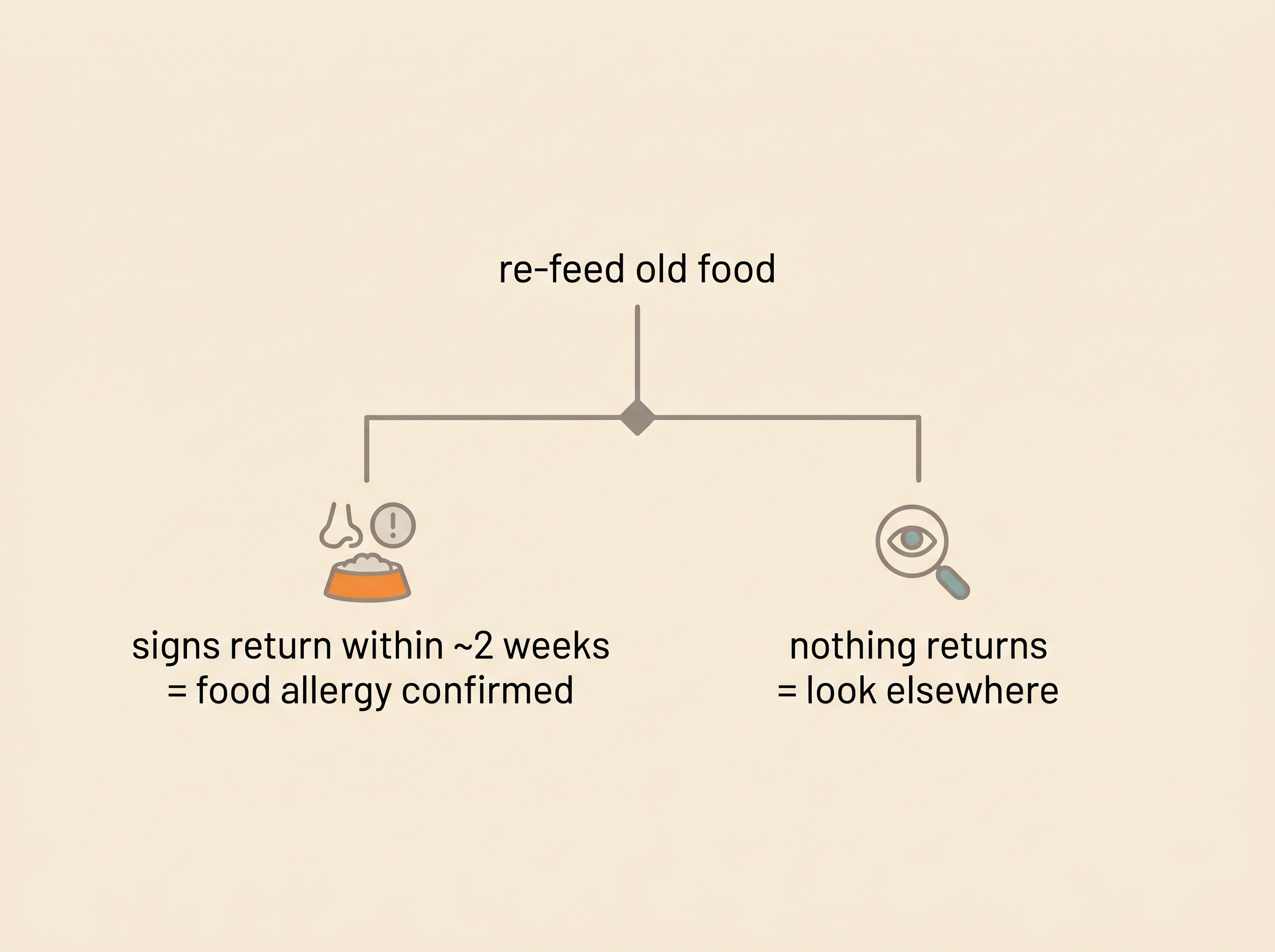
How long do you wait before calling it? The best owner-facing rule comes from a review of 234 dogs and 83 cats. In dogs, half flared by day 5 and 90% by day 14; cats are faster, half by day 4 and 90% by day 7, and by 14 days nearly every truly food-allergic patient of either species had relapsed (Olivry and Mueller, 2020). About 9% of dogs and a striking 27% of cats reacted on the very first day (Olivry and Mueller, 2020). So the practical rule, which matches the 10-to-14-day outer limit in the MSD manual (MSD Veterinary Manual, 2025): wait up to 14 days in a dog, or 7 days in a cat, before concluding the challenge is negative.
Almost every challenge flare is gradual and skin-deep: more scratching, redder ears, perhaps looser stools over a few days. That is not dangerous, and it is what you are watching for. Very occasionally a re-exposure provokes something faster: facial or muzzle swelling, hives spreading over the body, vomiting with collapse, or any difficulty breathing. That is a different event, and it is an emergency: stop the food and ring your vet or the nearest out-of-hours clinic straight away (more on those sudden reactions in is this a skin emergency). For the ordinary slow flare, read on.
This is exactly where a tracked itch score earns its keep. "He seems a bit worse" is far too vague to hang a lifelong diagnosis on; a scored itch level plus a couple of photos turns a hunch into a clear before-and-after, the data point that confirms the diagnosis. The Skin & Itch Tracker is built for this, and the Elimination-Diet Companion holds the challenge timeline so you know what went in and when.
And if nothing happens? If you re-feed the old food and no flare comes within those windows, this was never a food allergy, and the itch is coming from elsewhere: environmental atopy, fleas, or infection (Olivry and Mueller, 2020). That is useful news, not a wasted trial, and it sends you back to the five-cause work-up and usually onward to atopic dermatitis explained.
Pinning down the exact trigger
Once a whole-diet challenge has confirmed the allergy, you can, if you wish, pin down the precise protein. Let the flare settle on the elimination diet again, then reintroduce single ingredients one at a time: the proteins the pet used to eat, typically chicken, beef, dairy, fish, egg or lamb. Each goes in as a small top-up at meals (a tablespoon up to a quarter-cup by dog size, or the feline equivalent) on top of the unchanged base diet, watched for two weeks before the next (MSD Veterinary Manual, 2025; VCA Hospitals). Two weeks is not arbitrary: a positive response can take that long, and rushing risks blaming the wrong ingredient (MSD Veterinary Manual, 2025). If an ingredient flares, that protein is confirmed; pull it, let the pet settle, continue once calm. The Companion's reintroduction log and two-week spacing prompt are built for this, and the itch tracker is how you attribute a flare to the right ingredient rather than guessing. (And no, a blood, saliva or hair test cannot shortcut this and name the trigger for you; why they fail at exactly this job is set out in allergy tests that work.)
Individual-ingredient challenge is not always practical or even necessary (MSD Veterinary Manual, 2025). Plenty of owners do not want to provoke flare after flare, and a pet can be managed beautifully for life on a diet known to be safe without ever naming the precise molecule. So you have explicit permission to stop at "we have a diet that works". Sequential reintroduction is the route to freedom, not an obligation: knowing it is, say, beef lets you pick ordinary foods and treats again rather than the prescription bag forever. If that freedom is not worth repeated flares, stopping is a perfectly good decision too.
One number is worth carrying whichever route you choose. In a 2026 double-blinded study, most dogs needed a fairly large amount before reacting (the mean eliciting dose was around 21 g of food protein, and most reactions came only at the higher 10 to 30 g doses), but roughly 6% reacted to the lowest dose tested, just 1 g, with a median eliciting dose near 0.86 g/kg (Udraite Vovk et al., 2026). For a sensitive individual, a single treat or one flavoured tablet can be enough. Most pets are not that exquisitely sensitive, but you cannot tell in advance which yours is, so the avoidance that follows has to be genuinely strict, not "mostly".
Feeding for life: choose the diet on purpose
Long-term management of a confirmed food allergy is lifelong avoidance of the trigger, on a diet that is complete and balanced for everyday feeding, ideally holding the pet in full or near-full remission on diet alone (MSD Veterinary Manual, 2025). The lazy advice you have probably met, "just keep feeding the special food forever", is fine if that food is a complete maintenance diet, but it should be a deliberate choice, not a default. There are three sensible routes.
The first, and the lowest-risk default, is to stay on the trial diet, provided it is a complete maintenance food. Veterinary hydrolysed and novel-protein diets are formulated as complete and balanced for long-term feeding, not just for the trial, so continuing one is a convenient option (MSD Veterinary Manual, 2025; The Veterinary Nurse, 2021). The second, once you know the specific protein, is to move to any ordinary complete food that avoids it: the payoff for sequential reintroduction, widening your choice and usually cutting the cost. The third, for pets that refuse a commercial option or have several confirmed triggers, is a home-cooked diet, but only one formulated by a board-certified veterinary nutritionist.
That last caveat is not fussiness, and the evidence is sobering. When researchers assessed 200 home-prepared maintenance recipes for dogs, the overwhelming majority fell short on at least one essential nutrient against NRC or AAFCO recommendations, and only 5 met every requirement, all 5 written by veterinarians (Stockman et al., 2013). Cats fare worse: across 114 recipes, not one met all NRC recommended allowances, with choline, iron, thiamine, zinc, manganese, vitamin E and copper the commonest shortfalls (Wilson et al., 2019). Home-cooking for an allergic pet is legitimate, but a recipe pulled off the internet is a nutritional liability. Insist on a nutritionist-formulated one.
Labels, treats and the outside world
Reading the ingredients panel now becomes a lifelong habit, because the trigger protein hides where you would not think to look: flavoured medications and chewable parasite preventatives, dental chews, table scraps, the other pet's bowl. The threshold-dose finding above (a sensitive dog reacting to roughly 1 g of protein) is exactly why one "harmless" beef-flavoured tablet can undo things (Udraite Vovk et al., 2026). The practical tactics, the treat swaps, getting the household on side, managing scavenging, are the same ones the trial demanded and are owned by surviving the food trial; lifelong avoidance simply needs that same trial-grade strictness.
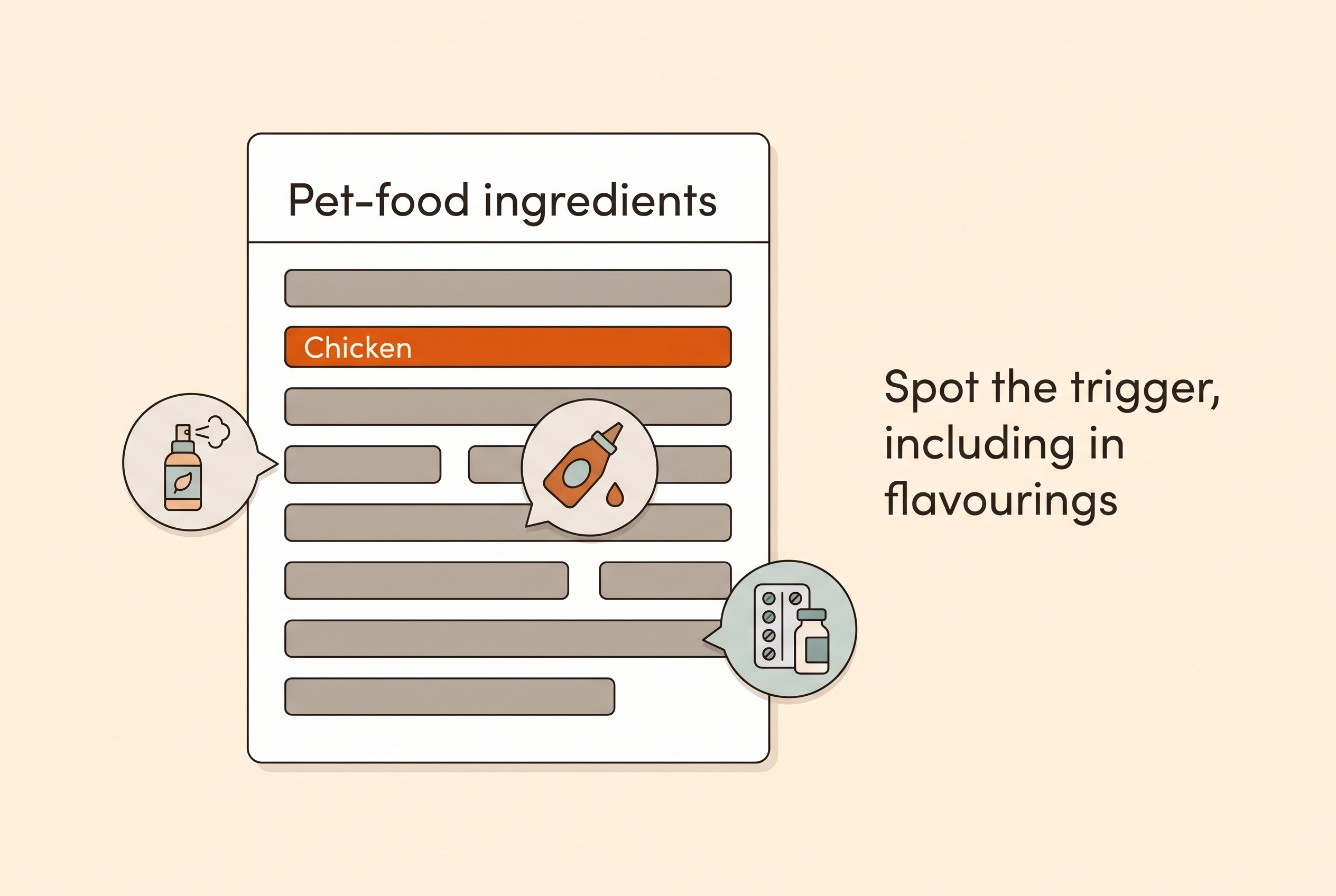
A word on labels themselves: they are imperfect, and supermarket "hypoallergenic" or "limited ingredient" claims are not reliable for a confirmed-allergic pet (the published evidence on undeclared proteins is in the elimination diet article). Sticking to a veterinary diet or a single known-safe recipe is safer. Keep the life-admin concrete: tell the boarding kennel, the cattery, the groomer and your own vet about the diet; bring your pet's food when travelling or hospitalised; and at the vet, ask for non-flavoured medications, since flavoured tablets are food as far as the allergy is concerned.
Still itchy on a clean diet? Think about a second allergy
A meaningful number of food-allergic pets also have environmental atopic dermatitis, and food can trigger atopic flares that are clinically indistinguishable from those caused by pollens, dust mites and moulds (Olivry et al., 2007; Jackson, 2023). So a pet can have its food trigger perfectly controlled and still itch, because a second allergy is also loading the system. Picture it as the itch threshold (explained here): clearing the food removes one load, but if the environment is also pushing, or a secondary skin or ear infection flares, the pet can still sit over the line.
The right move here is not to tweak the diet forever, chasing a food cause that is already handled. It is to investigate the second allergy. The work-up belongs to atopic dermatitis explained and the toolkit to atopic dermatitis treatment, so I will hand you over there rather than half-build an atopy plan. And it is not a failure: a confirmed, well-managed food allergy is one of the most controllable allergic conditions there is, because unlike pollen you can actually remove the trigger. A lingering itch is information, not defeat.
That is the whole loop. The challenge is the small, deliberate, reversible step that turns "the diet seemed to help" into "we know exactly what to avoid", and the Skin & Itch Tracker and Elimination-Diet Companion are how you run it cleanly and carry the answer into a diet for life. From here you are either choosing that long-term food with confidence, or, if the itch lingers, ruling in atopy. Either way, you finally know what you are dealing with.
References
- Olivry T, Mueller RS. (2020). Critically appraised topic on adverse food reactions of companion animals (9): time to flare of cutaneous signs after a dietary challenge in dogs and cats with food allergies. BMC Veterinary Research, 16(1): 158.
- Pucheu-Haston CM, et al. Cutaneous Food Allergy in Animals. MSD Veterinary Manual (Merck Veterinary Manual), reviewed/revised 2025.
- Udraite Vovk L, Widorn L, Lehner G, Mueller RS. (2026). A prospective double-blinded study evaluating threshold doses of dietary allergens that trigger adverse food reactions in dogs, and time to flare after exposure. Frontiers in Veterinary Science, 13: Article 1767167.
- Stockman J, Fascetti AJ, Kass PH, Larsen JA. (2013). Evaluation of recipes of home-prepared maintenance diets for dogs. Journal of the American Veterinary Medical Association, 242(11): 1500–1505.
- Wilson SA, Villaverde C, Fascetti AJ, Larsen JA. (2019). Evaluation of the nutritional adequacy of recipes for home-prepared maintenance diets for cats. Journal of the American Veterinary Medical Association, 254(10): 1172–1179.
- Olivry T, DeBoer DJ, Prélaud P, Bensignor E, and the International Task Force on Canine Atopic Dermatitis. (2007). Food for thought: pondering the relationship between canine atopic dermatitis and cutaneous adverse food reactions. Veterinary Dermatology, 18(6): 390–391.
- The Veterinary Nurse. (2021). Diet in canine dermatology part 2: management of cutaneous adverse food reactions. (UK peer-reviewed practitioner journal.)
- Hensel P, Santoro D. (2023). Food allergy in dogs and cats; current perspectives on etiology, diagnosis, and management. Journal of the American Veterinary Medical Association (JAVMA), 261(S1): S23–S29.
- VCA Animal Hospitals. Implementing an Elimination (Hypoallergenic) Food Trial in Dogs. (Owner-facing clinical resource.)
Keep track of how your pet is doing
The owners who cope best are the ones who notice changes early. A simple health log shows you what is working, and what is not, before the next vet visit.
Start tracking, freeYou're not doing this alone
Compare treatment journeys and talk to owners managing allergies & skin. Free to join.
Join PetsLikeMine