


Is this a skin emergency? Swelling, hives, collapse and the hot, painful patch
Alastair Greenway
BVM&S MRCVS
Most skin trouble is miserable but safe. A pet who scratches, licks and looks moth-eaten is uncomfortable and deserves help, but is almost never in danger in the next hour. A small number of things are different: they come on fast and can turn serious. This article lets you tell those apart from the everyday itch at a glance, so you act fast on the rare dangerous one and stay calm about the common one. We are not working out the cause of a chronic itch here. That belongs to why is my pet so itchy. This is only "is this the dangerous kind, and what do I do right now".
The thing that separates an emergency from chronic allergy is the mechanism. Long-running itch from atopy, food allergy or fleas is a quality-of-life problem that builds over weeks. The genuine emergencies run on a different machine: a sudden allergic reaction, a spreading deep painful lesion, or an ear that has turned neurological. Acute allergic reactions are type I (IgE and mast-cell mediated) and are fast, usually within about six hours of meeting the trigger and often within minutes (Clinician's Brief; MSD Veterinary Manual). Speed is the tell.
The swollen face: hives and the bee-sting look
Two things show up after a sting, a vaccine, a new food or a new drug, and they look alarming. The first is hives (urticaria): raised, itchy wheals, usually a centimetre or several across, sometimes a few and sometimes covering the body, with redness and swelling (MSD Veterinary Manual). The second is angioedema: a deeper, puffy swelling you see most around the muzzle, lips, eyelids and ear flaps, the classic "bee-sting face" (MSD Veterinary Manual; Vetlexicon). The reassuring part comes first, because it matters: most of these reactions are mild and settle on their own, with hives often resolving within roughly twelve to forty-eight hours (MSD Veterinary Manual).
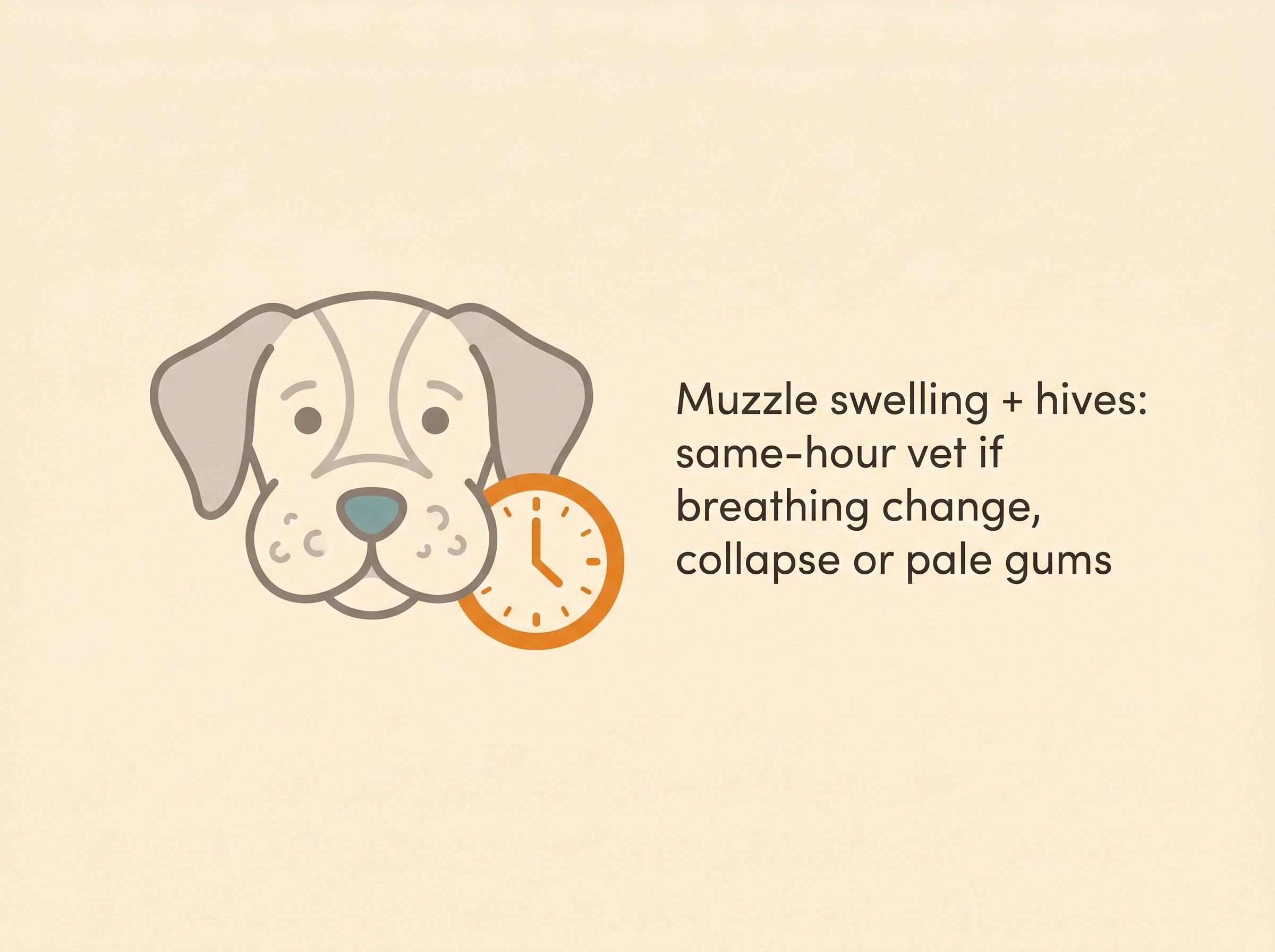
So why mention them in an emergency article at all? Because the swelling can be the first step of something bigger. Urticaria can be a precursor to anaphylaxis, and angioedema near the mouth or throat can extend to the voice box and threaten the airway (MSD Veterinary Manual; Vetlexicon). The rule is worth memorising. A puffy face on a bright, comfortable pet who is breathing normally can usually be watched closely and seen soon. A puffy face plus any breathing change, collapse, repeated vomiting or pale gums is an emergency, not a wait-and-see.
It helps to know where this comes from, because it explains why the face is what swells. The best-recognised triggers are vaccines and insect stings (bees, wasps, hornets), along with new drugs, foods and blood products (Clinician's Brief; MSD Veterinary Manual; Chapman et al., 2024). In a study of dogs with bee and wasp venom allergy, the commonest sting site was the face at 39%, then the paw at 28% and the mouth at 21% (Chapman et al., 2024). Dogs investigate the world nose-first, and that is exactly the part that puffs up.
Vaccines, for their part, paint a reassuring picture. In the largest study of its kind, adverse events within three days of vaccination happened in 38.2 dogs per 10,000 vaccinated, and most were not severe (Moore et al., 2005). That is rare, but "rare" is not "never", so if the face swells after a jab, sting or new medicine, ring your vet and keep a closer eye for the next few hours.
Anaphylaxis: the real emergency, and why it can fool you
Anaphylaxis is the severe end of an acute allergic reaction: a sudden failure of the body's systems, breathing, circulation or the gut, after a known or suspected allergen, with or without skin signs (Clinician's Brief). It comes on in minutes to a few hours. And here is the part that catches owners, and frankly some advice sites, out: what it looks like depends on the species, because the organ that takes the hit differs.
In dogs, the main shock organ is the liver and gut, so canine anaphylaxis often looks like a previously well dog who suddenly vomits, has diarrhoea (sometimes bloody) and collapses, with pale gums and a weak pulse, rather than a textbook rash (MSD Veterinary Manual; Today's Veterinary Nurse). In cats, the main shock organ is the lungs, so it classically shows as sudden, severe difficulty breathing, with collapse, pale gums and cold paws (Today's Veterinary Nurse; Clinician's Brief). A cat struggling to breathe is always an emergency, full stop.
The single most important thing here is counter-intuitive: the skin can look completely normal. Owners expect hives and wait for them. But a large proportion of dogs in anaphylaxis have no skin signs at all: one study population found roughly 40% with no cutaneous signs (Quantz et al., 2009, as summarised in Lisciandro, FASTVet), and a separate case series found 57.9% lacked them, with cardiovascular collapse in 42.1% (Clinician's Brief). So do not wait for a rash. Sudden collapse, vomiting or breathing trouble in a pet who was fine an hour ago, with or without swelling, especially after a sting, vaccine, new food or new drug, is a drop-everything trip to the vet.
What will the vet do? Adrenaline (epinephrine) is the first-line drug, the only one that both treats the signs and stops the reaction progressing, supported by intravenous fluids, oxygen, and antihistamines and steroids as add-ons (Today's Veterinary Nurse; Clinician's Brief). What that means at home is plain: do not reach for a human antihistamine or an EpiPen unless your own vet has specifically prescribed and instructed it for your pet. Dose, drug and route all matter, there is no licensed pet "allergy pen", and the genuinely useful action is getting to a vet fast. One sobering detail: in that venom study, 84% of the dogs with moderate-to-severe reactions had no history of a previous sting (Chapman et al., 2024). There is often no warning shot.
The hot, painful patch that appeared overnight
A dog goes to bed normal and wakes with a flat, wet, angry, hairless patch that was not there yesterday, intensely itchy and sore to touch. That is almost always a hot spot (acute moist dermatitis), a wound the pet has created by frantically licking or scratching an underlying itch (Clinician's Brief). It is a symptom, not a random event, which is why the full treatment and finding the itch underneath live in hot spots in pets. Here we answer one question: is this one urgent?
Most are not. A single surface patch on a pet who is otherwise bright, eating and themselves can usually be seen soon rather than at 2am. But a hot spot can hide something deeper. If clipping the fur reveals smaller "satellite" spots around the main patch, that suggests a deeper infection (folliculitis or furunculosis) needing systemic antibiotics, not just a topical wash (Clinician's Brief). There is also a more serious lookalike. A hot spot is a surface problem. Cellulitis is a deeper, spreading bacterial infection of the tissue that causes hot, painful swelling and can make a pet systemically unwell, while an abscess is a walled-off pocket of pus. Which antibiotic and how deep the infection runs belongs to skin and ear infections; what you need tonight is the urgency rule.
That rule cuts through cleanly. Surface and itchy, on a well pet, can wait for a soon appointment. Swollen, hot, spreading, deeply painful, or weeping pus on a pet who is off their food, flat or feverish, is a same-day vet. A pet who suddenly stops eating or is in real, obvious pain over a skin lesion has gone past "miserable itch", and should be seen.
Ears: when an infection turns into a red flag
Chronic, recurring ear infections are a different story, usually an allergy underneath, and that whole picture belongs to recurrent ear infections. Ears appear in an emergency article only for a short, specific list of signs that mean the problem has reached the deeper, neurological part of the ear and needs prompt attention, not another bottle of drops.
Watch for sudden severe ear pain, a pet crying out or refusing to let you near the head. And watch for signs that the middle or inner ear is involved: a head tilt, loss of balance, falling or circling, or eyes that flick back and forth (nystagmus). These point to otitis media or interna, which can also cause facial paralysis (a drooping face, an inability to blink) or Horner's syndrome (a sunken eye, a droopy lid and a small pupil) (MSD Veterinary Manual). They warrant a prompt vet visit, because deficits like facial paralysis and head tilt can become permanent if left, and the cause needs imaging and proper treatment rather than more drops (MSD Veterinary Manual).
What to do in the next hour, and what is safe to watch
One line decides whether you are reaching for the phone now or the diary later.
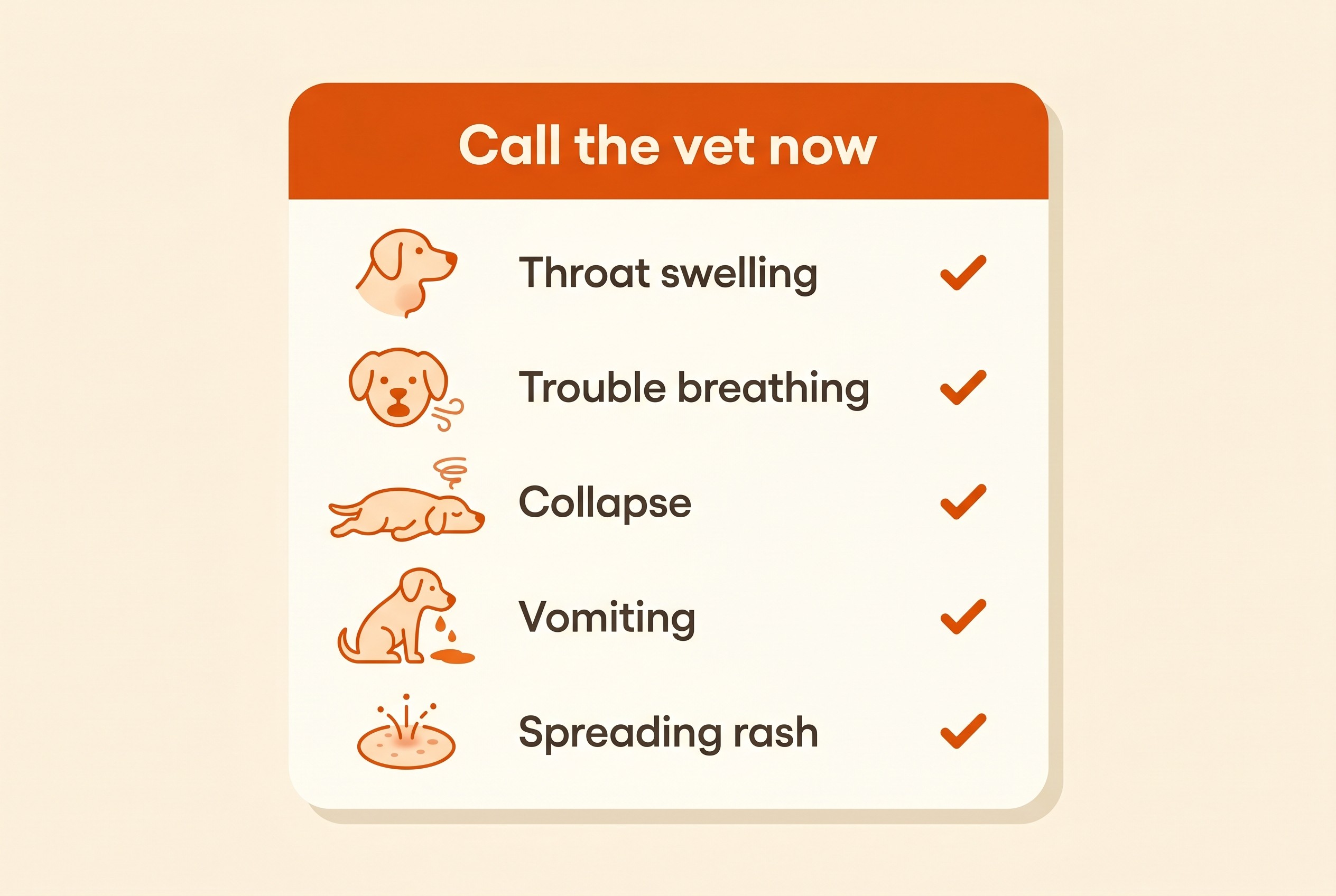
Act now, ring your vet or the out-of-hours service straight away, if you see: facial swelling that is spreading or sits near the throat; any difficulty breathing (and in a cat, any open-mouth or laboured breathing at all); collapse, marked weakness or pale, white or grey gums; sudden vomiting and diarrhoea in a previously well pet, especially after a vaccine, sting, new food or new drug; a rapidly enlarging, very painful or pus-filled patch on an unwell pet; or sudden severe ear pain with a head tilt or loss of balance.
Safe to watch carefully at home, and book a routine appointment, if you have: a single small patch of itch or redness on a bright, alert pet who is eating and drinking; mild, localised hives with no facial or throat swelling and no other signs (keep watching, as hives can be the opening move of a bigger reaction); or a long-standing itch that is no worse than usual.
This is where the Skin & Itch Tracker earns its place. When you are in the "watch carefully" camp, a dated photo and an itch score turn "I think it's a bit worse" into evidence: they show whether a patch is growing hour by hour, give your vet something concrete, and help you catch a creeping flare before it becomes the 2am hot spot. (Much later, once you are chasing a chronic food trigger, the Elimination-Diet Companion is there too, but that is a calm-day job, not a tonight one.)
The truth to hold onto is that the dangerous reactions are rare and most settle quickly, with hives often gone in a day or two (MSD Veterinary Manual), and the overwhelming majority of itchy pets are uncomfortable, not in danger. Knowing the red flags is not about living on alert. It lets you relax over the common case precisely because you would recognise the rare one. If your pet is on the safe side of that line, the next read is why is my pet so itchy, where a vet works out the cause.
References
- Chapman E, West EA, Kosnik M, Fischer NM, Favrot C, Beeler L, Rostaher A. Natural History and Risk Factors of Hymenoptera Venom Allergy in Dogs. Animals (Basel). 2024;14(22):3220.
- Moore GE, Guptill LF, Ward MP, Glickman NW, Faunt KK, Lewis HB, Glickman LT. Adverse events diagnosed within three days of vaccine administration in dogs. Journal of the American Veterinary Medical Association. 2005;227(7):1102-1108.
- Quantz JE, Miles MS, Reed AL, White GA. Elevation of alanine transaminase and gallbladder wall abnormalities as biomarkers of anaphylaxis in canine hypersensitivity patients. Journal of Veterinary Emergency and Critical Care (San Antonio). 2009;19(6):536-544.
Keep track of how your pet is doing
The owners who cope best are the ones who notice changes early. A simple health log shows you what is working, and what is not, before the next vet visit.
Start tracking, freeYou're not doing this alone
Compare treatment journeys and talk to owners managing allergies & skin. Free to join.
Join PetsLikeMine