

Recurrent ear infections: why they keep coming back
Alastair Greenway
BVM&S MRCVS
There is a pattern most owners of a flare-prone pet know by heart. The ear clears on the drops. A few weeks later your pet is shaking their head again, the ear smells, and you are back at the start, opening the third or fourth bottle of the year. It is easy to conclude that your pet simply has unlucky ears.
They almost certainly do not. In dogs especially, a recurring ear is a symptom of something else, usually an allergy, that nobody has found yet (Saridomichelakis et al., 2007; Nuttall, 2023). The question to ask is not "which drops this time?" but "what is causing this?".
The ear is skin, and the infection is rarely the real problem
Ear infections are extremely common. A UK study of more than 22,000 dogs in general practice found around one in fourteen, a one-year prevalence of 7.30%, were seen for otitis externa, inflammation of the ear canal (O'Neill et al., 2021). That frequency is part of why "just another ear infection" is such an entrenched idea, and why it is so often wrong.
The ear canal is lined with the same skin that covers the rest of your pet, so anything that inflames skin elsewhere, allergy above all, inflames the ear too. Modern veterinary dermatology no longer treats an ear infection as a single event but sorts every case into four parts, sometimes called PSPP, and this is what explains why these ears recur (Nuttall, 2023; MSD Veterinary Manual):
- The primary cause starts the inflammation in an otherwise normal ear. The big one is allergy, both atopic dermatitis and food allergy; others include ear mites, foreign bodies like grass seeds, hormonal disease and, less often, growths (Nuttall, 2023; MSD Veterinary Manual; Saridomichelakis et al., 2007).
- The secondary infection is the bacteria and yeast that overgrow once the primary cause has changed the canal. This is the part you notice, the smell and the discharge, but it is a consequence, not the cause (Nuttall, 2023; MSD Veterinary Manual).
- The predisposing factors make a given ear more likely to flare: heavy pendulous flaps, hairy or narrow canals, and moisture. The UK study put numbers on the first, with pendulous ears carrying nearly twice the odds of otitis as erect ones (O'Neill et al., 2021).
- The perpetuating factors are the changes chronic inflammation itself creates, which keep the ear diseased even after the original trigger is gone: a thickened, narrowed canal, scarring, and eventually calcification of the canal wall (Nuttall, 2023; MSD Veterinary Manual).
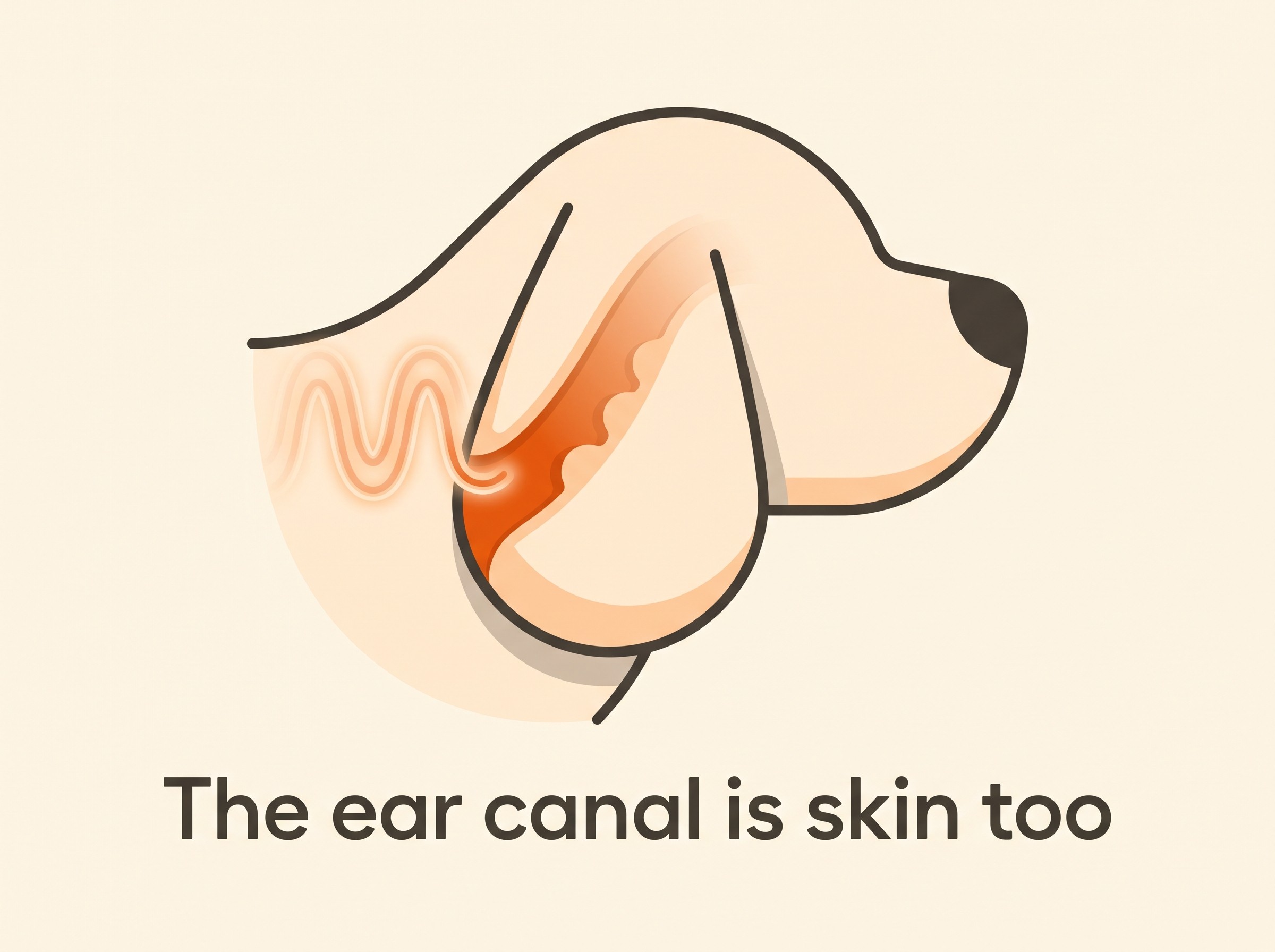
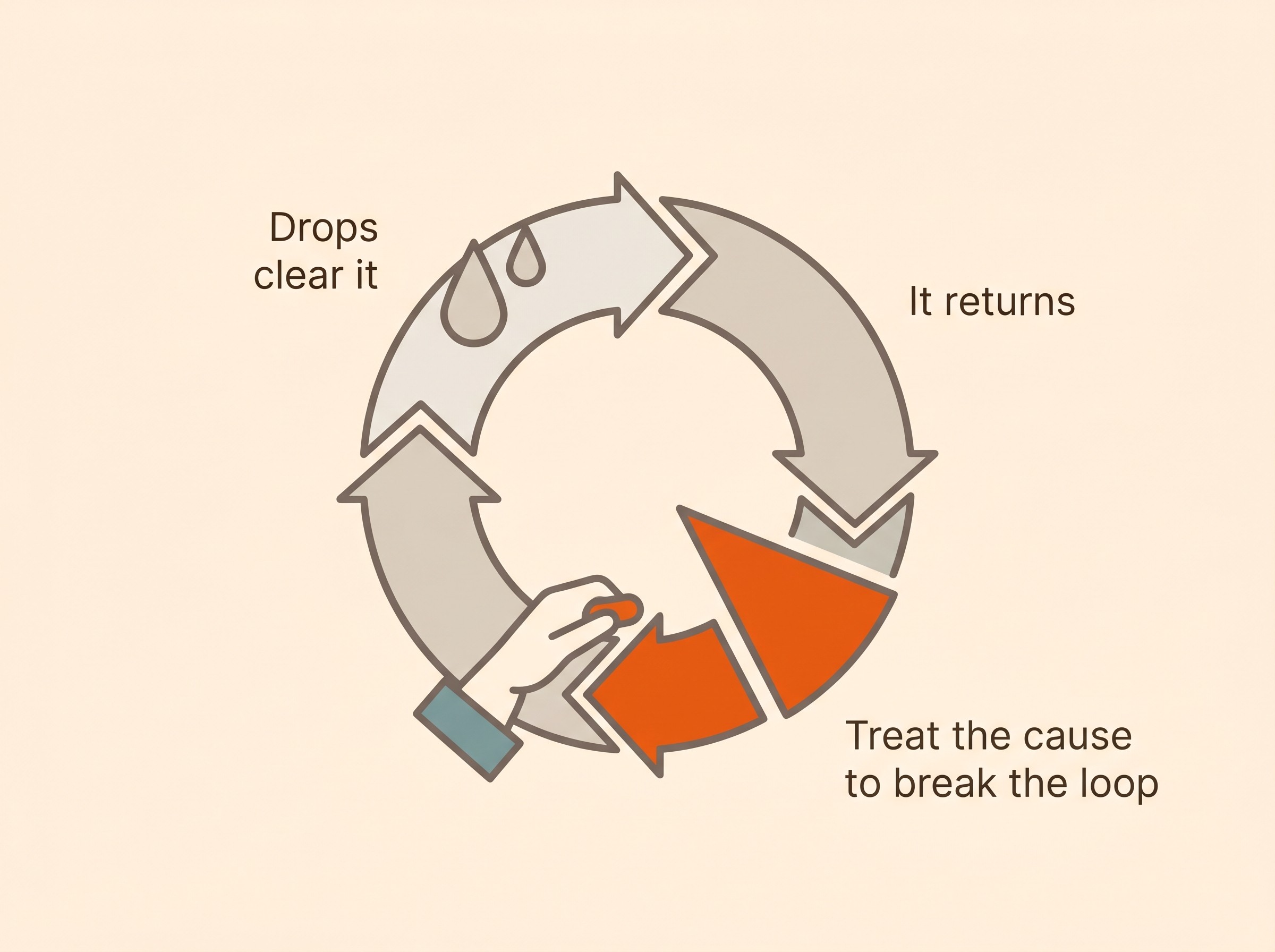
Treat only the secondary infection and you clear the smell and discharge while leaving the primary cause untouched, so it returns. In dogs, as the best recent reviews put it, recurrent ear infections are essentially always secondary to an underlying cause, and treating each flare without finding that cause is precisely why it keeps coming back (Nuttall, 2023; Montin Mills and Lundberg, 2025).
When the allergy hides in the ear
In dogs, that primary cause is, more often than not, an allergy. In one study of 100 dogs with otitis externa, allergic skin disease (atopic dermatitis and food allergy together) was the primary cause in 43 of them, far ahead of grass awns (12) or ear mites (7), and almost two thirds of those ears were already chronic or recurrent (Saridomichelakis et al., 2007). So in first-opinion practice roughly four in ten otitis cases are allergic, rising to the majority, up to around three-quarters, in the chronically recurring ears that reach dermatologists (Paterson, 2002; Montin Mills and Lundberg, 2025). The more an ear recurs, the more likely allergy is behind it, which is exactly why the hunt for a cause matters most in the pets whose ears never quite stay better.
What catches owners off guard is this: the ear can be the first, and sometimes the only, place an allergy shows up. The MSD Veterinary Manual states plainly that chronic or recurrent otitis may be the only clinical sign in a small number of dogs with atopic dermatitis. So "but her skin is perfectly fine, it is only her ears" does not rule allergy out; it is the ear equivalent of "but I never see any fleas". The ears are simply one of the classic allergic sites, alongside the paws, face, front-leg creases, armpits and belly (MSD Veterinary Manual; Favrot et al., 2010). The timing fits too: when atopic dermatitis is the cause, the ear disease usually begins in young dogs, so a young dog with recurring ears who is otherwise well should make everyone think allergy, not coincidence (Zur et al., 2011).
The way to stop the ears recurring, then, is to find and treat that allergy. For what the underlying disease is, read atopic dermatitis explained, and for how to control it, the treatment toolkit. Because food allergy commonly shows up as ear disease, a properly run elimination diet is often part of the work-up, and the elimination diet article and the Elimination-Diet Companion are how you work through it.
Cats break the rule: check for mites first
The "it is usually allergy" headline is a canine truth, and it needs a caveat for cats. The commonest cause of otitis externa in cats is not allergy at all but the ear mite Otodectes cynotis, particularly in kittens and young cats, producing a dry, dark, crumbly discharge like coffee grounds and intense itching (Cornell Feline Health Center; MSD Veterinary Manual). Allergy does cause feline ear disease too, but not the way it dominates in dogs. So the feline rule is straightforward: an itchy or waxy cat ear needs mites ruled out first, with a quick swab down the microscope, before anyone reaches for allergy. The mites, and how to tell a mite ear from an allergic one, are covered in ear mites and the other mites; if mites are excluded, feline atopic syndrome takes it from there.
What the swab is actually for
The organisms that overgrow in an infected ear, the yeast Malassezia, the bacterium Staphylococcus pseudintermedius, and in chronic ears harder-to-clear Gram-negative rods such as Pseudomonas, all need different drugs, and you cannot tell them apart by smell or by eye (Saridomichelakis et al., 2007; MSD Veterinary Manual; Nuttall, 2023). That is why a good vet swabs the ear and reads it under the microscope. This ear cytology shows whether the infection is yeast, cocci, rods or a mixture, and directs which drops to choose, so a vet who samples at each significant flare is doing the job properly, not padding the bill (Nuttall, 2023; MSD Veterinary Manual). Most flares then clear with drops alone, without oral antibiotics. Why repeated oral antibiotics are the wrong reflex, and what resistant bacteria mean, is owned by treating the infection and finding the cause; the bacteria and yeast themselves are explained in skin and ear infections explained.
Cleaning is not the same as treating
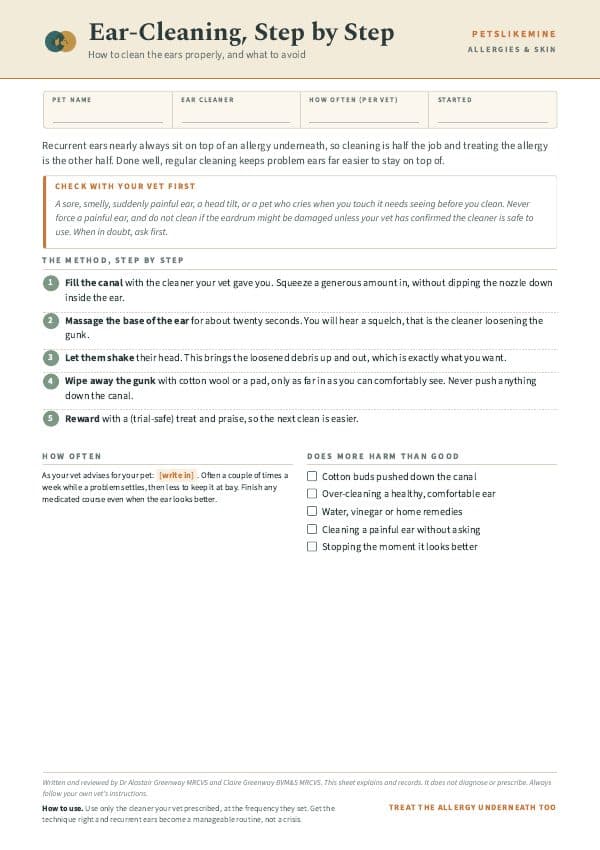
This distinction is routinely muddled, and getting it wrong does harm. Gentle cleaning of a healthy or mildly waxy ear can help; aggressive cleaning of an inflamed ear, or the wrong cleaner in it, does not (MSD Veterinary Manual; Nuttall, 2023). Cotton buds should never go down the canal: pushing a cotton-tipped swab into it impacts wax deeper and traumatises the lining (Montin Mills and Lundberg, 2025). And more is not better: frequent, vigorous cleaning is itself a recognised but often overlooked cause of otitis, the repeated trauma inflaming the delicate lining while the wet left behind keeps it macerated (Montin Mills and Lundberg, 2025; MSD Veterinary Manual).
The most important rule: do not clean or medicate a suddenly painful ear, or one that might have a ruptured eardrum, without your vet's direction. If the eardrum is perforated, stronger detergent cleaners are contraindicated because they can reach the middle ear and cause real damage, so owners are cautioned to watch for reduced hearing, a head tilt and loss of balance (MSD Veterinary Manual). That is why a vet checks the eardrum before choosing products, and why you should never tip leftover old drops into a newly sore ear. The aim is to clear debris so medication can reach the lining, not to scrub the ear daily; let your vet set the technique and frequency, and taper it as the ear settles.
Breaking the cycle, and the surgery you are trying to avoid
The mindset shift that ends the loop is to think in two phases: an induction phase to get the ear into remission (clear the infection, calm the inflammation), then a maintenance phase to keep it there, all while the primary cause is diagnosed and controlled (Nuttall, 2023). Maintenance might mean periodic medicated cleaning and intermittent anti-inflammatory drops, but above all it means treating the allergy underneath rather than waiting for the next flare.
This is where keeping a record changes everything. Logging each flare, the date, which ear, how it looked and smelled, and what was given, turns "her ears again" into a dated pattern a vet can read: how often it recurs, which ear leads, and whether treating the allergy is reducing flares over time. The Skin & Itch Tracker is built for exactly this. And there is real, if early, evidence it works. In a 2026 randomised, blinded, controlled trial, atopic dogs whose allergy was managed with a therapeutic diet had far fewer ear flares over six months: a quarter of the diet group had an episode, against around six in ten of the controls (Watson et al., 2026). It was a small, industry-funded study of 34 dogs, but the direction matches long clinical experience: treat the cause, and the ears settle.
The reason this is worth the effort is the endpoint you are working to avoid. Repeated, poorly controlled flares drive the perpetuating changes, the thickened, narrowed and eventually calcified canal, that no amount of drops can reverse. The only definitive treatment for an ear that reaches this end stage is to remove the whole canal surgically, in an operation called total ear canal ablation: effective, but major surgery on a structure that did not have to get there (Nuttall, 2023). The quietly hopeful conclusion from the best recent review is that most of this surgery is avoidable if recurrent otitis is recognised and managed early (Nuttall, 2023). A recurring ear is not a life sentence of drops; it is a warning to find the cause now, while the canal is still healthy.
When an ear is an emergency
Most recurring ears can be worked up calmly, but a few presentations cannot wait. Sudden severe pain, a head tilt, a loss of balance, flicking eyes or sudden deafness suggest the middle or inner ear is involved and need a same-day vet visit (MSD Veterinary Manual). An ear flap that swells up quickly like a cushion, usually after violent head-shaking, is an aural haematoma and also needs prompt attention. These urgent signs are covered in full in is this a skin emergency?.
If your pet is on their third bottle of drops this year, the most valuable next conversation with your vet is not about a stronger drop. It is the one that starts: "what is causing this, and how do we find it?" That question, and the work-up it opens, is how the cycle finally ends.
References
- Nuttall T. "Managing recurrent otitis externa in dogs: what have we learned and what can we do better?" Journal of the American Veterinary Medical Association. 2023;261(Suppl 1):S10-S22.
- Saridomichelakis MN, Farmaki R, Leontides LS, Koutinas AF. "Aetiology of canine otitis externa: a retrospective study of 100 cases." Veterinary Dermatology. 2007;18(5):341-347.
- O'Neill DG, Volk AV, Soares T, Church DB, Brodbelt DC, Pegram C. "Frequency and predisposing factors for canine otitis externa in the UK: a primary veterinary care epidemiological view." Canine Medicine and Genetics. 2021;8:7.
- MSD Veterinary Manual (Merck Veterinary Manual). "Otitis Externa in Animals." Ear Disorders; and "Atopic Dermatitis in Dogs." Integumentary System.
- Favrot C, Steffan J, Seewald W, Picco F. "A prospective study on the clinical features of chronic canine atopic dermatitis and its diagnosis." Veterinary Dermatology. 2010;21(1):23-31.
- Zur G, Lifshitz B, Bdolah-Abram T. "The association between the signalment, common causes of canine otitis externa and pathogens." Journal of Small Animal Practice / related Zur et al. work. 2011. (Age-of-onset and signalment of allergic otitis.)
- Cornell University College of Veterinary Medicine, Cornell Feline Health Center. "Otitis." (Feline ear disease overview.)
- Watson F, et al. "Incidence Rate of Otitis Externa Episodes in Atopic Dogs Is Reduced by a Therapeutic Diet in a 6-Month Randomised, Blinded, Controlled, Clinical Trial." Veterinary Dermatology. 2026.
Free downloads
Companion worksheets to put what you've read into practice. Free PDFs, print at home.
Keep track of how your pet is doing
The owners who cope best are the ones who notice changes early. A simple health log shows you what is working, and what is not, before the next vet visit.
Start tracking, freeYou're not doing this alone
Compare treatment journeys and talk to owners managing allergies & skin. Free to join.
Join PetsLikeMine