


The smaller culprits: ear mites, harvest mites and walking dandruff
Alastair Greenway
BVM&S MRCVS
Ruling out fleas does not finish the parasitic part of an itch work-up. Three smaller mites get overlooked again and again because they are easy to mistake for other things: ear mites read as "just a dirty ear", harvest mites as a mystery autumn flare, and walking dandruff as ordinary dry skin. They are worth knowing for a hopeful reason. Unlike an allergy, which you manage for life, a confirmed mite is one of the few itch causes you can largely cure. Itch is a symptom with a short list of causes worked through in order (why is my pet so itchy), and these three round out the parasite shelf so the work-up does not stop at fleas. Two relatives sit just outside and belong to other pages: the mange mites Demodex and scabies, in mites and mange, and the far more common itchy adult-dog ear that is really allergy, in recurrent ear infections.
Ear mites and the coffee-ground ear
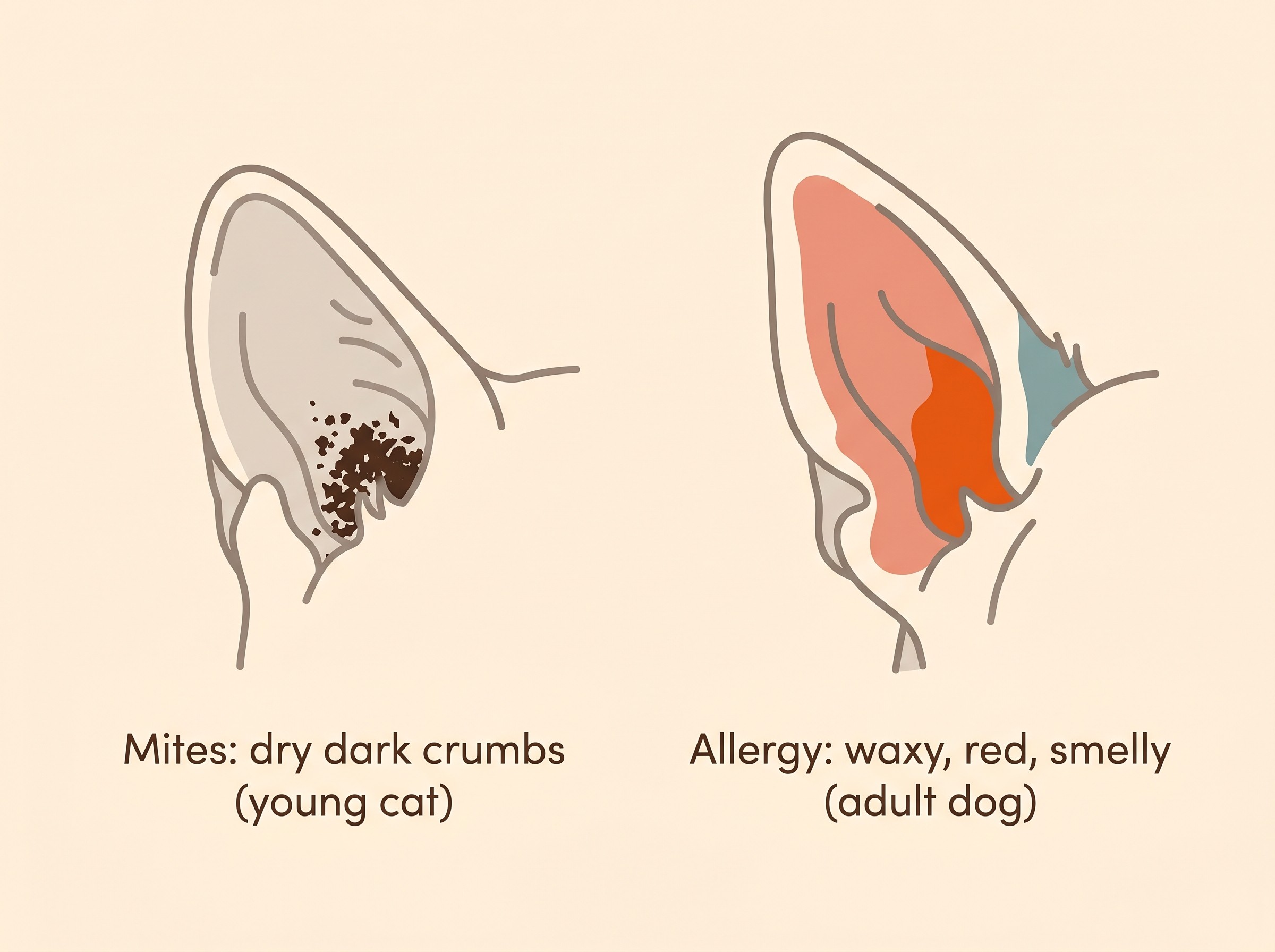
Ear mites are real and common, and frequently both over-diagnosed and under-diagnosed at once. Otodectes cynotis is a surface mite that lives in the ear canal. It is one of the most common ectoparasites of cats, thought to be the primary factor in more than half of feline otitis externa cases, and it turns up more often in feral cats and in cats under a year old, in whom it is "more likely to be pathogenic" (Taenzler et al., 2018; CAPC, 2019). So signalment matters. In a young cat with crumbly black ears, mites are the prime suspect; in an itchy adult dog with one waxy, smelly ear, allergy is far more likely, and that pet needs recurrent ear infections, not a mite product.
The classic look is the most useful thing an owner can carry: a dry, dark-brown, "coffee-ground" discharge deep in the ear, with head-shaking, red ear flaps and an obviously itchy ear (Taenzler et al., 2018; ESCCAP UK & Ireland). That is a brilliant starting clue and a poor finishing one, because wax colour alone does not prove mites. The diagnosis is made by your vet seeing the mites, down the otoscope or under the microscope on an ear swab (CAPC, 2019), which matters because a dark ear treated as the wrong thing wastes weeks. One line is worth knowing: a sore ear with sudden severe pain, a head tilt or loss of balance needs a same-day vet visit, not wait-and-see, and those ear red flags are covered in recurrent ear infections.
Two practical facts shape treatment. First, ear mites are highly contagious by direct contact (Taenzler et al., 2018), so every dog and cat in the home is treated, not just the one scratching, or the mites walk back from the untreated housemate (CAPC, 2019). Off-host survival is not a significant route of spread (CAPC, 2019), so the heavy household cleaning that fleas demand is far less central here. Second, the whole life cycle runs on the host over about three weeks, the complete egg-to-egg cycle taking 18 to 28 days (CAPC, 2019), which is why dosing intervals matter: a single short-acting drop can fail if it does not outlast the next generation hatching.
Modern treatment works well and is increasingly a single dose, though the evidence deserves a fair word. A systematic review found only fair evidence for the older spot-ons such as selamectin (Stronghold) or imidacloprid plus moxidectin (Advocate), and judged the data behind most other drugs too weak to grade despite high apparent efficacy (Yang and Huang, 2016): the drugs work, but the evidence is patchier than the marketing implies. The newer ones have stronger single-dose data. One topical application of fluralaner plus moxidectin (Bravecto Plus for cats) reduced mean mite counts by 100% by day 28 (Taenzler et al., 2018), and a single oral dose clears mites too, with lotilaner (Credelio) giving a 99.6% reduction and no mites down the otoscope by day 14 in cats (Hayes et al., 2025), and sarolaner (Simparica) a 99.4% cure in dogs (Becskei et al., 2018). The practical message is that many broad-spectrum flea and tick products you may already use also clear ear mites, but do not improvise: your vet picks the right licensed product, treats every in-contact animal, and confirms the ear is genuinely clear, not just cleaner-looking. An infested ear can also pick up a secondary infection, which has its own home in skin and ear infections.
Harvest mites and the orange specks of autumn
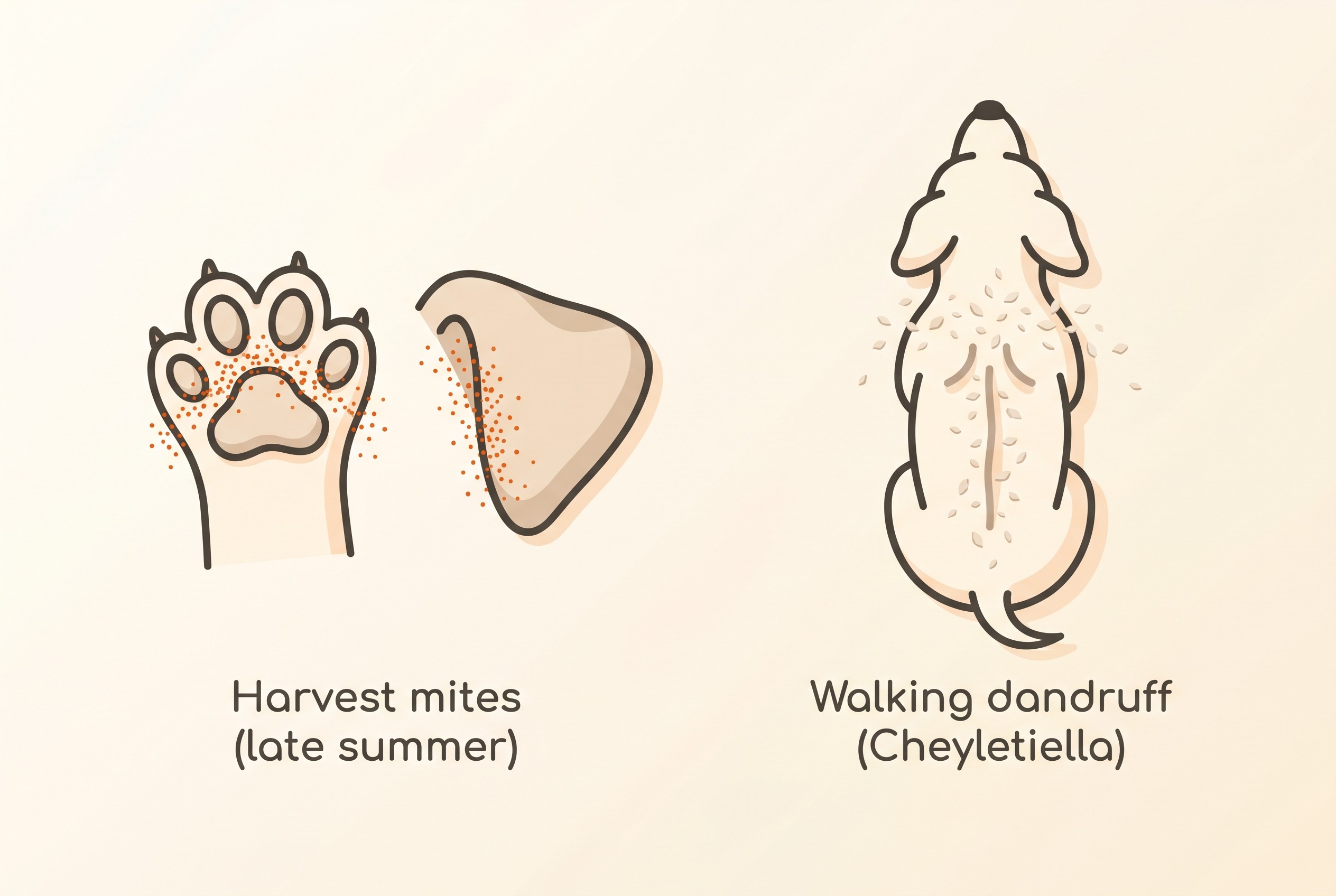
If your pet's paws and ears flare every late summer and you can find no fleas, look closely for tiny orange dots. Neotrombicula autumnalis, the harvest mite, chigger or "berry bug", is the most common chigger in Europe and the British Isles, and only its larval stage parasitises hosts. The larva is "a small reddish-orange mite of about 0.7 mm long"; the adults live free in soil and grass, and the six-legged larvae climb aboard as a pet walks through infested ground (Lecru et al., 2019; ESCCAP UK & Ireland).
The larvae appear in the highest numbers in late summer and autumn (Lecru et al., 2019), gathering where skin is thin and meets the ground: between the toes, along the ear margins, on the eyelids and around the head, and in cats in "Henry's pocket", the small flap-pouch on the edge of the ear (Lecru et al., 2019; ESCCAP UK & Ireland). The itch can be intense and out of all proportion to how few mites you find (ESCCAP UK & Ireland). They feed on liquefied tissue rather than blood, injecting digestive enzymes and taking up partly digested skin (Lecru et al., 2019), then drop off after a few days to develop in the soil. That is why the problem clears off the infested ground but returns with the next walk there, and why this seasonal, site-specific pattern separates harvest mites from year-round atopy on the same paws and face.
Treatment is where a both-species article has to be blunt, because the headline product is dangerous to cats. In a study in naturally infested dogs, a permethrin 54.5% and fipronil 6.1% spot-on (Effitix) cut the parasite score from 2.4 to 0.5 within a day (about a 79% drop) and to near zero by four weeks, with the skin lesions settling over the same period (Lecru et al., 2019). But permethrin is highly toxic to cats, and concentrated permethrin spot-ons are licensed for dogs only: in a retrospective of 42 feline permethrin cases, signs included tremors in 86% and seizures in a third, usually after a canine spot-on was applied to the cat, and the syndrome can be fatal (Boland and Angles, 2010; Sutton et al., 2007). So that evidence is a dog product. Cats need a cat-safe approach (fipronil-based products are an option; your vet will advise), and a dog wearing a permethrin product is itself a hazard to any cat it lives with until it has dried in (Boland and Angles, 2010). For most pets the most useful advice is prevention by avoidance: steer clear of known hot-spot fields at peak times, rinse the paws and ear margins after autumn walks, and ask your vet for a short anti-itch course if the irritation warrants it.
Walking dandruff, the scale that moves
Cheyletiella is the mite most often dismissed as dry skin, and the name tells you why it should not be. It is a large surface mite that causes scaling, and sometimes hair loss, classically along the back; the "walking dandruff" name comes from the large pale mites moving through the scale, so the dandruff itself appears to crawl (ESCCAP UK & Ireland; WCVM Learn About Parasites). There are three host-adapted species (C. yasguri on dogs, C. blakei on cats, C. parasitivorax on rabbits), but they are not strictly host-specific, so a new rabbit, or a dog and cat sharing a home, can pass it between them (WCVM Learn About Parasites). Dogs tend to show more obvious signs than cats, and the itch is variable, which is how it gets written off as a grooming problem rather than a treatable parasite. Crucially, it is contagious and zoonotic: it can give human owners an itchy, spotty (papular) rash where the pet is held (ESCCAP UK & Ireland; WCVM Learn About Parasites). People do not host a breeding population, so the rash settles once the animal is treated, but it is the single most useful clue here: if the family is itchy too, tell your vet, because that points hard at a mite and away from an allergy.
The whole life cycle runs on the host over roughly three weeks, but adult females can survive off it for a week or more (ESCCAP UK & Ireland; WCVM Learn About Parasites), which is why, unlike ear mites, the environment matters here: washing bedding and vacuuming go alongside treating the pet. Diagnosis is by collecting scale, brushing the coat onto dark paper, lifting mites with acetate (sticky) tape, or superficial scrapes (ESCCAP UK & Ireland). Mites can be sparse, especially in cats who groom themselves clean, so a negative test does not rule it out, and a treatment trial is sometimes justified on suspicion, as for scabies in mites and mange. Fipronil or selamectin are effective, repeated as directed, with all in-contact animals and the environment treated together (ESCCAP UK & Ireland).
Is it a mite, or is it allergy?
This is the question that changes everything you do next. Fleas are still step one in any itchy pet (flea allergy dermatitis; flea control that works); these smaller mites come next. Three features then push the diagnosis towards a mite: contagion (other pets, or you, are also itching); a giveaway look or site (coffee-ground wax in a young cat, orange specks on autumn paws, moving dandruff along the back); and seasonality or signalment (harvest mites only in autumn, ear mites mostly in the young). Allergy tends to be the opposite, non-contagious and either year-round or recurring each spring and summer, with the itch pattern owned by why is my pet so itchy.
The nuance is that mites and allergy can co-exist, and a mite can tip an already-allergic pet over its itch threshold, so finding one does not always end the work-up. This is where tracking earns its keep. In the Skin and Itch Tracker you can log where the itch sits and whether it is seasonal (autumn-only paws are a strong harvest-mite hint), photograph the ear or scaly back for your vet, and note whether other pets or people are affected. Watching that score genuinely drop to zero, which a food allergy or atopy never does, is the satisfying part: a mite is not a food problem, so the Elimination-Diet Companion is not the tool for it, and if you are unsure whether to see a vet at all the quick itchy pet triage check will steer you in under a minute.
The thread through all three is the one running through the whole space: get to a diagnosis, do not buy a product blind. A scaly back or itchy ear guessed wrong costs weeks, and a mite is one of the few causes you can actually clear, so if the picture fits, ask your vet to look properly, with an otoscope, swab or coat brushing, and let the result decide what you treat.
References
- Taenzler J, de Vos C, Roepke RKA, Heckeroth AR. (2018). Efficacy of fluralaner plus moxidectin (Bravecto Plus spot-on solution for cats) against Otodectes cynotis infestations in cats. Parasites & Vectors, 11, 595.
- Companion Animal Parasite Council (CAPC). (2019). Otodectic Mite (Otodectes cynotis) guideline. Last updated 13 March 2019.
- Yang C, Huang H-P. (2016). Evidence-based veterinary dermatology: a review of published studies of treatments for Otodectes cynotis (ear mite) infestation in cats. Veterinary Dermatology, 27(4), 221-e56.
- Hayes B, Viljoen A, Rouenhoff S, Mehrotra S, Michler S, Ahlstrom L, Kramer F, Schunack B. (2025). Efficacy evaluation of lotilaner (Credelio) in experimentally induced Otodectes cynotis infestations in cats. Parasites & Vectors, 18, 438.
- Becskei C, Cuppens O, Mahabir SP. (2018). Efficacy and safety of sarolaner in the treatment of canine ear mite infestation caused by Otodectes cynotis: a non-inferiority study. Veterinary Dermatology, 29(2), 100-e39.
- Lecru LA, Combarros D, Castilla-Castano E, Navarro C, Cadiergues MC. (2019). Treatment of harvest mite infestation in dogs using a permethrin 54.5% and fipronil 6.1% (Effitix) topical spot-on formulation. Veterinary Sciences, 6(4), 100.
- Boland LA, Angles JM. (2010). Feline permethrin toxicity: retrospective study of 42 cases. Journal of Feline Medicine and Surgery, 12(2), 61-71.
- Sutton NM, Bates N, Campbell A. (2007). Clinical effects and outcome of feline permethrin spot-on poisonings reported to the Veterinary Poisons Information Service (VPIS), London. Journal of Feline Medicine and Surgery, 9(4), 335-339.
Keep track of how your pet is doing
The owners who cope best are the ones who notice changes early. A simple health log shows you what is working, and what is not, before the next vet visit.
Start tracking, freeYou're not doing this alone
Compare treatment journeys and talk to owners managing allergies & skin. Free to join.
Join PetsLikeMine