

Winning the flea war: treating every pet and the home, all year
Alastair Greenway
BVM&S MRCVS
Half-done flea control is the single commonest reason an itchy pet stays itchy. Owners treat, often faithfully, still see fleas and scratching, and quietly conclude the product has failed. It almost never has. The trouble is that fleas are not really a problem of the fleas you can see, and a plan aimed only at the animal in front of you is fighting about 5% of the war. This is the doing article: how to actually get rid of fleas and keep them gone. The companion piece flea allergy: how one bite causes weeks of misery explains why a single bite matters so much for an allergic pet, and why fleas are step one of every itch work-up.
The hidden 95%: why the home is most of the battle
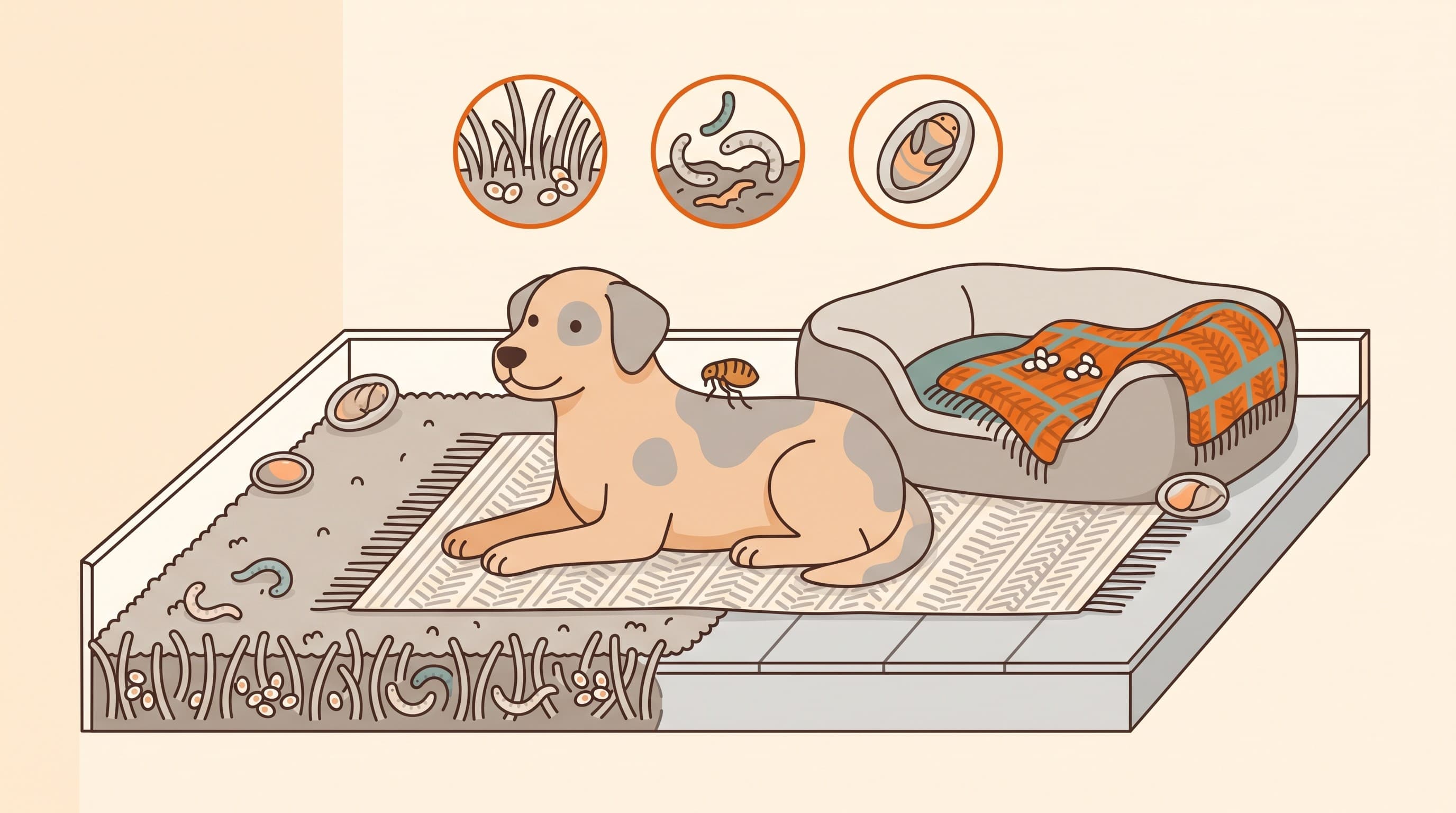
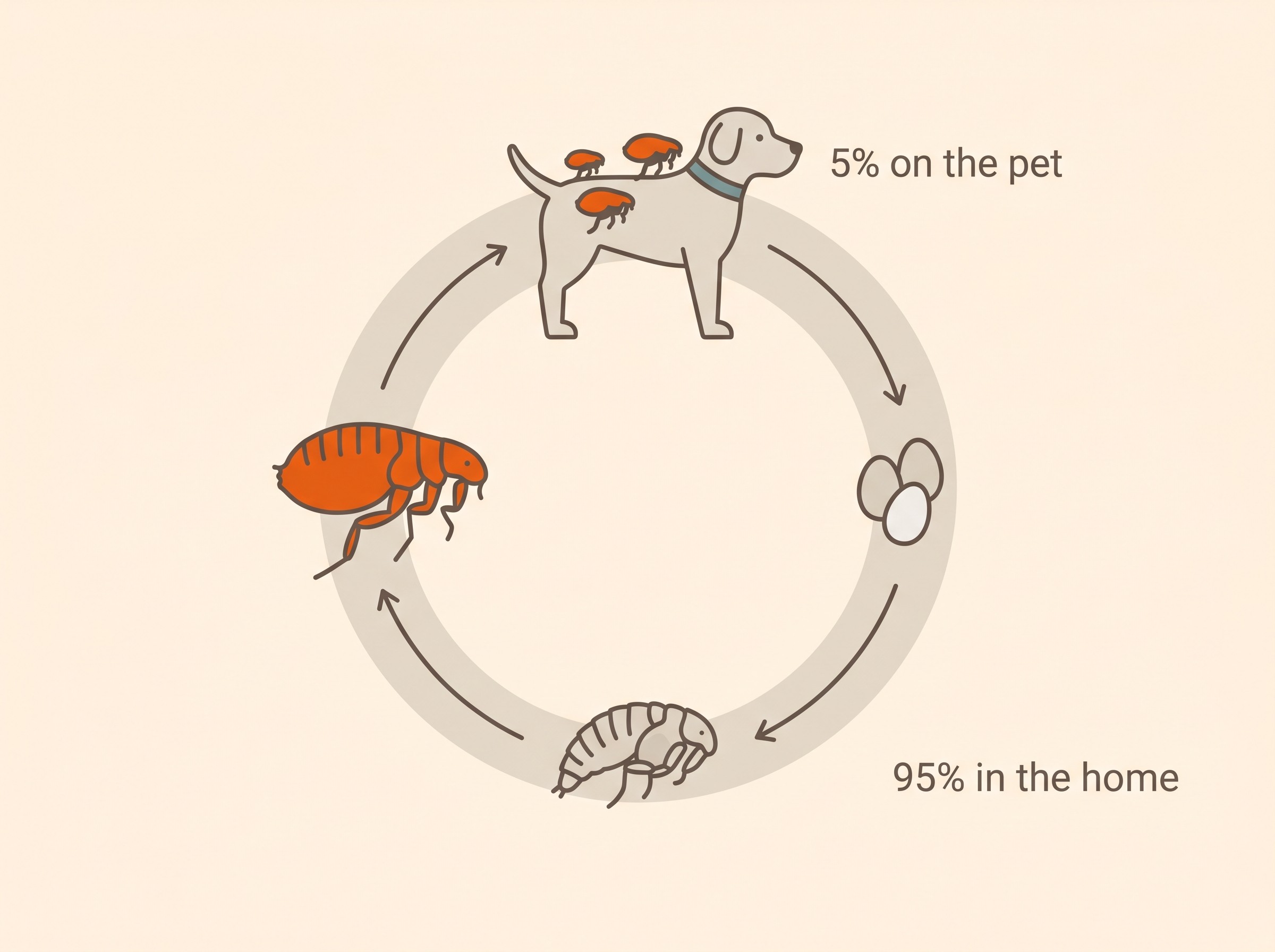
Start with the one fact that makes everything else make sense. The flea on almost every UK dog and cat is the cat flea, Ctenocephalides felis, which despite its name is the dominant species on both; the true "dog flea" (C. canis) is comparatively rare (Rust, 2017; Dryden and Rust, 1994). It goes through complete metamorphosis (egg, larva, pupa, adult), and only the adult lives and feeds on your pet. The eggs, larvae and pupae develop off the pet, in your home and garden (Rust, 2017). The eggs are smooth and, once dry, non-sticky, so although a female lays them on the host they roll straight off into carpet, bedding, floor cracks and your pet's resting spots within hours (Dryden and Rust, 1994; CAPC, 2023). A feeding female lays on the order of tens of eggs a day (Rust, 2017 reports around 38 in one dataset), so a handful of adults seeds an enormous environmental population fast.
The established rule of thumb, which traces to Dryden's foundational work on flea biology, is that around 95% of the total flea burden is the immature stages hidden in the home, and only the visible 5% are the adults on the pet (Dryden and Rust, 1994; Rust, 2017). Treat it as a teaching approximation rather than a precisely measured constant, but the mechanism behind it is solid. When on-pet treatment alone feels like it is "not working", this is why: you are killing the tip of the iceberg while the carpet quietly restocks it.
The worst offender is the pupa, sealed inside a sticky cocoon that resists insecticides, where the pre-emerged adult can lie dormant for weeks to months waiting for a host (Rust, 2017; CAPC, 2023). At cool temperatures that wait can be remarkably long: CAPC puts it at up to around 30 weeks at 11°C, and Rust's review notes some adults still emerging as late as 155 days after the egg was laid (CAPC, 2023; Rust, 2017). Emergence is triggered by physical pressure, vibration, warmth and exhaled carbon dioxide, the signals of a passing animal or person (CAPC, 2023). This single fact rescues more flea-control plans than any product: you will keep seeing new fleas for weeks after you start treating, and that is expected, not failure. No product reliably kills the pupa in its cocoon, so for two to four weeks, sometimes longer, new adults keep hatching from cocoons already in the home, jump on your pet, get killed by the product, but are seen first (CAPC, 2023; Halos et al., 2014). Knowing this in advance is the difference between sticking with a working plan and abandoning it on day ten.
Treating the pet: what actually works, and what disappoints
The modern systemic adulticides, the isoxazoline class, kill fleas fast, and fast kill is exactly what breaks the cycle. They reach very high efficacy within hours: in one study on dogs, sarolaner killed close to 100% of fleas within 8 to 12 hours of the first dose, and held at least 98.8% knock-down at the 8-hour mark through weekly reinfestations across a month (Six et al., 2016). The point is not "kills fleas", it is "kills them before they breed": an adult killed in the first hours never lays the eggs that would have seeded the carpet, which is precisely how a fast adulticide disrupts the life cycle (Six et al., 2016). They work by blocking GABA-gated and glutamate-gated chloride channels in the flea's nervous system (Zhou et al., 2022), and the UK options, with correct names, are worth getting right:
- Isoxazolines (the prescription, fastest, best-evidenced group, POM-V). Oral: fluralaner (Bravecto chew, dogs and cats, roughly 12-weekly), afoxolaner (NexGard, dogs only), sarolaner (Simparica, dogs; Simparica Trio adds wormers), lotilaner (Credelio, dogs and cats, monthly). A topical spot-on fluralaner (Bravecto spot-on) is licensed for both (Zhou et al., 2022). Always check the current datasheet for the exact licensed species, weight band and interval, because licences are updated.
- Older topical adulticides. Fipronil (Frontline and generics) and imidacloprid (Advantage; Advocate adds moxidectin): widely available and generally effective, but slower-killing than the isoxazolines and washed off by water (Perkins and Goulson, 2023).
- Insect growth regulators (IGRs). (S)-methoprene, pyriproxyfen and the oral lufenuron kill no adult fleas; they stop eggs hatching and larvae developing, attacking that hidden 95% (Pucheu-Haston, 2017). An adjunct, not a standalone for an itchy pet.
A word on the cheap end. Some supermarket spot-ons use older actives, are easy to apply at the wrong weight band, and many shop-bought flea collars and herbal products have weak or no evidence behind them, so cheaper is often a false economy. One safety point is not optional: permethrin-based dog spot-ons are highly toxic to cats and one of the commonest causes of feline poisoning worldwide, because cats cannot metabolise the drug the way dogs can (PDSA, 2023; International Cat Care, 2023). A dog product must never go on a cat, and in a cat household a freshly treated dog must be kept apart until dry. If a permethrin product has gone on a cat, or a treated dog has been groomed by one, that is a same-hour emergency for your vet, not something to manage at home: signs include drooling, muscle tremors and seizures, there is no antidote, and treatment is supportive only (PDSA, 2023).
Application matters as much as the product. Topical fipronil and imidacloprid are reduced by bathing and swimming, and datasheets advise against frequent bathing (Perkins and Goulson, 2023), so for a dog that swims or is bathed often an oral product sidesteps wash-off entirely. Whatever you use: right dose, right weight band, parted onto the skin not the coat, and do not bath straight afterwards.
Every pet, every month, all year
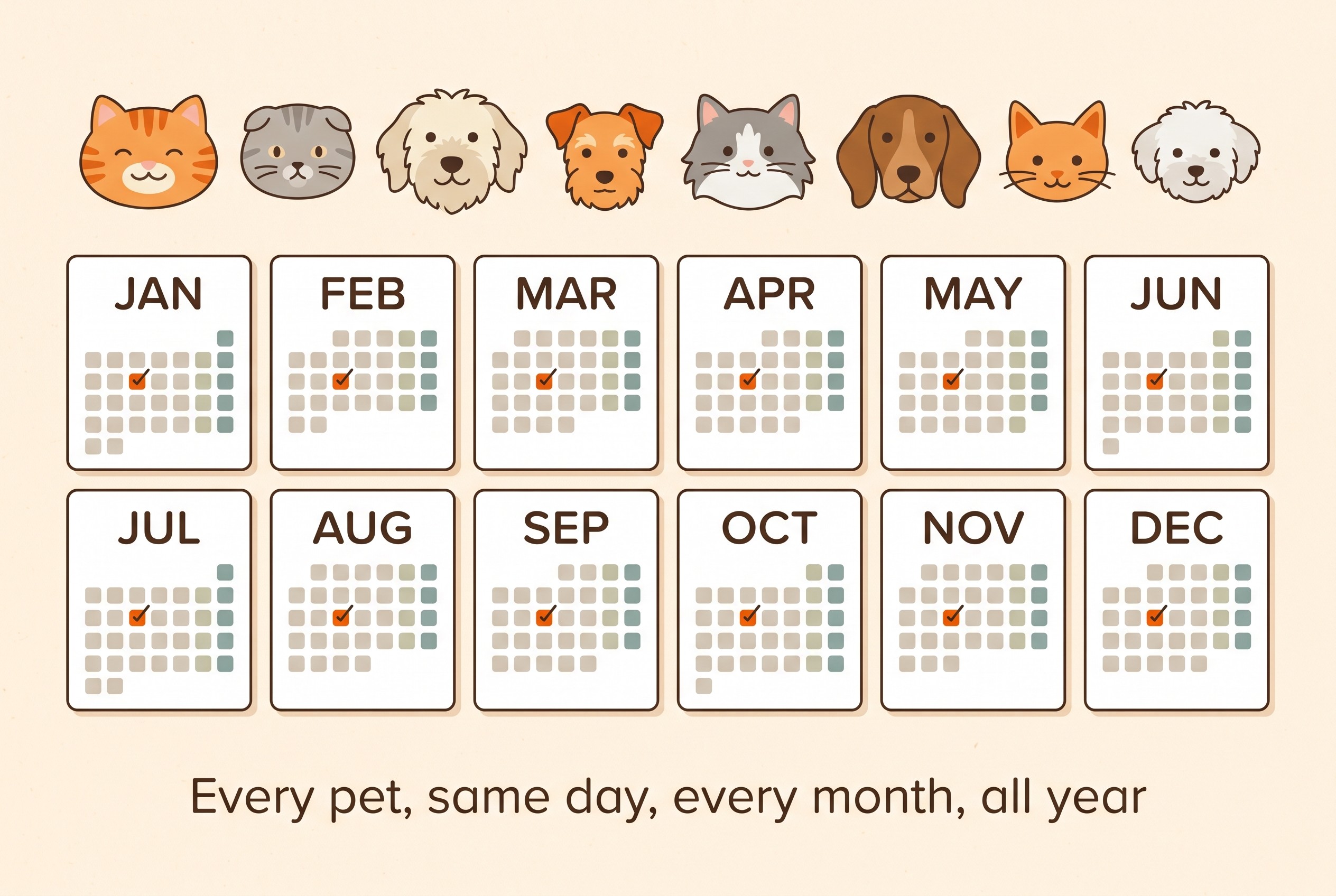
Here is the part owners most often get wrong. Every in-contact mammal must be treated, every time: one untreated cat, rabbit or visiting dog is a living flea reservoir that re-seeds the home, which is why CAPC is blunt that "every pet in the home must be treated" and that dogs and cats "should be treated year-round and throughout their life" (CAPC, 2023; Pucheu-Haston, 2017). The familiar "but the cat never goes out" fails because fleas and eggs arrive on the other pets, on people and on the dog, so the indoor cat still needs treating (Pucheu-Haston, 2017).
And it really is year-round, not just summer. Central heating keeps flea life cycles ticking over indoors through a UK winter, and the reservoir does not politely die off in October (CAPC, 2023; Rust, 2017). Continuous monthly dosing (or 12-weekly for fluralaner) without gaps is what drains the hidden population, by killing each newly emerged adult before it breeds. A missed month reopens the cycle.
This is where the evidence matters more than the marketing. "Treat everything forever" is the manufacturer line, and for a flea-allergic pet or an active infestation it is genuinely the right call. But blanket, year-round chemical treatment of every pet regardless of risk is now under legitimate scrutiny on environmental grounds: fipronil and imidacloprid from spot-ons are widespread pollutants of UK rivers, reaching waterways through bathing, swimming, washing bedding and even owners' hands after application (Perkins and Goulson, 2023; Perkins et al., 2025). In one UK survey, 81.3% of owners were advised blanket year-round treatment and only 7.6% were given risk-based advice (Perkins and Goulson, 2023). So the position is this: if your pet has flea-allergic skin disease or an active infestation, consistent year-round control is the right thing to do. For a low-risk pet, the choice of product (an oral over a wash-off spot-on, to cut river pollution) and risk-based versus blanket use is a fair conversation to have with your vet. The trade-off is real, but it does not change what the allergic pet needs.
Treating the home: mechanical, free, and mostly the answer
Because around 95% of fleas live off the pet, the home is most of the battle, and most of it costs nothing (Dryden and Rust, 1994; Rust, 2017). Vacuum thoroughly and often, especially under furniture, along skirting, carpet edges and your pet's resting spots, then empty it: vacuuming lifts out eggs and larvae, and the vibration helps trigger pupae to emerge so the on-pet product can kill the adults (Pucheu-Haston, 2017; CAPC, 2023). Wash pet bedding hot and regularly, along with anything else your pet lies on, and concentrate on the small slice of the house that holds most of the fleas, your pet's favourite places, rather than spreading thin over every floor (Pucheu-Haston, 2017). For heavier infestations, a household spray combining an IGR with an adulticide (UK products with pyriproxyfen and permethrin, for example) can treat the whole indoor area: ventilate, keep pets, especially cats, off until fully dry, follow the label, and the IGR then gives months of larval and egg suppression (Pucheu-Haston, 2017).
Then the hardest part: patience. Because of the pupal reservoir the home does not clear in days, so plan for eight to twelve weeks of consistent effort before fleas are truly gone (CAPC, 2023; Halos et al., 2014).
"I treat and still see fleas": the troubleshooting checklist
Coles and Dryden (2014) reviewed insecticide and acaricide resistance in fleas and ticks and concluded that the apparent lack of efficacy owners report is most likely a treatment deficiency, not true drug resistance, which is not established as a widespread field problem. The reasons control actually fails are mundane and fixable: inadequate or inconsistent application, not treating every pet, ignoring the environment, underestimating the pupal reservoir, the wrong dose or weight band, wash-off, and reinfestation from outside (Halos et al., 2014). So when control seems to fail, work through it in order: are all pets treated, every dose on time, the weight band correct, the spot-on not washed off by a bath, the environment being done, and has it been long enough for the pupal window to close? That calm checklist solves far more cases than switching product (Halos et al., 2014).
One caveat for the flea-allergic pet: even fast adulticides let some fleas bite before they die. In cited work, around 89 to 92% of fleas had taken a blood meal on treated cats before they were killed (Rust, 2017). For a non-allergic pet that is irrelevant; for an allergic one, even those few bites can keep the itch going, which is exactly why the fastest products, rigorous environmental control and treating the whole cycle all matter together. Why a few residual bites tip an already-loaded pet over the edge is the itch threshold at work. If you eradicate fleas properly and the itch persists, the next suspects are mites and mange, not a failed flea product, and scratched skin can pick up a secondary infection.
One sensible flag for your vet, not a reason to avoid the best products: the isoxazoline class has been associated with uncommon neurological events (muscle tremors, ataxia, occasionally seizures) in some dogs and cats, and these can occasionally occur in an animal with no prior history, though the FDA still considers the class safe and effective (FDA isoxazoline fact sheet). If your pet has a seizure history, mention it before you start.
The simple routine, and watching it work
Here is the plan, in one breath. Pick one effective vet-recommended product. Treat every pet in the home on the same day each month (or per the 12-weekly schedule), and set a phone reminder so a dose is never missed. During an active infestation, vacuum and wash bedding weekly, focusing on your pet's spots. Keep going for at least eight to twelve weeks before judging success, then continue year-round.
That routine asks for patience because of the pupal window, and the way to make patience bearable is to make progress visible. Take a baseline itch score in the Skin & Itch Tracker today, before you change anything, then log it weekly as control beds in. Watching that score fall over the eradication window turns "be patient" into something you can see, and gives your vet objective data if control genuinely is not working. If the itch drops as the fleas clear, you have your answer cheaply. If it truly does not budge after thorough, sustained control, that is your cue to look further down the work-up rather than blame the flea treatment. The chart, not your memory, is the reliable test.
References
- Rust, M.K. (2017). The Biology and Ecology of Cat Fleas and Advancements in Their Pest Management: A Review. Insects, 8(4): 118.
- Dryden, M.W. and Rust, M.K. (1994). The cat flea: biology, ecology and control. Veterinary Parasitology, 52(1-2): 1-19.
- Companion Animal Parasite Council (CAPC) (accessed 2023). Fleas: CAPC Guidelines. Companion Animal Parasite Council.
- Six, R.H., Liebenberg, J., Honsberger, N.A. and Mahabir, S.P. (2016). Comparative speed of kill of sarolaner (Simparica) and afoxolaner (NexGard) against induced infestations of Ctenocephalides felis on dogs. Parasites & Vectors, 9: 90.
- Zhou, X., Hohman, A.E. and Hsu, W.H. (2022). Current review of isoxazoline ectoparasiticides used in veterinary medicine. Journal of Veterinary Pharmacology and Therapeutics, 45(1): 1-15.
- Perkins, R. and Goulson, D. (2023). To flea or not to flea: survey of UK companion animal ectoparasiticide usage and activities affecting pathways to the environment. PeerJ, 11: e15561.
- Pucheu-Haston, C.M. (2017). The Flea-Infested Pet: How to Manage the Pet and Its Environment. Today's Veterinary Practice, July/August 2017.
- Halos, L., Beugnet, F., Cardoso, L., Farkas, R., Franc, M., Guillot, J., Pfister, K. and Wall, R. (2014). Flea control failure? Myths and realities. Trends in Parasitology, 30(5): 228-233.
- Perkins, R., Glauser, G. and Goulson, D. (2025). Swimming emissions from dogs treated with spot-on fipronil or imidacloprid: Assessing the environmental risk. Veterinary Record, 196(11): e5560.
- People's Dispensary for Sick Animals (PDSA) (accessed 2023). Permethrin toxicity in cats. PDSA Pet Health Hub.
- International Cat Care (accessed 2023). Permethrin Poisoning. International Cat Care (iCatCare).
- Coles, T.B. and Dryden, M.W. (2014). Insecticide/acaricide resistance in fleas and ticks infesting dogs and cats. Parasites & Vectors, 7: 8.
- U.S. Food and Drug Administration (FDA) (accessed 2023). Fact Sheet for Pet Owners and Veterinarians about Potential Adverse Events Associated with Isoxazoline Flea and Tick Products. U.S. Food and Drug Administration.
Keep track of how your pet is doing
The owners who cope best are the ones who notice changes early. A simple health log shows you what is working, and what is not, before the next vet visit.
Start tracking, freeYou're not doing this alone
Compare treatment journeys and talk to owners managing allergies & skin. Free to join.
Join PetsLikeMine