

The smell, the goo and the scratching: skin and ear infections explained
Alastair Greenway
BVM&S MRCVS
A dog that suddenly smells different, a strong sweetish slightly rancid odour that wasn't there last week. An ear weeping brown waxy gunk, and the head-shaking that goes with it. A patch of skin the pet won't leave alone, licked and scratched until the fur thins and the surface goes raw. That trio, the smell, the goo and the scratching, is the everyday face of skin and ear infections, and it's among the commonest reasons an itchy pet ends up in front of a vet.
One thing is worth getting clear before you read any further: these infections are almost always a symptom, not the original fault. The bug you can smell is overgrowing on skin that something else has already disturbed. Clear it and your pet feels better for a while, but if you don't find and fix what let it overgrow, it comes straight back. The word for that is secondary.
The two usual suspects
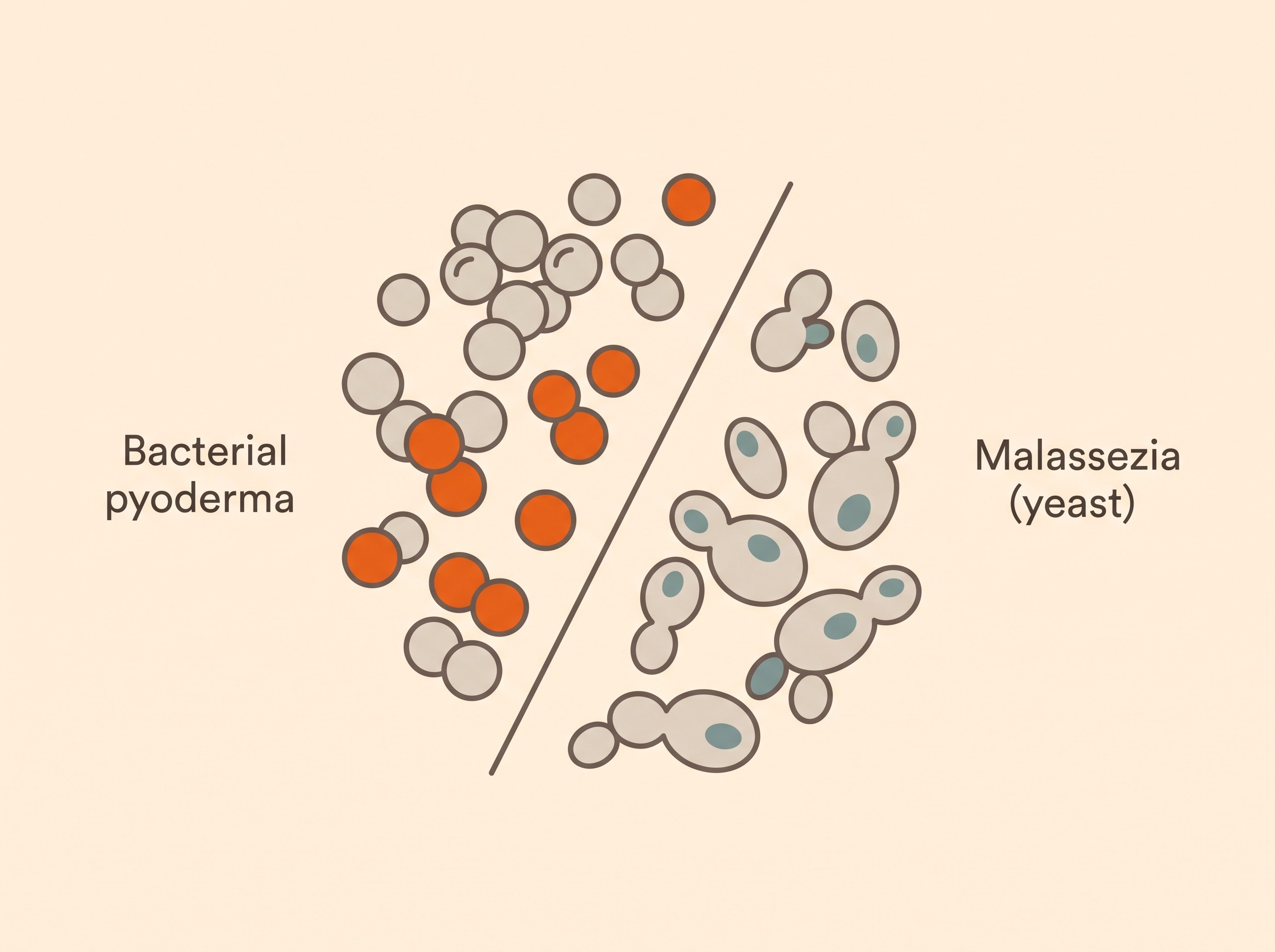
Most of the smell, goo and itch comes down to one bacterium and one yeast. The bacterium is almost always Staphylococcus pseudintermedius, which turns up in more than 90% of all canine pyoderma ("pyoderma" being simply the medical word for a bacterial skin infection) (Loeffler et al., 2025). The yeast is Malassezia pachydermatis, a type of fungus that lives on the skin (Bajwa, 2017; Bond et al., 2020).
Now the part the content mills miss, and the part that should lift a lot of guilt. Both are normal residents of healthy skin, not invaders from outside. S. pseudintermedius is a normal inhabitant of canine skin (MSD Veterinary Manual). M. pachydermatis "is a commensal yeast that is normally present in low numbers in the external ear canals and superficial muco-cutaneous sites in dogs" (Bajwa, 2017). So this is rarely a hygiene failure, and your pet didn't "catch" it: it's the skin's own flora multiplying out of control because the local conditions changed.
A quick word on the cat in the room. Both infections are far more common in dogs; cats get them too, but less often and with a different picture (Bond et al., 2020), so this article is dog-weighted, with the feline allergy story in feline atopic syndrome.
Why the bugs overgrow in the first place
This is the heart of it. The 2025 international guideline on canine pyoderma could not be blunter: "Pyoderma is always secondary to underlying primary causes, and these must be considered at the first occurrence", and it explicitly states that the idea of a primary or idiopathic pyoderma "is no longer tenable" (Loeffler et al., 2025). The same holds for yeast: Malassezia dermatitis in dogs is usually secondary to an underlying skin disease such as allergy (including atopic dermatitis and flea allergy), recurrent bacterial pyoderma, or hormonal disease, especially hypothyroidism (Bajwa, 2017; Bond et al., 2020).
So what are the usual things underneath? Allergy is by far the commonest, with atopic dermatitis, flea allergy and food allergy leading the field. After that come parasites, hormonal disease (hypothyroidism and Cushing's in particular), and conformation, meaning moist skin folds and the warm, humid tunnel of the ear canal (Loeffler et al., 2025; Bajwa, 2017). For yeast specifically, overgrowth is favoured by humidity, skin folds, an altered skin pH, and previous courses of antibiotics or corticosteroids (Bajwa, 2017). The full five-cause picture and the order a vet works through it belong to why is my pet so itchy, and the commonest culprit, environmental allergy, to atopic dermatitis explained.
In plain language, the mechanism runs like this: healthy skin is a barrier that keeps its own flora in check. Allergy, parasites, hormonal disease or a damp fold break that barrier or change the local climate, and the resident bugs multiply into the opening.
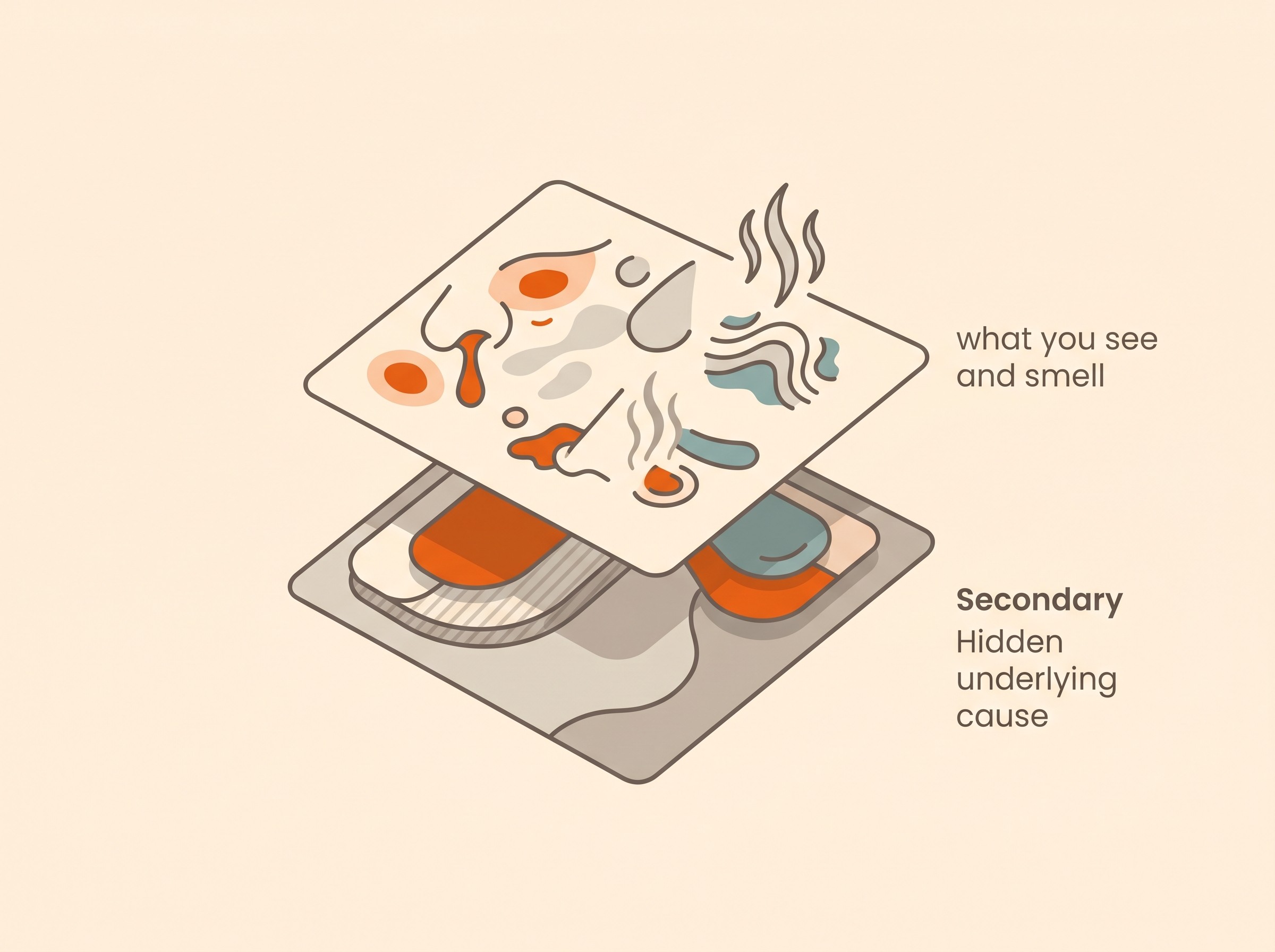
There's a catch worth naming, because it explains so much owner frustration: this sets up a vicious circle. Allergic skin gets infected, the infection is itchy in its own right, the extra scratching damages the skin further, and that invites yet more infection. Yeast makes it worse still, because many allergic dogs become genuinely allergic to their own Malassezia, with higher levels of Malassezia-specific IgE in atopic dogs than healthy ones, so even small numbers cause disproportionate irritation (Bajwa, 2017). This is why "the antibiotics worked but it came back" is the rule, not bad luck, when the cause is left untreated. The way these itches stack on each other is the idea behind the itch threshold.
What they look and smell like
Bacterial pyoderma, in its superficial form (much the commonest), follows a typical sequence. Small red bumps (papules) become small spots, sometimes with a yellow head (pustules), which rupture and leave epidermal collarettes: round, expanding rings of scale with a reddened edge and a sometimes-darkened, healing centre, plus crusts and patchy hair loss (MSD Veterinary Manual; Loeffler et al., 2025). That ring-shaped collarette is the classic "this is pyoderma" lesion, and owners often mistake it for ringworm, a different, fungal thing covered in ringworm in pets. When the self-trauma is sudden and a raw, weeping patch erupts almost overnight, that is a hot spot (acute moist dermatitis), with its own first-aid article: hot spots in pets.
Malassezia (yeast) dermatitis looks greasy rather than spotty: redness, a scaly, waxy or greasy coat, and over time thickened, leathery skin (lichenification) and darkened, sometimes slate-grey patches (hyperpigmentation), usually with a severe itch and an unpleasant odour (Bajwa, 2017). The favourite sites are the lip margins, ear canals, armpits, groin, underside of the neck, between the toes, and facial or tail folds (Bajwa, 2017). This greasy overlap means yeast and seborrhoea often travel together; that barrier-turnover story sits in dandruff, greasy coat and seborrhoea.
One word on the smell, so owners of healthy dogs don't take fright. A faint "corn chip" smell from healthy paws is normal: it comes from ordinary resident bacteria and low numbers of yeast, and on its own it is not a disease (veterinary owner-education sources). The smell that matters is different, a strong, sweet, musty, almost rancid odour that arrives with greasy or reddened skin, itch and waxy ears: that is overgrowth (Bajwa, 2017). One is background; the other is a red flag.
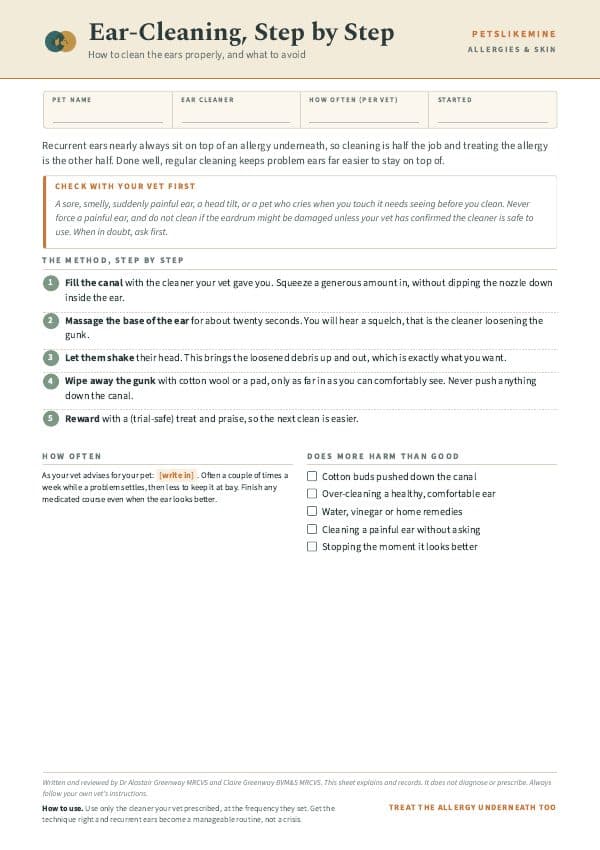
Ears are skin too, so both bugs commonly set up home in the ear canal and produce the weeping, waxy discharge and odour owners think of as an "ear infection". Why ears keep flaring, and why "another bottle of drops" misses the point, is its own article: recurrent ear infections. One caveat at the emergency end of the scale: a suddenly very painful ear, a head tilt or a loss of balance is not a wait-and-see problem and warrants a same-day call. And because bacteria and yeast often coexist, one infected allergic dog can be spotty, greasy, smelly and itchy all at once (Bajwa, 2017; MSD Veterinary Manual).
Finding the cause matters as much as clearing the bug
This is the payoff of the whole "secondary" idea. The 2025 guideline is explicit that resolution depends on the cause: because bacterial skin infection always occurs secondary to a primary one, "it is incumbent upon attending veterinarians to identify and address the primary aetiology to achieve resolution" (Loeffler et al., 2025). So clear the infection and find what let it happen, or you'll be back in a few weeks.
There's a bigger stake, too. Every avoidable course of oral antibiotics for an infection that was never going to stay away helps breed resistance, and the driver behind the modern guidelines is the rise of resistant bacteria such as meticillin-resistant S. pseudintermedius (MRSP) (Hillier et al., 2014). So "find the cause" is part of using antibiotics responsibly, not just convenience. Reassuringly, topical therapy alone is the treatment of choice for the commonest form of bacterial skin infection, so many clear with products applied to the skin rather than tablets (Loeffler et al., 2025), and once the underlying cause is controlled the infections become less frequent and milder. How to treat them, and why repeated oral antibiotics are the wrong reflex, is the job of treating the infection and finding the cause.
Because recurrent skin and ear infections are a classic flag for food allergy, a diet trial may be on the cards: the mechanics live in the elimination diet, with the Elimination-Diet Companion to keep it on track.
How vets confirm it, and why that beats guessing
The single most useful test here, and one most owners have never heard of, is cytology: the vet takes a quick sample from the skin or ear (a tape strip, a swab or a pressed slide), stains it and looks under the microscope. For Malassezia, this is the most useful and practical method of diagnosis (Bajwa, 2017). For bacterial pyoderma, cytology of a pustule, papule, crust or collarette should show inflammatory cells (neutrophils) and, for a true infection, bacteria sitting inside those cells (MSD Veterinary Manual; Loeffler et al., 2025). It's fast, cheap and usually done in the consult room while you wait, and it tells the vet which bug and how much, which is exactly what choosing treatment depends on.
Why does this beat guessing? Because both bugs are normal residents, you cannot diagnose overgrowth simply by finding them; you weigh the numbers against the clinical picture, and a guess risks treating only half of a mixed infection. This is where good vets out-teach the internet: for yeast there is genuine professional debate about how many is "too many", and clinicians ultimately diagnose on clinical signs and cytology together rather than yeast numbers alone (Bajwa, 2017). It's also why sending a swab for fungal "culture" is usually unhelpful: because M. pachydermatis is a commensal, the test finds the normal yeast on almost any dog and never answers the overgrowth question (Bajwa, 2017).
Bacterial culture and sensitivity (growing the bacteria in a lab to test which antibiotics work) is a separate, more involved test, reserved for deep or non-responding infections, a history of recurrence, or a suspected resistant bug like MRSP (Loeffler et al., 2025; Hillier et al., 2014). In-house cytology comes first.
To catch these patterns early, the Skin & Itch Tracker is built for exactly this kind of recurring, photographable, smell-changing problem. Scoring the itch, logging photos and noting when the smell or a flare appears is how you and your vet actually see whether the underlying cause is being controlled, rather than guessing from memory at the next appointment. It turns "I think it's a bit better" into a trend you can act on, and it's the difference between chasing one infection after another and getting ahead of the thing underneath. For what to photograph, how to check your pet's skin at home pairs naturally with it.
References
- Loeffler A, Cain CL, Ferrer L, et al. "Antimicrobial use guidelines for canine pyoderma by the International Society for Companion Animal Infectious Diseases (ISCAID)." Veterinary Dermatology 2025;36(3):234-282.
- Bond R, Morris DO, Guillot J, et al. "Biology, diagnosis and treatment of Malassezia dermatitis in dogs and cats: Clinical Consensus Guidelines of the World Association for Veterinary Dermatology." Veterinary Dermatology 2020;31(1):27-43 (commentary/summary 31(1):75)
- Bensignor E, Jankowski F. (review) "Canine Malassezia dermatitis." (peer-reviewed review, open access on PMC)
- Hillier A, Lloyd DH, Weese JS, et al. "Guidelines for the diagnosis and antimicrobial therapy of canine superficial bacterial folliculitis (Antimicrobial Guidelines Working Group of the International Society for Companion Animal Infectious Diseases)." Veterinary Dermatology 2014;25(3):163-175.
- MSD Veterinary Manual (Merck Veterinary Manual). "Pyoderma in Dogs and Cats." Integumentary System.
- Frontiers in Cellular and Infection Microbiology. "Malassezia Yeasts in Veterinary Dermatology: An Updated Overview." 2020;10:79.
- Today's Veterinary Practice. "Treating Canine Superficial Pyoderma in the Era of Antimicrobial Resistance" / "Topical Treatment of Canine Superficial Pyoderma." (peer-reviewed clinical practice articles)
- (Supporting, for the smell distinction only) AKC / BetterPet veterinary explainers on the "corn chip / Fritos" paw smell.
Free downloads
Companion worksheets to put what you've read into practice. Free PDFs, print at home.
Keep track of how your pet is doing
The owners who cope best are the ones who notice changes early. A simple health log shows you what is working, and what is not, before the next vet visit.
Start tracking, freeYou're not doing this alone
Compare treatment journeys and talk to owners managing allergies & skin. Free to join.
Join PetsLikeMine