

Ringworm: the contagious one that is not a worm
Alastair Greenway
BVM&S MRCVS
Ringworm is the odd one out in this library. Almost everything else here is an allergy or a parasite. Ringworm is neither: it is a fungus, it is genuinely catching, and unlike an itchy allergy it can jump from your pet to you, and to your children. That is why it earns its own article, and why it is worth confirming rather than guessing. Guess wrong and it cuts both ways: you can miss a household infection, or treat a simple allergy with the wrong medicine for weeks.
Not a worm, and not an allergy
There is no worm. The disease is named for the ring-shaped, centrally-clearing rash it can raise on human skin, and the organism behind it is a small group of keratin-eating fungi called dermatophytes that live in hair, the outer skin and the claws (CDC, 2024; Moriello et al., 2017). The proper name is dermatophytosis. So you can't worm it away like a parasite, and you can't soothe it with steroid cream like an allergy. In cats, over 90% of cases are one species, Microsporum canis (Frymus et al., 2013). In dogs M. canis still dominates, but two others appear more often: Microsporum gypseum, a soil organism picked up by digging, and Trichophyton mentagrophytes, associated with rodents (Moriello et al., 2017; MSD Veterinary Manual, 2023). So a digging terrier fits the soil or rodent pattern; a kitten or longhaired cat fits M. canis.
Why your eyes will mislead you
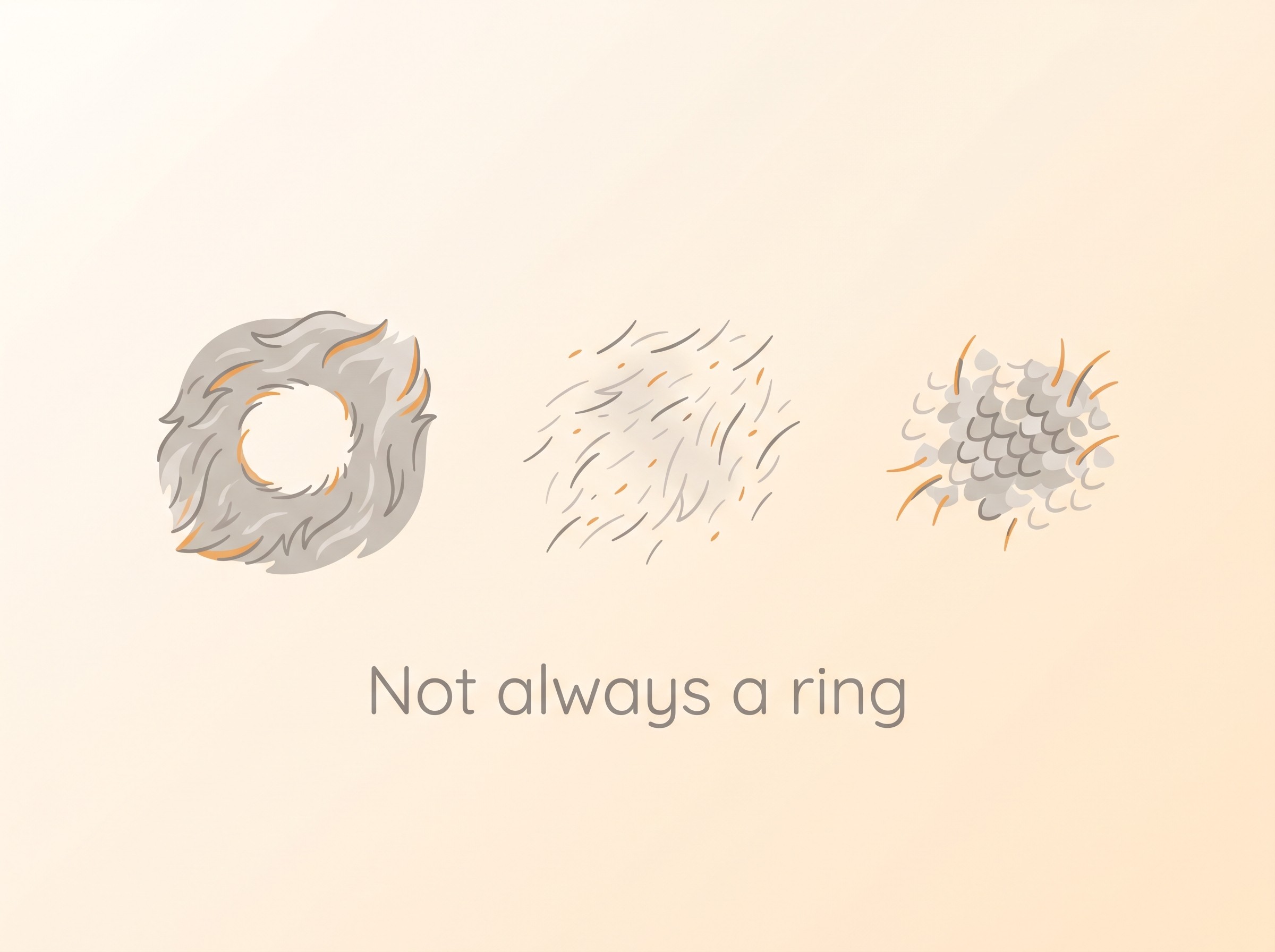
One fact should shape how you treat any suspicious patch: ringworm often does not look like a ring. The textbook circular bald patch with a scaly edge does happen, but in pets the picture is far more varied. You might see patchy or diffuse hair loss, broken stubbly hairs, scaling, crusting, redness, darkened skin, occasionally a raised lump called a kerion, and frequently only mild itch or none at all (Moriello et al., 2017; MSD Veterinary Manual, 2023). Two mistakes are equally easy: ruling ringworm out because there is no neat ring, and assuming a round crusty patch must be ringworm.
The other big mimic is mange: demodex and sarcoptic mange produce very similar hair loss and crusting, which is why neither can be told apart from ringworm across the room (mites and mange walks through those). Ringworm is simply the fungal entry on the short list of things that make a pet itchy or bald, and that list, and the order a vet works through it, belong to why is my pet itchy. What matters here is that look alone will not settle it. This is a confirm-it-properly disease.
The carrier you never see, and who falls ill
One fact most owners need is buried on most websites. Some cats, particularly in multi-cat homes, shelters, and among longhaired and Persian cats, carry and shed infectious M. canis spores on their coat with no visible lesions at all (Frymus et al., 2013; Moriello et al., 2017). These asymptomatic carriers are why a confirmed case is rarely a one-animal problem: the obviously affected pet may not be the only one shedding, so a vet will usually want to check, and often treat, every animal in the household (Frymus et al., 2013).
The pets that actually fall ill tend to be young (kittens and puppies are the classic patients), immunosuppressed or unwell, poorly nourished, or kept in warm, humid, overcrowded places like shelters and catteries (Frymus et al., 2013). A healthy adult, with an intact immune system and normal skin, is both less likely to develop established disease and more likely to clear it without help (Moriello et al., 2017). Spread is by direct contact and through the environment, where spores ride on shed hairs onto clippers, brushes, bedding and furniture and can stay viable in a home for many months, which is why cleaning matters as much as the tablets (Piorunek et al., 2024; Moriello et al., 2017).
It spreads to people, and that is the reason to act
Here is the lever that should move you, told plainly rather than with alarm. Ringworm from a pet causes the infections doctors call tinea corporis (on the body) and tinea capitis (on the scalp) in people (Piorunek et al., 2024). In one clinical series of cat-associated cases, M. canis was confirmed in 83.9% of the human patients, and children were strongly over-represented, with scalp involvement almost entirely paediatric, simply because children handle and cuddle cats more closely; the immunosuppressed and chronically unwell are at higher risk of a more troublesome infection (Piorunek et al., 2024). So the household message is direct: if anyone at home develops a new itchy, scaly, expanding round patch, especially a child or someone immunocompromised, they should see their own GP and mention the pet, not reach for human antifungals on a hunch. The reassuring half is that human cases are usually treatable, and the risk drops once the pet is treated and the environment cleaned, so this is a reason to confirm, treat and tidy up, not to panic or rehome a cat (Frymus et al., 2013; Moriello et al., 2017).
Diagnosis: no single perfect test
There is no gold-standard single test, plainly put. The World Association for Veterinary Dermatology consensus is explicit: vets combine history and signs with one or more of a Wood's lamp, direct microscopy, fungal culture, and PCR, and each has a catch (Moriello et al., 2017).
The Wood's lamp is a handheld ultraviolet light that can make M. canis-infected hairs glow apple-green: a fast, cheap, in-clinic screen, but only around half of M. canis strains fluoresce at all, and Trichophyton species and M. gypseum generally do not glow, so in one shelter study the lamp still missed nearly a third of infections (Frymus et al., 2013; Mrazkova et al., 2023). A negative lamp therefore does not rule ringworm out, and only the true apple-green glow of the hair shaft counts (scale, lint and topical products fluoresce a misleading blue-white) (Moriello et al., 2017). Direct microscopy of plucked hairs can show fungal spores coating the shaft for a same-day answer, but fungal culture remains the reference test, confirming infection and identifying the species, at the cost of one to three weeks (Moriello et al., 2017; Frymus et al., 2013).
PCR carries a sting in the tail: it is sensitive and quick, but it detects fungal DNA from both living and dead organisms, so a positive can mean true infection, harmless carriage, contamination, or just dead spores left after treatment (Moriello et al., 2017; IDEXX, 2023). It is good for catching an infection but cannot reliably tell you when you have cured one, because it keeps reading dead spore DNA as positive long after the fungus is gone, which is why vets confirm cure with culture, not PCR (Moriello et al., 2017; IDEXX, 2023). And there is no useful at-home kit, any more than there is a valid at-home allergy kit; confirmation is a lab job (allergy tests that work covers why those overpromise).
Treatment, and why it takes patience
Two things surprise owners. The first is that we treat at all. In an otherwise healthy pet ringworm is usually self-limiting, with lesions often clearing by themselves over one to three months, so why bother? Because treating shortens the course, cuts the weeks during which the pet sheds infectious spores, and protects the people and other animals in the home (Moriello et al., 2017; Frymus et al., 2013). A content mill says "treat it now, it is dangerous"; the truer version is that the body would probably win eventually, and we treat to win faster and stop the spread meanwhile.
The second surprise is that proper treatment comes from two directions at once. The consensus is unambiguous: a true infection needs both a systemic (oral) antifungal and topical disinfection of the coat, together (Moriello et al., 2017). The topical rinses remove the infective spores on the hairs, so the pet stops contaminating the house, while the oral drug reaches the fungus growing down inside the hair follicle, where rinses cannot get (Moriello et al., 2017). The best-evidenced topicals are lime sulphur (1:16) rinses, 0.2% enilconazole rinses, and a 2% miconazole with 2% chlorhexidine shampoo, applied two to three times a week over the whole body, with a long coat clipped gently to let them reach the skin (Moriello et al., 2017; Frymus et al., 2013). A frank word on lime sulphur: it works and is safe, but it smells of rotten egg, can tint a pale coat, and whole-body rinsing of a cat is nobody's idea of fun, which is why compliance is the hard part.
For the oral drugs, get the names right. The two safest and most effective for cats and dogs are itraconazole, often the first choice because it concentrates in skin and hair and can be pulsed, and terbinafine; the older griseofulvin still works but has more side effects and is now second-line (Frymus et al., 2013; Moriello et al., 2017). One warning saves money: compounded, specially-mixed itraconazole can be unreliable, so the licensed branded formulation is preferred, and all of these are prescription-only and need a vet's dosing and monitoring (Moriello et al., 2017). And one myth deserves burying: lufenuron, a flea-control drug, is sold by some breeders and websites as a ringworm cure, but in a controlled feline challenge study it did not prevent M. canis infection or alter its course, and the consensus does not recommend it as an antifungal (DeBoer et al., 2003; Moriello et al., 2017). It is a waste of money and a source of false reassurance while an infectious pet keeps shedding.
The cultures, not the lesions, tell you when to stop
This is the discipline that separates a cured pet from a relapse. Cure is mycological, not cosmetic. Treatment continues, with the coat re-cultured along the way (typically a weekly toothbrush brushing sent off), until there are at least two consecutive negative fungal cultures a week or more apart (Frymus et al., 2013; Moriello et al., 2017). Stopping when the lesions look healed but the coat is still culture-positive is a classic trap: you land back where you started, often having re-contaminated the house in between. Expect several weeks to a few months, not a one-week course, and confirm the cure with culture rather than PCR (Moriello et al., 2017).
Cleaning the home: mechanical, twice, calm
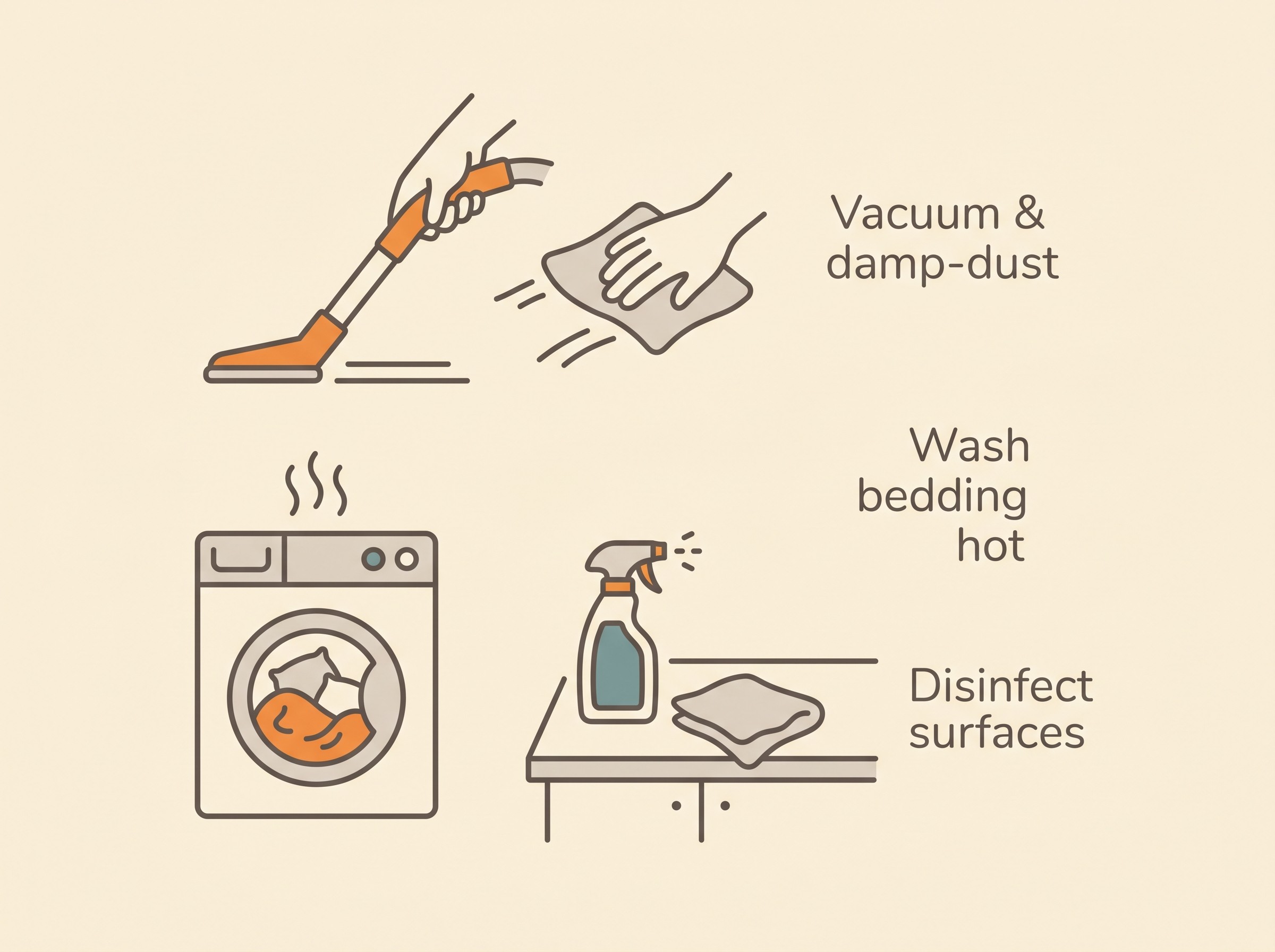
Because spores survive for months, the environment is half the battle, and the good news from Karen Moriello's University of Wisconsin work is how low-tech the winning approach is. Mechanical removal of hair and debris is the most important step, so vacuuming, damp-dusting and washable surfaces do most of the work; contaminated laundry is decontaminated by washing it twice on the longest cycle without overloading the machine, because agitation matters more than hot water or bleach; and hard surfaces are cleaned first to remove the organic matter that disarms disinfectants, then treated with an antifungal one (Moriello et al., 2017). This is a doable household routine, not a hazmat operation.
If you suspect it, here is your first move
You have spotted a suspicious patch. The most useful things you can do today are about not making it worse and getting it confirmed. Do not guess with allergy creams or steroids; steroids in particular suppress local immunity and can make a fungal infection worse (Moriello et al., 2017). Keep the affected pet and its bedding a little apart from young children and anyone immunocompromised, and book the vet so it can be confirmed by lamp, microscopy and culture before treatment begins (Piorunek et al., 2024; Moriello et al., 2017).
Then start a record. Photograph the lesions on day one, same spot, same light, dated, so you and your vet can see whether they are shrinking; the technique lives in checking your pet's skin at home. Log the lesion and any itch in the Skin & Itch Tracker from the start: it shows objectively whether the fungal lesion is settling, and it helps separate a healing ringworm patch from an allergy stacking up underneath, because plenty of pets have more than one thing going on. Ringworm is also a non-hormonal cause of patchy hair loss, so if the picture is really a barely-itchy, symmetrical thinning, hair loss without itching points toward the hormonal suspects.
The patience this disease asks for is all in the cleaning and the cultures, not in any real doubt about the outcome. In a healthy pet ringworm is curable and self-limiting, so once it is confirmed, treated, the home cleaned and the cultures clear, it goes, and it takes the worry about the rest of the family with it (Moriello et al., 2017; Frymus et al., 2013).
References
- Centers for Disease Control and Prevention (CDC) (2024). Clinical Overview of Ringworm. Atlanta, GA: U.S. Department of Health and Human Services, CDC.
- Moriello KA, Coyner K, Paterson S, Mignon B (2017). Diagnosis and treatment of dermatophytosis in dogs and cats: Clinical Consensus Guidelines of the World Association for Veterinary Dermatology. Veterinary Dermatology, 28(3), 266-e68.
- Frymus T, Gruffydd-Jones T, Pennisi MG, Addie D, Belak S, Boucraut-Baralon C, Egberink H, Hartmann K, Hosie MJ, Lloret A, Lutz H, Marsilio F, Mostl K, Radford AD, Thiry E, Truyen U, Horzinek MC (2013). Dermatophytosis in cats: ABCD guidelines on prevention and management. Journal of Feline Medicine and Surgery, 15(7), 598-604.
- Moriello KA (2023). Dermatophytosis in Dogs and Cats. MSD Veterinary Manual (professional edition), Integumentary System. Rahway, NJ: Merck & Co.
- Piorunek M, Kubisiak-Rzepczyk H, Danczak-Pazdrowska A, Trafas T, Walkowiak J (2024). Superficial Zoonotic Mycoses in Humans Associated with Cats. Journal of Fungi, 10(4), 244.
- Mrazkova K, Konvalinova J, Bedanova I (2023). Reliability of using Wood's lamp by shelter personnel to diagnose Microsporum canis in cats. Veterinarni Medicina, 68(7), 281-286.
- IDEXX Laboratories. RealPCR Dermatophyte (Ringworm) Panel: technical reference and background note. Westbrook, ME: IDEXX Laboratories.
- DeBoer DJ, Moriello KA, Blum JL, Volk LM (2003). Effects of lufenuron treatment in cats on the establishment and course of Microsporum canis infection following exposure to infected cats. Journal of the American Veterinary Medical Association, 222(9), 1216-1220.
Keep track of how your pet is doing
The owners who cope best are the ones who notice changes early. A simple health log shows you what is working, and what is not, before the next vet visit.
Start tracking, freeYou're not doing this alone
Compare treatment journeys and talk to owners managing allergies & skin. Free to join.
Join PetsLikeMine