

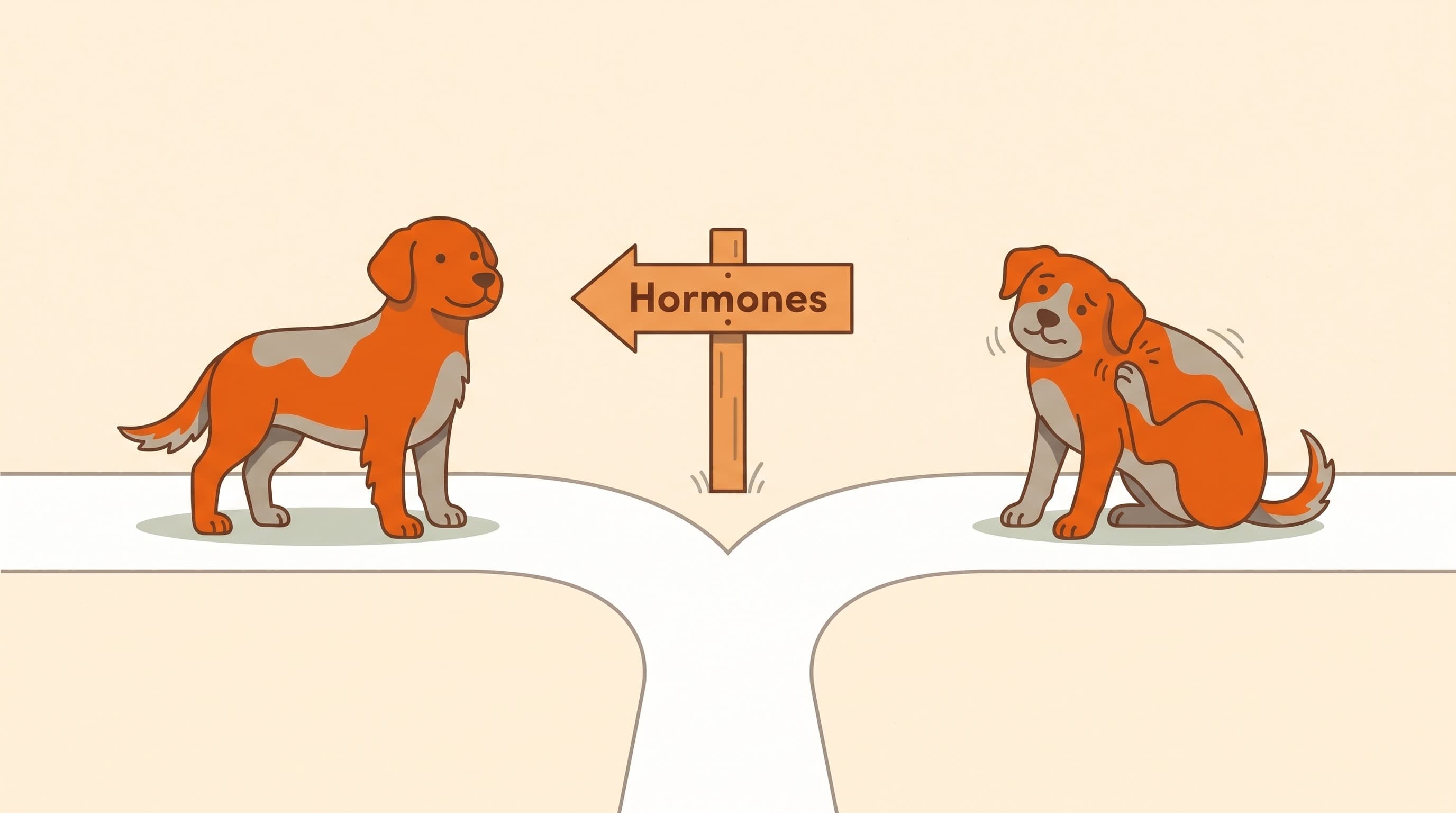
Losing fur but not very itchy? When it is hormonal, not allergic
Alastair Greenway
BVM&S MRCVS
Most of this part of the site speaks to an itchy pet, because itch is what sends owners looking up skin problems in the first place. This article is for the other owner, the one whose dog or cat is going bald, or thinning in the coat, while barely scratching at all. If that describes your pet, start with this: a thin or patchy coat with little or no itch usually does not point at allergy, and reaching for an anti-itch tablet or a diet trial would most likely cost you several months for nothing. The fur is going somewhere, but the answer often sits a long way from the skin, frequently in a hormone. This page helps you knock on the right door first.
One question that splits the whole problem
Almost everything turns on a single question, and you can answer it at home before any test: is your pet damaging the skin to lose the hair, or is the hair simply coming out on its own? Those are two completely different stories (Apostolopoulos, 2025; Welle, 2023).
When a pet is itchy, the hair comes off from the outside. The animal scratches, licks, chews or, in cats, barbers the fur away, so you find broken stubble, redness, scabs and obvious self-trauma around the bald area. That is the signature of the itchy diseases (allergy, fleas, mites, skin infection) (Apostolopoulos, 2025). Hair lost the other way, from inside the follicle, stops growing or falls out at the root, and the skin left behind is usually quiet and unremarkable, with smooth, often strikingly symmetrical borders (Welle, 2023; Apostolopoulos, 2025). That second pattern, hair loss without inflammation, points away from allergy and towards a hormonal or hair-cycle cause.
Vets settle this cheaply on the same day with a trichogram, plucking a few hairs to look at the tips under the microscope: broken, frayed tips mean the hair was chewed or scratched off, so something itches, while fine, tapered, intact tips mean it came out on its own (Apostolopoulos, 2025). That is one reason your vet may not reach straight for an allergy test. The home version is simply to look closely at the skin and ask which story you are seeing.
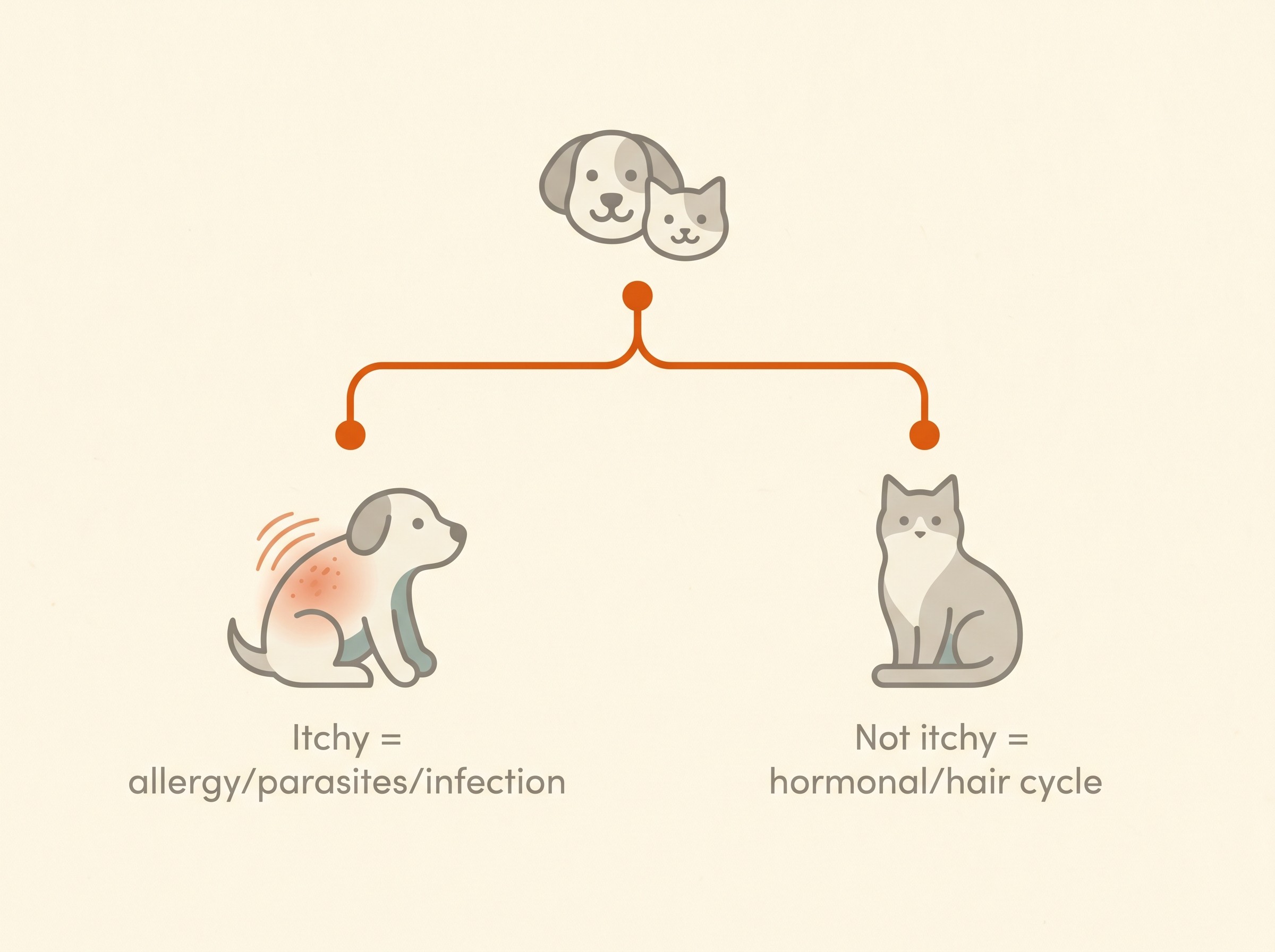
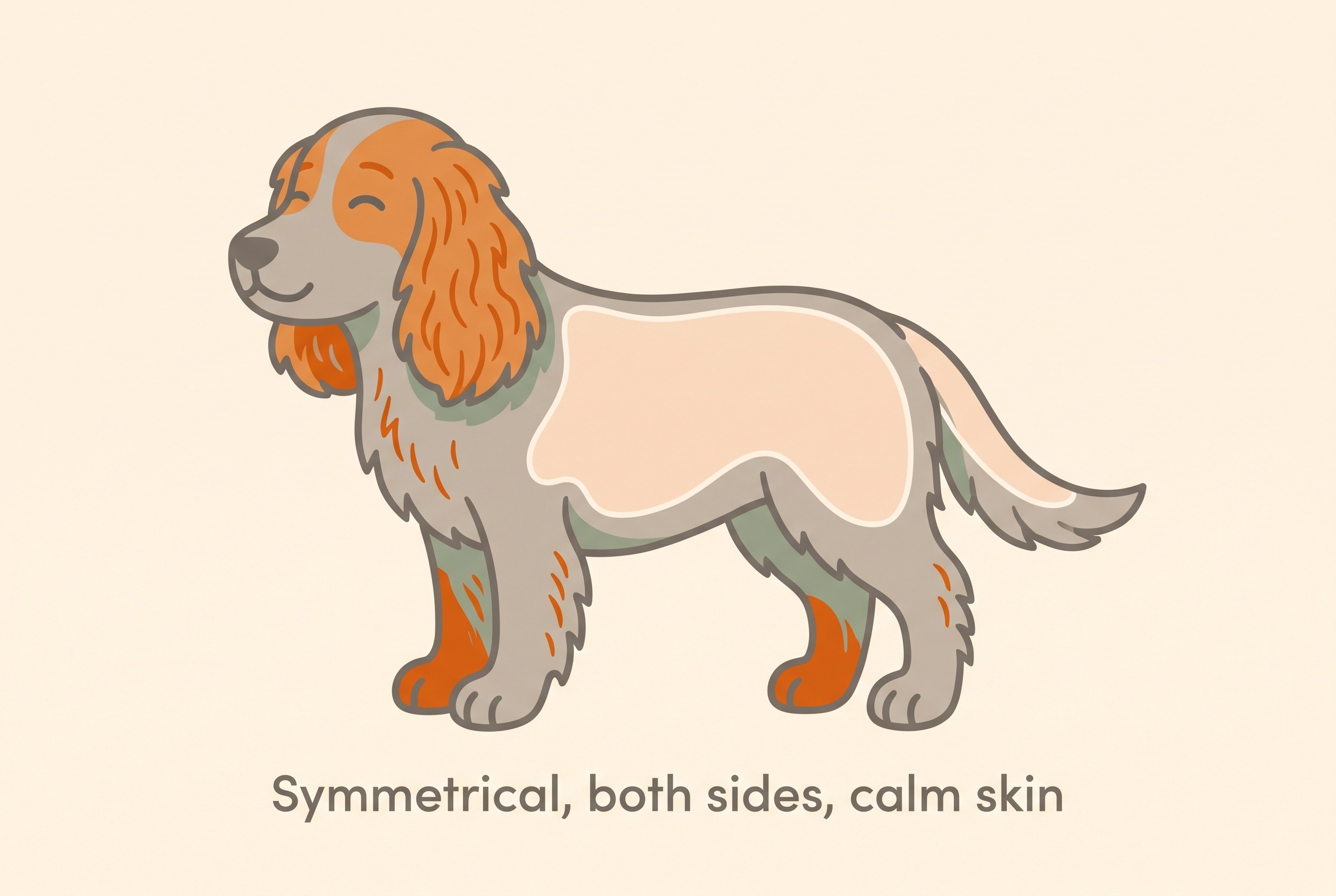
Where the bald patches sit is a clue too. Symmetrical thinning across the flanks, trunk, tail and backs of the thighs, sparing the head and lower legs, is the look of the hormonal and hair-cycle disorders; patchy, lopsided loss on the paws, face, ears, armpits and belly is the look of the itchy, allergic diseases (Heseltine, 2019; Scholz and Crothers, 2021; Welle, 2023). If the skin is red, scabby and self-traumatised, you are at the itchy door, and the place to start is the funnel that maps out the five usual causes: read why is my pet so itchy. The rest of this article is for the calm, symmetrical, not-very-itchy picture.
One caveat is worth naming. A non-itchy alopecia can pick up a secondary infection in the bald, exposed skin and start to itch, looking like two problems at once. If your once-quiet bald patch turns red, smelly, weepy or suddenly itchy, that is the infection talking and it is worth a vet visit sooner rather than later, because it needs treating in its own right while the underlying cause is found (basics at skin and ear infections).
Two hormones behind most canine baldness
In dogs, true hormonal (endocrine) hair loss is well recognised, and two conditions sit behind most of it. The job here is to name them and to point out the clues elsewhere in the body that flag a hormone rather than an allergy; the work-up and treatment of both belong to the Endocrine and Hormones space, so this is the signpost, not the full story.
The first is an underactive thyroid (hypothyroidism), a leading endocrine cause of canine baldness. The coat changes are bilaterally symmetrical, non-itchy hair loss over the trunk and areas of wear, a dull, lustreless coat, and hair that fails to grow back after clipping (Heseltine, 2019), often with a thinning "rat tail" as the tail loses its plume, plus scaling, darkened skin and recurrent skin or ear infections (MSD Veterinary Manual, 2023). Skin signs turn up in around two-thirds of hypothyroid dogs, so they are common but not universal, and their absence does not rule the disease out (MSD Veterinary Manual, 2023). What really gives it away is what travels with the coat: dullness or lethargy, weight gain without eating more, and a habit of seeking out warm spots (Heseltine, 2019). In advanced, long-untreated cases the face can thicken and droop into the so-called "tragic" expression of myxoedema, but that is a late sign, not an early one (MSD Veterinary Manual, 2023). Those whole-body signs are the signal to think hormone. The test is a blood sample, not an allergy panel, and treatment is a daily thyroid tablet (Heseltine, 2019).
The second is Cushing's syndrome (hyperadrenocorticism), where the body makes too much of its own steroid, cortisol. The hair loss is again a bilaterally symmetrical, non-itchy truncal pattern, but with a distinctive set of skin extras: thin, slack skin with blood vessels showing through, blackheads, darkened patches, easy bruising, poor wound healing, gritty calcium deposits (calcinosis cutis) and repeated infections (Scholz and Crothers, 2021; MSD Veterinary Manual, 2023). The systemic giveaways are often more useful than the coat: marked thirst and urination, a ravenous appetite, a pot-bellied or sagging tummy, panting and muscle weakness (Scholz and Crothers, 2021). A dog that is balding, drinking the water bowl dry and growing a pot belly is a "see the vet for bloods" picture, screened by adrenal-function blood and urine tests, not an allergy panel (Scholz and Crothers, 2021).
A smaller group of sex-hormone-related hair losses rounds out the list, from an ovarian remnant left after spaying or a hormone-producing testicular tumour in an entire male dog, again symmetrical, non-itchy and often starting around the back end and flanks (MSD Veterinary Manual, 2023; Welle, 2023). It is worth knowing the category exists; the detail belongs to the Endocrine and Hormones space.
Harmless causes that look alarming but are not allergy
Making this only about hormones would mislead you, because several common, harmless conditions cause non-itchy hair loss with completely normal blood tests, and naming them spares a lot of worry.
Alopecia X, sometimes called "black skin disease", is a hair-cycle arrest in plush, double-coated spitz breeds (Pomeranians, Chow Chows, Keeshonds, Samoyeds, Miniature Poodles): the coat is lost symmetrically over the trunk and thighs, sparing the head and legs, and the bare skin often darkens to a grey-black (MedVet, 2023). It is poorly understood, and its long trail of folk names (coat funk, woolly syndrome, pseudo-Cushing's) reflects how uncertain the cause is (MedVet, 2023). The point worth making: once the dangerous mimics above are ruled out, it is a cosmetic problem in an otherwise healthy dog, not a medical threat. Various treatments, from neutering to melatonin to trilostane, regrow the coat in some dogs, but none is reliably curative and relapse is common even on treatment, so "watch and leave alone" is a respectable choice (Cerundolo et al., 2004; MedVet, 2023).
Seasonal (recurrent) flank alopecia is the one that genuinely confuses people: bilaterally symmetrical, sharply outlined bald patches on the flanks that appear in autumn or winter and grow back in spring or summer, driven by shortening day length acting through melatonin (Apostolopoulos, 2025). It has a strong breed bias (Boxers, Bulldogs, French Bulldogs, Airedales, Schnauzers, Rhodesian Ridgebacks), the skin in the patch is often a little darker but otherwise healthy, and it is neither itchy nor harmful (Apostolopoulos, 2025). If the bald flank follows the calendar, it is almost certainly this, not allergy.
Post-clipping alopecia is the bald square that never grew back after surgery or a blood sample: in thick-coated breeds the clipped hair can take many months to return, because the cut follicles were caught in their resting phase. It is a recognised, benign, self-resolving phenomenon that needs nothing but patience (Scott and Miller, 2012; MSD Veterinary Manual, 2023).
That leaves two stress-related shedding patterns. Telogen effluvium is a delayed wave of shedding a month or more after a major stressor (serious illness, surgery, pregnancy and nursing), when many follicles were pushed into rest together and then let go of their hairs at once; anagen defluxion is faster, with hair lost within days of an insult to actively growing follicles, classically after chemotherapy or severe illness (Apostolopoulos, 2025; Welle, 2023). Both are non-itchy and usually self-correct once the trigger has passed, which spares an owner a hunt for an allergy that was never there.
Two more in a line each. Ringworm, a fungal infection, can cause patchy, often only mildly itchy hair loss and is the one infectious mimic that also spreads to people and other pets, so it gets its own page: see ringworm in pets. And genuine scarring alopecia, after a deep wound, burn or certain immune-mediated diseases, destroys the follicle so the hair will not return; that is a vet diagnosis that points towards the Immune and Blood space, not this one (Welle, 2023).
Cats are different: "non-itchy" usually means itch in disguise
In cats, the picture flips. The old label "feline endocrine alopecia" has been abandoned, because there is no good evidence of a hormonal cause for the symmetrical hair loss cats show, and the great majority of it is actually self-induced by overgrooming in response to something itchy or irritating, most often fleas, atopy or food allergy (Pucheu-Haston, 2021). The catch is that cats groom fastidiously and often in private, so an owner can be quite certain they have never seen the cat scratch while it is quietly licking a smooth bald stripe down its belly. "She can't be itchy, I never see her scratch" is the classic feline error.
Vets prove it simply: the trichogram again tells the tale (broken tips mean barbering, tapered tips suggest genuine fallout), and the buster-collar test is beautifully direct, because if fresh fur grows back under a protective collar over two to three weeks, the cat was doing it (Pucheu-Haston, 2021). Because covert overgrooming is so often the cause, the feline detail, including the behavioural side, is handed to feline atopic syndrome, with the wider allergy picture at atopic dermatitis explained.
When a cat really is losing hair without grooming it off, the suspects differ from the dog list, and Cushing's and hypothyroidism are essentially dog problems here, not feline ones. Think instead of hyperthyroidism (the over-active thyroid) in an older cat, especially with weight loss despite a big appetite; paraneoplastic alopecia, an uncommon but serious sign of internal cancer that shows as a strikingly smooth, shiny, often belly-and-thigh baldness with skin that peels and hairs that lift away easily; and telogen effluvium after a stressor (Pucheu-Haston, 2021; Caporali et al., 2016). The forward-looking message for cats is simple: an older cat losing hair on the belly, particularly if it is also losing weight or seems unwell, needs a vet and blood tests promptly, not an allergy kit (Caporali et al., 2016; Pucheu-Haston, 2021).
When allergy is still on the table, and your next steps
The fork is a strong clue, not a cast-iron law. A minority of allergic or mite-affected pets do present more bald than visibly sore, particularly cats grooming on the quiet and dogs carrying a low-grade demodex burden (Apostolopoulos, 2025; Pucheu-Haston, 2021). So the position is not "never think allergy again": it is to rule out the hormonal and hair-cycle causes first with the pattern, the skin and blood tests, and if those come back clean, allergy and parasites are back on the table. If the trail leads that way, pick it up at the funnel in why is my pet so itchy, where a pet can cope with one trigger but tip over the edge when a second is added (the idea behind the itch threshold).
So, practically, if your pet is balding but not very itchy: read the skin and the symmetry (quiet, even, healthy skin points away from allergy; red, scabby, broken-haired skin points back towards it), and watch the non-skin clues that flag a hormone, which in dogs means thirst, appetite, weight, energy and a pot belly, and in cats means weight, appetite and age. From day one, photograph the affected areas the same way in the same light, the habit covered in checking your pet's skin at home, and log the coat and any itch in the Skin and Itch Tracker. That earns its place here: if your pet is quietly overgrooming, the rising itch picture is captured rather than missed; the symmetry and timeline are documented for the vet; and any regrowth or further loss over the months these conditions take is tracked rather than guessed at. If you are unsure which door you are at, the itchy-pet check is a quick first pass.
The one thing to resist is starting an anti-itch medicine or an elimination diet on a hunch: if the cause is hormonal or a hair-cycle problem, neither will help, and both delay the blood tests that answer the question. A food trial in particular is exactly the wrong move for symmetrical, non-itchy baldness, which is why this is the one allergy article that does not send you to the Elimination-Diet Companion; that tool earns its keep when an itchy pet is doing a proper food trial. The reassurance to hold on to is that most of these causes are either very treatable once named (the hormonal ones) or harmless and self-correcting (post-clipping, seasonal flank, stress shedding). The fastest route to the answer is starting at the right door, and for a non-itchy, balding pet that door is usually the Endocrine and Hormones space and a set of blood tests, not the allergy funnel.
References
- Apostolopoulos N. Understanding and treating canine alopecic dermatoses. Today's Veterinary Practice. March/April 2025.
- Welle MM. Canine noninflammatory alopecia: an approach to its classification and a diagnostic aid. Veterinary Pathology. 2023;60(6):748-769.
- Heseltine J. Canine hypothyroidism: diagnosis and treatment. Today's Veterinary Practice. March/April 2019.
- Scholz F, Crothers S. Canine hyperadrenocorticism. Veterinary Focus. 2021;31(2).
- Pinchbeck L. Alopecia X in dogs (hair cycle arrest). MedVet clinical reference. Accessed 2023.
- Cerundolo R, Lloyd DH, Persechino A, Evans H, Cauvin A. Treatment of canine Alopecia X with trilostane. Veterinary Dermatology. 2004;15(5):285-293.
- Scott DW, Miller WH. Retrospective record review of canine postclipping hair follicle arrest. Veterinary Dermatology. 2012;23(3):248-249.
- Pucheu-Haston CM. A clinical approach to alopecia in cats. Today's Veterinary Practice. March/April 2021.
- Caporali C, Albanese F, Binanti D, Abramo F. Two cases of feline paraneoplastic alopecia associated with a neuroendocrine pancreatic neoplasia and a hepatosplenic plasma cell tumour. Veterinary Dermatology. 2016;27(6):508-e137.
Keep track of how your pet is doing
The owners who cope best are the ones who notice changes early. A simple health log shows you what is working, and what is not, before the next vet visit.
Start tracking, freeYou're not doing this alone
Compare treatment journeys and talk to owners managing allergies & skin. Free to join.
Join PetsLikeMine