

Feline atopic syndrome: how allergy looks different in cats
Alastair Greenway
BVM&S MRCVS
A cat that licks itself bald, grows scabby little bumps along its back, or scratches its face and neck raw has usually earned one of two labels from someone: "it might be allergies", or "it might be stress". The first is often right. The second is a guess, and it is wrong more often than people realise. Cats genuinely do get allergies. They just show them in a way that looks nothing like the textbook itchy dog, which is exactly why the disease gets missed, mislabelled, or treated as if the cat were a small dog. It is not, and saying so plainly is where good care begins.
Cats speak a different language
Even the experts only recently settled on what to call this. In 2021 an international panel agreed a set of names for allergic disease in cats (Halliwell et al., 2021a). The umbrella term is feline atopic syndrome, covering the skin, the gut and the airways (asthma). The skin part, which is what this article is about, is feline atopic skin syndrome: itchy, inflamed skin driven by environmental allergens (Halliwell et al., 2021a; Santoro et al., 2021). If your cat's notes say "feline atopic dermatitis", "feline allergic dermatitis" or "non-flea non-food hypersensitivity dermatitis", don't be thrown; they are older names for the same territory.
Most cat-allergy pages skip the next bit. The panel deliberately chose not to call this "feline atopic dermatitis", because none of the allergic skin diseases cats get actually showed the features of the atopic dermatitis seen in dogs and people (Halliwell et al., 2021a). The "atopic" word was kept only by analogy, for the whole-body syndrome, and not because the cat illness is the same disease. So "how allergy looks different in cats" is, quite literally, why the name had to change. There is an immune basis involving IgE antibodies, but the evidence for it is supportive "albeit not strongly so" (Halliwell et al., 2021b). This is a disease to be humble about.
Four patterns an itchy cat falls into
Where a dog with allergies tends to produce a recognisable rash, a cat funnels almost any itchy skin disease into one of four patterns. None of them is a "this means allergy" badge; each can equally be caused by fleas or food. They are simply the vocabulary of the itchy cat, and one cat can show more than one at once, or switch between them over months (Santoro et al., 2021; Halliwell et al., 2021a).
- Miliary dermatitis. Tiny crusty bumps, classically felt rather than seen: stroke the cat along its back and tail base and it feels gritty, like fine sandpaper under the fur. The name comes from the bumps resembling millet seeds (Santoro et al., 2021).
- Eosinophilic dermatoses. A trio of lesions: an indolent or "rodent" ulcer on the upper lip, raised red plaques often on the belly or inner thighs, and firm linear streaks down the back of a hind leg (Santoro et al., 2021). Older notes call this the eosinophilic granuloma complex, or EGC.
- Self-induced symmetrical alopecia. Hair loss from overgrooming, usually fairly even side to side, classically on the belly, inner thighs, flanks and the backs of the forelegs. The skin underneath often looks near-normal, because the cat is removing the hair, not the skin (Santoro et al., 2021). This is the pattern most often mistaken for behaviour.
- Head and neck itch. Intense scratching about the face, ears and neck, leaving raw sores, scabs and erosions. This is a particularly common and severe site in cats, and a fixed, ferocious version is one reason to take a food trial seriously (Santoro et al., 2021).
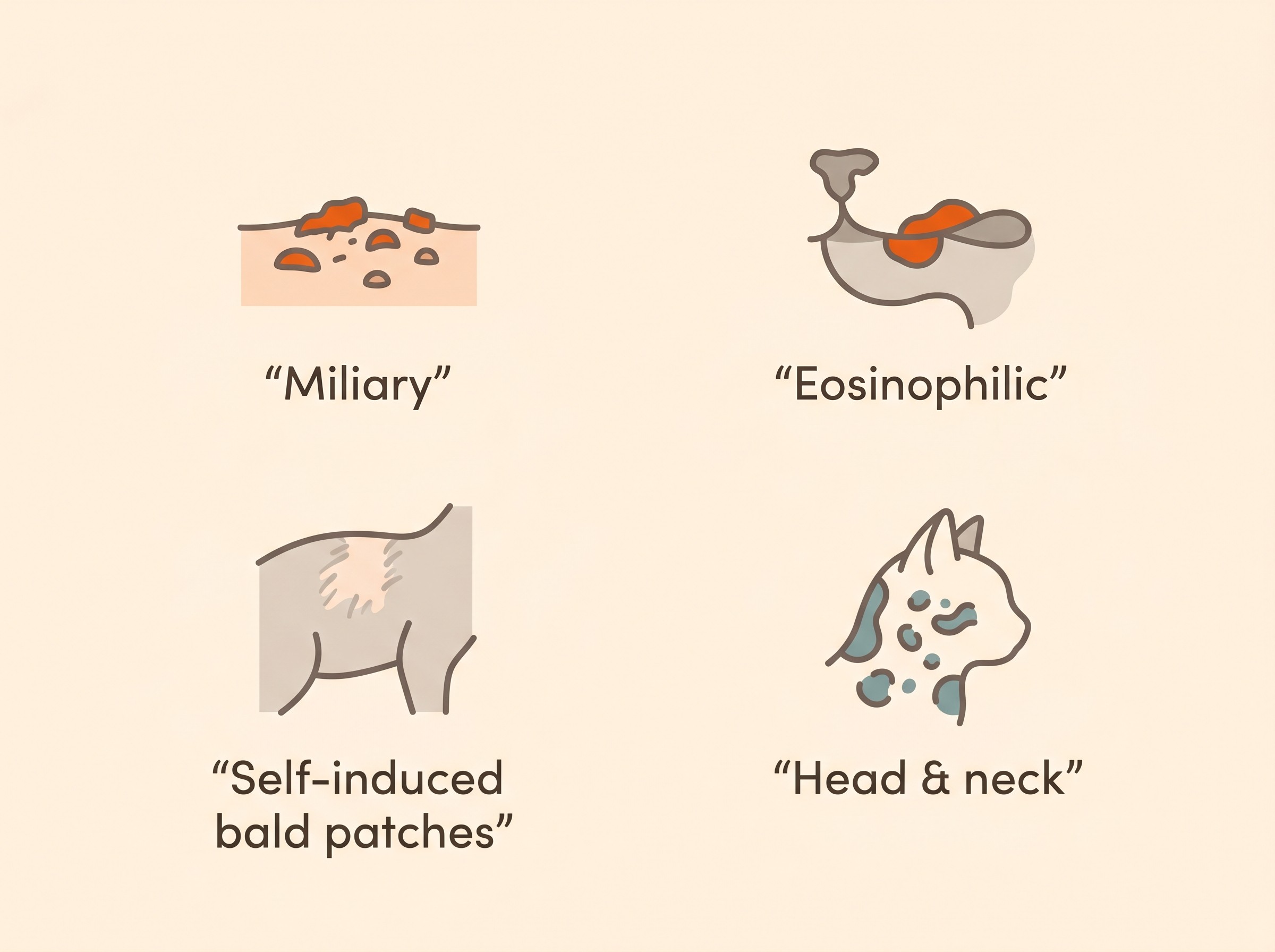
A cat almost never reads the textbook: two allergic cats living next door can look completely different, and that is normal.
When overgrooming is an itch, not neurosis
When a cat licks itself bald, the reflex, sometimes even among vets, is to reach for "stress" or "psychogenic alopecia". The evidence says that reflex is usually backwards. In the landmark study, of 21 cats referred with presumed psychogenic alopecia, a medical cause for the itch was found in 16 (76%); only 2 (10%) were purely behavioural and 3 (14%) mixed, while an adverse food reaction alone accounted for 12 (57%). The authors concluded plainly that psychogenic alopecia is over-diagnosed (Waisglass et al., 2006). An overgrooming cat is far more likely itchy than neurotic, and that is good news, because an itch can be found and treated, where "she's just highly strung" leaves you nowhere.
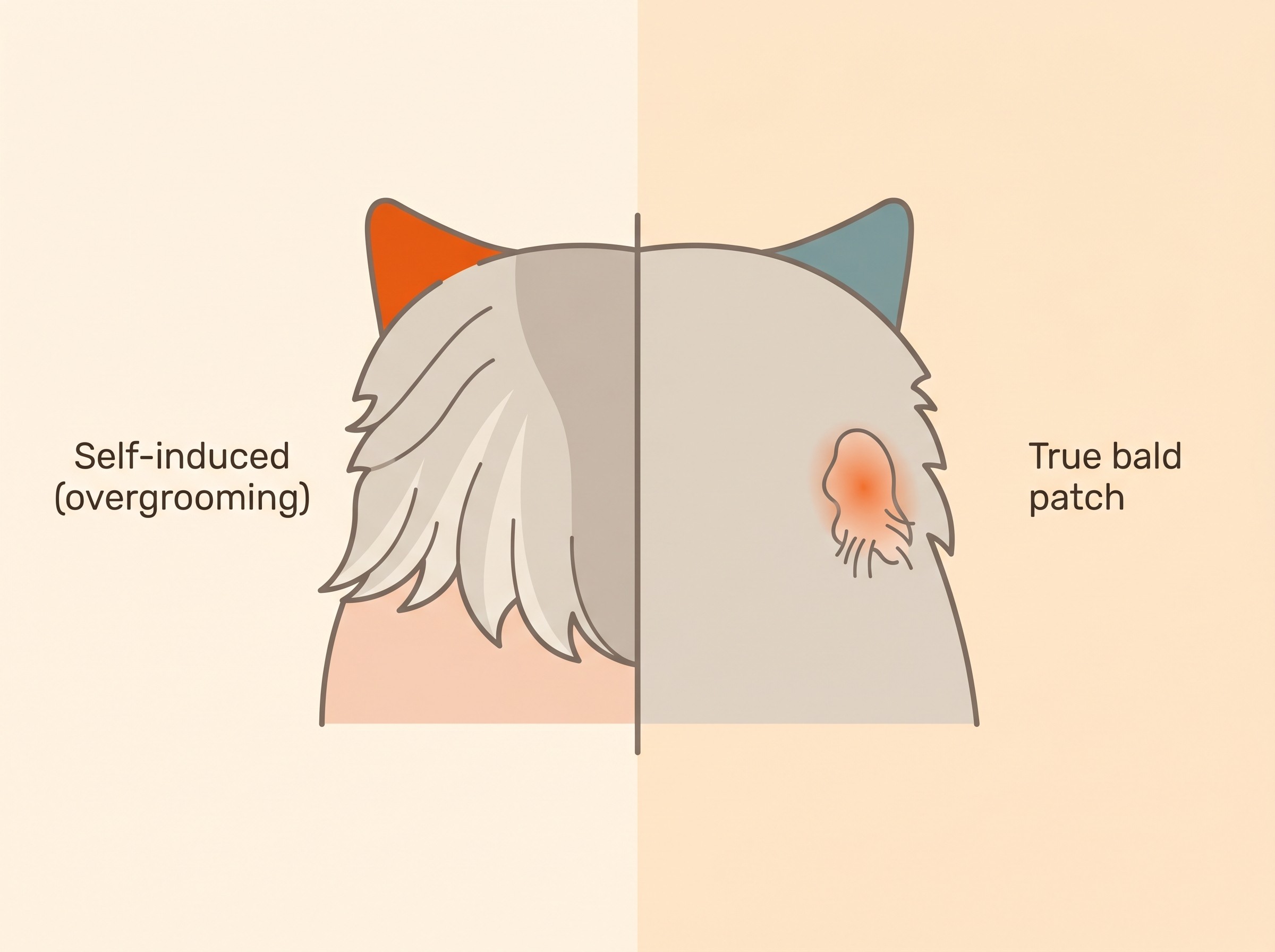
Part of why this gets missed is that in a cat the lick is the scratch, so many owners never see scratching; grooming looks like grooming until the bald patch appears. The order of operations follows from that. Treat the medical itch first (fleas, food, environmental allergy, hidden infection, pain, the same stacking covered in the itch threshold), and only once that is genuinely clean is it fair to call the problem behavioural. Any true anxiety or compulsive component that remains afterwards belongs in the Behaviour space (compulsive behaviour and overgrooming). Because the feline itch is so easy to under-see, this is where the Skin and Itch Tracker earns its keep: logging daily grooming time and a weekly photo turns "I think she's a bit less obsessed" into a real before-and-after.
Diagnosis, tuned for cats
Diagnosis is by exclusion, the same backbone used across this site, but the order is tuned for cats: parasites (above all fleas), then a strict elimination diet trial, while treating any secondary infection along the way (Santoro et al., 2021). Feline atopic skin syndrome is what remains once those are excluded and the picture fits.
Fleas come first, and this matters more than in dogs. Flea allergy is the most common allergic skin disease of cats, and because cats are such fastidious groomers you often cannot find a single flea or any flea dirt on a genuinely flea-allergic one (Santoro et al., 2021). So an itchy cat goes onto rigorous, every-pet, year-round flea control as step one, whether or not a flea has been seen. The biology and the eradication plan belong to flea allergy dermatitis: fleas first, and you will not always see them.
Food comes next, because there is no way to tell food-driven from environment-driven allergy by looking. A strict elimination diet trial, usually a single novel protein or hydrolysed diet for around eight weeks, is part of working up almost every allergic cat (Santoro et al., 2021). The mechanics live in the elimination diet, done properly; the feline catch is that the trial lives or dies on strictness, which the outdoor hunter, the fussy eater and the shared multi-cat bowl all conspire against. The Elimination-Diet Companion tracks every mouthful so one slip does not wreck the answer.
Then there is the test everyone asks for and nobody should rely on. No blood, saliva or hair test diagnoses feline allergy. The 2021 guidelines are explicit that neither intradermal nor serum IgE testing should be used to diagnose it, because studies find no reliable difference in IgE between allergic and healthy cats; the tests only help choose allergens for immunotherapy once the diagnosis is already made by exclusion (Santoro et al., 2021). The fuller myth-bust sits in allergy tests that work, and the ones that waste your money. Published feline criteria exist too, a checklist that supports the diagnosis, but they back your vet's judgement rather than replacing it (Santoro et al., 2021).
Treatment: straight about the licensing and the evidence
The shared mechanism is covered in atopic dermatitis: allergic to the world and the full drug comparison in the treatments compared. What belongs here is the cat-specific reality, where most pages lazily transplant the dog playbook.
Begin with a humbling fact. A systematic review of feline atopic syndrome treatment found good evidence for only two things: systemic steroids and ciclosporin. Everything else, including topical steroids, oclacitinib, immunotherapy, antihistamines and essential fatty acids, had only limited or weak evidence (Mueller et al., 2021). Cat allergy treatment rests on fewer good studies than dog treatment, so anyone who sounds completely certain is overselling.
- Ciclosporin (Atopica) is the licensed non-steroid mainstay. A feline formulation is licensed for managing feline allergic dermatitis, with the better evidence behind it (Mueller et al., 2021). It is not a fast fix though, commonly taking four to six weeks to work, after which the vet tapers to the lowest holding dose.
- Steroids (such as prednisolone) work, but mind the feline cost. They are effective, cheap and still the most reached-for drug, partly because the alternatives are licence-limited (Mueller et al., 2021). The catch is real: in one cohort of cats on higher-dose prednisolone (roughly 1.9 mg/kg/day or more for over three weeks), 9.7% developed steroid-induced diabetes, most within three months (Nerhagen et al., 2021). So steroids earn their place short-term and for flares, but long-term reliance is a reason to ask about steroid-sparing.
- Oclacitinib (Apoquel) is not licensed in cats, and the response is mixed. It is licensed for dogs only; use in cats is off-label, often at a higher per-kg dose and twice daily. The feline studies show variable, frequently sub-canine results: in one, of the cats that completed it, around 61% achieved at least a halving of their itch and 88% at least a halving of skin lesions, with no useful link between blood drug level and response (Carrasco et al., 2022). A reasonable off-label vet decision, then, not a copy-paste of the dog regime. The same goes for the newer JAK inhibitor ilunocitinib (Zenrelia): it is licensed for dogs only, so if you have read about it for a dog, it is not a feline option either (Zenrelia UK SPC, 2025).
- Lokivetmab (Cytopoint) is a dog medicine. It is a caninised antibody licensed for dogs, not a feline product. If you have read about it for your dog, do not ask for it for your cat: a cat would need a species-specific antibody, which the canine one is not.
- Immunotherapy is the one disease-modifying option. Allergen-specific immunotherapy retrains the immune response rather than just dampening the itch, and is available for cats, though the feline evidence is limited rather than strong (Mueller et al., 2021). For a confirmed environmental allergy it is the hopeful long game, and immunotherapy: the only treatment that changes the disease covers how it works.
- Antihistamines and essential fatty acids are safe and commonly tried, but have only weak feline evidence: helpers alongside a real plan, not the plan itself (Mueller et al., 2021).
Where to go from here
The hopeful thread through all of this is that a cat which seems "just neurotic", licking patches bald while you sleep, is very often simply an itchy cat, and an itch can be found. The path is the same calm, step-by-step work-up as for any allergic pet, with the drugs chosen properly for cats rather than dogs. So if that is your cat, start today: put every animal in the house onto year-round flea control, ask your vet about a proper eight-week diet trial, and log it in the Skin and Itch Tracker. When the feline itch is this easy to miss, a fortnight of recorded grooming times and photos is the difference between "I think she's better" and actually knowing.
References
- Halliwell, R., Pucheu-Haston, C. M., Olivry, T., Prost, C., Jackson, H., Banovic, F., Nuttall, T., Santoro, D., Bizikova, P., & Mueller, R. S. (2021). Feline allergic diseases: introduction and proposed nomenclature. Veterinary Dermatology, 32(1), 8-e2.
- Halliwell, R., Banovic, F., Mueller, R. S., & Olivry, T. (2021). Immunopathogenesis of the feline atopic syndrome. Veterinary Dermatology, 32(1), 13-e4.
- Santoro, D., Pucheu-Haston, C. M., Prost, C., Mueller, R. S., & Jackson, H. (2021). Clinical signs and diagnosis of feline atopic syndrome: detailed guidelines for a correct diagnosis. Veterinary Dermatology, 32(1), 26-e6.
- Mueller, R. S., Nuttall, T., Prost, C., Schulz, B., & Bizikova, P. (2021). Treatment of the feline atopic syndrome: a systematic review. Veterinary Dermatology, 32(1), 43-e8.
- Carrasco, I., Ferrer, L., & Puigdemont, A. (2022). Efficacy of oclacitinib for the control of feline atopic skin syndrome: correlating plasma concentrations with clinical response. Journal of Feline Medicine and Surgery, 24(8), 787-793.
- Zenrelia (ilunocitinib) film-coated tablets for dogs — UK Summary of Product Characteristics. Veterinary Medicines Directorate Product Information Database; issued August 2025. Supports: ilunocitinib, the newer canine JAK inhibitor, is licensed in dogs only and has no feline licence.
- Waisglass, S. E., Landsberg, G. M., Yager, J. A., & Hall, J. A. (2006). Underlying medical conditions in cats with presumptive psychogenic alopecia. Journal of the American Veterinary Medical Association, 228(11), 1705-1709.
- Nerhagen, S., Moberg, H. L., Boge, G. S., & Glanemann, B. (2021). Prednisolone-induced diabetes mellitus in the cat: a historical cohort. Journal of Feline Medicine and Surgery, 23(2), 175-180.
Keep track of how your pet is doing
The owners who cope best are the ones who notice changes early. A simple health log shows you what is working, and what is not, before the next vet visit.
Start tracking, freeYou're not doing this alone
Compare treatment journeys and talk to owners managing allergies & skin. Free to join.
Join PetsLikeMine