

Immunotherapy: the only treatment that changes the disease
Alastair Greenway
BVM&S MRCVS
Nearly every drug we give an atopic pet works the same way: it mutes the itch. Apoquel, Cytopoint, steroids, ciclosporin are all good drugs, and each one turns the signal down without laying a finger on the disease underneath. Immunotherapy breaks that pattern. It goes after the allergy itself, retraining the immune system so it stops overreacting in the first place (Mueller, 2023). It is also slow, unglamorous and quietly under-offered, partly because the monthly drugs control signs well enough that nobody has to reach for it.
What immunotherapy actually is
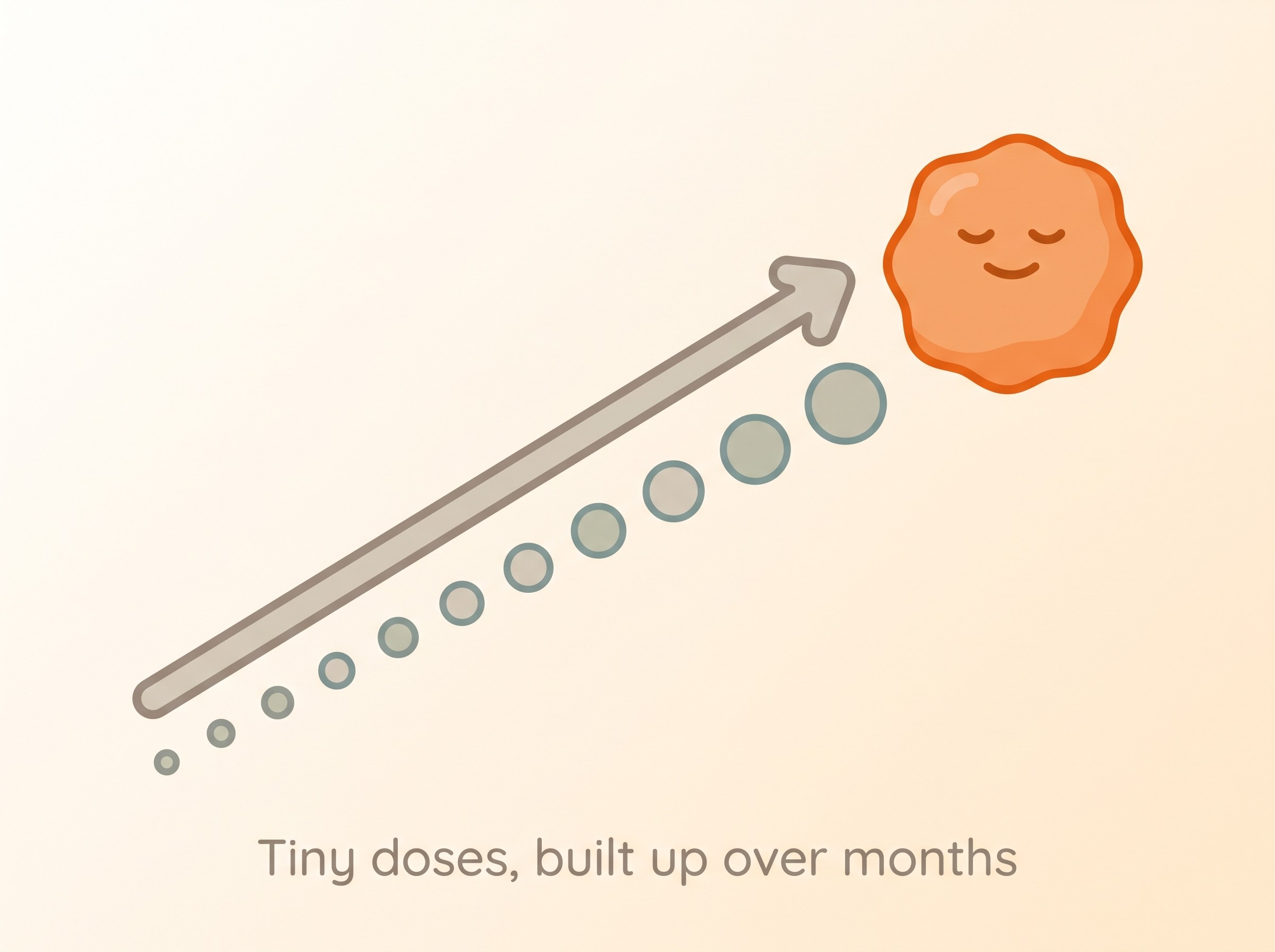
Allergen-specific immunotherapy, usually shortened to ASIT and also called desensitisation, hyposensitisation or simply "allergy shots", gives your pet tiny, gradually increasing doses of the exact environmental allergens it reacts to, such as house dust mites, storage mites, grass and tree pollens and mould spores (Olivry et al., 2015; Mueller, 2023). The dose starts almost imperceptibly small and climbs over months, coaxing the immune system into tolerating those allergens instead of treating them as threats.
Underneath, the immune system genuinely shifts, away from the exaggerated allergic response and towards a calmer, regulatory one (Mueller, 2023). The consequence is what matters: this is the only therapy shown to manage the allergic component of the disease, and the only definitive treatment based on its actual cause (Mueller, 2023). One clinical update calls it "the only potentially disease-modifying" approach for this kind of allergy (Austel, 2021).
The one word to handle carefully is "cure". ASIT changes the disease but rarely erases it: complete resolution happens in only around 5% of dogs (Olivry et al., 2015). Think of it as the treatment most likely to let your pet live well on far less medication, not a switch that turns the allergy off.
Who it is for, and the one strict prerequisite
ASIT is for confirmed atopic dermatitis, the environmental allergy. It does nothing for food allergy or flea allergy, which have their own answers: a properly run diet trial and strict flea control. If food has never been excluded, that route is the elimination diet rather than allergy shots, and the Elimination-Diet Companion is built for it. ASIT exists precisely for the allergens you cannot avoid, the pollens and mites that are part of the world your pet lives in (Olivry et al., 2015).
There is one hard prerequisite, and it trips a lot of owners up. Atopy has to be diagnosed first, as a clinical diagnosis of exclusion, and only then are the specific allergens chosen by intradermal skin testing or a serum IgE blood test (Austel, 2021). Those tests do not diagnose atopy and are not screening tests: a healthy, non-itchy pet can test positive. Their only job is to pick what goes into the vaccine for a pet already known to be atopic, which is why allergy testing in pets and the prior diagnosis of exclusion both come first.
The resulting formula is bespoke: in the UK, a custom-made product compounded for your individual animal from its own test results, history and locally relevant allergens, not an off-the-shelf licensed drug like Apoquel or Cytopoint (Austel, 2021).
Realistic expectations: the core
Roughly two in three dogs improve, but how you count matters. The international guidelines rate "nearly two thirds" of owners as satisfied-to-very-satisfied after a year or more (Olivry et al., 2015). The cleanest single figure comes from a retrospective study of 664 dogs, which graded the response as excellent (ASIT alone controlled the signs, with no other systemic medication needed) in 31.5%, good (at least a 50% reduction in signs, but still on some medication) in 28.5%, and poor (under 50% improvement) in 40.1% (Fennis et al., 2022). That is a good-or-excellent result in about 60%, with just under a third needing no other drugs at all, and a systematic review lands in the same place at 50 to 70% over the first year (Fennis et al., 2022; Tham and Olivry, 2022). So the headline is around 60 to 70%, with about a third coming off other medication, not a tidy "70% cured".
It is also slow, and this catches families out. Benefit typically takes three to six months even to begin, and ASIT must run for at least a year before you can fairly judge it (Mueller, 2023; Olivry et al., 2015; Tham and Olivry, 2022). It was never meant to be a rescue for a pet that is itchy tonight. Around nine months is a fair point to take stock, because virtually all responders do so within that window, though with the standard extracts in most UK vaccines a fifth take longer (Fennis et al., 2022; Tham and Olivry, 2022).
And it is a long commitment: after loading, maintenance carries on for years, sometimes for life (Austel, 2021). Two things measurably improve the odds. The first is regular re-examination (good-or-excellent outcomes ran at 69.3% in dogs reviewed at least every three months, against 55.4% in those who were not). The second is keeping off long-term systemic steroids early on, which may dampen the response (Olivry et al., 2015; Fennis et al., 2022). That same study found breed, sex and age at the start made no measurable difference, so an older dog is not written off (Fennis et al., 2022). And the payoff is real: ASIT, alongside proactive topical steroid, is one of the only interventions shown to actually prevent or delay flares (Olivry et al., 2015; Fennis et al., 2022).
Two ways to give it: shots or drops
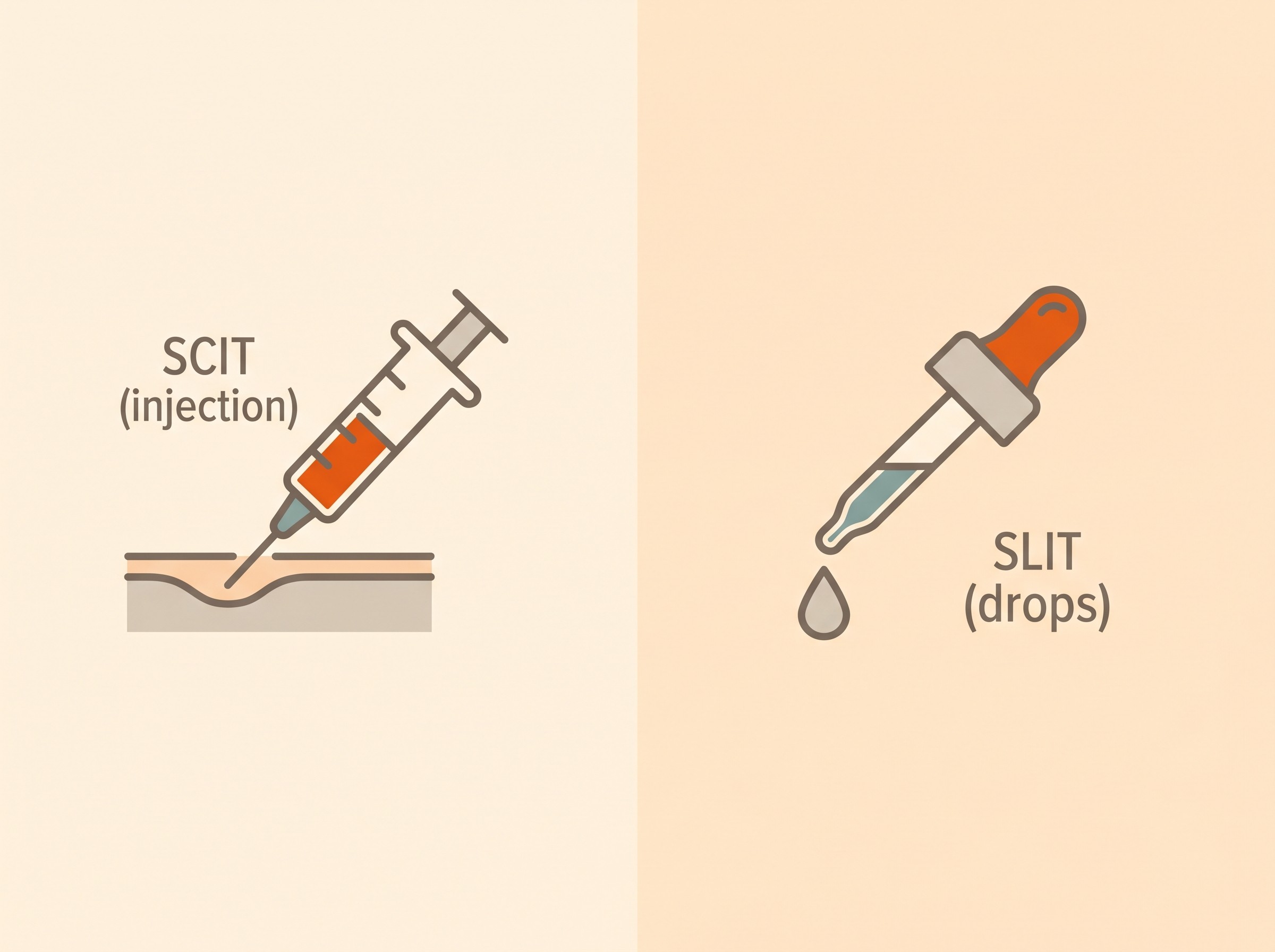
Subcutaneous immunotherapy (SCIT, the classic "allergy shots") is a small injection under the skin, frequent during loading and then tapering to a monthly maintenance dose that many owners are trained to give at home. Sublingual immunotherapy (SLIT, "allergy drops") goes under the tongue, typically twice a day, with no needles, which suits needle-averse owners and fractious cats.
Head-to-head data are limited and small. The one direct comparison, in just 30 dogs, returned fewer animals to normal on the sublingual route than on injections, and fewer still than on a newer injected-into-a-lymph-node method (Fischer et al., 2020). That tiny sample should not be over-read, but it is a fair warning against assuming the needle-free option is automatically as good. Both SCIT and SLIT are reasonable, the choice driven by the pet, the owner and the dermatologist, and there is no reliable way yet to predict which route a given animal will respond to: some pets fail one and do well on the other (Fischer et al., 2020; Mueller, 2023). That lymph-node route, intralymphatic immunotherapy, looked the strongest in that small study but is not yet routine in UK first-opinion practice (Fischer et al., 2020).
Safety, and carrying on while it works
ASIT is one of the safer long-term options. Serious reactions are uncommon: for the injected form, severe systemic reactions are reported in only around 1% of patients, and the sublingual form is very well tolerated, with reactions from none to mild (Austel, 2021). The everyday issues are minor and local, a little swelling at the injection site or a temporary uptick in itch a few hours after a dose, both usually settling with a tweak to the schedule, and the first doses are often supervised at the practice for that reason. You should still know the rare red flags: a swollen face or muzzle, hives, vomiting or collapse in the minutes to hours after a dose is a possible allergic reaction to the injection itself and needs a vet straight away (what these emergencies look like is covered in pet skin emergencies). "Rush" protocols, which compress loading into a single supervised day, exist to shorten induction but are not proven to work better (Austel, 2021).
Because ASIT is slow, your pet is kept comfortable with symptomatic treatment during the months it takes to work, and that is expected, not a sign of failure. Stopping the itch with oclacitinib (Apoquel), lokivetmab (Cytopoint, licensed in dogs only), a short steroid course or ciclosporin (Atopica) simply buys time while the immune system retrains. The one thing to flag with your vet is the steroids: long-term systemic steroids are best minimised in the early months as they may blunt the response, which is part of why a non-steroidal anti-itch drug is often the more sensible companion during induction (Olivry et al., 2015). Where each of these drugs sits, with the trade-offs and costs, is in itch treatments compared, and how immunotherapy fits the wider plan belongs to the atopic dermatitis treatment plan: this is the closer look at one tool within it.
A note for cats
Immunotherapy is used in cats too and can clearly help, though the evidence is thinner: the systematic review of feline treatments rates the support for ASIT in cats as limited rather than strong (Mueller et al., 2021). The most encouraging cat-specific data are for the sublingual drops, which in a study of 22 cats with atopic dermatitis brought itch and skin scores down significantly and were safe and well tolerated, a real plus in a needle-shy species (Foj et al., 2021). The bigger practical difference is the toolkit around ASIT: lokivetmab (Cytopoint) is licensed in dogs only, so what keeps a cat comfortable while immunotherapy works is not the same as for a dog, and the full feline picture is in feline atopic syndrome.
How you will actually know it is working
This is the practical heart of it. ASIT's win is gradual and quietly negative: fewer flares, milder, less medication, over a year. That slow improvement is almost impossible to judge from memory, because flares come and go on their own and last winter's misery fades. The only reliable measure is a logged itch score tracked over months, which is exactly why the Skin & Itch Tracker matters more here than almost anywhere else. Start logging a score now, before ASIT begins, so you have a real baseline; then at nine and twelve months you and your vet can read the trend rather than guess, and that same baseline protects you from giving up too early on a treatment that has not had its year yet.
So the single most useful thing you can do is ask your vet one question at the next visit: is my pet a candidate for immunotherapy? It is worth raising in particular for a young pet, an itch that runs all year, or any household stuck in permanent rescue mode. Whatever you decide, start logging that baseline in the Skin & Itch Tracker now, because the score from this week is what will show you, a year from now, that the slow win was real and bought your pet a calmer, less medicated life. Needing Apoquel or Cytopoint during that wait is normal, and it does not mean immunotherapy is failing.
References
- Mueller RS. (2023). A systematic review of allergen immunotherapy, a successful therapy for canine atopic dermatitis and feline atopic skin syndrome. Journal of the American Veterinary Medical Association, 261(S1), S30-S35.
- Olivry T, DeBoer DJ, Favrot C, Jackson HA, Mueller RS, Nuttall T, Prelaud P; International Committee on Allergic Diseases of Animals (ICADA). (2015). Treatment of canine atopic dermatitis: 2015 updated guidelines from the International Committee on Allergic Diseases of Animals (ICADA). BMC Veterinary Research, 11, 210.
- Austel M. (2021). Allergen immunotherapy for canine atopic dermatitis: an update. Today's Veterinary Practice, published 14 December 2021.
- Fennis EEM, van Damme CMM, Schlotter YM, Sinke JD, Leistra MHG, Bartels RT, Broere F. (2022). Efficacy of subcutaneous allergen immunotherapy in atopic dogs: a retrospective study of 664 cases. Veterinary Dermatology, 33(4), 321-e75.
- Tham HL, Olivry T. (2022). Determination of the efficacy rate and time-to-efficacy of subcutaneous immunotherapy in dogs with atopic dermatitis: a systematic review. Veterinary Dermatology, 33(2), 155-e44.
- Fischer NM, Rostaher A, Favrot C. (2020). A comparative study of subcutaneous, intralymphatic and sublingual immunotherapy for the long-term control of dogs with nonseasonal atopic dermatitis. Veterinary Dermatology, 31(5), 365-e96.
- Mueller RS, Nuttall T, Prost C, Schulz B, Bizikova P. (2021). Treatment of the feline atopic syndrome: a systematic review. Veterinary Dermatology, 32(1), 43-e8.
Keep track of how your pet is doing
The owners who cope best are the ones who notice changes early. A simple health log shows you what is working, and what is not, before the next vet visit.
Start tracking, freeYou're not doing this alone
Compare treatment journeys and talk to owners managing allergies & skin. Free to join.
Join PetsLikeMine