

Calming the flare and controlling the itch: your treatment toolkit
Alastair Greenway
BVM&S MRCVS
There is no single product that fixes atopic dermatitis, and any plan built around one is already in trouble. What works is an ordered approach: get the itch down fast, then keep it down with as little medication as the skin will allow. The individual drugs are weighed up side by side in the treatments compared; here we build them into a plan.
The shape of it: managed, not cured
Start with the truth the drug-company leaflets tend to skip. Atopic dermatitis is a lifelong disease, and the goal of every treatment is control, not cure. The international veterinary dermatology guidelines (ICADA) are built entirely around this idea: they describe the treatment of the disease as "multifaceted", say "interventions should be combined for a proven (or likely) optimal benefit", and warn that treatment plans "are likely to vary between dogs and, for the same dog, between times when the disease is at different stages" (Olivry et al., 2015). In plainer words from a dermatologist's own review, affected pets "can be successfully managed, yet rarely cured" (Gortel, 2018).
That is not a counsel of despair. It is what lets you set a sane target. Zero itch is the wrong goal, because chasing perfection in a lifelong disease only drives over-medication. The right one is the lowest itch your pet can comfortably live with, on the least medication, judged by a number you track rather than a gut feeling (Hill et al., 2007; Rybníček et al., 2009). Comfortable, not sterile.
Two phases: break the flare, then hold the line
ICADA organises atopy treatment into two distinct jobs: settling an acute flare, and managing the chronic disease in between (Olivry et al., 2015). They need different tools, and confusing them is where a lot of plans go wrong.
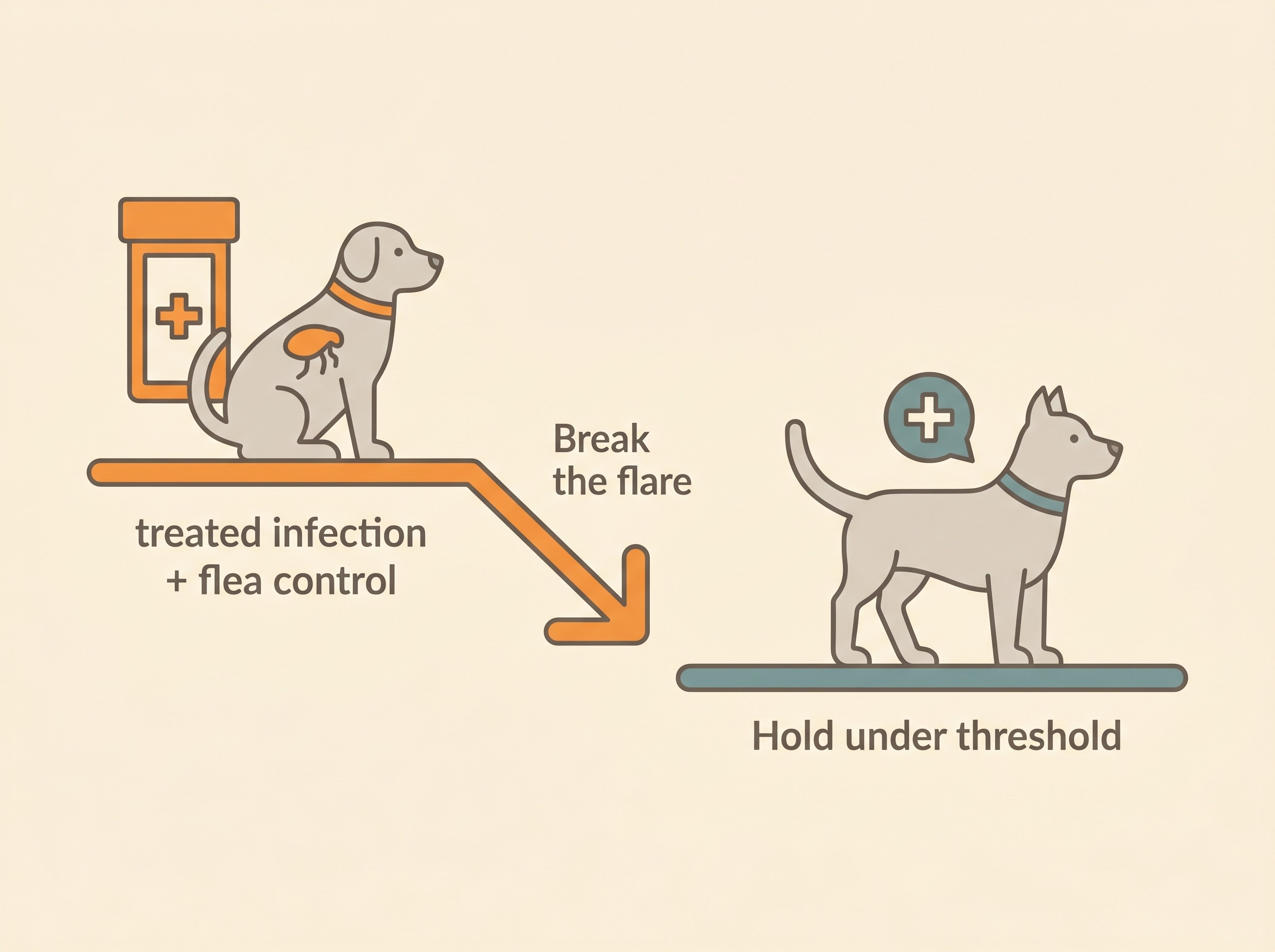
Phase one is the rescue: get an angry flare under control quickly so your pet can sleep and the skin can heal. Phase two is the long, quiet work of holding the itch under threshold with the smallest amount of treatment that keeps your pet comfortable. Underneath both are two foundations that have to be right, or nothing on top of them works properly.
The foundation: treat what piggybacks
Before you judge any itch medicine, sort the two things that ride along with allergic skin, because the commonest reason an atopy plan looks like it has "failed" is not the allergy at all.
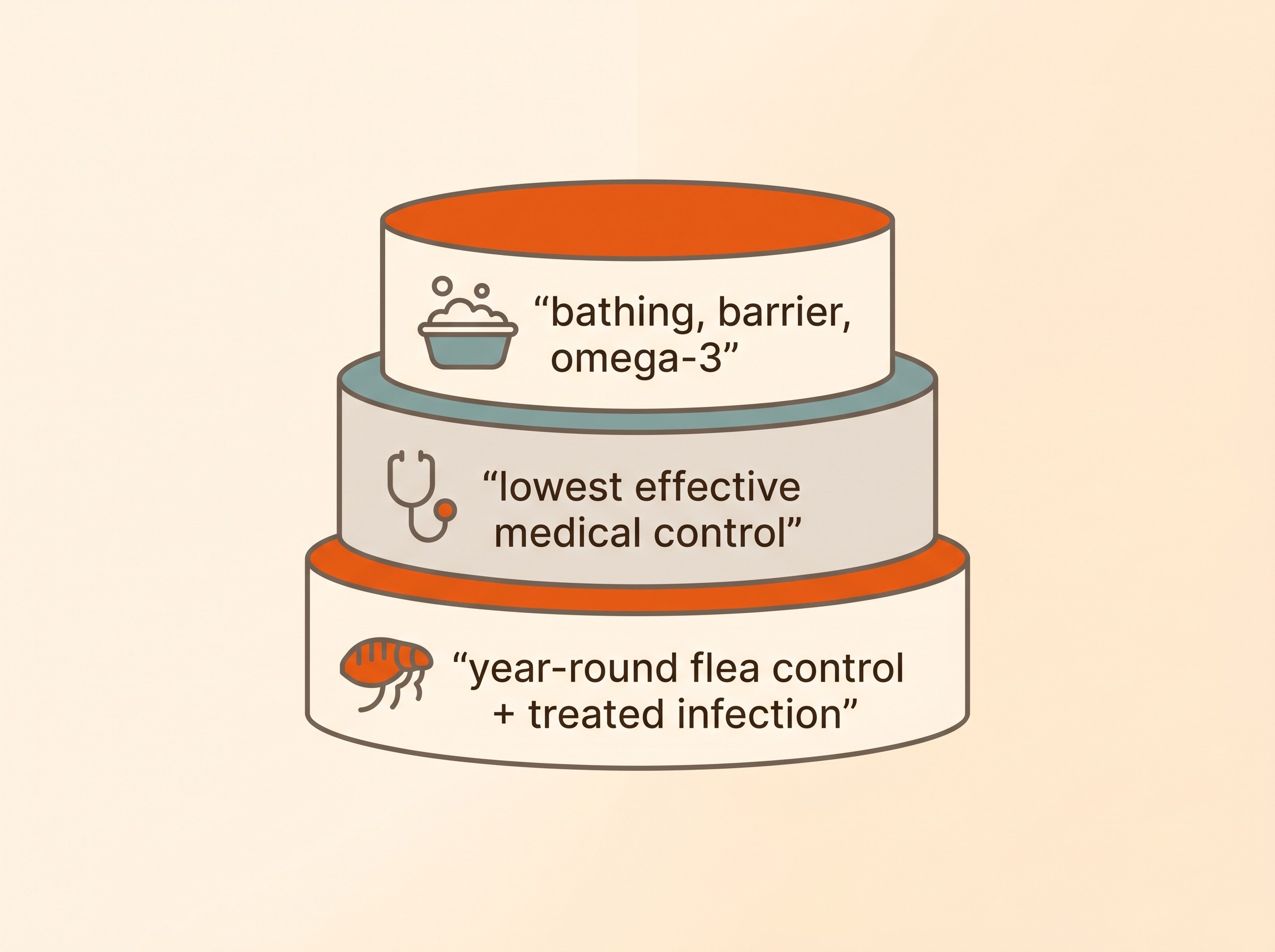
The first is infection. Atopic skin is readily overgrown by bacteria (usually Staphylococcus pseudintermedius) and yeast (Malassezia pachydermatis), and these drive a large share of the smell, the grease and the itch. When a pet responds poorly to anti-allergy treatment, finding undiagnosed infection with skin cytology is exactly the next step, not a stronger allergy drug (Olivry et al., 2015; Hillier et al., 2014). What the infections are and how they are treated belongs to skin and ear infections; the point here is that they must be cleared for the plan to read true.
The second is fleas, year-round, on every animal in the household. ICADA includes rigorous flea control as a core flare-factor measure (Olivry et al., 2015), and even the Apoquel datasheet tells vets to investigate and treat underlying causes such as flea allergic dermatitis, contact dermatitis or food hypersensitivity before relying on the drug (Zoetis UK Apoquel SPC, 2026). The eradication detail lives in flea control that works. And if a food trigger has never been properly excluded, that gap belongs with a diet trial and its Elimination-Diet Companion, with the mechanics handed to the elimination diet. Get the foundation right and the picture often improves before you have touched the allergy medication at all.
Phase one: stopping the itch now
For a bad flare you want speed, and your vet has several fast tools. Here I orient you on each, rather than weigh them against one another; that comparison, with the real trade-offs and rough costs, is the treatments compared.
Oclacitinib (Apoquel) is a daily tablet that works fast, often calming the itch within a day (Cosgrove et al., 2013; Gadeyne et al., 2014). It is licensed in dogs only, given twice daily for up to 14 days then once daily to maintain, and is not used in dogs under 12 months or 3 kg, or those with evidence of immune suppression (such as hyperadrenocorticism) or progressive cancer (Zoetis UK Apoquel SPC, 2026).
Ilunocitinib (Zenrelia) is a newer once-daily tablet in the same JAK-inhibitor family as Apoquel, licensed in dogs for the same allergic and atopic dermatitis and about as fast; the practical difference is that it is given once daily from the start rather than twice daily for the first fortnight (Zenrelia UK SPC, 2025). It carries the same class cautions as oclacitinib and, like it, is not licensed for cats.
Lokivetmab (Cytopoint) is an injection your vet gives roughly monthly. It is fast in onset and lasts about four to eight weeks (Michels et al., 2016; Moyaert et al., 2017), and because it is an antibody rather than a drug cleared by the liver or kidneys, it often suits older dogs or those already on other medication. It too is licensed in dogs only (Zoetis UK Cytopoint SPC, 2025).
A short course of glucocorticoid (steroid), oral prednisolone at roughly 0.5 to 1.0 mg/kg/day or a potent topical spray, is genuinely effective and very fast for a severe flare, tapered to the lowest effective dose (Olivry et al., 2015). Put plainly, this is a brilliant short-term tool, not a long-term plan, which is precisely why steroid-sparing maintenance exists. One practical note: oral steroids and oclacitinib are not given together, especially where there is infection (Olivry et al., 2015).
Choosing between these is your vet's call, and it turns on species, age, how fast you need relief, other illnesses, your preference for a pill or an injection, and cost (Gortel, 2018). The full weighing is in the treatments compared.
Phase two: holding the line with the least medication
Once the flare is broken, the work shifts to keeping the itch quietly under threshold. The single most important idea here is that proactive beats reactive: treating the residual, simmering disease before it boils over uses less drug overall than waiting for the next flare and firefighting it.
The evidence is concrete. In a double-blind, placebo-controlled study, applying a mild topical steroid (hydrocortisone aceponate) twice a week to the spots that usually flare lengthened the median time to relapse to 115 days, against just 33 days on placebo (Lourenço-Martins et al., 2016). It was a pilot study, so treat it as a well-supported strategy rather than gospel, but the principle is sound and ICADA endorses it (Olivry et al., 2015).
For pets who need an ongoing steroid-sparing tablet, ciclosporin (Atopica) is the workhorse. It takes four to six weeks to reach full effect, so it is a maintenance drug, not a rescue, and vets often bridge that opening gap with a short steroid or oclacitinib overlap (Olivry et al., 2015; Steffan et al., 2006). Its lesion and itch control are comparable to oral steroids, with a better profile for long-term use (Steffan et al., 2006), and importantly it is licensed for both dogs and cats in the UK (Elanco Atopica).
Bathing, barrier care and omega-3 supplements sit in this maintenance layer too, as real but modest adjuncts. ICADA supports bathing and topical therapy, and even notes that the "intensity and frequency of bathing may be the most important factor in relieving pruritus", while essential fatty acids give only a limited benefit and are far too slow to treat a flare, with any benefit unlikely to show before about two months (Olivry et al., 2015). They lower the overall load; they are never the whole plan alone. Antihistamines are weaker still and best used preventively, not to rescue an active flare (Olivry et al., 2015). The daily and weekly routine that pulls these together is owned by living with an atopic pet.
How you know it is working: the tracked itch score
Flares come and go on their own, which is the quiet thing that defeats most plans: you genuinely cannot tell from feel whether a treatment is holding. The only reliable measure is a logged itch score over weeks (Hill et al., 2007; Rybníček et al., 2009), and the Skin & Itch Tracker makes that a thirty-second habit.
A tracked number does two things. It tells you when your pet is comfortable enough to ease the medication down, which is how you reach that "least drug" goal without guessing. And when the itch creeps back up, it tells you why. The complaint that "the medication stopped working" is usually not drug failure at all: it is a new flare factor stacking on top, a missed flea dose, a fresh infection, the start of pollen season, pushing the total load back over the line. That is the itch-threshold idea, explained in the itch threshold, and the tracker makes it visible early enough to act.
Catching a flare early, and acting on it
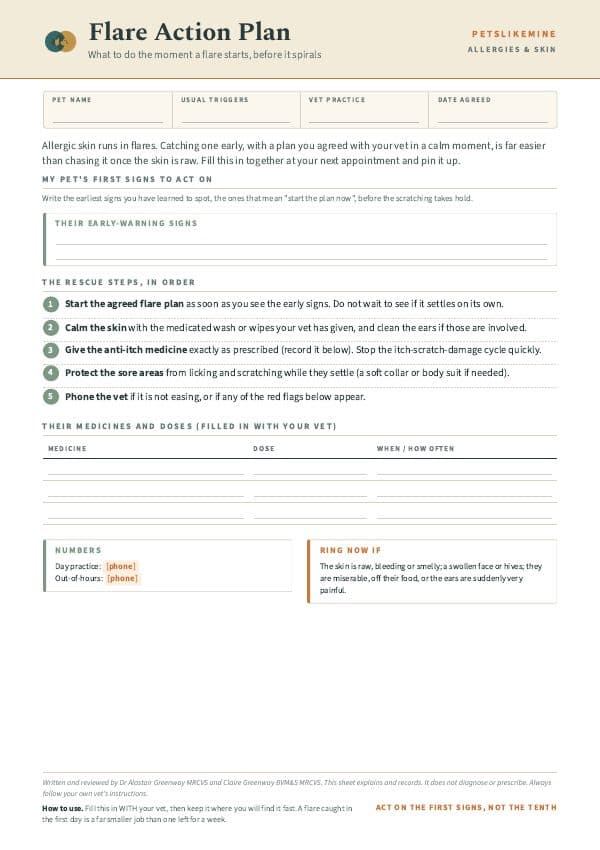
A flare left to run drives the itch-scratch-infect cycle straight into secondary infection and hot spots, which is far harder to claw back than nipping it in the bud. So a rising itch score, new redness in an ear, or a hot spot just starting are your cue to step up the agreed plan, not to wait and see. Every atopic pet should have a written, rehearsed step-up plan worked out with their vet in advance, so a flare meets a prepared response rather than a 9pm panic. Building and running that plan, including knowing when a flare needs the vet that day, is owned by managing allergy flares; having one is non-negotiable. One safety line worth holding onto whatever your plan says: sudden facial or muzzle swelling, hives spreading fast, or any difficulty breathing is not a flare to manage at home but a same-day, sometimes same-hour, emergency.
The long game, and a note for cats
If your pet seems to live in permanent rescue mode, raise immunotherapy with your vet. Allergen-specific immunotherapy is the only treatment that changes the underlying disease rather than just muting it, with roughly two thirds of dogs improving; it is slow to judge (months, often up to a year) and a long commitment, but it can reduce or remove the need for daily drugs (Olivry et al., 2015). It is the strategic option above all for young or year-round patients, and the full picture is in immunotherapy for pet allergies.
One important difference for cat owners: the fast itch-stoppers above are canine. Oclacitinib and lokivetmab are licensed in dogs, not cats (Zoetis UK Apoquel SPC, 2026; Zoetis UK Cytopoint SPC, 2025). In cats the best-evidenced and licensed options are glucocorticoids and ciclosporin (Atopica, which is licensed for cats) (Mueller et al., 2021; Elanco Atopica). The fuller feline story, which presents quite differently, is in feline atopic syndrome.
Pull all of this together and the plan is not really about any one drug. It is two phases on a steady foundation, the smallest dose that keeps your pet comfortable, and a tracked number that tells you the truth. Start the Skin & Itch Tracker today, even in the middle of a flare: the baseline you log now is what will show you, in a month, that the line is finally holding.
References
- Olivry T, DeBoer DJ, Favrot C, Jackson HA, Mueller RS, Nuttall T, Prélaud P; International Committee on Allergic Diseases of Animals (ICADA). Treatment of canine atopic dermatitis: 2015 updated guidelines from the International Committee on Allergic Diseases of Animals (ICADA). BMC Vet Res. 2015;11:210. Supports: the acute-flare vs chronic-disease two-phase structure; multimodal/individualised/lifelong-control framing and no cure; identify-and-treat flare factors (infection, fleas, food) first; oral prednisolone 0.5 to 1.0 mg/kg/day and topical glucocorticoid for flares; oclacitinib dosing principle; ciclosporin 5 mg/kg until control then taper; ASIT as disease-modifier; proactive topical steroid delays relapse; bathing/topical fair evidence and "frequency of bathing may be the most important factor"; essential fatty acids limited and slow, not monotherapy; antihistamines modest/preventive; oral-glucocorticoid-with-oclacitinib likely contraindicated. Verified: YES, full text read via PMC (PMC4537558); open access. Exact phrasings captured. URL: (DOI ) Confidence: HIGH.
- Cosgrove SB, Wren JA, Cleaver DM, Martin DD, Walsh KF, Parker JN, et al. A blinded, randomized, placebo-controlled trial of the efficacy and safety of the Janus kinase inhibitor oclacitinib (Apoquel) in client-owned dogs with atopic dermatitis. Vet Dermatol. 2013;24(6):587-597, e141-2. Supports: oclacitinib is a JAK inhibitor with rapid, effective control of pruritus and skin lesions in atopic dogs; onset within hours to a day; safety profile. Verified: PARTIAL. Citation (authors, journal, 2013;24(6):587-597) confirmed via the journal listing and multiple cross-references; full text is paywalled (Wiley returned HTTP 402) and the PMID I first tried was wrong, so I did not read the article body directly. The companion open paper below carries the hard efficacy numbers, so the article should attach quantitative claims to Cosgrove 2013b only qualitatively (rapid, effective) and cite the allergic-dermatitis paper for figures. URL: Confidence: MEDIUM (citation HIGH; internal figures not personally verified)
- Cosgrove SB, Wren JA, Cleaver DM, Walsh KF, Follis SI, King VL, et al. Efficacy and safety of oclacitinib for the control of pruritus and associated skin lesions in dogs with canine allergic dermatitis. Vet Dermatol. 2013;24(5):479-e114. Supports: the quantitative speed/efficacy of oclacitinib (owner-assessed pruritus VAS fell ~4.9 cm on oclacitinib vs ~1.9 cm on placebo; rapid onset). Verified: PARTIAL. Citation (2013;24(5):479-e114) and the headline VAS figures confirmed via journal listing and secondary summaries; full text paywalled. Numbers are corroborated across sources but not read in the primary PDF. URL: Confidence: MEDIUM-HIGH.
- Gadeyne C, Little P, King VL, Edwards N, Davis K, Stegemann MR. Efficacy of oclacitinib (Apoquel) compared with prednisolone for the control of pruritus and clinical signs associated with allergic dermatitis in client-owned dogs in Australia. Vet Dermatol. 2014;25(6):512-e86. Supports: oclacitinib's rapid onset (meaningful pruritus reduction within hours of dosing) and efficacy comparable to prednisolone. Verified: PARTIAL. Citation and headline finding confirmed via journal listing and multiple secondary sources; full text paywalled. URL: Confidence: MEDIUM-HIGH.
- Apoquel 3.6 mg / 5.4 mg / 16 mg film-coated tablets for dogs — Summary of Product Characteristics. Marketing authorisation holder: Zoetis UK Limited. Vm 42058/5006. Revised May 2026 (AN: 00026/2026). UK Veterinary Medicines Directorate Product Information Database. Supports: oclacitinib licensed in dogs only; indication wording ("Treatment of pruritus associated with allergic dermatitis in dogs" / "Treatment of clinical manifestations of atopic dermatitis in dogs"); dose 0.4 to 0.6 mg/kg twice daily up to 14 days then once daily; not under 12 months or 3 kg; contraindicated with immune suppression (eg hyperadrenocorticism) or progressive malignant neoplasia; precaution to investigate and treat underlying causes (flea allergy, contact, food) and complicating bacterial/fungal/parasitic infection; monitoring on long-term use. Verified: YES, full 7-page official SPC PDF read directly (VMD). URL: Confidence: HIGH.
- Zenrelia (ilunocitinib) 4.8 mg and 15 mg film-coated tablets for dogs — UK Summary of Product Characteristics. Marketing authorisation holder: Elanco. UK Veterinary Medicines Directorate Product Information Database; issued August 2025. Supports: ilunocitinib is a JAK inhibitor licensed in dogs only; once-daily dosing (0.6 to 0.8 mg/kg) from the start with no twice-daily loading fortnight; indications "treatment of pruritus associated with allergic dermatitis in dogs" and "treatment of clinical manifestations of atopic dermatitis in dogs"; same class cautions as oclacitinib (contraindicated with immune suppression or progressive malignant neoplasia; not recommended under 12 months; blood-count monitoring on long-term use).
- Michels GM, Ramsey DS, Walsh KF, Martinon OM, Mahabir SP, Hoevers JD, et al. A blinded, randomized, placebo-controlled, dose determination trial of lokivetmab (ZTS-00103289), a caninized, anti-canine IL-31 monoclonal antibody in client-owned dogs with atopic dermatitis. Vet Dermatol. 2016;27(6):478-e129. Supports: lokivetmab is a caninised anti-canine-IL-31 monoclonal antibody; a single subcutaneous dose reduces pruritus and lesions; effect at the effective dose lasts several weeks (supports ~monthly dosing). Verified: YES, citation and design/onset/duration confirmed via PubMed and the abstract. URL: Confidence: HIGH (citation/design); MEDIUM on exact per-dose percentages (abstract gave directions, not all figures)
- Moyaert H, Van Brussel L, Borowski S, Escalada M, Mahabir SP, Walters RR, Stegemann MR. A blinded, randomized clinical trial evaluating the efficacy and safety of lokivetmab compared to ciclosporin in client-owned dogs with atopic dermatitis. Vet Dermatol. 2017;28(6):593-e145. Supports: lokivetmab given roughly monthly, fast onset, good safety; broadly comparable pruritus control to ciclosporin over three months (lokivetmab was non-inferior on pruritus, ~52% vs ~44% reduction at day 28 in the sibling brief's reading). Verified: YES, citation and design confirmed via Wiley listing and PubMed; specific percentage cross-checked against sibling `itch-treatments-compared` brief (consistent). Full text paywalled. URL: Confidence: HIGH (citation/design); MEDIUM on the exact percentage.
- Cytopoint solution for injection for dogs — UK product information / SPC. Marketing authorisation holder: Zoetis. UK VMD / EU register (lokivetmab). Supports: lokivetmab licensed in dogs only; indication "treatment of clinical manifestations of atopic dermatitis in dogs"; subcutaneous; not under 3 kg; presentations 10/20/30/40 mg per 1 ml vial. Verified: YES (content), via the VMD QRD document and the EU Commission register PDF for Cytopoint (lokivetmab). Note: a clean single canonical UK SPC URL should be reconfirmed at final citation pass; the indication and dog-only licence are unambiguous across both regulator documents. URL: (EU annex) and VMD QRD Confidence: HIGH on the licensed-species and indication claims; MEDIUM on which exact URL to print.
- Steffan J, Favrot C, Mueller R. A systematic review and meta-analysis of the efficacy and safety of cyclosporin for the treatment of atopic dermatitis in dogs. Vet Dermatol. 2006;17(1):3-16. Supports: ciclosporin efficacy comparable to systemic glucocorticoid; lesion scores improved ~30 to 52% (4 wk), 53 to 84% (6 wk); ~4 to 6 weeks to effect; GI signs the commonest adverse effect (~45%); suitable for long-term steroid-sparing maintenance. Verified: YES, citation and figures confirmed via PubMed and corroborating sources. URL: Confidence: HIGH.
- Atopica oral solution / soft capsules for dogs and cats — UK product information (NOAH Compendium / VMD). Marketing authorisation holder: Elanco. Active substance ciclosporin 100 mg/ml. Supports: ciclosporin (Atopica) licensed in both dogs and cats in the UK (cats: symptomatic treatment of chronic allergic dermatitis; dogs: chronic manifestations of atopic dermatitis); >2 kg. Verified: YES (content), via NOAH/VMD listings and the VMD SPC entry; this is the load-bearing point that ciclosporin, unlike Apoquel/Cytopoint, covers cats. URL: Confidence: HIGH.
- Lourenço-Martins AM, et al. Efficacy of proactive long-term maintenance therapy of canine atopic dermatitis with 0.0584% hydrocortisone aceponate spray: a double-blind placebo controlled pilot study. Vet Dermatol. 2016;27(2):88-e25. Supports: proactive twice-weekly hydrocortisone aceponate to previously affected sites delays relapse (median time to relapse 115 days vs 33 days on placebo; P < 0.0001); well tolerated. Underpins the "treat residual disease proactively, use less drug" maintenance message. Verified: YES, design and the 115-vs-33-day figures confirmed via the Wiley listing and corroborating summaries. URL: Confidence: HIGH (note: pilot study, so describe as a well-tolerated proactive strategy with supportive evidence, not as definitive)
- Gortel K. An embarrassment of riches: an update on the symptomatic treatment of canine atopic dermatitis. Can Vet J. 2018;59(9):1013-1016. Supports: plain-language "successfully managed, yet rarely cured"; oclacitinib onset comparable to oral glucocorticoid and lokivetmab very rapid, ciclosporin markedly slower; treatment is always part of a multimodal approach including infection prevention, allergen avoidance, barrier care and ASIT; "I do not expect to find it the first time, every time" (individualisation). Verified: YES, full text read via PMC (PMC6091120); open access. URL: Confidence: HIGH.
- Mueller RS, Nuttall T, Prost C, Schulz B, Bizikova P. Treatment of the feline atopic syndrome — a systematic review. Vet Dermatol. 2021;32(1):43-e8. Supports: in cats, good evidence for systemic glucocorticoids and ciclosporin for allergic skin disease; ASIT should be offered where feasible; evidence limited for several other options; underpins the feline paragraph and the fact that the canine-only biologics are not the feline answer. Verified: YES, citation (32:43-e8) and conclusions confirmed via PubMed and the journal listing; an author PDF is also openly posted. URL: Confidence: HIGH.
- Hill PB, Lau P, Rybníček J. Development of an owner-assessed scale to measure the severity of pruritus in dogs. Vet Dermatol. 2007;18(5):301-308. AND Rybníček J, Lau-Gillard PJ, Harvey R, Hill PB. Further validation of a pruritus severity scale for use in dogs. Vet Dermatol. 2009;20(2):115-122. Supports: the validated owner pruritus Visual Analog Scale that justifies framing the goal as a tracked itch score and the "comfortable not zero" target; underpins the tracker (`/tools/itch-check`) loop. Verified: YES, both citations confirmed via PubMed/journal listings and 19392772 respectively). Detailed scale design owned by `checking-your-pets-skin-at-home`; cite lightly here. URL: and Confidence: HIGH.
- Hillier A, Lloyd DH, Weese JS, Blondeau JM, Boothe D, Breitschwerdt E, et al. Guidelines for the diagnosis and antimicrobial therapy of canine superficial bacterial folliculitis (Antimicrobial Guidelines Working Group of the International Society for Companion Animal Infectious Diseases). Vet Dermatol. 2014;25(3):163-e43. Supports: the one-sentence handoff that secondary bacterial pyoderma (S. pseudintermedius) is cytology-diagnosed and topical-first, and is a common reason an atopy plan looks like it failed. Detail owned by `skin-and-ear-infections` / `treating-skin-infections`. Verified: PARTIAL. Citation widely corroborated and used by the sibling infection briefs; I did not open the primary PDF in this session (paywalled). Use only for the light handoff sentence, not for any specific number. URL: Confidence: MEDIUM (citation HIGH; not personally re-read here) ---.
Free downloads
Companion worksheets to put what you've read into practice. Free PDFs, print at home.
Keep track of how your pet is doing
The owners who cope best are the ones who notice changes early. A simple health log shows you what is working, and what is not, before the next vet visit.
Start tracking, freeYou're not doing this alone
Compare treatment journeys and talk to owners managing allergies & skin. Free to join.
Join PetsLikeMine