

Riding out a flare: a plan that stops the itch spiralling
Alastair Greenway
BVM&S MRCVS
The skin has been settled for weeks, the itch quiet, and then one evening the scratching starts up again. A paw licked too long, a back leg working at an ear, and by morning a patch of pink skin where there was none. That is a flare, and the single most useful thing you can do about it is decide, in advance and in writing, exactly what you will do when it starts. A panicking owner at nine on a Friday night does not invent good dermatology. A rehearsed plan does.
A flare is expected, not a failure
A flare does not mean you have done something wrong, or that the treatment has stopped working. Atopic dermatitis is a relapsing disease by nature: even well-controlled pets flare, and the realistic goal is to make each one shorter and softer, not to feel you have lost control every time (Olivry et al., 2015). The international consensus guidelines for canine atopic dermatitis are built around three jobs, and managing the acute flare is one of them, distinct from day-to-day maintenance and from preventing the next relapse (Olivry et al., 2015). A flare, then, is a known and plannable event, and that reassurance is grounded in fact rather than bedside manner. What you cannot do is ride it out passively, because an itch left alone rarely stays a simple itch.
Why catching it early is the whole game
The itch-scratch cycle is a genuine feedback loop, not a figure of speech. Scratching damages the skin surface and disrupts the normal microbial balance living on it, letting opportunistic bacteria and yeast overgrow, and those microbes are themselves intensely itchy, so they drive more scratching, more damage, more overgrowth (Santoro et al., 2015; Olivry et al., 2015). Secondary infections, usually the bacterium Staphylococcus pseudintermedius or the yeast Malassezia, are among the commonest reasons an atopic flare takes off, and a Malassezia overgrowth in particular is one of the most ferociously pruritic complications there is (Olivry et al., 2015; Bond et al., 2020). What this means in practice: catch it while it is still just itch, before it becomes itch-plus-infection that needs more drugs and more weeks to clear.
Spotting the first signs: watch the number, not the wound
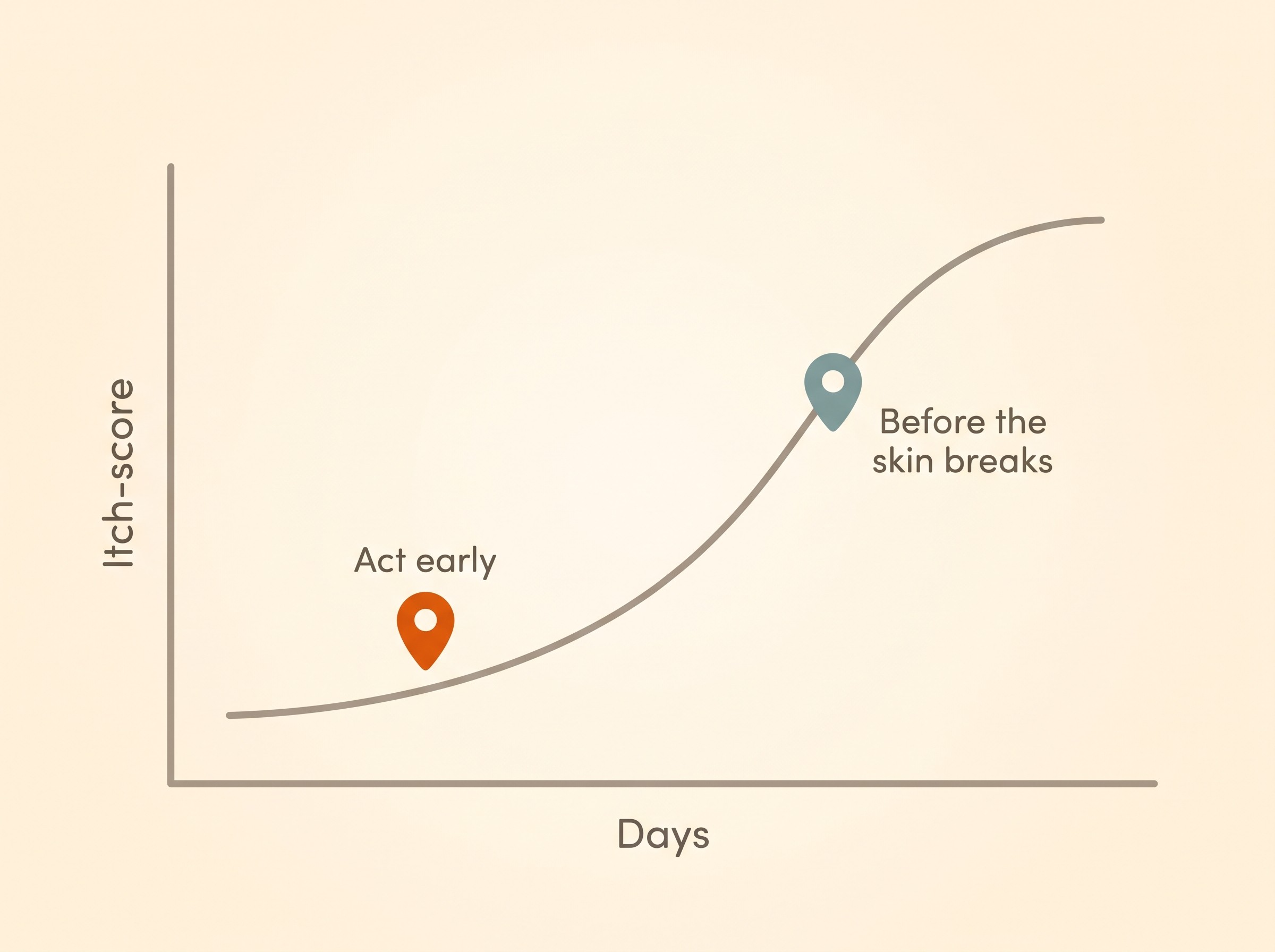
A flare announces itself days before there is a weeping sore: a creeping increase in scratching, more licking (paws especially), more head-shaking or ear-rubbing, perhaps a single patch of pink skin. The trouble is that "she seems a bit itchier" is easy to talk yourself out of, which is exactly why a number beats an impression. A validated owner-assessed pruritus scale exists, and it works: owners can reliably score their pet's itch on a 0 to 10 scale, with a normal range of roughly 0 to 1.9 (Hill et al., 2007; Rybnicek et al., 2009). That makes a 3 climbing to a 6 visible and actionable while the skin is still intact. This is the load-bearing reason to use the Skin & Itch Tracker: it turns a fuzzy worry into a number that crosses an agreed line and triggers the plan. (How to perform the home skin check and what to photograph is owned by checking your pet's skin at home.)
The step-up plan, agreed with your vet in advance
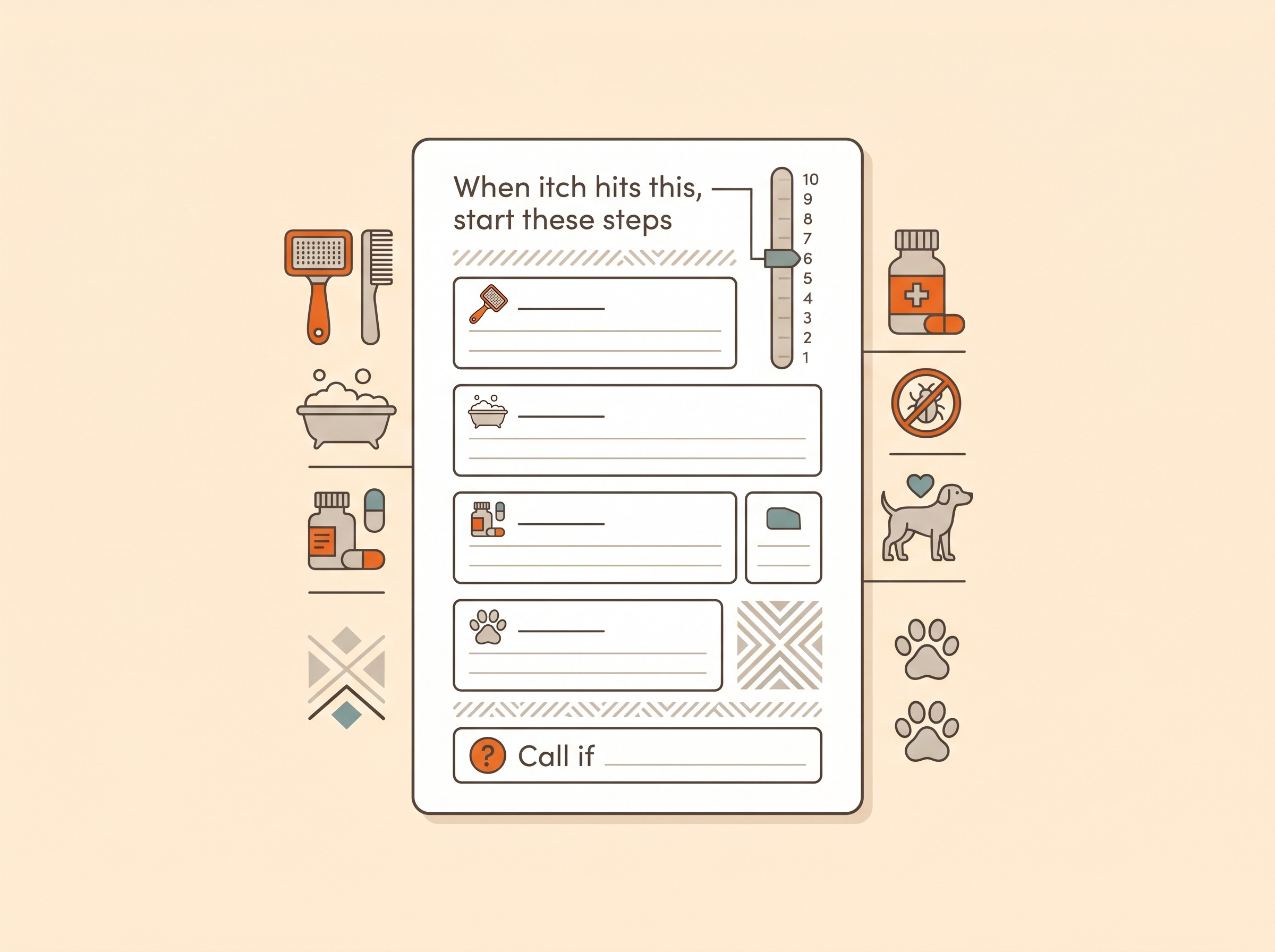
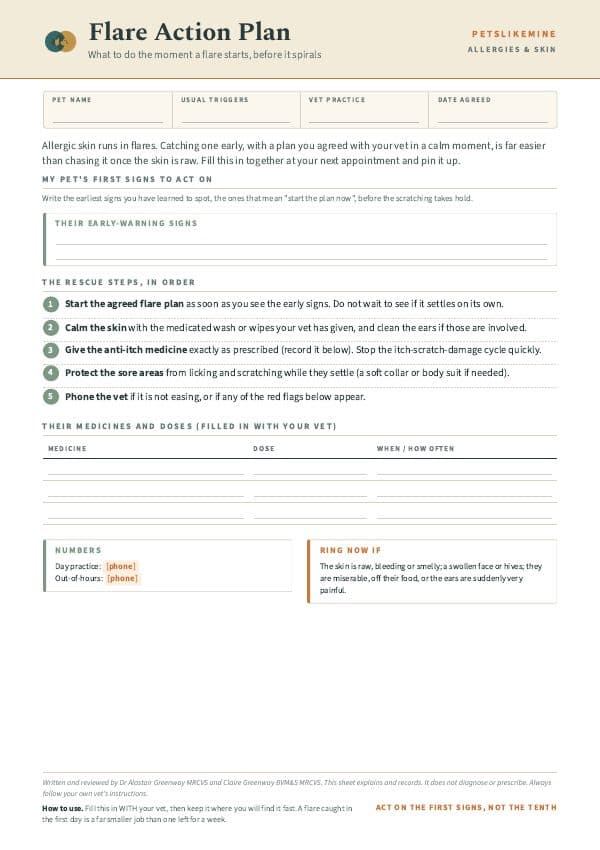
This is the heart of it. Your pet's normal maintenance routine is the floor: the standing baseline of bathing, skin-barrier care and omega-3s that sits underneath everything, owned in full by living with an atopic pet. The flare plan is the extra steps you layer on top when the itch score crosses the line, and writing it down in advance is what makes it happen early. A typical plan, built with your vet, says: when the score reaches the agreed number, start or intensify bathing, begin the rescue itch relief your vet has provided, attend to the ears if they are starting, and know the point at which to phone the practice. The printable flare action plan is the fill-in artefact for exactly this: a "when the score hits X, do Y, and call if you see Z" sheet you complete with your vet and put on the fridge.
Bathing is your front-line lever, and it is free
Before any drug, the most underrated tool in a flare is the bath. Bathing frequency and contact time are among the most useful levers you have, they cost nothing, and emollient or antiseptic shampoos give a modest but real reduction in lesions and itch (Olivry et al., 2015). In a flare you intensify temporarily: more frequent baths, with the shampoo left in contact for the time the bottle states, then peel back once things calm. It washes off allergens and surface microbes while it soothes.
Rescue itch relief, named plainly
The fast, evidence-backed ways to break a flare are a short course of a topical and/or oral glucocorticoid, or oclacitinib (Apoquel) (Olivry et al., 2015). Oclacitinib is a JAK inhibitor licensed in dogs from twelve months, given at 0.4 to 0.6 mg/kg twice daily for up to fourteen days then once daily (Apoquel UK datasheet, NOAH). Ilunocitinib (Zenrelia) is a newer JAK inhibitor in the same family, also licensed in dogs only and given as a single once-daily tablet from the start (Zenrelia UK SPC, 2025). A topical hydrocortisone aceponate spray (Cortavance) is effective for a single localised patch (Olivry et al., 2015). Lokivetmab (Cytopoint) is an injectable anti-IL-31 monoclonal antibody, licensed in dogs only and given by your vet, which makes it a control and prevention tool rather than a same-evening rescue (Olivry et al., 2015; Cytopoint UK/EMA datasheet).
Which rescue belongs in your pet's plan is a decision made with your vet, because some are given by you at home and some are not, and none is a cure (the doses above are for accuracy, not an instruction to self-dose). Whatever the rescue, the shape is "step up, then step down": you add layers to break the flare, then peel them back to the maintenance floor once the skin is calm, not ratchet medication permanently upward. The full comparison, on speed, cost and what each treats, is owned by itch treatments compared, and the wider toolkit this plan slots into is set out in the atopic dermatitis treatment guide.
Be straight about antihistamines and "natural" rescues
Owners reach for antihistamines in a flare, so let me say it plainly: they are poor at breaking an established flare in a significantly itchy pet. The consensus review found insufficient evidence to recommend oral antihistamines for an acute flare, noting they are best given before a flare to pre-empt it rather than to rescue one underway (Olivry et al., 2015). The same caution applies to most "natural" flare remedies: better to know it now than lose two miserable days on something that will not touch a real flare.
When a flare will not settle, look underneath
If a flare is not improving on itch relief and bathing, the usual reason is not a failed drug but an unaddressed secondary infection: apparent treatment failure is very frequently an untreated Staphylococcus or Malassezia overgrowth (Olivry et al., 2015). So a flare that will not settle, that smells, that has pustules or crusts, or that shows greasy, darkened skin, needs your vet to look rather than you escalating the anti-itch. A swab under the microscope tells them whether it is bacteria or yeast. What those infections are and how they are treated is owned by skin and ear infections and treating skin infections, and recurrent ear trouble by recurrent ear infections.
Manage at home tonight, or ring now?
Most flares are miserable but safe to start managing at home. A few things are not, and mean same-day or same-hour veterinary attention instead: facial or muzzle swelling, hives, vomiting or collapse (an acute allergic reaction, a different beast from a chronic itch flare), a hot, rapidly spreading, painful patch, or an ear suddenly severely painful with a head tilt or loss of balance. If you see any of these, skip the plan and ring. These red flags are owned in full by pet skin emergencies. And one common escalation, a flare erupting overnight into a hot, weeping sore, is a hot spot, covered by hot spots in pets.
After the flare: review it, then log it
A flare is a data point, wasted if you simply feel relieved and move on. The post-flare job is to ask what stacked up to tip your pet over: a missed flea dose, the start of pollen season, a new bed or walk, a secondary infection, or a dietary slip in a food-allergic pet. Identifying and avoiding those flare factors is, in the guidelines' own framing, the cornerstone of long-term management (Olivry et al., 2015). This is the itch threshold in action, the way several small triggers sum to push a pet over the edge, explained in full by the itch threshold. If a food slip is a suspect, the Elimination-Diet Companion helps you check whether the diet really held.
This is where tracking earns its keep a second time. Log the flare in the Skin & Itch Tracker: when it started, how high the score climbed, the likely trigger, and what helped. Over a few flares your pet's own pattern emerges, the next one is caught sooner, and you can see whether maintenance needs a tweak so the one after is smaller, or later, or does not come at all.
If you keep firefighting, change the game
Now for the part most competitor pages skip. If your pet keeps flaring, especially in the same spots, there is a strong case for moving from reaction to prevention. Two things are shown to genuinely prevent or delay the recurrence of flares: allergen-specific immunotherapy, and proactive intermittent topical glucocorticoid (Olivry et al., 2015). The evidence for the second is striking. Applying a hydrocortisone aceponate spray to previously-affected sites on two consecutive days each week lowered the risk of a flare by roughly three and a half times compared with placebo, and stretched the median time to relapse from around a month to nearly four, without visible thinning of the skin (Lourenco et al., 2016; Olivry et al., 2015). So a pet who flares in the same place again and again is a candidate to discuss proactive topical therapy with the vet. Immunotherapy, the disease-modifying option that can change the underlying tendency to react, is covered in immunotherapy for pet allergies.
A note for cat owners
Cats flare too, and the same logic holds: catch the rising itch early (in cats that often means overgrooming, a rash of tiny crusty bumps, or scratching around the head and neck), hunt the trigger, and treat any infection underneath. One difference belongs in a cat's plan: lokivetmab (Cytopoint) is licensed in dogs only, and oclacitinib (Apoquel) is not licensed in cats, so a cat's rescue leans instead on glucocorticoids and ciclosporin and is necessarily vet-led (Olivry et al., 2015; Cytopoint UK/EMA datasheet). Please never give a cat the dog's medication. How allergy looks and is treated in cats, including the overgrooming-versus-behaviour question, is owned by feline atopic syndrome.
References
- Olivry T, DeBoer DJ, Favrot C, Jackson HA, Mueller RS, Nuttall T, Prelaud P; for the International Committee on Allergic Diseases of Animals (ICADA). Treatment of canine atopic dermatitis: 2015 updated guidelines from the International Committee on Allergic Diseases of Animals (ICADA). BMC Veterinary Research. 2015;11:210.
- Lourenco AM, Schmidt V, Sao Braz B, Nobrega D, Nunes T, Duarte-Correia JH, et al. Efficacy of proactive long-term maintenance therapy of canine atopic dermatitis with 0.0584% hydrocortisone aceponate spray: a double-blind placebo controlled pilot study. Veterinary Dermatology. 2016;27(2):88-e25.
- Hill PB, Lau P, Rybnicek J. Development of an owner-assessed scale to measure the severity of pruritus in dogs. Veterinary Dermatology. 2007;18(5):301-308.
- Rybnicek J, Lau-Gillard PJ, Harvey R, Hill PB. Further validation of a pruritus severity scale for use in dogs. Veterinary Dermatology. 2009;20(2):115-122.
- Bond R, Morris DO, Guillot J, Bensignor EJ, Robson D, Mason KV, Kano R, Hill PB. Biology, diagnosis and treatment of Malassezia dermatitis in dogs and cats: Clinical Consensus Guidelines of the World Association for Veterinary Dermatology. Veterinary Dermatology. 2020;31(1):27-e4.
- Santoro D, Marsella R, Pucheu-Haston CM, Eisenschenk MNC, Nuttall T, Bizikova P. Review: Pathogenesis of canine atopic dermatitis: skin barrier and host-micro-organism interaction. Veterinary Dermatology. 2015;26(2):84-e25.
- Apoquel (oclacitinib maleate) film-coated tablets for dogs. Summary of Product Characteristics / NOAH Compendium datasheet (GB). National Office of Animal Health / UK Veterinary Medicines Directorate.
- Zenrelia (ilunocitinib) film-coated tablets for dogs — UK Summary of Product Characteristics. Veterinary Medicines Directorate Product Information Database; issued August 2025. Supports: ilunocitinib is a JAK inhibitor licensed in dogs only, given as a single once-daily tablet from the start.
- Cytopoint (lokivetmab) solution for injection for dogs. EMA product information / UK datasheet. Zoetis.
Free downloads
Companion worksheets to put what you've read into practice. Free PDFs, print at home.
Keep track of how your pet is doing
The owners who cope best are the ones who notice changes early. A simple health log shows you what is working, and what is not, before the next vet visit.
Start tracking, freeYou're not doing this alone
Compare treatment journeys and talk to owners managing allergies & skin. Free to join.
Join PetsLikeMine