

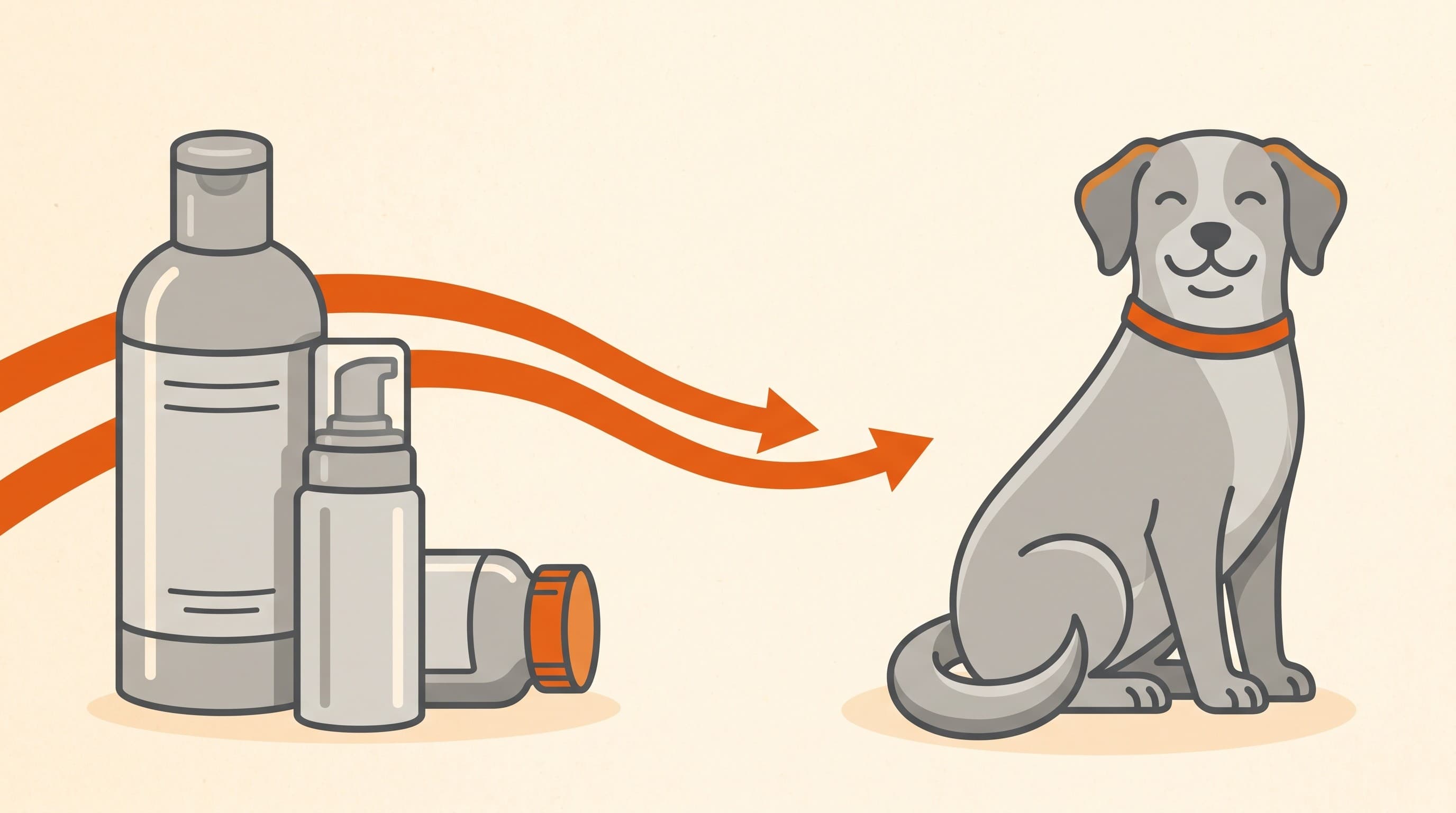
Treating the infection and finding the cause: why antibiotics alone are not the answer
Alastair Greenway
BVM&S MRCVS
A course of antibiotic tablets is the classic fix for a flared, smelly, itchy patch of skin or ear, and a fortnight later the problem is gone. So when it returns, and it does return, the natural move is to ask for the same tablets that worked last time. It is a completely reasonable request, and also, for the commonest skin and ear infections, often not the best treatment and sometimes not needed at all.
This article is about what good treatment looks like, and why. It is not a guide to medicating your pet yourself: most of the drugs that matter are not yours to dose, and an undiagnosed infection should not be home-treated. Think of it as the briefing for a much better conversation with your vet. For the groundwork (what these infections are, and why they are almost always a symptom of something else) start with skin and ear infections explained; this article picks up from "right, how do we treat it".
Tablets treat the bug, not the cause
An oral antibiotic clears bacteria, and that is why the tablets seem to work. The problem is what they do not do. The infection on your pet's skin is almost never the original fault: it is overgrowing on skin that something else has already disturbed. The 2025 international guideline on canine pyoderma is about as blunt as veterinary medicine gets: "Pyoderma is always secondary to underlying primary causes, and these must be considered at the first occurrence" (Loeffler et al., 2025). Clear the bug and leave the cause untouched, and it comes straight back.
There is a wider cost too: every avoidable course of antibiotics for an infection that was always going to recur helps bacteria learn to resist, which is the worry that prompted these guidelines in the first place (Hillier et al., 2014). This does not make antibiotics the enemy. The right position is to use them only when they are the right tool, chosen well, and never as a substitute for finding the cause.
Medicated washes can clear many infections without a single tablet
For the commonest infections your pet may not need tablets at all, which surprises a lot of owners. For surface and superficial bacterial infections, the guideline grades topical antimicrobial therapy used on its own at its highest strength: "Topical antimicrobial therapy as the sole antibacterial treatment is the treatment-of-choice for canine superficial bacterial folliculitis (SOR A)", and the same for surface pyoderma (Loeffler et al., 2025).
Across the published trials topical therapy worked in the large majority, with the clearest evidence for 2 to 4% chlorhexidine (Loeffler et al., 2025). One study pitted a chlorhexidine protocol head to head against an oral antibiotic: a 4% chlorhexidine digluconate shampoo twice weekly plus a leave-on solution once daily for four weeks "resulted in resolution of clinical signs in all dogs", and the authors concluded "topical therapy with chlorhexidine digluconate products may be as effective as systemic therapy with amoxicillin-clavulanic acid" (Borio et al., 2015).
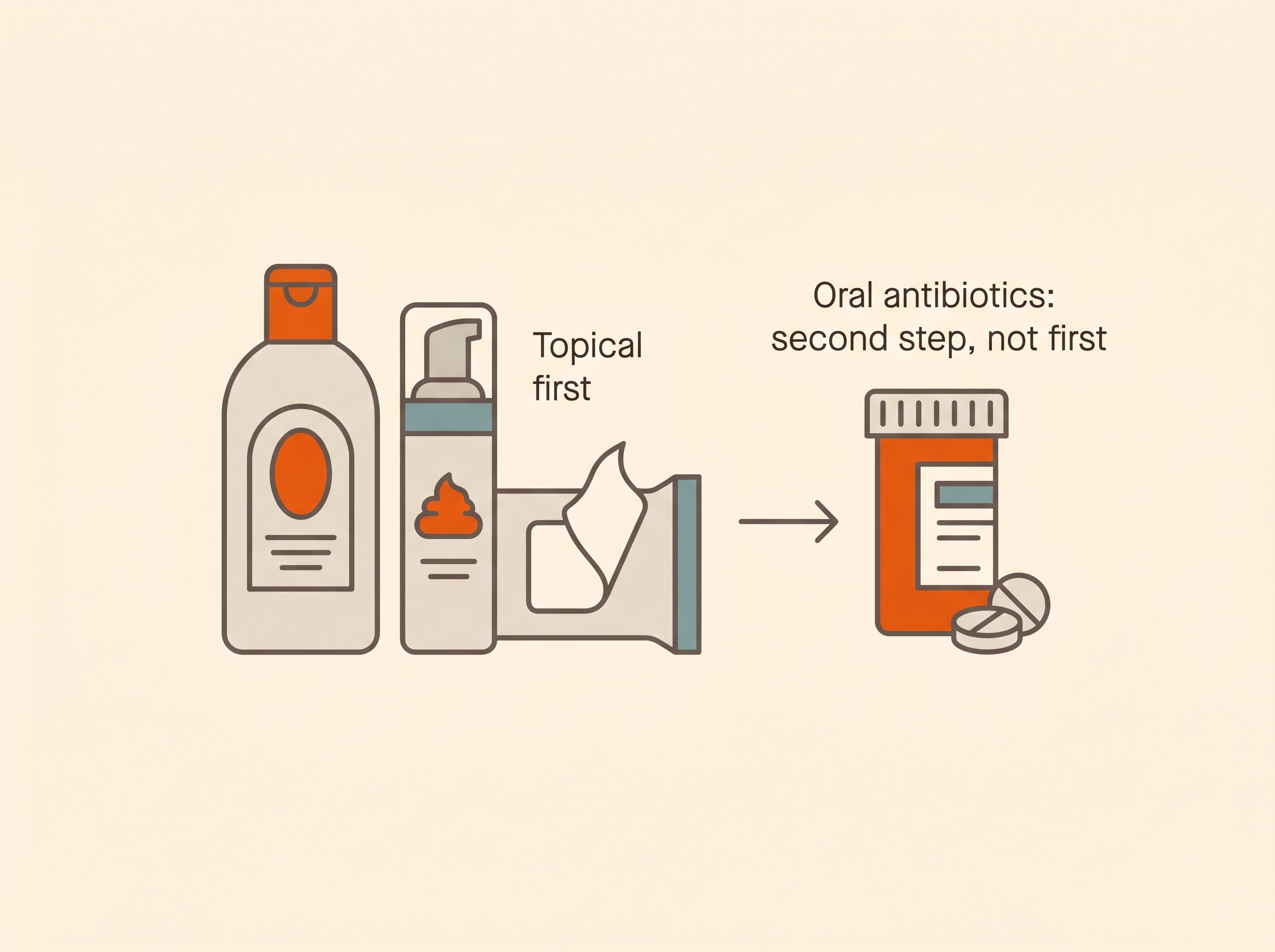
The workhorse is chlorhexidine, an antiseptic, and that word matters: antiseptics are not subject to the same resistance problem as antibiotics, so they do not erode with use the way the tablets do. The detail that makes or breaks a medicated wash is contact time: chlorhexidine needs roughly five to ten minutes on the skin before you rinse, because the contact is what does the work, and a quick once-over with an immediate rinse is the commonest reason one disappoints (Today's Veterinary Practice). The guideline adds a point inside the topical choice: antiseptics should be preferred over topical antibiotics such as fusidic acid or mupirocin (Loeffler et al., 2025).
The same logic covers the yeast side, because the smell and the grease are often Malassezia rather than bacteria. For yeast overgrowth the best-evidenced treatment is again a wash, a shampoo of 2% miconazole with 2% chlorhexidine twice weekly, with oral antifungals such as ketoconazole or itraconazole kept for refractory or widespread cases rather than the opening move (Bond et al., 2020; Frontiers in Cellular and Infection Microbiology, 2020).
A medicated bath is one of the few things you do, at home, that genuinely treats the disease, which makes it the natural moment to pair the routine with the Skin & Itch Tracker: logging the redness, greasiness, smell and an itch score week by week is how you and your vet see the treatment working and judge whether a recheck is due. (The long-term bathing and barrier routine belongs to living with an atopic pet; here we are treating the active infection.)
When tablets are genuinely justified, and how a good vet chooses them
Systemic treatment, whole-body antibiotics by tablet or injection, is not the villain here: it is a reserve tool. The guideline keeps it for deep infections and for superficial ones that have not responded to topical therapy: systemic antimicrobials should be "reserved for deep pyoderma and for superficial pyoderma when topical therapy is not effective" (Loeffler et al., 2025). So the first question a good vet asks is not "which antibiotic" but "does this need a systemic antibiotic at all".
Before any antimicrobial is used, the vet should look at a stained sample down the microscope: "Cytology should be performed in all cases before antimicrobials are used" (Loeffler et al., 2025). That quick test (covered in skin and ear infections explained) confirms there really is an infection and whether it is bacteria, yeast or both, so antibiotics are not handed out for a problem they will not fix. And when a systemic antibiotic is used, the choice should be guided not guessed: culture and susceptibility testing is recommended whenever systemic therapy is planned, and "always strongly recommended" for deep pyoderma (Loeffler et al., 2025). That is the real answer to "why won't the vet just give me tablets today": choosing blind both risks failure and feeds resistance.
"An antibiotic" is not one thing, either. The first-choice drugs for ordinary, susceptible infections are the narrower, older agents: a first-generation cephalosporin such as cefalexin, amoxicillin-clavulanate, or a potentiated sulphonamide (trimethoprim-sulphonamide) (Loeffler et al., 2025; Today's Veterinary Practice). Plain amoxicillin or penicillin alone is the wrong choice for a neat reason: the usual pyoderma bacterium produces beta-lactamase, an enzyme that destroys plain penicillins, which is why the combination with clavulanic acid, or a cephalosporin, is used (Today's Veterinary Practice).
The reserved tier is the stewardship heart of all this. The big-gun antibiotics, the fluoroquinolones (enrofloxacin, marbofloxacin) and the third-generation cephalosporins (such as cefovecin, the long-acting Convenia injection), are second-line, kept for cases proven by culture to need them (Loeffler et al., 2025). That is not just one guideline's opinion: in Europe these classes are formally categorised by the medicines regulator as "Category B (Restrict)", among the highest-priority critically important antimicrobials for human medicine, to be used in animals only when nothing in a lower category will do, and on susceptibility testing where possible (European Medicines Agency, AMEG categorisation, 2019). Cefovecin (Convenia) makes the point: licensed in dogs and cats and indicated in dogs for skin infections including secondary superficial pyoderma, it is a single injection that works for up to 14 days but can persist in the body for up to 65 days, and once it is in it cannot be taken back out (European Medicines Agency, Convenia SPC). If a vet declines to jump straight to the injection, that is good medicine, not stinginess. Modern practice also treats until the infection clears then rechecks, rather than running open-ended courses, so finish the course your vet sets: stopping early when your pet "looks better" breeds resistance (Loeffler et al., 2025).
The resistance picture, kept clear and not frightening
Meticillin-resistant Staphylococcus pseudintermedius, MRSP, is the resistant version of the usual pyoderma bug, and it emerged and spread internationally from around the mid-2000s (Veterinary Research Communications, 2024). In one national surveillance the share of S. pseudintermedius that was meticillin-resistant rose from under 1% in 2004 to around 7% by 2013 (Duim et al., 2016), and at referral level it turns up in a substantial minority of cases. MRSP is typically resistant to many drugs at once, so it shrinks the list of antibiotics that work and pushes vets towards the very reserved, last-resort drugs we are trying to protect (Loeffler et al., 2025).
Now the reassuring part. MRSP is resistant to antibiotics. It is not resistant to good topical antiseptic therapy: in the same head-to-head trial, the chlorhexidine protocol cleared the infections in every dog "including those infected with MRSP", just as well as in the non-resistant ones (Borio et al., 2015). So topical-first is doubly powerful: it works even when the bug has outsmarted the tablets, and spares the antibiotics that resistance is eroding. (These resistant staph can occasionally pass between pets and people, a further reason responsible use matters, but a reason for care, not alarm: Hillier et al., 2014.)
Treat the cause in parallel, or sign up for a lifetime of repeats
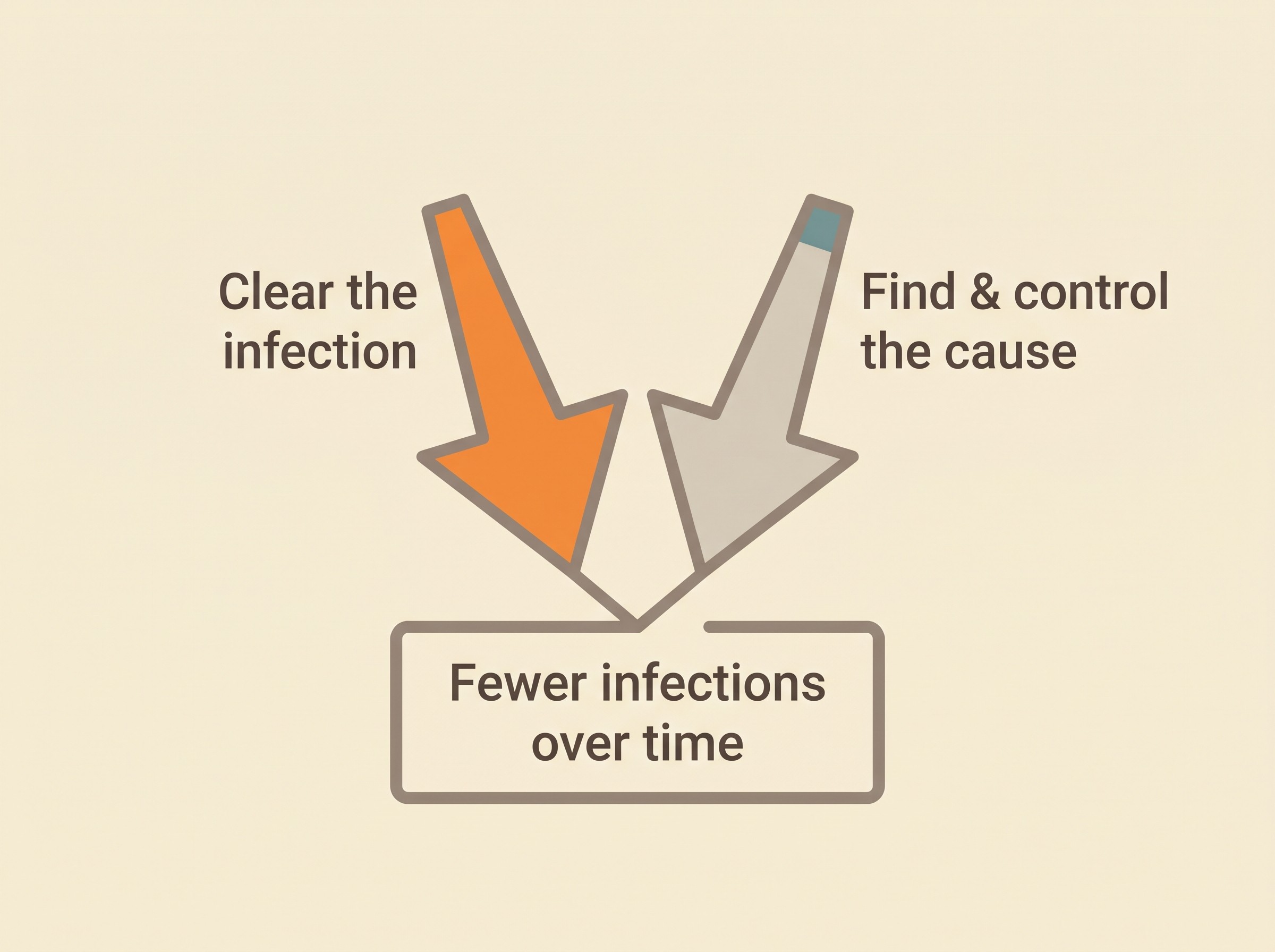
Because the infection is always secondary (Loeffler et al., 2025), clearing the bug and finding the cause are not two jobs you do one after the other; they happen together. The commonest thing underneath is allergic skin disease, atopic dermatitis, flea allergy or food allergy, with parasites, hormonal disease and skin folds behind it (Loeffler et al., 2025). What those causes are, and how the allergy is managed, belong to the siblings: the funnel of possibilities is why is my pet so itchy, and the plan for the commonest culprit is the atopic dermatitis treatment toolkit. Ears are skin, so the same principles apply to the ear canal, but the recurring-otitis story is its own in recurrent ear infections, and the angry overnight patch is hot spots. One safety note: sudden severe ear pain, a head tilt or loss of balance is not a wait-and-see infection, it is a same-day vet trip (is this a skin emergency).
A pet who keeps relapsing is also a classic pointer to an undiagnosed food allergy, so a properly run elimination diet may be part of finding the cause: the Elimination-Diet Companion helps you run one without slipping up, and the mechanics live in the elimination diet. On cats: the evidence above is overwhelmingly canine, so it would be wrong to quote feline efficacy figures, but the principles hold across species, and how allergy presents in cats is handled in feline atopic syndrome.
Treat only the bug and you sign up for a lifetime of recurring infections and escalating antibiotics; control the cause as well, and many pets reach a point where flares are occasional and topical-managed rather than constant. The way you and your vet will know it is working is not a feeling, it is a trend: keep logging the redness, the smell and the itch in the Skin & Itch Tracker, and watch the gaps between flares get longer. That widening gap is the proof that the harder up-front work was worth it, and the whole reason antibiotics alone were never the answer.
References
- Loeffler A, Cain CL, Ferrer L, Nishifuji K, Varjonen K, Papich MG, Guardabassi L, Frosini SM, Barker EN, Weese JS. "Antimicrobial use guidelines for canine pyoderma by the International Society for Companion Animal Infectious Diseases (ISCAID)." Veterinary Dermatology 2025;36(3):234-282.
- Borio S, Colombo S, La Rosa G, De Lucia M, Damborg P, Guardabassi L. "Effectiveness of a combined (4% chlorhexidine digluconate shampoo and solution) protocol in MRS and non-MRS canine superficial pyoderma: a randomized, blinded, antibiotic-controlled study." Veterinary Dermatology 2015;26(5):339-344.
- Hillier A, Lloyd DH, Weese JS, et al. "Guidelines for the diagnosis and antimicrobial therapy of canine superficial bacterial folliculitis (Antimicrobial Guidelines Working Group of the International Society for Companion Animal Infectious Diseases)." Veterinary Dermatology 2014;25(3):163-175.
- Bond R, Morris DO, Guillot J, et al. "Biology, diagnosis and treatment of Malassezia dermatitis in dogs and cats: Clinical Consensus Guidelines of the World Association for Veterinary Dermatology." Veterinary Dermatology 2020;31(1):27-43.
- Frontiers in Cellular and Infection Microbiology. "Malassezia Yeasts in Veterinary Dermatology: An Updated Overview." 2020;10:79.
- European Medicines Agency, Antimicrobial Advice Ad Hoc Expert Group (AMEG). "Categorisation of antibiotics in the European Union: Answer to the request from the European Commission for updating the scientific advice on the impact on public health and animal health of the use of antibiotics in animals." EMA/CVMP/CHMP, 2019 (EMA/688114/2020 publication)
- Today's Veterinary Practice. "Treating Canine Superficial Pyoderma in the Era of Antimicrobial Resistance" (peer-reviewed clinical practice review)
- European Medicines Agency. "Convenia (cefovecin) Summary of Product Characteristics.".
Keep track of how your pet is doing
The owners who cope best are the ones who notice changes early. A simple health log shows you what is working, and what is not, before the next vet visit.
Start tracking, freeYou're not doing this alone
Compare treatment journeys and talk to owners managing allergies & skin. Free to join.
Join PetsLikeMine