


Atopic dermatitis: when your pet is allergic to the world
Alastair Greenway
BVM&S MRCVS
Atopic dermatitis, often just called "allergies" in the consulting room, is one of the most common skin diseases in dogs, and it has a one-line summary worth getting straight before anything else. In plain terms it is an inherited tendency for the immune system to overreact to ordinary, harmless things in the everyday environment: house dust mites, pollens, mould spores, the stuff your pet breathes and walks through every day. The result is itchy, inflamed skin. It is not something you caused, it cannot currently be cured, and it can almost always be controlled well. Let us unpack that. (If you are not yet sure that allergy is the problem and your pet is simply scratching, start one step back, with why is my pet so itchy, which lays out the short list of things itch can be.)
What the diagnosis really means
Formally, canine atopic dermatitis is "a genetically-predisposed inflammatory and pruritic allergic skin disease", most often linked to IgE antibodies against environmental allergens (Halliwell, 2006). Translated for the consulting room: the immune system has learned to treat everyday, harmless things as a threat, and it mounts an allergic, inflammatory response in the skin every time it meets them. The itch ("pruritic") and the redness ("inflammatory") follow from that.
Two things are going wrong at once, and both matter. The first is that over-reactive, allergy-skewed immune response to environmental allergens. The second is a skin barrier that does not work as well as it should, so those allergens get in more easily in the first place (Olivry, 2011; Marsella, 2013). The most up-to-date veterinary definition now adds a third strand, the community of microbes living on the skin, describing atopic dermatitis as an interplay between a faulty skin barrier, allergen sensitisation and a disturbed skin microbe population (Eisenschenk et al., 2024). For an owner, the headline is simpler: an immune system that overreacts and a skin surface that lets too much through. This is the heart of the "allergic to the world" idea.
It is genetically predisposed and multifactorial, and that distinction matters: genes plus environment, not a single cause and certainly not a husbandry failure (Drechsler et al., 2024). Owners often arrive convinced they fed the wrong food or somehow let this happen. They did not. Your pet was born with the tendency, and what you do from here is what shapes how comfortable their life is.
The leaky barrier, and what we do and do not know
The skin's surface works like a brick wall: flat dead cells are the bricks, and a layer of fatty material between them is the mortar that keeps water in and irritants out. In atopic skin, that mortar is measurably abnormal. The fatty layers are disordered, the ceramide content (a key part of the mortar) is reduced and abnormal, some affected dogs make less filaggrin (a protein the barrier relies on), and the skin loses water faster than normal skin does (Olivry, 2011). In plain terms, the mortar is thinner and patchier, so the skin holds water less well and lets allergens through more easily.
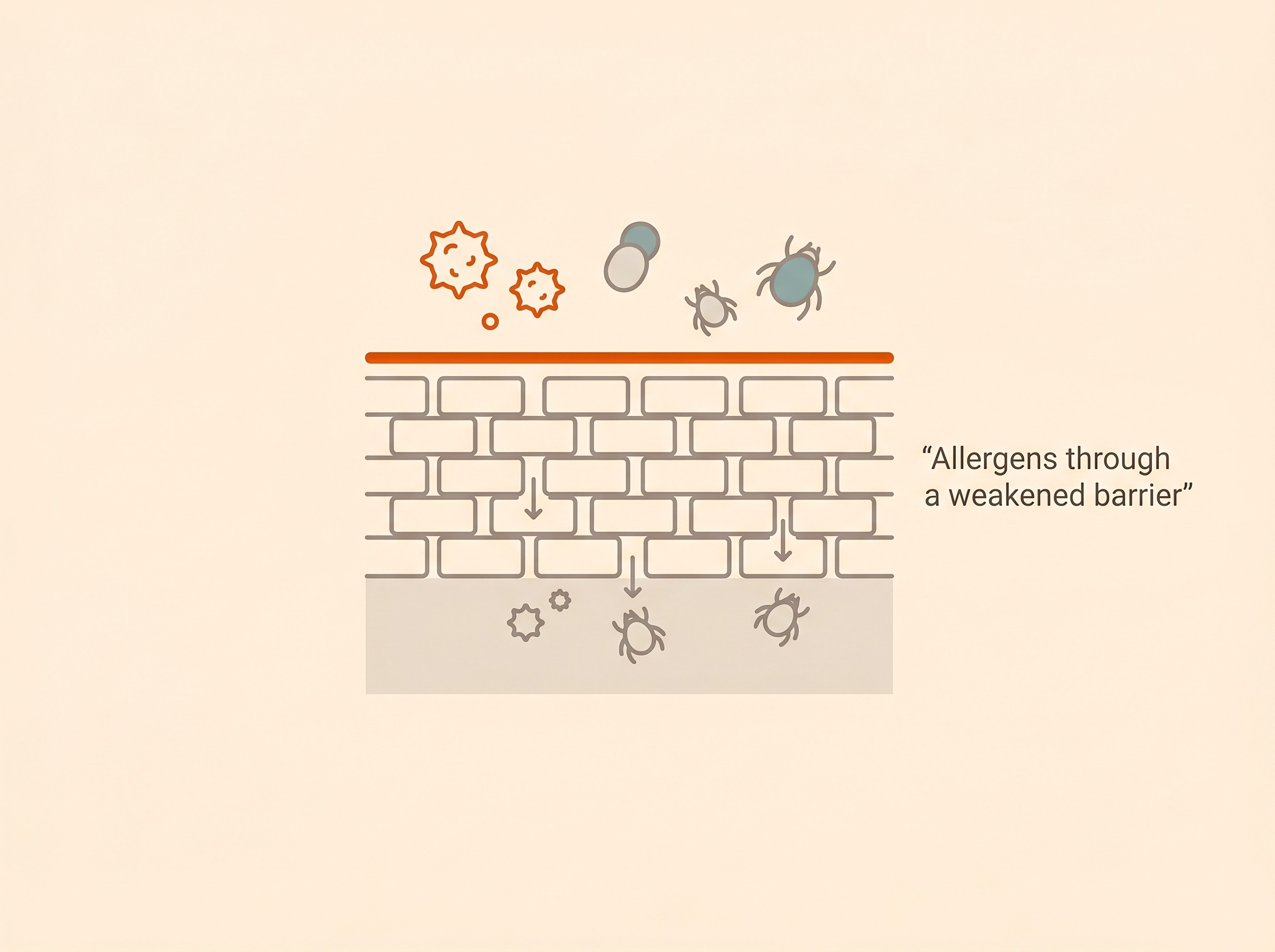
Good information has to be straight with you here, because a lot of what you will read online is not. We genuinely do not yet know whether that barrier defect comes first, as an inherited fault that lets the allergy develop, or whether it is a consequence of the allergic inflammation, or, most likely, both at once (Olivry, 2011). What is clear is that the barrier and the immune system feed off each other, which is exactly why a good plan tackles both: medicine to calm the immune overreaction, and skin care to support the barrier. The day-to-day routine for that (bathing, moisturisers, omega-3s) belongs to a sister article, daily life with an atopic pet, so we will simply flag it here and move on.
One more note, because the marketing is loud: barrier-repair products such as ceramide sprays are biologically plausible and widely sold, but solid proof that any single one actually changes outcomes is still thin (Marsella, 2013). They may help. They are not the cure the packaging implies. Treat them as a reasonable adjunct, not the answer.
Who gets it, and when
Atopic dermatitis is common, somewhere in the region of 3 to 15% of dogs depending on the population and how it is counted (Drechsler et al., 2024). You will often see "around 1 in 10" quoted, which is a fair rough sense of it, but the exact prevalence is not well established (Hillier and Griffin, 2001), so be wary of anyone stating a precise figure as fact.
It usually starts young. Most affected dogs first show signs between about six months and three years of age, and an onset before three years is one of the recognised pointers towards atopy (Drechsler et al., 2024; Favrot et al., 2010). Some predisposed breeds start even earlier (Drechsler et al., 2024). This cuts the other way too, and it is useful: an itch that appears for the very first time in an older, previously comfortable dog should make a vet think harder about other causes rather than assume atopy.
Certain breeds crop up more often: West Highland white terriers, Boxers, French and English bulldogs, Labrador and golden retrievers, and German shepherds are among those over-represented, though which breeds top the list varies by region (Drechsler et al., 2024). This is a list of tendencies, not a closed club. Any dog, crossbreeds very much included, can be atopic.
Spotting the signs
The first and most important thing to know is that itch comes first. Pruritus is the predominant sign, and early in the disease it can be present with little or nothing to see on the skin, so your pet may be plainly miserable while the coat still looks almost normal (Hensel et al., 2015; Drechsler et al., 2024). "Nothing to see" does not mean "nothing wrong", and this is exactly where an owner's observation earns its keep.
The itch also tends to settle in recognisable places: the face and muzzle, around the eyes, the ears, the paws and between the toes, the armpits, the groin and the underside of the belly. Affected front feet and the inner surface of the ear flaps are characteristic, while the ear margins and the rump (the area over the lower back and tail base) are typically spared (Favrot et al., 2010). That sparing is genuinely useful, because itch concentrated at the ear margins or over the rump points away from atopy and towards other things: fleas favour the rump, certain mites favour the ear margins (Favrot et al., 2010).
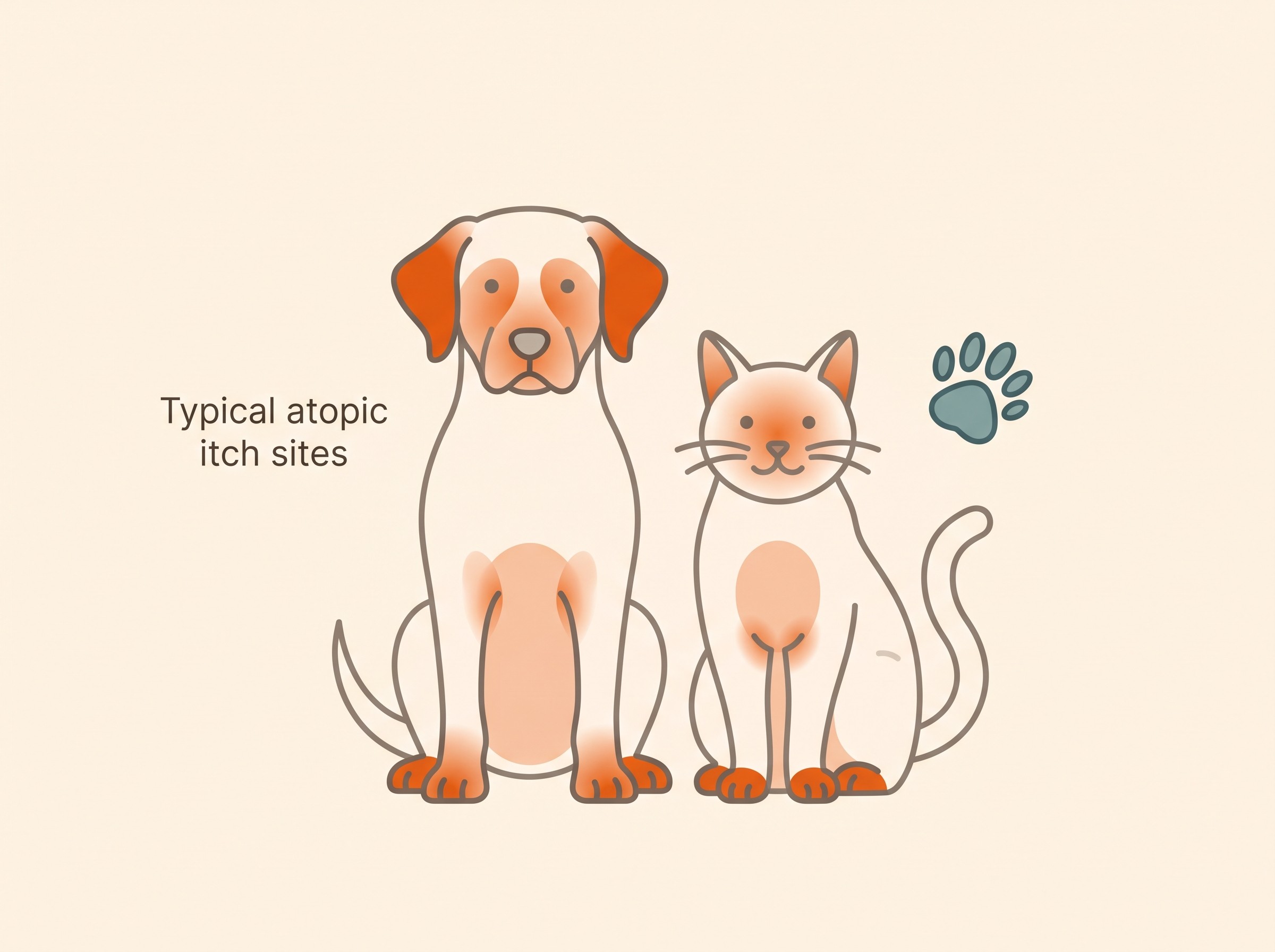
Two more features round out the picture. First, secondary infections are common and amplify everything: atopic skin readily overgrows with bacteria (mostly Staphylococcus pseudintermedius) and Malassezia yeast, which aggravate the already-inflamed skin and crank the itch up further (Drechsler et al., 2024). This explains a smell, new spots or a sudden worsening; the word "secondary" matters, because the bug rides on top of the allergy rather than causing it, and the detail belongs to skin and ear infections. Second, signs are often seasonal at first, worse in pollen season, and commonly broaden towards all-year-round over time as the pet reacts to more allergens, including perennial ones like house dust mites (Olivry et al., 2015).
Cats deserve a clear note here, because this article covers both species. Cats get the same underlying allergic disease but show it differently, through overgrooming, crusty miliary dermatitis, raw eosinophilic plaques and head-and-neck itch rather than the dog's textbook pattern (Halliwell et al., 2021). If you have a cat, feline atopic syndrome is written for you.
The single most useful thing you can do while this is being worked out is to start measuring it. A 0 to 10 itch score, jotted down regularly, plus a few photographs of the classic sites in the same light, turns "she seems a bit better" into something you and your vet can actually see. The Skin and Itch Tracker does exactly this, and a baseline recorded before you change anything is what later proves a treatment is working, or is not.
Why it flares
Atopy waxes and wanes, and the reason is worth understanding because it changes how you manage it. Every pet has a level of irritation they can carry before they start to itch, and flares happen when the total load stacks above that personal line: atopy plus a few flea bites plus a skin infection plus dry winter air can together tip a pet over when no single one of them would. This summation idea, the itch threshold, is the most clarifying concept in the whole subject, and it has its own article, the itch threshold. The practical consequence: because flares are about total load, control means lowering every layer you can, fleas, infection, barrier, allergens, rather than hunting for one villain to blame.
The road ahead
Two facts shape everything from here, and both are better faced squarely.
The first is that diagnosis is by exclusion, not by a single test. There is no blood test that diagnoses atopic dermatitis. It is what remains, fitting the clinical picture, once fleas, other parasites, infection and food allergy have been ruled out (Hensel et al., 2015; Favrot et al., 2010). That is why your vet works through steps rather than simply "running the allergy test", and why so much money is wasted on kits that promise a shortcut. The full reasoning lives in getting the diagnosis, and the question of which tests are real in allergy tests that work. One practical knock-on: because food allergy has to be excluded, many atopic pets go through a food elimination trial along the way, and the Elimination-Diet Companion is what makes that trial survivable.
The second fact is the reassuring one, and it is true: there is no cure, but there is excellent control. Atopic dermatitis is managed for life rather than cured, yet the great majority of pets can be made genuinely comfortable with the right plan (Drechsler et al., 2024; Olivry et al., 2015). That plan is a combination chosen with your vet and adjusted over time, not a single wonder drug, and the practical version is set out in your treatment toolkit. One option deserves special mention: allergen-specific immunotherapy is the one treatment that actually modifies the underlying disease rather than just damping the signs (Olivry et al., 2015), covered in immunotherapy for pet allergies.
So if you have just heard this diagnosis, the reality is neither despair nor a false promise. It is realistic hope: a tendency you did not cause and cannot cure, but one you can usually keep well under control by lowering the load on several fronts and acting early when it creeps up. The most useful next move is not a shopping decision. It is getting a proper diagnosis and starting to track the itch today, so the first thing you change has a baseline to be measured against.
References
- Favrot, C., Steffan, J., Seewald, W., & Picco, F. (2010). A prospective study on the clinical features of chronic canine atopic dermatitis and its diagnosis. Veterinary Dermatology, 21(1), 23-31.
- Olivry, T. (2011). Is the skin barrier abnormal in dogs with atopic dermatitis? Veterinary Immunology and Immunopathology, 144(1-2), 11-16.
- Marsella, R. (2013). Fixing the skin barrier: past, present and future, man and dog compared. Veterinary Dermatology, 24(1), 73-76.e17.
- Drechsler, Y., Dong, C., Clark, D. E., & Kaur, G. (2024). Canine atopic dermatitis: prevalence, impact, and management strategies. Veterinary Medicine: Research and Reports, 15, 15-29.
- Hillier, A., & Griffin, C. E. (2001). The ACVD task force on canine atopic dermatitis (I): incidence and prevalence. Veterinary Immunology and Immunopathology, 81(3-4), 147-151. )00296-3.
- Olivry, T., DeBoer, D. J., Favrot, C., Jackson, H. A., Mueller, R. S., Nuttall, T., & Prelaud, P. (2015). Treatment of canine atopic dermatitis: 2015 updated guidelines from the International Committee on Allergic Diseases of Animals (ICADA). BMC Veterinary Research, 11, 210.
- Halliwell, R. (2006). Revised nomenclature for veterinary allergy. Veterinary Immunology and Immunopathology, 114(3-4), 207-208.
- Halliwell, R., Pucheu-Haston, C. M., Olivry, T., Prost, C., Jackson, H., Banovic, F., Nuttall, T., Santoro, D., Bizikova, P., & Mueller, R. S. (2021). Feline allergic diseases: introduction and proposed nomenclature. Veterinary Dermatology, 32(1), 8-e2.
Keep track of how your pet is doing
The owners who cope best are the ones who notice changes early. A simple health log shows you what is working, and what is not, before the next vet visit.
Start tracking, freeYou're not doing this alone
Compare treatment journeys and talk to owners managing allergies & skin. Free to join.
Join PetsLikeMine