

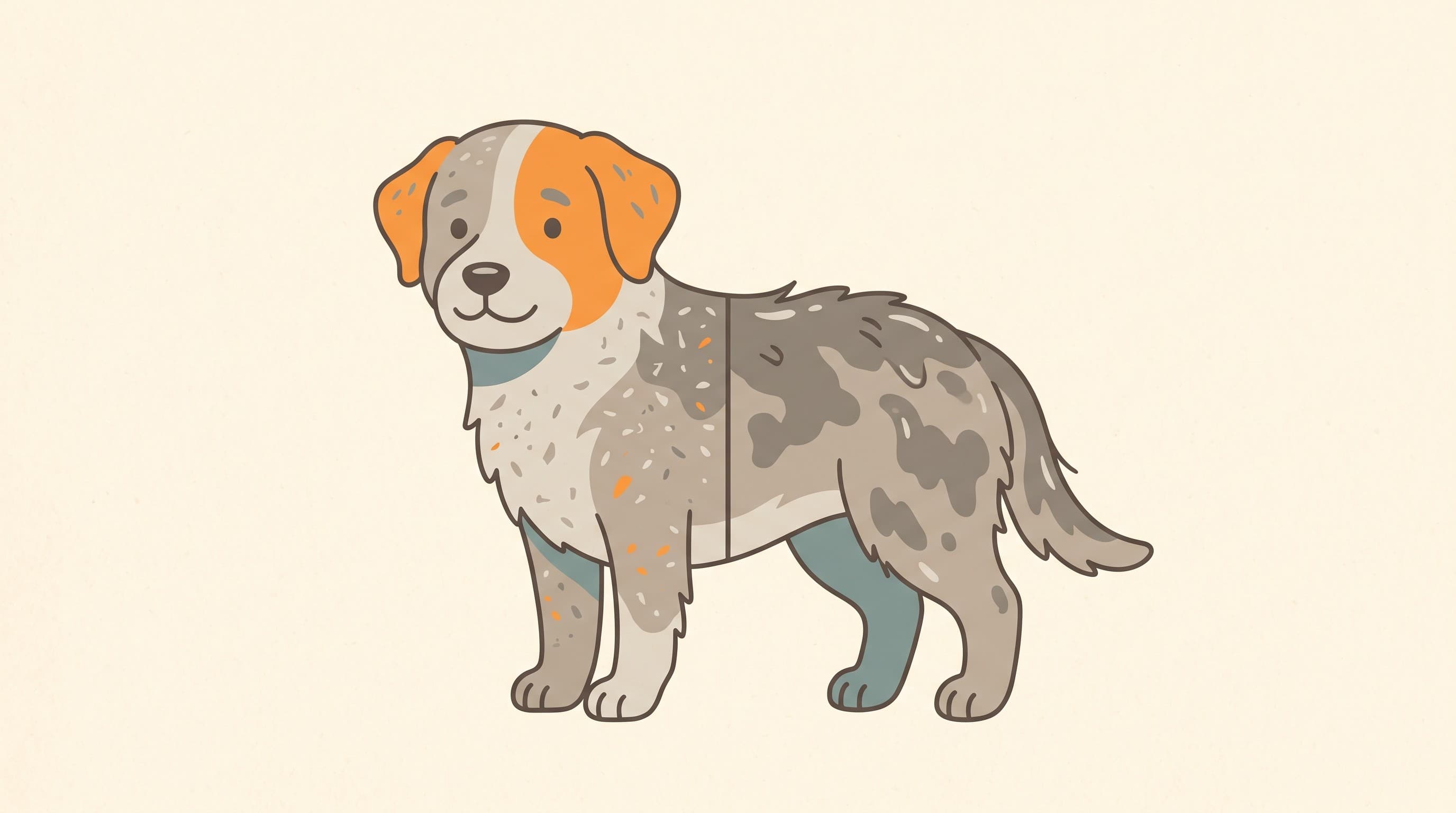
Dandruff, greasy coat and seborrhoea: when the skin barrier breaks down
Alastair Greenway
BVM&S MRCVS
White flakes scattered across the bedding, a rancid "off" smell that no amount of brushing shifts, a dull scurfy back or a greasy yellow patch under the chin: that picture is seborrhoea. The most useful thing to grasp before you reach for a shampoo is that it is almost never a disease in its own right. It is a sign that the skin's normal renewal and oil control have gone wrong, and in the great majority of pets that is because something else is driving it (MSD Vet Manual, 2023; Bajwa, 2023). Treat only the flakes and you will be washing the same pet again in a fortnight. Find and treat the cause and the flakes look after themselves.
What seborrhoea actually is (and why "dry skin" is the wrong word)
The skin renews itself on a conveyor belt: cells are born in the base layer, mature as they rise, and flake off the top so gradually you never notice them. In seborrhoea that belt runs too fast and the oil glands misbehave alongside it, so the shedding becomes visible scale while the surface turns greasy. The proper term is a defect in keratinisation, disordered skin-cell turnover, "characterized by a defect in keratinization that results in excessive cutaneous scaling" (MSD Vet Manual, 2023).
This is genuinely measurable. In the landmark study of Cocker Spaniels with idiopathic seborrhoea, the epidermis renewed itself in about eight days (7.85 plus or minus 1.80 days) instead of the normal three weeks (Kwochka and Rademakers, 1989), against roughly 21 to 23 days in healthy skin (Kwochka and Rademakers, 1989b). Grafting in the same work showed the fault lives in the skin itself, not the blood or deeper tissue (Kwochka and Rademakers, 1989). That one figure, eight days versus three weeks, turns a vague "flaky skin" into something almost mechanical you can picture.
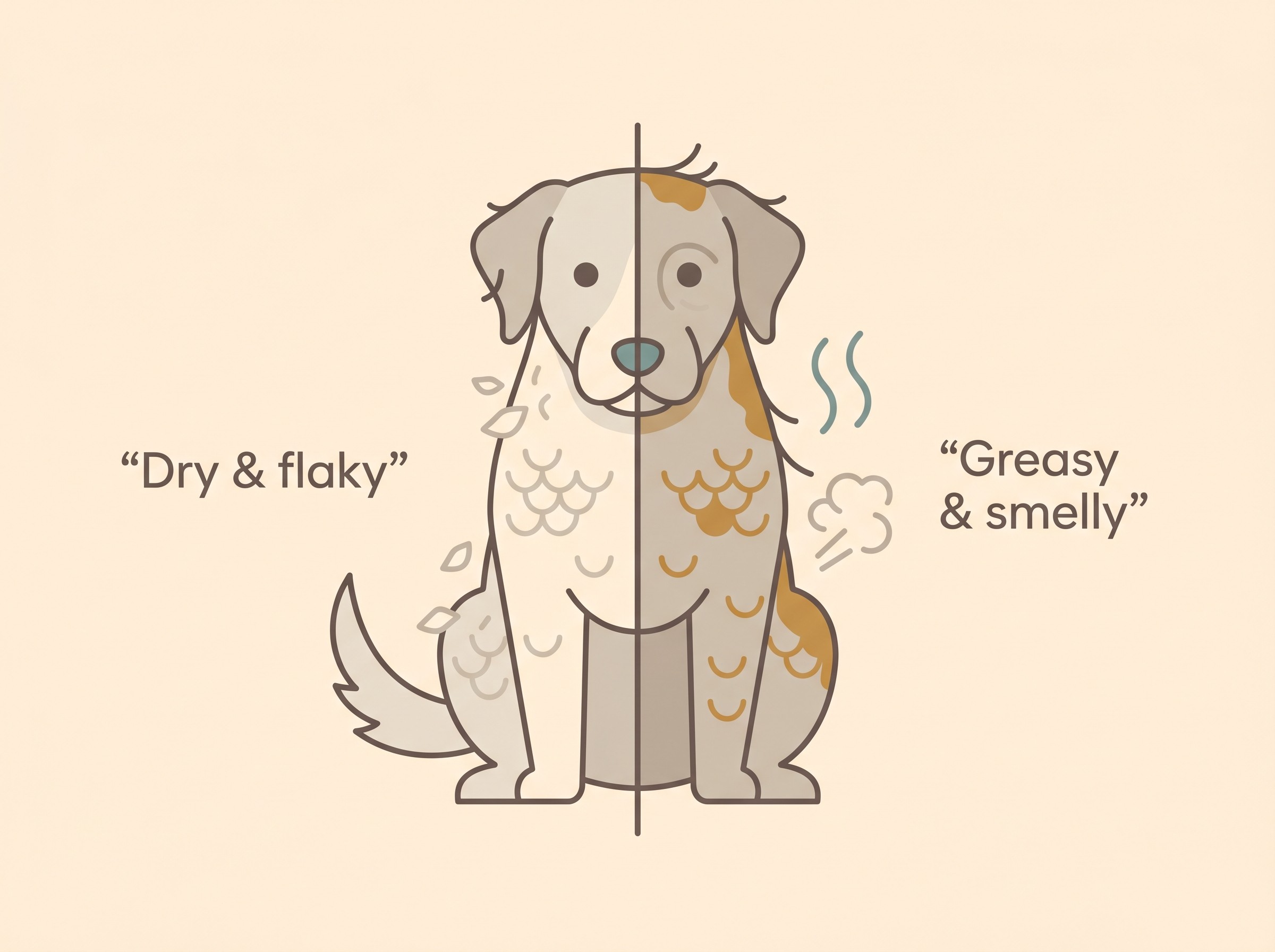
It is also why "dry skin", the label most of the internet reaches for, is misleading: seborrhoea comes in a dry, flaky form (loose scale, dandruff) and a greasy, oily, smelly form (oily coat, brown-yellow waxy scale, rancid smell), and a greasy seborrhoeic dog is the opposite of dry (MSD Vet Manual, 2023). Which end you see nudges the work-up: greasy and smelly leans towards yeast and allergy, bone-dry and scaly more towards parasites, nutrition and, rarely, an inherited fault.
Primary is rare. Secondary is the rule.
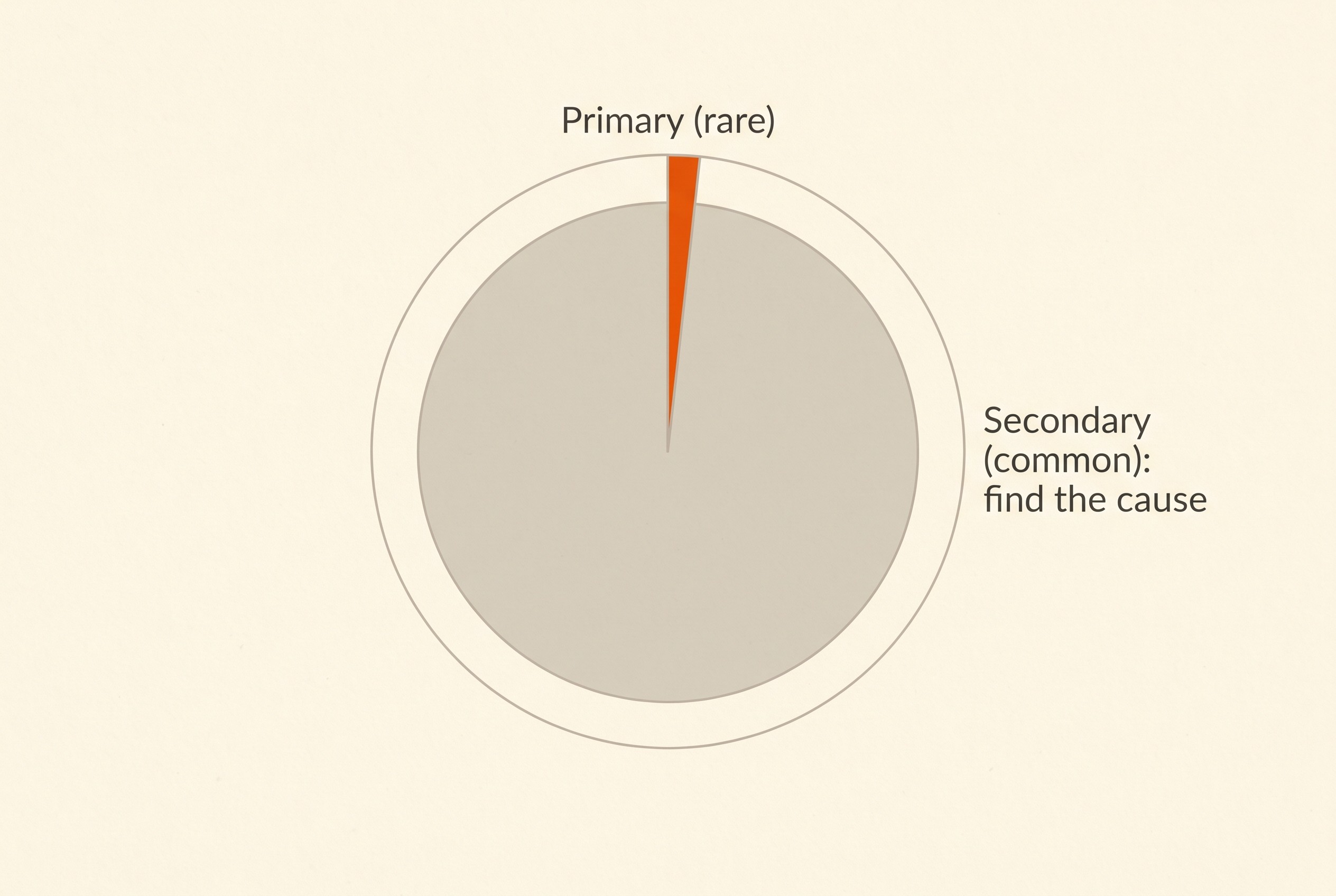
A true inherited keratinisation defect, where the skin's renewal is faulty in and of itself, is uncommon. Primary (idiopathic) seborrhoea is "a very rare keratinization disorder" and "an inherited skin disorder" that "begins at a young age (usually < 18 to 24 months) and typically progresses throughout the animal's life", over-represented in breeds such as American Cocker and English Springer Spaniels, Basset Hounds, West Highland White Terriers, Dachshunds, the retrievers and German Shepherd Dogs (MSD Vet Manual, 2023). It is not itchy in itself; it only becomes itchy once a secondary infection joins in. So the rare pet who genuinely has it is a young pedigree dog from that list whose scaling started as a youngster and never went away, and even then the day-to-day misery is usually the infection riding on top.
Everyone else, nearly every flaky or greasy pet you will meet, has secondary seborrhoea: the skin is scaling because of another problem entirely. "In dogs, secondary seborrhea is more common than primary seborrhea," and "the most common underlying causes of secondary seborrhea are endocrinopathies and allergies" (MSD Vet Manual, 2023). The fuller shortlist is allergic skin disease, parasites (fleas and mites), bacterial and yeast infection, hormonal disease such as hypothyroidism and Cushing's, nutritional shortfalls, and plain environmental dryness (MSD Vet Manual, 2023; Bajwa, 2023).
This article will not re-teach each of those causes. Working out which one is driving the scaling is the methodical work-up the funnel article owns: rule out fleas, treat any infection, run a diet trial, and what is left is usually allergy. Read why is my pet so itchy for the five-cause map and the order a vet works through it. The reassuring part is that because most seborrhoea is secondary, it is not a life sentence: control the underlying disease and the disordered turnover settles, the coat tending to come good. The flakes are a clue, not a verdict.
The grease usually means yeast. And the yeast usually means something else again.
If the coat is greasy and smelly rather than simply dusty, there is a good chance you are dealing with yeast. That rancid odour and the brownish-yellow greasy scale are the fingerprint of Malassezia overgrowth. Malassezia pachydermatis is "the most prevalent and important commensal yeast of canine skin and mucosa", which means it lives there normally and only causes trouble when it overgrows (Bajwa, 2023; Bond et al., 2020). When it does, it produces redness, brown-yellow-grey greasy scale, thickened darkened skin and an "offensive, rancid odor", favouring the moist, rubbed areas: the neck, armpits, belly, between the toes, the lips and the ears (Bajwa, 2023). The smell is often what finally brings an owner in, and yes, that is yeast, and it is treatable.
There is a catch, though, and it explains why "just bathe it" so often fails. Malassezia overgrowth is itself almost always secondary. The yeast multiplies when a primary skin problem alters the surface (more moisture, changed oils, a disrupted barrier), the usual drivers being allergic disease, parasites, bacterial infection, hormonal disease and seborrhoeic defects (Bajwa, 2023). So a greasy, smelly pet is often a stack: an allergy or hormone problem at the bottom, disordered turnover and oil in the middle, yeast on top. This is why the experts stress finding and treating the underlying disease rather than chasing the yeast alone (Bond et al., 2020). One twist: some dogs predisposed to atopic dermatitis become genuinely allergic to proteins from their own Malassezia, part of why a yeasty flare in an allergic dog can feel so disproportionately itchy, and why clearing it often brings a bigger comfort win than you would expect (Bajwa, 2023).
The infection biology, the cytology that confirms whether the grease is yeast, bacteria, both or neither, and how it is treated all belong to the infection articles. For the full picture read skin and ear infections explained, and for topical-first treatment and using antibiotics responsibly, treating the infection and finding the cause. The short version: the vet takes a quick sample off the greasy skin, stains it and reads it under the microscope, which beats guessing every time.
Managing it: soothe the surface, chase the cause
Soothing the surface is worth doing, because it makes your pet comfortable today, but it is only half the job; the half that stops it coming back is finding the driver. The topical workhorse is a medicated antiseborrhoeic shampoo, usually two to three times weekly, and the active should match the picture rather than being treated as a black box (MSD Vet Manual, 2023). For a dry, flaky coat, sulfur and salicylic acid (usually paired) are the gentle first choice: both are "keratolytic, keratoplastic, antibacterial, and antipruritic", so they loosen and normalise scale and lower the skin's stickiness (MSD Vet Manual, 2023). For a genuinely greasy coat, benzoyl peroxide gives "strong degreasing actions along with potent antibacterial and follicular flushing", as does selenium sulfide; both suit the oily picture but are stronger and can dry and irritate, so they are not for the dry-flaky pet (MSD Vet Manual, 2023). Where yeast or bacteria ride along, chlorhexidine (often with miconazole) targets that layer, and many shampoos now build in barrier ingredients such as ceramides or phytosphingosine (MSD Vet Manual, 2023; Bond et al., 2020). One detail makes or breaks results: leave a medicated shampoo on for five to ten minutes before rinsing, not lather-and-wash. The full how-to of bathing, frequency and the daily barrier routine sits in living with an atopic pet; this article only says which active suits which coat.
One safety line matters enormously in a both-species article, so it goes in bold: coal tar shampoos are for dogs only and must never be used on cats. Coal tar is an effective older antiseborrhoeic for oily canine coats, but it is contraindicated in cats, who are highly sensitive to the phenol and cresol it contains, and even in dogs higher concentrations can dry the skin, irritate it and discolour pale coats (VCA Animal Hospitals, n.d.; MSD Vet Manual, 2023). More broadly, never assume a dog product is cat-safe.
Now the omega-3 question, told straight, because this is a heavily marketed corner. In a prospective, randomised, double-blind, placebo-controlled trial, a fish-oil (n-3) supplement significantly improved coat quality in dogs with poor coats, with the benefit peaking at about two months (Combarros et al., 2020): real, and low-risk. But the evidence has limits. In healthy dogs, supplementing plant oils did not change transepidermal water loss, a direct measure of how "leaky" the barrier is, and coat quality improved across all groups including the controls, so the gain was not specific to the oil (Richards et al., 2023). The fair conclusion a fish-oil advert will not give you: omega-3s and barrier care are a sensible support over weeks to months, especially where allergy is in the mix, but they are an adjunct, not a cure, and not a substitute for finding the cause.
For the rare pet with genuine primary seborrhoea, the toolbox is bigger than shampoo: lifelong management can add systemic help such as vitamin A or synthetic retinoids in selected vitamin-A-responsive dermatoses, which are prescription decisions taken and monitored by your vet (MSD Vet Manual, 2023).
When greasy or scaly skin should send you back to the vet
A few things should redirect the work-up rather than prompt another bottle of shampoo. Because hormonal disease is one of the commonest hidden drivers of a flaky, greasy coat, a scaly pet who is also off-colour in other ways (weight changes, increased thirst, low energy, a pot belly) needs bloods, not allergy tests. That route is signposted in losing fur but not very itchy, which points on to the Endocrine & Hormones space for hypothyroidism and Cushing's.
Bear in mind, too, that not all scale is seborrhoea. Sebaceous adenitis is an immune-mediated destruction of the oil glands, inherited and over-represented in Standard Poodles and Akitas (also Vizslas, Havanese and Springer Spaniels), whose hallmark is follicular casts: scale stuck tightly around the hair shafts in tufts rather than coming off as loose dandruff, alongside dull brittle hair and patchy non-itchy hair loss, especially over the head (Marsella, 2023). Because several diseases look alike, it can only be confirmed on skin biopsy (Marsella, 2023). The flag: a long-coated dog, classically a Standard Poodle, whose scale clings to the hair rather than falling free deserves a biopsy, not another wash.
In cats, think parasites first. "Walking dandruff" (the surface mite Cheyletiella) produces heavy scale down the back and looks exactly like simple dandruff, but is treatable and can spread to people, so a scaly cat warrants a parasite check, covered in mites and mange. Two cat-specific pictures are "stud tail" (greasy waxy build-up over the tail-base gland in entire toms) and the greasy face seen in some Persians. The feline allergic half, once parasites are excluded, belongs to feline atopic syndrome.
What to actually do next
Do not just keep bathing and hoping, because seborrhoea that keeps returning is telling you there is a cause to find. Flea-treat the whole household first (the cheapest driver to rule out), then book the vet for the work-up that separates allergy, parasites, infection and hormonal disease (MSD Vet Manual, 2023; Bajwa, 2023; Bond et al., 2020), and start a medicated shampoo matched to the coat, coal tar dog-only, with omega-3s as a slow adjunct.
Then photograph it: same patch, same light, dated, with an itch and skin score in the Skin & Itch Tracker, so you and your vet can see whether the coat is genuinely settling (drier, less smell, fewer flakes) over the weeks, which is the sign the cause is being controlled rather than papered over between baths. How to check your pet's skin at home shows what to photograph, and if the flakes track with food, the Elimination-Diet Companion is the structured way to test that link. A flaky, greasy, smelly coat almost always has a findable cause, and once it is under control the skin's renewal settles and the coat comes good and stays good, far better than a lifetime of weekly baths chasing the same dandruff.
References
- Merck & Co., Inc. Seborrhea in Animals. MSD Veterinary Manual (Merck Veterinary Manual), professional edition, Integumentary System. 2023 (reviewed/revised).
- Bajwa J. Malassezia species and its significance in canine skin disease. The Canadian Veterinary Journal. 2023;64(1):87-90.
- Kwochka KW, Rademakers AM. Cell proliferation kinetics of epidermis, hair follicles, and sebaceous glands of cocker spaniels with idiopathic seborrhea. American Journal of Veterinary Research. 1989;50(11):1918-1922.
- Kwochka KW, Rademakers AM. Cell proliferation of epidermis, hair follicles, and sebaceous glands of beagles and cocker spaniels with healthy skin. American Journal of Veterinary Research. 1989;50(4):587-591.
- Bond R, Morris DO, Guillot J, Bensignor EJ, Robson D, Mason KV, Kano R, Hill PB. Biology, diagnosis and treatment of Malassezia dermatitis in dogs and cats: Clinical Consensus Guidelines of the World Association for Veterinary Dermatology. Veterinary Dermatology. 2020;31(1):27-e4.
- Combarros D, Castilla-Castano E, Lecru LA, Pressanti C, Amalric N, Cadiergues MC. A prospective, randomized, double blind, placebo-controlled evaluation of the effects of an n-3 essential fatty acids supplement (Agepi omega-3) on clinical signs, and fatty acid concentrations in the erythrocyte membrane, hair shafts and skin surface of dogs with poor quality coats. Prostaglandins, Leukotrienes and Essential Fatty Acids. 2020;159:102140.
- Richards TL, Burron S, Ma DWL, Pearson W, Trevizan L, Minikhiem D, Grant C, Patterson K, Shoveller AK. Effects of dietary camelina, flaxseed, and canola oil supplementation on inflammatory and oxidative markers, transepidermal water loss, and coat quality in healthy adult dogs. Frontiers in Veterinary Science. 2023;10:1085890.
- Marsella R. Sebaceous Adenitis in Companion Animals. Today's Veterinary Practice. 2023 November/December.
- Hamilton A. Coal Tar and Coal Tar Combinations (Topical). VCA Animal Hospitals, Know Your Pet. No date.
Keep track of how your pet is doing
The owners who cope best are the ones who notice changes early. A simple health log shows you what is working, and what is not, before the next vet visit.
Start tracking, freeYou're not doing this alone
Compare treatment journeys and talk to owners managing allergies & skin. Free to join.
Join PetsLikeMine