


Food allergies in pets: what they are, and what they are not
Alastair Greenway
BVM&S MRCVS
Few topics in pet health are sold to owners as hard as food allergy. Walk down any pet-shop aisle and the bags shout "grain-free", "hypoallergenic" and "limited ingredient" at you, and the internet is full of confident advice to "just switch the food". The reality is quieter and more useful. Food allergy is real and worth ruling out carefully, but it is one cause of itch among several, it is rarer than the marketing implies, and almost none of those reassuring words on the packet mean what an anxious owner hopes. This article covers what food allergy actually is, how common it really is, why the labels mislead, and the one test that genuinely works.
Allergy, intolerance, and why the difference barely matters
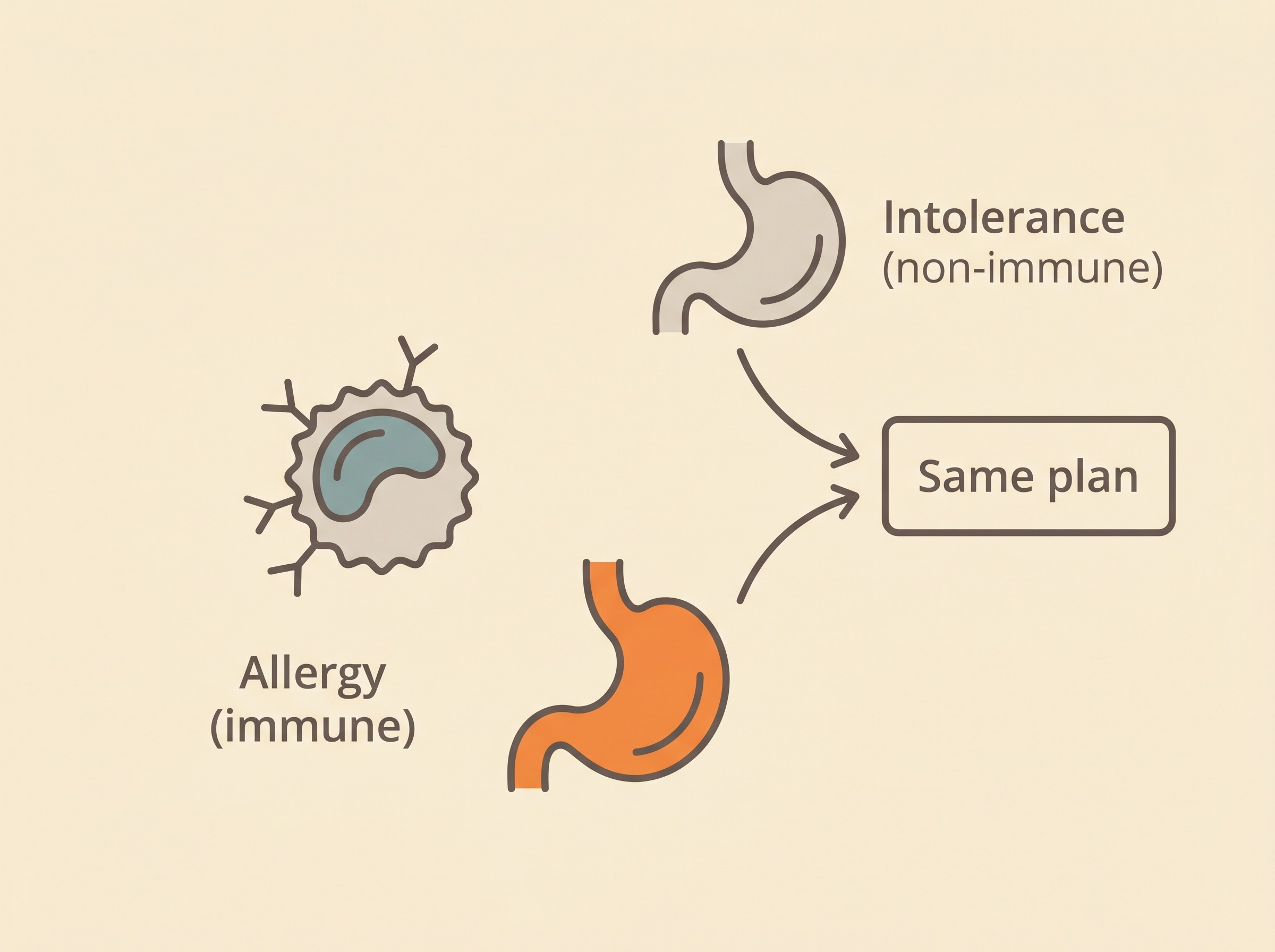
Owners arrive saying "allergy" when the precise word covers more than that. The umbrella term dermatologists use is cutaneous adverse food reaction, which means any reproducible skin reaction to a food, whatever the underlying mechanism (Olivry and Mueller, 2017). Tucked inside that umbrella are two different things.
A true food allergy is immune-mediated: the immune system reacts to a dietary protein it ought to tolerate, treating an ordinary ingredient as a threat. A food intolerance does not involve the immune system at all. It is a metabolic or non-immunologic reaction, the classic example being a lack of the enzyme that digests milk sugar, which leaves some animals with an upset stomach after dairy (Merck Veterinary Manual). Here is the clarifying point for a worried owner. In a living, itchy pet you cannot tell the two apart, and you do not need to. The body is reacting badly to a food either way; the difference is the internal machinery, not the experience. Both are found and managed the same way, by an elimination diet and then avoidance. So we make the distinction once and move on.
How common it really is
The gap between how common food allergy feels online and how common it is in the data is large. Among all dogs seen by a vet for any reason, cutaneous adverse food reactions account for only around 1 to 2% (Olivry and Mueller, 2017). Even among pets that are genuinely itchy, food is behind a minority: across studies, somewhere between 9 and 40% of pruritic dogs, with a median near 18%, and among dogs already diagnosed with allergic skin disease the median is about 20% (Olivry and Mueller, 2017). In cats the picture is similar, with food allergy reported in roughly 12 to 21% of itchy cats (Olivry and Mueller, 2017).
None of that means food does not matter. It plainly does, and ruling it out properly is part of every careful work-up. What it means is that food is one cause among several, and usually not the most common one, so the instinct to switch the food and expect the problem to vanish is usually misplaced. The value is not in guessing, it is in finding out. For where food sits in the short list of things a vet rules out, and in what order, see why is my pet so itchy.
What it looks like
Food allergy is, first and foremost, an itchy skin disease. Most affected dogs are pruritic in a generalised pattern, with the ears, feet and belly frequently involved, and the rear caught up only in a minority (around 4 to 25% of dogs) (Olivry and Mueller, 2019). That last point is worth making plainly, because a lot of pet-health pages claim food allergy classically targets "the ears and the rear", and the evidence does not really support the rear part. Cats tend to concentrate the trouble on the head, face and neck, through the familiar feline patterns of overgrooming, crusty miliary dermatitis and raw eosinophilic lesions; the feline picture is covered in feline atopic syndrome.
Two features are useful pointers rather than hard rules. First, food allergy is typically non-seasonal: a pet that eats the trigger all year tends to itch all year, which is one of the few clinical clues that nudges suspicion towards food and away from pollen-driven allergy (Olivry and Mueller, 2019). Second, it can begin at almost any age. The mean age of onset in dogs is about 2.9 years, but the range runs from under one year to thirteen, and about 38% of affected dogs are showing signs by their first birthday (Olivry and Mueller, 2019). That corrects a common belief that food allergy only appears after years on the same diet: a young dog with a year-round itch is a perfectly legitimate candidate. There is no reliable breed or sex predisposition either, although a few breeds such as German shepherds, West Highland white terriers, Labradors and golden retrievers turn up more often in case series, most likely because they carry a heavier allergy burden in general (Olivry and Mueller, 2019).
There is one more presentation fact that does more work than any other: the skin signs of food allergy are clinically indistinguishable from environmental atopic dermatitis. No item of history and no physical-examination finding reliably tells them apart (AAHA, 2023). That is precisely why a diet trial is needed, not a hunch and not a test.
Sometimes the tummy too, but mostly the skin
A fair number of food-allergic pets have gut signs alongside the skin disease, but it is a minority. In the dermatology-led studies that capture skin cases best, about 27% of food-allergic dogs and 20% of food-allergic cats showed both gastrointestinal and skin signs, and most of the rest were skin-only (Mueller and Olivry, 2018). Where the gut is involved, the common signs are diarrhoea, vomiting and a raised frequency of passing faeces (Mueller and Olivry, 2018). One caveat: how often this overlap is reported depends heavily on who saw the pet, with dermatology-led studies finding far less gut involvement than internal-medicine-led ones, where the gut signs are the reason for the visit in the first place (Mueller and Olivry, 2018). The takeaway is simple: in an itchy pet, mostly skin, sometimes the gut as well.
The marketing myths, named plainly
Three claims dominate the food-allergy aisle, and all three mislead.
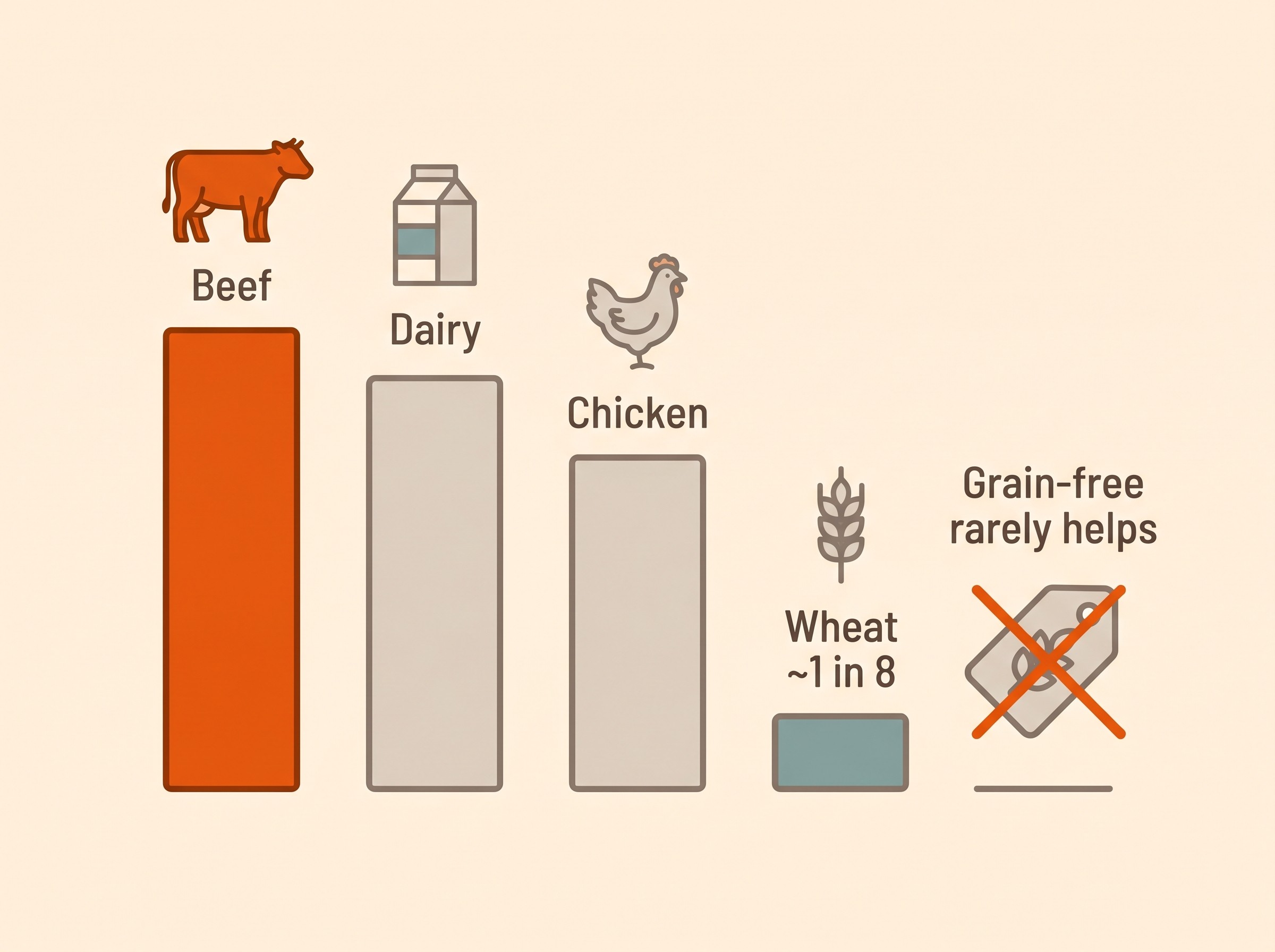
Grain-free does not mean hypoallergenic, and grain is rarely the villain. When researchers pooled the confirmed allergens from hundreds of properly diagnosed pets, the top triggers in dogs were beef (34%), dairy (17%), chicken (15%) and wheat (13%); in cats the leaders were beef (18%), fish (17%) and chicken (5%) (Mueller, Olivry and Prélaud, 2016). That is the centre of the whole topic: the commonest triggers are animal proteins, and wheat, the usual face of "grain", accounts for only about one in eight allergic dogs and roughly one in twenty-five cats (Mueller, Olivry and Prélaud, 2016). So moving a chicken-allergic dog from a grain-inclusive chicken food to a grain-free chicken food changes nothing that matters. The protein the dog reacts to is still in the bowl.
"Hypoallergenic" and "limited ingredient" on a packet are marketing terms, not guarantees, and the label is often not even accurate. When commercial diets were tested in the laboratory for what was actually in them, ingredients not on the label turned up in a median of 45% of diets, and in 33 to 83% of the over-the-counter "novel" or "limited ingredient" foods sold for elimination trials (Olivry and Mueller, 2018). In plain terms, a "venison and potato" food can contain undeclared beef, soy or chicken, the very proteins it is meant to exclude. There is a fair counterpoint that matters: hydrolysed and prescription diets were, with a single exception, not found to carry these unexpected proteins (Olivry and Mueller, 2018). So the criticism is aimed at the over-the-counter "free-from" shelf, not at properly formulated veterinary diets. Which diet to choose for a real trial, and why the supermarket "hypoallergenic" bag so often fails, is owned by the elimination diet, done properly.
Grain-free was not only unhelpful, it carried its own question mark. This is the owner-protective point the marketing pages skip. From July 2018 the US Food and Drug Administration began investigating a possible link between certain grain-free diets high in peas, lentils and other pulses and dilated cardiomyopathy, a serious heart-muscle disease, in dogs, including breeds with no inherited risk; over 90% of the reported diets were grain-free and 93% contained peas or lentils (FDA, 2018 to 2022). That link is not proven, and the FDA paused its routine public updates in December 2022 for lack of established causation (FDA, 2018 to 2022), so this must not be overstated: grain-free has not been shown to cause heart disease. The fair summary is that grain-free was widely adopted for an allergy problem grain rarely causes, while a separate, unresolved heart-health question hung over those same diets. As a swap for an itchy pet, it is a poor trade on two counts.
No shortcut exists, but one test does the job
Owners often hope for a quick blood, saliva or hair test that will simply name the culprit. There is no such test for food allergy that is valid: when these have been studied, none has proved reliable enough to diagnose it, and the reference standard remains an elimination diet followed by re-challenge (Mueller and Olivry, 2017; AAHA, 2023). The detail of why the kits fail is set out in the allergy tests that work and the ones that waste your money; the short version is that the only reliable answer comes from changing the diet, not from a sample in a tube.
That is why the diet trial is not a formality you can skip. It is the test. The practical way through it is the Elimination-Diet Companion, which gives you a structured trial to follow instead of buying a marketed "hypoallergenic" bag and hoping. And because a food trial is read by watching whether the itch settles over the weeks, a dated itch score is the evidence the whole thing turns on. The Skin & Itch Tracker does that job: it shows you whether the diet is working, and the same record reveals whether your pet's itch is seasonal (a pointer away from food) or year-round (a pointer towards it). How long the trial takes and exactly how to run it belongs to the elimination diet article; plan on a couple of months done strictly, not a fortnight of half-measures.
The genuinely hopeful part
There is a good note to end on. Unlike pollen-driven allergy, which is lifelong and managed with medication, a confirmed food allergy is managed by avoidance (Merck Veterinary Manual). Once the trigger protein is identified, you take it out, and for many pets the skin settles and stays settled on a suitable complete diet. That makes food allergy one of the few allergic conditions where you can actually find the cause and largely solve it, rather than control it for life. One thing to add: a pet can be food-allergic and have another allergy stacked on top, which is why a clean diet sometimes only takes the itch part of the way down; that is the itch threshold at work, and the itch threshold explains it. Pinpointing the exact trigger and building a sustainable long-term diet is covered in after the trial. The first move is the diet trial done properly, and that is a problem you can solve.
References
- Mueller RS, Olivry T, Prélaud P. (2016). Critically appraised topic on adverse food reactions of companion animals (2): common food allergen sources in dogs and cats. BMC Veterinary Research, 12: 9.
- Olivry T, Mueller RS. (2017). Critically appraised topic on adverse food reactions of companion animals (3): prevalence of cutaneous adverse food reactions in dogs and cats. BMC Veterinary Research, 13: 51.
- Olivry T, Mueller RS. (2019). Critically appraised topic on adverse food reactions of companion animals (7): signalment and cutaneous manifestations of dogs and cats with adverse food reactions. BMC Veterinary Research, 15: 140.
- Mueller RS, Olivry T. (2018). Critically appraised topic on adverse food reactions of companion animals (6): prevalence of noncutaneous manifestations of adverse food reactions in dogs and cats. BMC Veterinary Research, 14: 341.
- Olivry T, Mueller RS. (2018). Critically appraised topic on adverse food reactions of companion animals (5): discrepancies between ingredients and labeling in commercial pet foods. BMC Veterinary Research, 14: 24.
- Mueller RS, Olivry T. (2017). Critically appraised topic on adverse food reactions of companion animals (4): can we diagnose adverse food reactions in dogs and cats with in vivo or in vitro tests? BMC Veterinary Research, 13: 275.
- Santoro D, Pucheu-Haston CM, Prost C, Mueller RS, Jackson H, et al.; American Animal Hospital Association. (2023). 2023 AAHA Management of Allergic Skin Diseases in Dogs and Cats Guidelines. Journal of the American Animal Hospital Association, 59(6): 255-284.
- U.S. Food and Drug Administration (FDA). FDA Investigation into Potential Link between Certain Diets and Canine Dilated Cardiomyopathy. (Investigation opened July 2018; updates to December 2022.)
- Olivry T, Mueller RS, Prélaud P. (2015). Critically appraised topic on adverse food reactions of companion animals (1): duration of elimination diets. BMC Veterinary Research, 11: 225.
Keep track of how your pet is doing
The owners who cope best are the ones who notice changes early. A simple health log shows you what is working, and what is not, before the next vet visit.
Start tracking, freeYou're not doing this alone
Compare treatment journeys and talk to owners managing allergies & skin. Free to join.
Join PetsLikeMine