

My pet is being sick or has diarrhoea: what is going on, and what to do
Alastair Greenway
BVM&S MRCVS
A dog repeatedly sick at midnight, or a cat leaving a puddle of diarrhoea in the hall, sends most owners reaching for their phone. You want a name for it, and you want to know whether to be worried. That instinct makes sense, but I want to gently move you off that first question, because it is the wrong one to start with. Tonight, the useful question is not "what is this?" It is "is this one to watch, or one to act on?" Get that right and everything else follows.
This article does not try to diagnose your pet over the internet, because no one reliably can.
Sick or loose: a sign, not a diagnosis
Start with this. Vomiting and diarrhoea are signs, not diagnoses. They are the gut's, and sometimes the whole body's, common final response to a long list of different problems (Hall, Williams & Kathrani, 2019; Ettinger et al., 2017). The standard internal-medicine textbooks list well over a hundred causes between them, which is precisely why no remedy and no single look at the stool can sort it out for you.
That last point is the one I most want to land. You cannot reliably tell the cause by inspecting the vomit or the faeces (Hall, Williams & Kathrani, 2019). Owners understandably try, photographing the colour, hunting for a fragment of toy, deciding it "looks like a bug". I look at these things too, and they can be useful clues, but they are clues, not answers. The structured approach exists because the eye alone is not enough.
One nuance matters more for vomiting than for diarrhoea. Vomiting in particular often starts outside the gut altogether (VCA Animal Hospitals; Hall, Williams & Kathrani, 2019). Kidney disease, certain hormone problems, some toxins and other systemic conditions can all make a pet sick, and these are usually picked up on blood tests rather than by looking at the stomach (Ettinger et al., 2017). So "he is being sick" does not automatically mean "tummy bug", and that is one reason your vet may reach for a blood sample sooner than you expect. If thirst, weight loss or other whole-body signs are in the picture, your vet screens for organ and hormone disease as a matter of routine, and those conditions live in our Endocrine & Hormones and Urinary Health spaces rather than here.
A quick word on language, because "being sick" is slippery. True vomiting (an active heave that brings up stomach contents) is a different problem from regurgitation (food passively falling back up the oesophagus), and telling them apart genuinely changes what your vet thinks about. I will not untangle that here; vomiting versus regurgitation does it properly.
A short list of the usual culprits
You do not need the textbook's hundred causes. You need a handful to hold in mind, so that the pattern feels less like chaos. Treat this as your mental map, not a checklist to diagnose from.
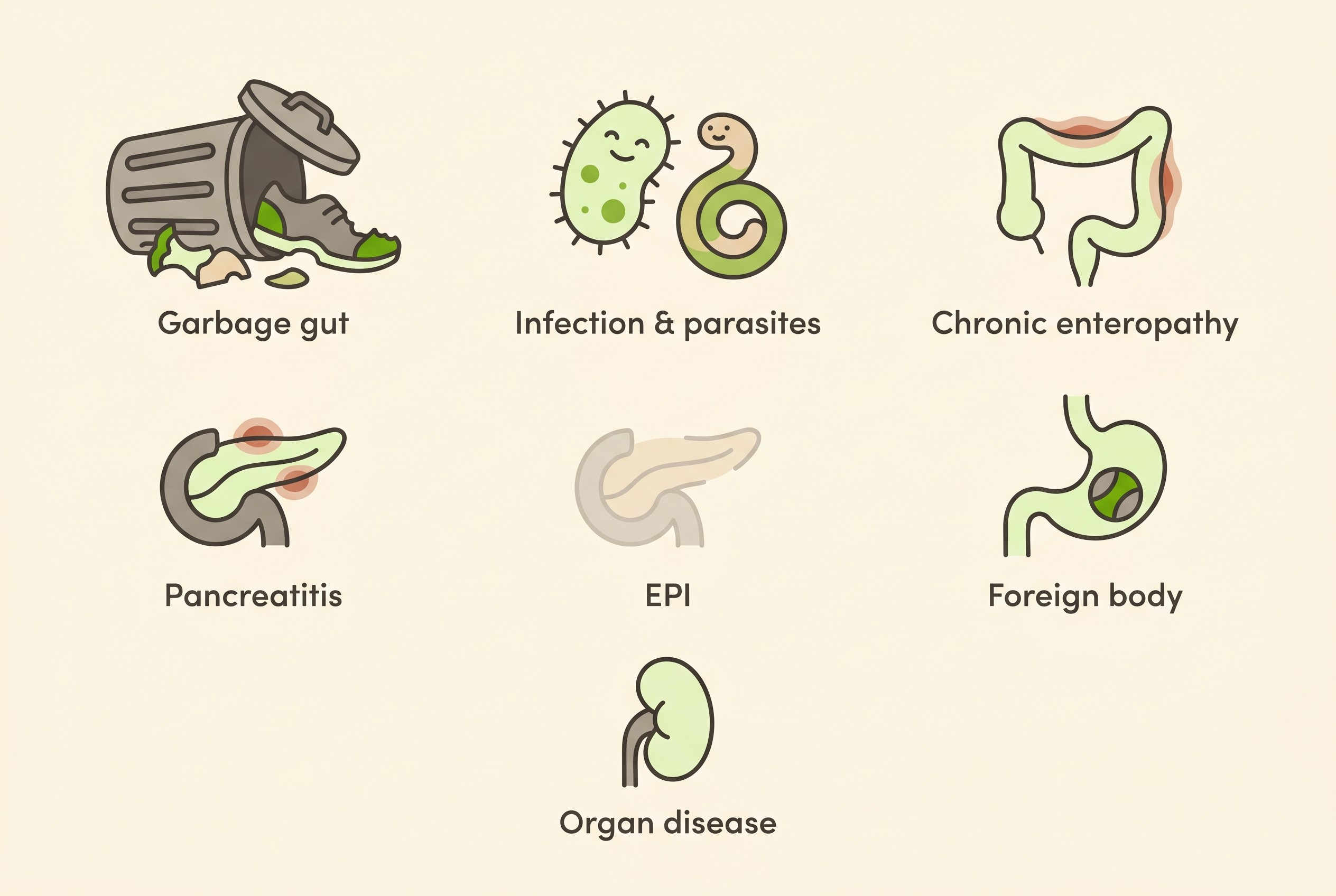
- Dietary indiscretion, or "garbage gut". Eating something they should not is the single commonest cause of a sudden upset in dogs, and much less so in cats. It is usually self-limiting. The full story is in dietary indiscretion.
- Infection and parasites. Viral (parvovirus in young or unvaccinated dogs is the serious example), bacterial, and parasitic causes such as worms and giardia. The parasite side is covered in worms, giardia and diarrhoea.
- Chronic enteropathy. This is the modern umbrella term that has largely replaced reaching for the label "IBD" first, and it is explained in chronic enteropathy.
- Pancreatitis, inflammation of the pancreas, covered in pancreatitis explained.
- Exocrine pancreatic insufficiency (EPI), where the pancreas stops making enough digestive enzymes. It is diagnosed by a single fasted blood test (serum trypsin-like immunoreactivity), not a hunch (Williams & Batt, 1983), and it has its own guide in EPI explained.
- Obstruction or a foreign body. A swallowed toy, bone, corn cob or piece of string. This is not a watch-and-wait situation; it is one of the emergencies below.
- Systemic or organ disease, such as kidney or hormone problems, which your vet screens for on bloods rather than by examining the gut.
The point of the list is not to pick your pet's diagnosis off it. It is to recognise that the cause sits somewhere in a finite, knowable set, and that getting to the right one is a job for a logical work-up, not for guessing or trying a third wormer.
Sudden, or has it been going on?
If there is one fork in the road that does the real work, it is this: acute or chronic.
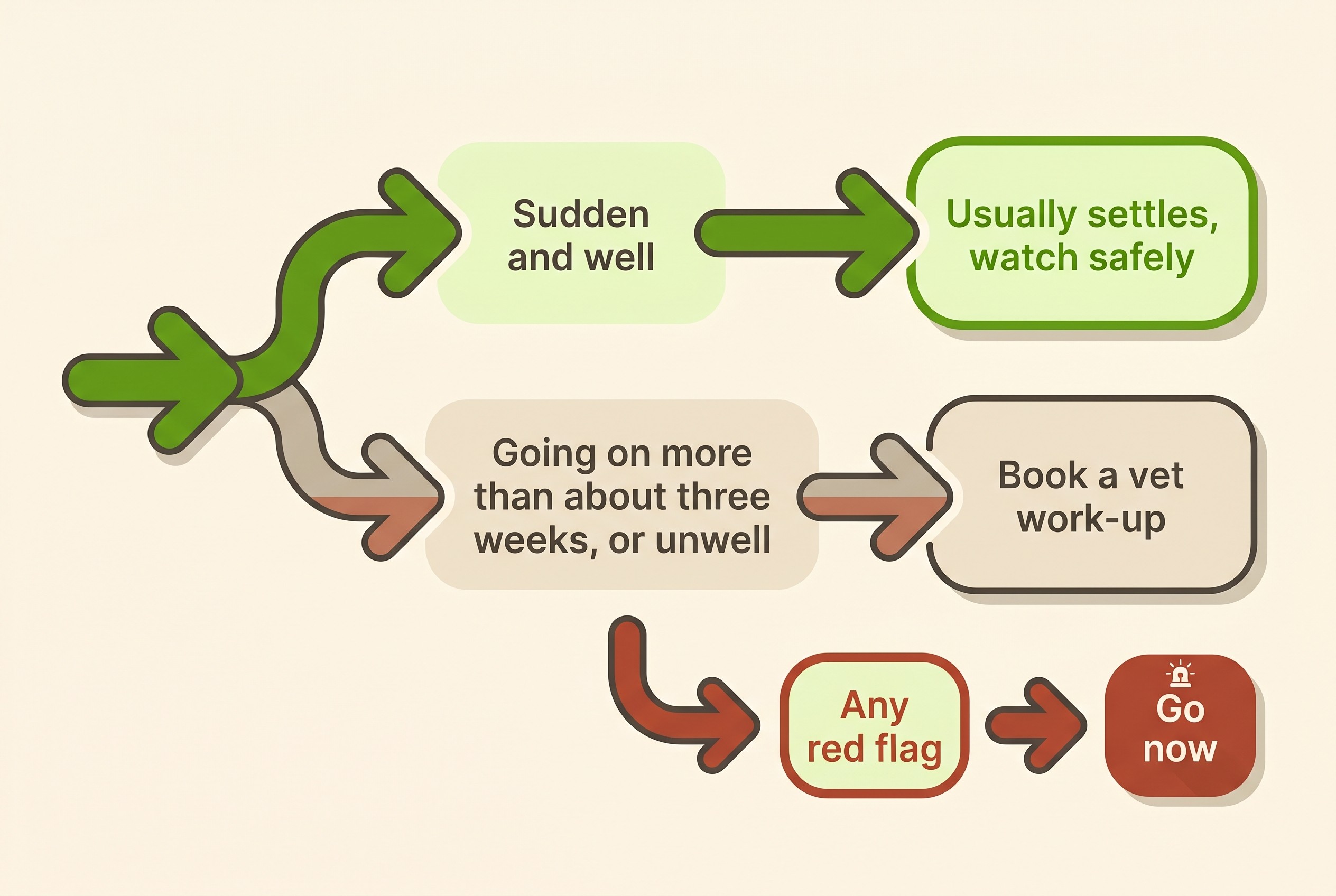
Acute signs come on suddenly. In an otherwise well pet, most acute vomiting and diarrhoea is self-limiting and settles with simple supportive care over a few days. The numbers back this up rather than just my reassurance. In a placebo-controlled trial, dogs with acute non-specific diarrhoea who received no specific drug at all recovered in a mean of about 3.6 days (Langlois et al., 2020), and the modern European and WSAVA guidance is that the overwhelming majority of canine acute diarrhoea is mild and needs only supportive care (Scahill et al., 2024). That is genuinely good news: most sudden tummy upsets get better largely on their own.
Chronic is a different animal. By convention, chronic means signs that persist or keep recurring beyond roughly three weeks, give or take (Hall, Williams & Kathrani, 2019; Dandrieux, 2016). Chronic signs are the ones that point towards the conditions in the sections of this space, the enteropathies, pancreatitis, EPI and organ disease, and they will not be fixed by a remedy or by waiting longer. They earn a proper veterinary work-up.
The job in front of you tonight is the decision, not the diagnosis. Cats deserve a specific note here, because they are not small dogs. Chronic vomiting in a cat is not "just hairballs" and should not be shrugged off; persistent vomiting in cats frequently reflects underlying small-bowel disease that warrants investigation (Norsworthy et al., 2015). The feline picture is set out in feline chronic enteropathy.
What helps most today
With that fork in mind, there are really only three places this lands, and your task is to work out which.
First, and most important, decide whether this is an emergency. A small number of digestive presentations are genuinely time-critical, and with those, minutes matter. I am deliberately not listing them here, because they deserve their own clear-headed treatment rather than a frightening aside; is this an emergency? walks through every red flag you must not wait on. If anything there matches what you are seeing, that article, not this one, is where you should be. Our Vomiting and Diarrhoea Triage is built to walk you through exactly this "go now, or can I watch?" question when you are not sure.
If it is not an emergency, the second job is to observe well and write it down. This sounds modest, but it is where owners add the most value, because the trend over a day or two tells your vet far more than a snapshot. I will not teach the faecal scoring chart here; describing symptoms to your vet covers what to record, what to film and how to put it into words. The easiest way to capture the trend is the Faecal Score Tracker, which logs each motion against the standard 1 to 7 scale so you and your vet can see at a glance whether things are improving or sliding.
So the three outcomes are clean. Watch safely at home if your pet is bright, well, hydrated and free of red flags. Book a routine appointment if signs are chronic or recurrent, if there is weight loss, or if something simply is not right. Go now for any red flag. If your pet is well and the upset is mild, careful home care is reasonable for a short time, and when you can treat a tummy upset at home sets out how, and crucially where its limits are.
Old advice worth dropping
A great deal of what circulates online about sick pets is years out of date. Three points are worth correcting in passing, because they change what good care looks like.
Start with reflexive antibiotics. Most acute diarrhoea does not need them, and the days of metronidazole being handed out as a matter of course are over. The European and WSAVA guidance gives a strong recommendation, on high-certainty evidence, against antimicrobials in mild-to-moderate acute diarrhoea, whether or not there is blood in it (Scahill et al., 2024). There is a real nuance, that one trial did find metronidazole shortened diarrhoea modestly (a mean of about 2.1 days against 3.6 on placebo), but the same authors cautioned against routine use because dogs recover anyway, and the drug measurably disrupts the gut microbiome for weeks afterwards (Langlois et al., 2020; Pilla et al., 2020). The full argument, and the genuine exceptions, are in antibiotics for diarrhoea.
Next, the 24-hour fast. The old instinct to "rest the gut" by withholding all food has been overtaken. Early, small amounts of easily-digested food support the gut barrier and recovery; in dogs with severe parvoviral enteritis, early feeding gave earlier clinical improvement and better gut-barrier function than withholding food (Mohr et al., 2003). The practical how-to lives in the home-care guide above.
And finally, the idea that a diagnosis of chronic gut disease means a lifetime of steroids. It usually does not. Chronic enteropathy is classified by how it responds to treatment, and the food-responsive group, treated with a diet trial rather than immunosuppression, is the largest (Dandrieux, 2016; Allenspach et al., 2007). Most dogs are not facing lifelong steroids, and chronic enteropathy explains why.
None of this is a reason to be complacent. Most tummy upsets settle, a minority are serious, and for the dangerous few, acting quickly is what counts. Understanding all this does not hand you a remedy or a diagnosis from your sofa. What it does is tell you which bucket your pet is probably in. So the most useful thing you can do right now is decide whether this is one to watch or one to act on, and the next two articles, is this an emergency? and when you can treat at home, help you do exactly that.
References
- Langlois DK, Koenigshof AM, Mani R. Metronidazole treatment of acute diarrhea in dogs: a randomized double blinded placebo-controlled clinical trial. J Vet Intern Med. 2020; 34(1):98–104.
- Pilla R, Gaschen FP, Barr JW, et al. Effects of metronidazole on the fecal microbiome and metabolome in healthy dogs. J Vet Intern Med. 2020;34(5):1853–1866.
- Scahill K, Jessen LR, Prior C, et al. Efficacy of antimicrobial and nutraceutical treatment for canine acute diarrhoea: a systematic review and meta-analysis for European Network for Optimization of Antimicrobial Therapy (ENOVAT) guidelines. Vet J. 2024; 303:106054. (Endorsed/co-published with WSAVA; basis of the 2024 ENOVAT canine acute diarrhoea antimicrobial-use guideline and the WSAVA/ENOVAT owner-facing infographic.)
- Mohr AJ, Leisewitz AL, Jacobson LS, et al. Effect of early enteral nutrition on intestinal permeability, intestinal protein loss, and outcome in dogs with severe parvoviral enteritis. J Vet Intern Med. 2003;17(6):791–798.
- Dandrieux JRS. Inflammatory bowel disease versus chronic enteropathy in dogs: are they one and the same? J Small Anim Pract. 2016;57(11):589–599.
- Allenspach K, Wieland B, Gröne A, Gaschen F. Chronic enteropathies in dogs: evaluation of risk factors for negative outcome. J Vet Intern Med. 2007;21(4):700–708.
- Hall EJ, Williams DA, Kathrani A (eds). BSAVA Manual of Canine and Feline Gastroenterology. 3rd ed. Gloucester: BSAVA; 2019. (Part 2: practical approach to presenting complaints, including acute and chronic diarrhoea and vomiting.)
- Ettinger SJ, Feldman EC, Côté E (eds). Textbook of Veterinary Internal Medicine: Diseases of the Dog and the Cat. 8th ed. St Louis: Elsevier; 2017. (Clinical signs chapters on vomiting and diarrhoea; alimentary-system disease.)
- Norsworthy GD, Estep JS, Hollinger C, et al. Prevalence and underlying causes of histologic abnormalities in cats suspected to have chronic small bowel disease: 300 cases (2008–2013). J Am Vet Med Assoc. 2015;247(6):629–635. (Companion to Norsworthy et al. 2013, JAVMA 243(10):1455–1461.)
- Williams DA, Batt RM. Diagnosis of canine exocrine pancreatic insufficiency by the assay of serum trypsin-like immunoreactivity. J Small Anim Pract. 1983;24(9):583–588. (And subsequent validation, eg. Williams & Batt, J Am Vet Med Assoc 1988 on sensitivity /specificity of serum cTLI.)
Keep track of how your pet is doing
The owners who cope best are the ones who notice changes early. A simple health log shows you what is working, and what is not, before the next vet visit.
Start tracking, freeYou're not doing this alone
Compare treatment journeys and talk to owners managing digestive health. Free to join.
Join PetsLikeMine