

Is this an emergency? The digestive red-flags you must not wait on
Alastair Greenway
BVM&S MRCVS
Most tummy upsets are not emergencies. Around 90% of acute diarrhoea cases in dogs are mild and can be managed at home with supportive care alone, and there is high-certainty evidence that antibiotics are not needed for the mild and moderate ones (WSAVA, 2024). So the message here isn't "panic at every loose stool", it's the opposite: learn the small handful of patterns that mean go now, and stay calm about the common many. The home-remedy advice that floods these searches tempts owners to wait one more night, and the few real emergencies are dangerous precisely because they don't wait.
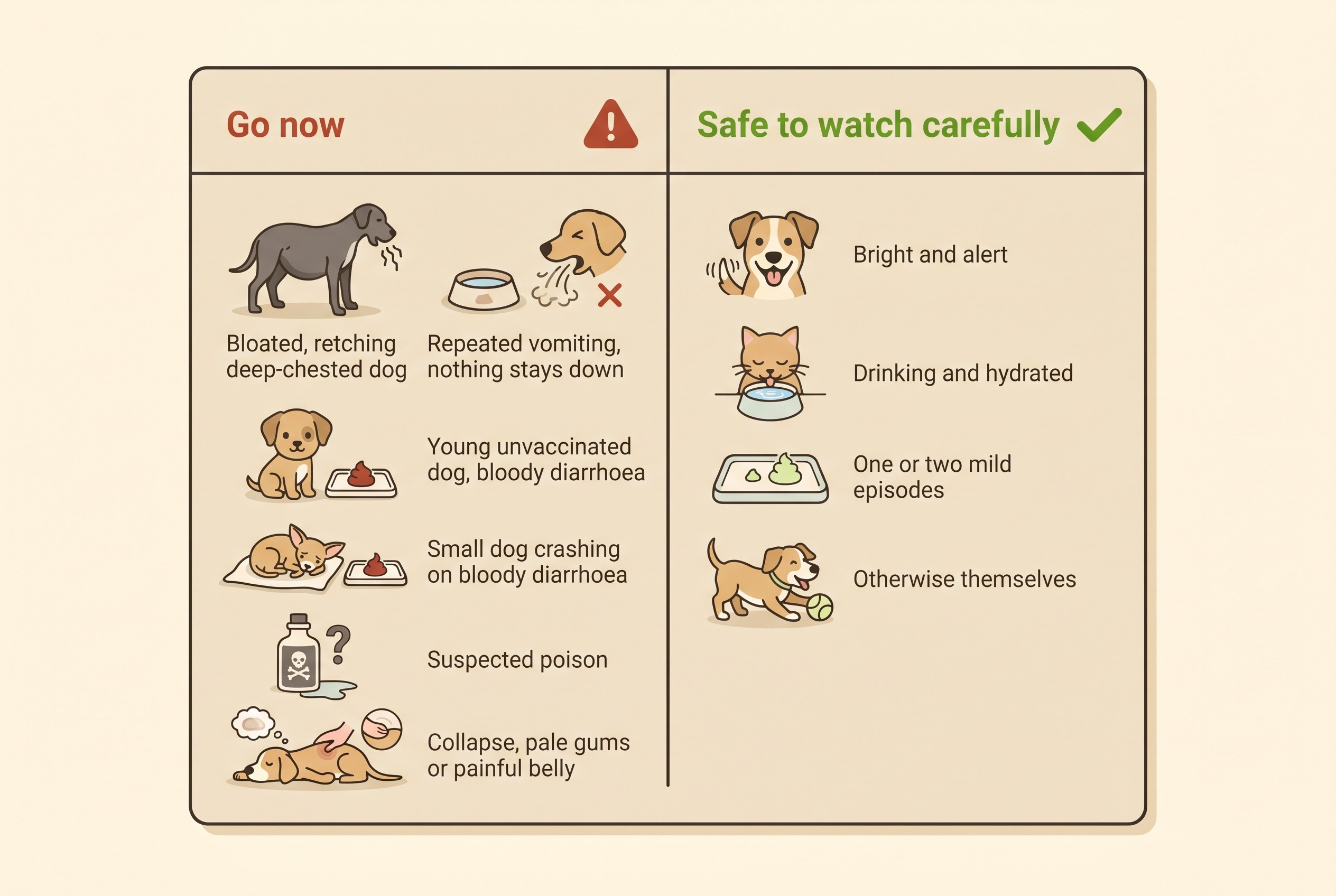
It helps to borrow how vets sort these cases. The reassuring picture is a pet that stays bright, alert, well hydrated and stable even while being sick or passing diarrhoea; what moves a case up the scale is systemic illness, meaning dullness, dehydration that doesn't pick up, fever, or blood with a pet who is unwell rather than simply messy (WSAVA, 2024). The patterns below are the owner-visible version of that line. I won't re-tread what's causing the upset, which is laid out in vomiting and diarrhoea explained.
Bloat (GDV): the deep-chested dog, measured in hours
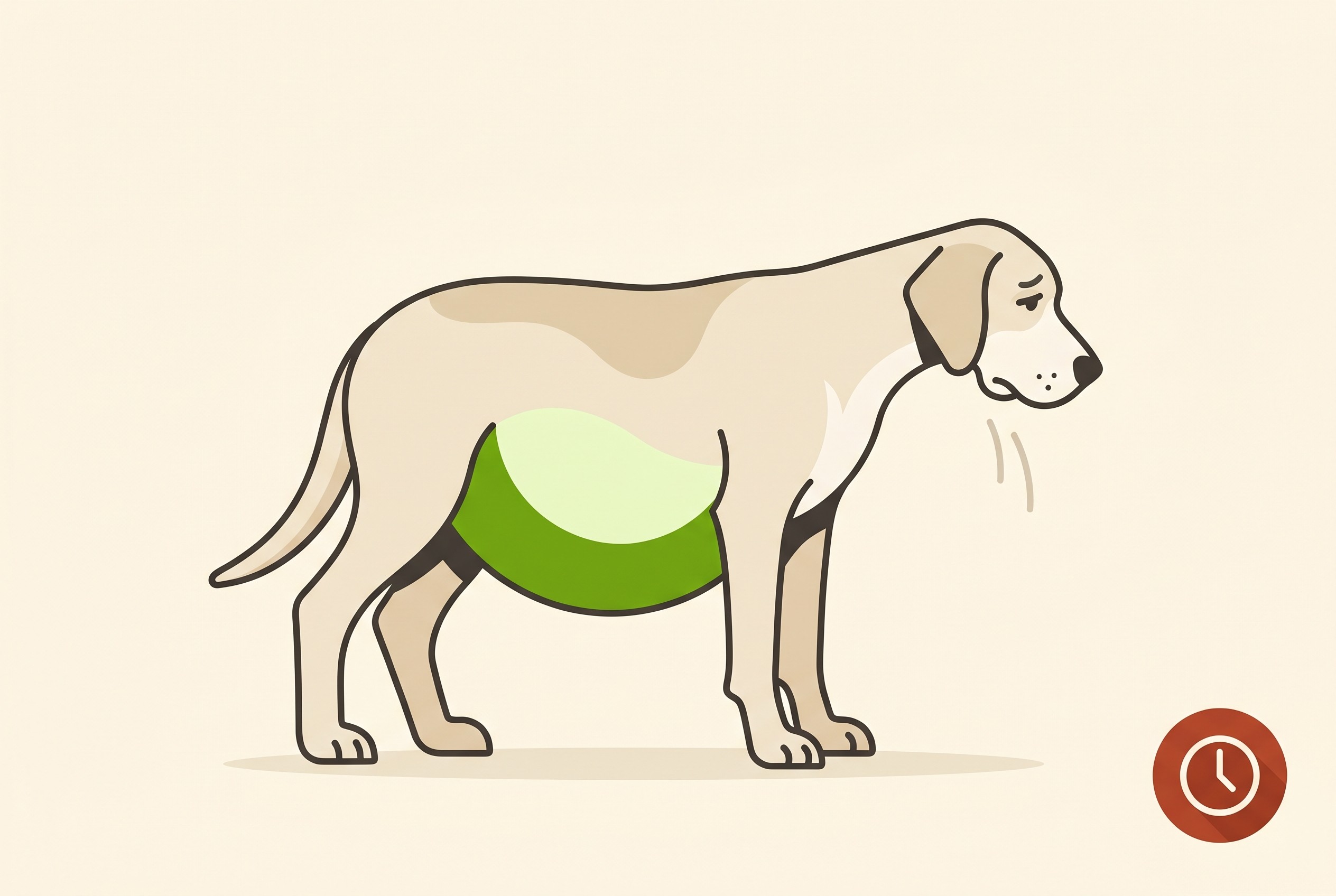
If you own a large, deep-chested dog, this is the one to know cold. Gastric dilatation and volvulus, or GDV ("bloat"), is where the stomach fills with gas and then twists on itself, sealing off its exits and its own blood supply and tipping the dog into shock fast (MSD Veterinary Manual). That twist is why it cannot be waited out or "burped" at home: it is a life-threatening surgical emergency, and even with prompt treatment roughly 10 to 30% of affected dogs do not survive (MSD Veterinary Manual). The big, deep-chested breeds are most at risk (Great Danes carry a lifetime risk of around a third, with German Shepherds, Weimaraners and Saint Bernards behind), and risk rises with age, a first-degree relative who has bloated, fast eating, and a raised bowl (Glickman et al., 2000; Ward et al., 2003).
The picture you are searching for at 11pm: a swollen, hard, distended belly; unproductive retching (trying to be sick over and over but bringing up little or nothing); restlessness, distress and drooling, progressing to collapse (MSD Veterinary Manual). That means go now, not in the morning.
A word on prevention. A prophylactic gastropexy (tacking the stomach to the body wall, often done at neutering in an at-risk breed) does not stop the stomach bloating but dramatically reduces the chance of the deadly twist, with a large modelled survival benefit in the highest-risk breeds, so it is worth raising for a giant-breed puppy (Ward et al., 2003).
When something gets stuck (and why you never pull the string)
The classic story is a pet that vomits repeatedly with little or nothing staying down, often after swallowing a toy, bone, corn cob or sock. When something lodges so that food and fluid cannot pass, that is an obstruction, and a complete one is an emergency that worsens the longer it is left (Hayes, 2009). In a first-opinion series of 208 gastrointestinal foreign body cases, 91% recovered overall, but a longer duration of signs before treatment, and the type of object, both predicted death (Hayes, 2009). Watch for the partial obstruction too: a pet still eating and vomiting only on and off looks less alarming, yet a partial blockage can become complete, so grumbling vomiting after a scavenge still warrants a call.
The bigger danger is the type of object. A linear foreign body (string, thread, tinsel or ribbon) is far more dangerous than a discrete one, and cats are the classic victims because they swallow it. In that same series, survival for linear foreign bodies was much worse (80% in dogs, 63% in cats) than for discrete objects (94% in dogs, 100% in cats) (Hayes, 2009). The mechanism is grim: the string anchors at one point, commonly under a cat's tongue, while the gut keeps pushing the rest along, so the intestine concertinas onto it and the taut thread can saw through the bowel wall, causing perforation and life-threatening infection (Hayes, 2009). In cats, linear foreign bodies reliably mean longer, more difficult surgery and higher complication rates than a discrete object (Gollnick et al., 2023). Hence the single most important instruction here: if you can see a thread hanging from your pet's mouth or bottom, do not pull it, because pulling can cut the gut from the inside. Leave it and get to the vet.
Parvovirus: the young, unvaccinated dog
Parvovirus is a young dog's disease: a puppy, unvaccinated or only part-way through its course, with sudden, often bloody and foul-smelling diarrhoea, vomiting, profound lethargy and collapse. It is among the commonest causes of serious illness and death in young dogs worldwide, because the virus strips both the gut lining and the bone marrow, so these puppies dehydrate and become overwhelmed by infection fast (Mazzaferro, 2020). The picture cuts both ways, and that is the reassurance: untreated, it kills a very high proportion of the dogs it infects, but with prompt, aggressive in-hospital care survival is commonly over 80 to 90% (Mazzaferro, 2020), and even structured outpatient care saved about 75% in one study where hospitalisation was not possible (Sarpong et al., 2017). Deadly if ignored, very survivable if treated quickly.
Prevention is the real headline: parvovirus is a core vaccine for every dog, a puppy course given every two to four weeks with the final dose at 16 weeks of age or older, and until that course is finished a puppy is not yet fully protected (Squires et al., 2024). Most parvo deaths are in dogs who never needed to catch it.
Acute haemorrhagic diarrhoea syndrome: the small dog who crashes
This one catches owners out. Acute haemorrhagic diarrhoea syndrome, or AHDS, is a sudden outpouring of profuse, often jam-like bloody diarrhoea (sometimes with vomiting) that causes rapid, severe dehydration within hours and can tip a dog into shock (Busch & Unterer, 2022). You may still see it called haemorrhagic gastroenteritis (HGE) on older pages; the name changed because the stomach is usually spared, and it is now linked to a toxin-producing strain of Clostridium perfringens (Busch & Unterer, 2022). It typically hits young to middle-aged small and toy breeds (Yorkshire Terriers, Miniature Schnauzers, Maltese), median age around five years (Busch & Unterer, 2022).
The danger is not an infection that needs killing, it is the speed and volume of fluid lost: a small dog can become dangerously haemoconcentrated and shocked within hours, so the cornerstone of treatment is prompt intravenous fluids, and one going flat on copious bloody diarrhoea needs the vet that day (Busch & Unterer, 2022). Owners assume blood means antibiotics, but in a placebo-controlled, blinded trial, AHDS dogs with no signs of sepsis did no better on amoxicillin/clavulanate than on placebo, with no difference in survival, hospital stay or severity (Unterer et al., 2011). So the urgency is fluids, not antibiotics; the wider antibiotic question lives with does my pet need antibiotics for diarrhoea.
Suspected poisons: ring first, don't wait for signs
With a suspected poison, the rule runs against instinct: ring your vet or a poisons line straight away, with the packet and a rough idea of the amount and the time in hand, rather than waiting for signs. For several of these, the most effective treatment is decontamination before the toxin is absorbed, a window that opens early and closes fast. This is a focused shortlist; the wider scavenging angle lives with dietary indiscretion.
Chocolate. Dark and baking chocolate are far more dangerous than milk chocolate, and white chocolate barely registers, because the danger is the methylxanthines (theobromine and caffeine), whose effects climb with dose from mild signs through heart effects to seizures (VPIS, 2014). It is rarely fatal and about half of cases stay symptom-free, but because the risk depends on the type and the amount per kilogram, the maths is a job for the phone, and UK exposures spike around Christmas and Easter (VPIS, 2014; Noble et al., 2017).
Grapes, raisins, sultanas and currants. These can cause acute kidney injury in dogs, with tartaric acid the leading suspect as the toxic principle, which dogs seem to handle poorly (Wegenast et al., 2022). The dangerous dose is unpredictable from one dog to the next, so any meaningful ingestion is a ring-the-vet-now event, not a watch-and-see.
Xylitol (also labelled birch sugar, found in sugar-free gum, sweets, some peanut butters and baked goods). Very dangerous to dogs, causing a sudden, sharp drop in blood sugar and, at higher doses, liver injury, with signs that can begin within about 30 minutes, so it is a phone-immediately poison (MSD Veterinary Manual). Other hazards exist too (some plants, human medicines, antifreeze); when in doubt, the move is the same: ring and check.
Signs that override whatever started it
Some signs say a pet is genuinely unwell whatever triggered it. These trust-the-whole-pet signs each earn a same-hour call.
- Collapse, marked weakness, or being unable to stand in a pet that was recently fine.
- Pale, white or grey gums (which can signal shock or internal bleeding), or gums that are very dry and tacky.
- A painful, tense or bloated belly, or a pet that flinches, guards its tummy or hunches into a "praying" posture. A truly painful abdomen is never something to sit on: it can mean obstruction or pancreatitis, the latter covered in pancreatitis explained.
- Repeated, unproductive vomiting, or repeated vomiting with nothing (not even water) staying down.
And one rule lowers the bar across all of the above: the more vulnerable the patient, the sooner you call. A very young puppy or kitten, a frail old pet, a pregnant animal, a tiny-breed dog or a diabetic can deteriorate alarmingly fast, so what you might watch in a robust adult becomes a phone call in them.
What to do in the moment
For any of the patterns above, phone first: a quick call lets the team prepare and tells you whether to come straight in or head to an out-of-hours service. And the hard don'ts: do not make a vomiting, bloated dog wait until morning; do not pull a string seen at the mouth or bottom; do not give human medicines or a leftover antibiotic; and do not wait for more signs if instinct says something is wrong.
For everything not on that list, which is most things, the common miserable-but-safe upset is handled calmly at home within limits, set out in when can you treat a tummy upset at home. The Vomiting & Diarrhoea Triage walks you through these exact red-flags so an out-of-hours decision is grounded rather than guessed, and the Faecal Score Tracker turns "his diarrhoea seems worse" into a dated record your vet can act on, and helps you catch a mild case tipping into a serious one. What turns a bad night into a good outcome is rarely a clever home remedy: it is knowing these patterns, and acting on them without hesitating.
References
- Busch, K., & Unterer, S. (2022). Update on acute hemorrhagic diarrhea syndrome in dogs. Advances in Small Animal Care, 3, 51–63.
- Glickman, L. T., Glickman, N. W., Schellenberg, D. B., Raghavan, M., & Lee, T. L. (2000). Non-dietary risk factors for gastric dilatation-volvulus in large and giant breed dogs. Journal of the American Veterinary Medical Association, 217(10), 1492–1499.
- Gollnick, H. R., Schmiedt, C. W., Wallace, M. L., Sutherland, B. J., & Grimes, J. A. (2023). Retrospective evaluation of surgical treatment of linear and discrete gastrointestinal foreign bodies in cats: 2009–2021. Journal of Feline Medicine and Surgery, 25(7).
- Hayes, G. (2009). Gastrointestinal foreign bodies in dogs and cats: a retrospective study of 208 cases. Journal of Small Animal Practice, 50(11), 576–583.
- Mazzaferro, E. M. (2020). Update on canine parvoviral enteritis. Veterinary Clinics of North America: Small Animal Practice, 50(6), 1307–1325.
- MSD Veterinary Manual. Gastric dilation and volvulus in small animals; Acute hemorrhagic diarrhea syndrome in dogs; Chocolate toxicosis in animals; Xylitol toxicosis in dogs.
- Noble, P. J. M., Newman, J., Wyatt, A. M., Radford, A. D., & Jones, P. H. (2017). Heightened risk of canine chocolate exposure at Christmas and Easter. Veterinary Record, 181(25), 684.
- Sarpong, K. J., Lukowski, J. M., & Knapp, C. G. (2017). Evaluation of mortality rate and predictors of outcome in dogs receiving outpatient treatment for parvoviral enteritis. Journal of the American Veterinary Medical Association, 251(9), 1035–1041.
- Squires, R. A., Crawford, C., Marcondes, M., & Whitley, N. (2024). 2024 guidelines for the vaccination of dogs and cats compiled by the Vaccination Guidelines Group (VGG) of the World Small Animal Veterinary Association (WSAVA). Journal of Small Animal Practice, 65(5), 277–316.
- Unterer, S., Strohmeyer, K., Kruse, B. D., Sauter-Louis, C., & Hartmann, K. (2011). Treatment of aseptic dogs with hemorrhagic gastroenteritis with amoxicillin/clavulanic acid: a prospective blinded study. Journal of Veterinary Internal Medicine, 25(5), 973–979.
- VPIS (Veterinary Poisons Information Service). (2014). Revised treatment doses for chocolate.
- Ward, M. P., Patronek, G. J., & Glickman, L. T. (2003). Benefits of prophylactic gastropexy for dogs at risk of gastric dilatation-volvulus. Preventive Veterinary Medicine, 60(4), 319–329.
- Wegenast, C. A., Meadows, I. D., Anderson, R. E., Southard, T., Gonzalez Barrientos, C. R., & Wismer, T. A. (2022). Acute kidney injury in dogs following ingestion of cream of tartar and tamarinds and the connection to tartaric acid as the proposed toxic principle in grapes and raisins. Journal of Veterinary Emergency and Critical Care, 32(6), 812–816.
- WSAVA (World Small Animal Veterinary Association). (2024). Canine acute diarrhoea: management guidance and antimicrobial use (compiled with ENOVAT); approximately 90% of cases mild, high-certainty evidence antimicrobials not needed for mild and moderate cases.
Keep track of how your pet is doing
The owners who cope best are the ones who notice changes early. A simple health log shows you what is working, and what is not, before the next vet visit.
Start tracking, freeYou're not doing this alone
Compare treatment journeys and talk to owners managing digestive health. Free to join.
Join PetsLikeMine