

Dietary indiscretion and garbage gut: the dog who ate something he should not
Alastair Greenway
BVM&S MRCVS
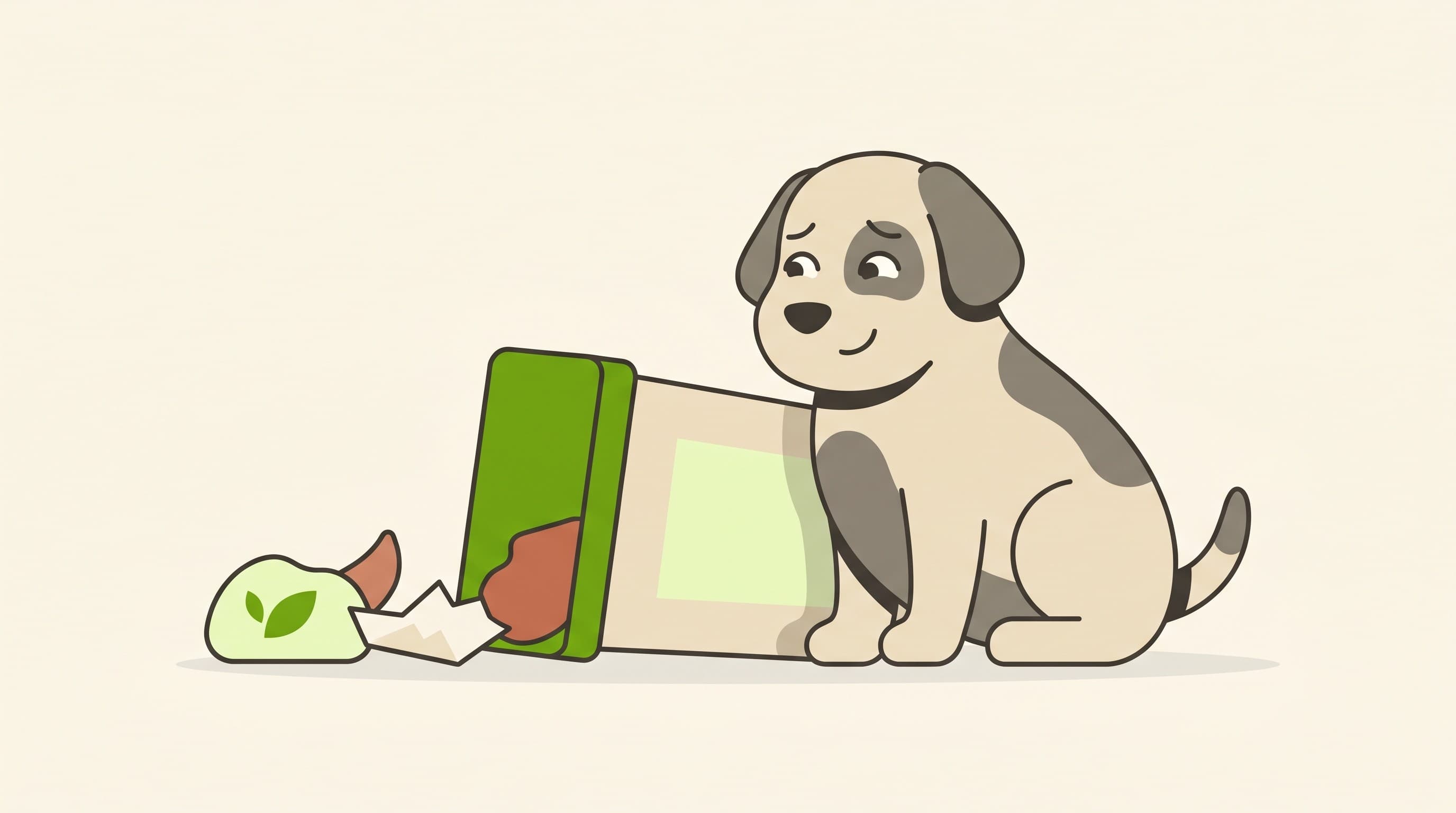
You turn your back for thirty seconds, and the bin is on its side, or the butter is gone, or the look on his face tells you the sausage roll that was on the side a moment ago is now somewhere inside him. By next morning there is sick on the kitchen floor, or diarrhoea in the garden, and you are left with two questions that are really only one. Is this just an upset that will pass, and is there anything here that is actually dangerous?
Dietary indiscretion, the catch-all for a dog eating something he should not, is the single most common cause of an acute tummy upset in dogs, and the great majority of the time it is exactly what it looks like: miserable for a day or two, then over (BSAVA Manual of Canine and Feline Gastroenterology, 2019). But it sits right on top of a small handful of things that masquerade as "he just ate something" and are not benign at all. My job here is to help you tell the ordinary from the dangerous, without either frightening you or lulling you.
What "garbage gut" actually is
"Dietary indiscretion" is just the clinical phrase for eating without discrimination: the bin raid, the rich or fatty treat, the table scraps, the spoiled food found on a walk, faeces, or a non-food object hoovered up off the floor (BSAVA Manual of Canine and Feline Gastroenterology, 2019). When spoiled material is involved, vets sometimes call it "garbage gut" or garbage toxicosis, which is as inelegant as it sounds and describes it perfectly.
The mechanism is not one single thing. An abrupt load of unfamiliar, rich, spoiled or simply excessive food, along with the bacteria and their toxins in anything that was going off, irritates the stomach and intestine, upsets the normal rhythm of the gut and disturbs its resident microbes. The result is the vomiting, the diarrhoea, or both, that brought you here (BSAVA Manual of Canine and Feline Gastroenterology, 2019).
One thing is worth saying early, because most pages gloss over it: this is largely a dog story. Cats are fussier and scavenge far less, so classic garbage gut is uncommon in them. But cats are over-represented for one particular indiscretion that is a genuine emergency, the linear foreign body (string, thread, tinsel, ribbon), which I will come back to. So when I say "dog" through most of this, that is deliberate, not lazy.
Why it usually ends well
Picture the typical case. An adult dog, bright in himself, drinking, maybe a bit subdued and off his food, with one or two episodes of vomiting or a soft stool after a known raid on something he should not have had. That dog is the classic self-limiting upset, and most settle within a day or two with simple support at home (BSAVA Manual of Canine and Feline Gastroenterology, 2019).
I am not going to set out the home-care protocol here, because a sibling article does it properly, but two modern points are worth a sentence each so you do not go wrong on them. First, do not impose a long starve. The old advice to withhold food for twenty-four hours has not aged well: the evidence from the severe end of the spectrum points the other way, with early feeding producing a faster return of appetite, demeanour and normal stools and better weight recovery than waiting (Mohr et al., 2003). Offer water, then small amounts of something light and easily digested sooner rather than later. Second, an uncomplicated indiscretion almost never needs antibiotics, which most dogs do not benefit from and which carry a real cost to the gut microbes (Langlois et al., 2020), and a probiotic paste may modestly shorten the diarrhoea but is no magic bullet (Nixon et al., 2019). The how-to of all of this, and the antibiotic question in full, live in tummy upset home care and antibiotics for diarrhoea. Read those for the doing; stay here for the deciding.
When "he just ate something" is hiding something else
For every hundred upsets that pass on their own, there is a small number where "he just ate something" is hiding a problem that needs a vet, sometimes urgently. You do not need to become a diagnostician; you need to recognise the short list and pick up the phone.
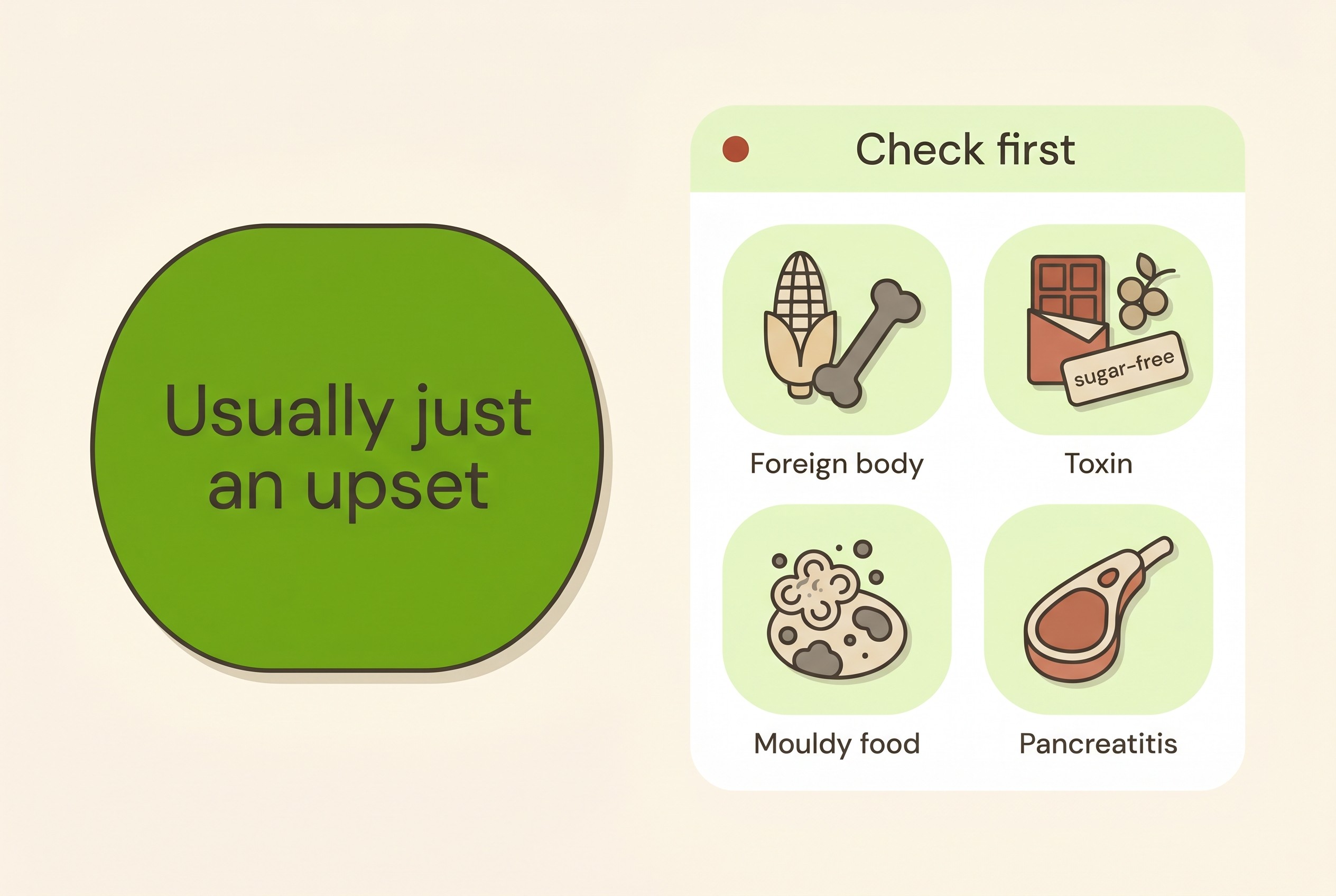
A foreign body or obstruction. If the vomiting is repeated and nothing will stay down, especially after a toy, a bone, a corn cob or a stone, think blockage rather than upset. Corn cobs and bones are among the objects that most commonly lodge and obstruct the gut (Cornell Riney Canine Health Center). Cooked bones deserve a flag of their own: they splinter, and can cause an obstruction, a perforation hours or days later, or a hard constipating impaction (BSAVA Manual of Canine and Feline Gastroenterology, 2019). The linear foreign body is the one to know about in cats. One end of the string anchors, at the base of the tongue or the outflow of the stomach, while the gut gathers itself up along the rest, and ordinary peristalsis then saws the taut material into the bowel wall, risking multiple perforations and a life-threatening peritonitis (BSAVA Manual of Canine and Feline Gastroenterology, 2019). The single practical rule: if you can see string coming from your pet's mouth or bottom, never pull it. Cut what is visible if it is around the tongue, and ring your vet.
A toxin. A scavenged item may simply be poisonous, and here the safe move is to check, not to wait and watch. The four worth naming by heart:
- Chocolate. The trouble is the theobromine, and toxicity is both dose- and type-dependent: roughly, mild signs from small amounts, heart effects and then seizures as the dose climbs (Merck Veterinary Manual; Gwaltney-Brant). Dark chocolate, baking chocolate and cocoa powder carry far more than milk chocolate, and white chocolate is essentially negligible. Theobromine also lingers in a dog for a long time, so signs can persist for a day or more (Merck Veterinary Manual). You do not need the exact numbers; you need to ring with the type and the rough amount.
- Grapes, raisins, sultanas and currants. This is where I most want to correct the internet. The suspected culprit is tartaric acid and its salt (Wegenast et al., 2022), and the crucial point is that there is no reliable safe dose. The tartaric-acid content varies with grape type, growing conditions and ripeness, and individual dogs vary in sensitivity, so any ingestion should be treated as potentially toxic, with acute kidney injury the outcome we fear (VPIS, 2021; Cornell Riney Canine Health Center). If a website tells you a "safe number of grapes", distrust it. We cannot give you one, which is exactly why a phone call beats a guess.
- Xylitol (sometimes labelled birch sugar), in sugar-free gum, sweets, some peanut butters and baked goods. In dogs it triggers a brisk surge of insulin, dropping the blood sugar at low doses and damaging the liver at higher ones, and it can act within thirty to sixty minutes (Merck Veterinary Manual; Veterinary Partner/VIN). For practical purposes this is a dogs-only danger, and it moves fast, so it is one to ring about straight away.
- Spoiled, mouldy food and compost. Beyond a simple upset, mouldy food, compost heaps and fallen nuts can contain tremorgenic mycotoxins, which produce rapid-onset whole-body tremors, twitching, wobbliness and even seizures rather than just sickness (UK Vet Companion Animal, 2021). Most owner pages miss this entirely. If your dog has raided something rotten and then starts shaking or twitching, that is not "just an upset", it is an emergency.
I am deliberately keeping the toxin detail light, because the moment-by-moment management, the doses and the in-clinic treatment belong with the emergencies. The owner-relevant message is the same for all four: phone your vet or an animal poison line with what was eaten and how much, rather than watching and hoping. Everything urgent here is covered properly in digestive emergencies.
A triggered bout of pancreatitis. A fatty indiscretion is a recognised trigger for acute pancreatitis. In a case-control study, eating an unusual food item raised the odds of pancreatitis (around fourfold), with getting into the bin carrying the greatest risk of all (Lem et al., 2008). I will not retread what pancreatitis is, or the well-worn idea that it is only ever about one fatty meal, because most cases are in fact idiopathic and a fatty meal is one risk factor among several (Cridge et al., 2022); the sibling article does that reframe in full. What matters here is simply to know the link, so that a dog who raids the Christmas ham and then turns into a hunched, painful, repeatedly sick patient gets seen rather than dismissed. The full picture is in pancreatitis explained, and the low-fat feeding that helps a scavenging-prone dog afterwards is in low-fat feeding for pancreatitis.
What lowers the threshold to call
Three things should make you reach for the phone sooner rather than later, and they stack.
The item. Bones, especially cooked ones, corn cobs, stones and peach stones, string or any linear material, a large volume of fat, or anything possibly toxic (chocolate, grapes and their dried cousins, xylitol products, mouldy food). The patient. The very young or very old, the toy breed or tiny dog, the pregnant bitch, the diabetic, and any pet already living with disease all have less room for spare. And the trajectory. Repeated unproductive retching, a bloated, hard or painful belly, blood at either end, collapse, tremors or any neurological sign, or signs that are getting worse rather than settling. Any one of these flips the situation from "watch at home" to "ring now", and they are all anchored, with what to do about each, in digestive emergencies.
Stopping it happening again
Prevention is the part of this story you actually control, and it is worth more than any remedy.
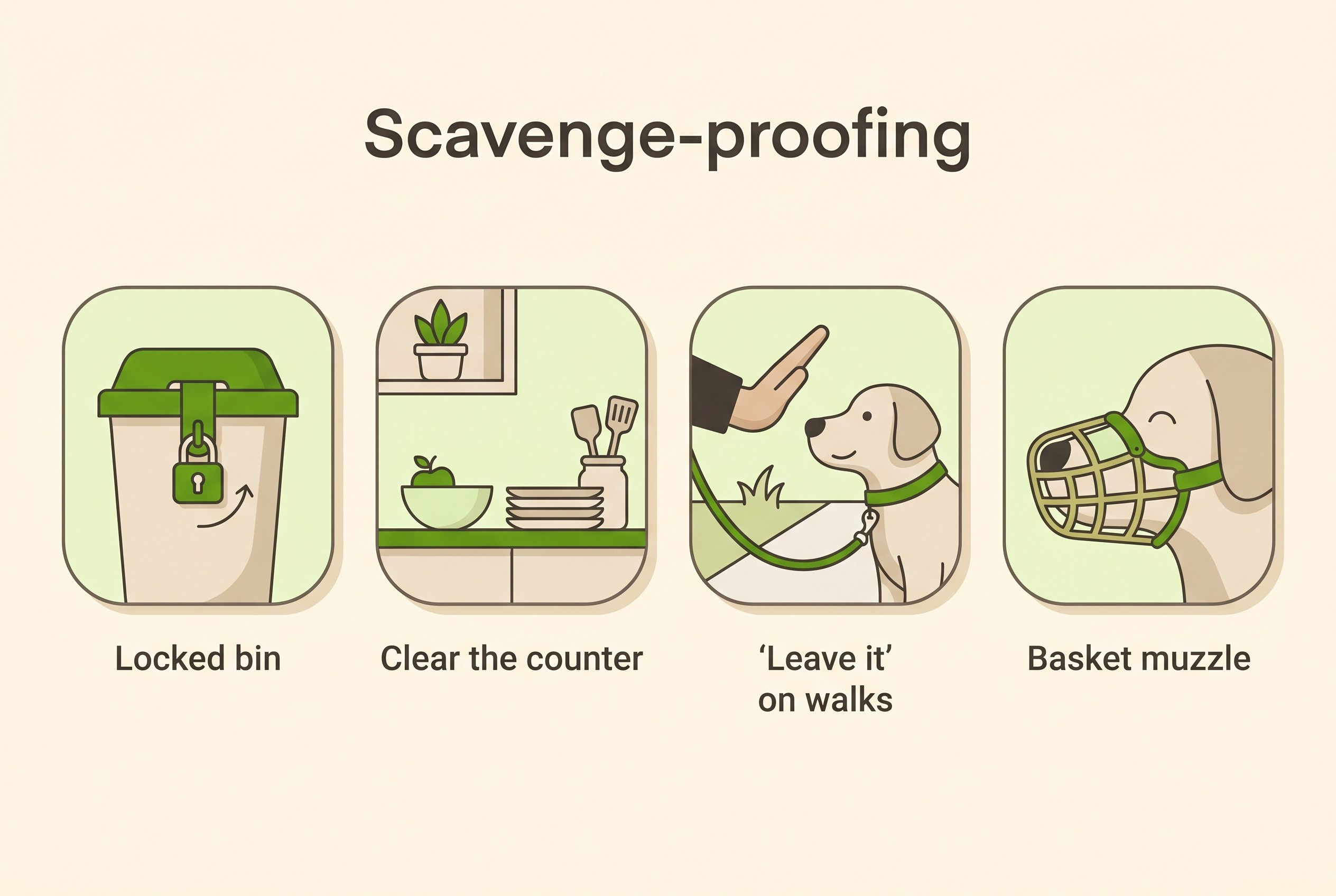
Most of it is dull and effective. A bin that locks or lives behind a cupboard door. Counters and tables kept clear, particularly of the things that are dangerous rather than merely rich. Supervision on walks, because scavenging is opportunistic and the half-eaten kebab on the verge is found in seconds. Care around compost heaps and fallen fruit and nuts in autumn. And keeping chocolate, grapes and raisins, and anything sugar-free, well out of reach, with extra vigilance at the predictable danger points: Christmas, Easter, and the summer barbecue.
Beyond the house, training earns its keep. A reliable "leave it" or "off" and a solid recall are genuinely protective, and for the committed scavenger who will eat anything anywhere, a well-fitted basket muzzle on walks is a kind and legitimate tool, not a cruelty. On bones, let me be plain rather than coy: the safest position is that cooked bones should not be fed at all, because they splinter, obstruct and perforate, and even raw bones carry real risks of obstruction, fractured teeth and contamination (BSAVA Manual of Canine and Feline Gastroenterology, 2019). A bone is not the benign chew it is often sold as.
The decision, and when to pick up the phone
So bring it back to that kitchen floor and the two questions that were really one. For most dogs, most of the time, dietary indiscretion is a thoroughly unpleasant but safe upset that you can support gently at home for a day or two. What changes that is a defined and short list: a worrying item, a vulnerable patient, or a trajectory heading the wrong way.
A couple of simple habits make the difference between guessing and knowing. Log what was eaten, roughly how much and when, alongside the stools, on the Faecal Score Tracker, so that you can actually see whether things are settling or sliding, and so your vet can see it too if you do end up booking in. And if you are genuinely unsure whether to watch or to ring, run the Vomiting and Diarrhoea Triage, which walks you through the same questions I would ask down the phone. The wider map of where this sits among all the other causes of sickness and diarrhoea is in vomiting and diarrhoea explained if you want the bigger picture.
The grape rule is the one the content mills get wrong: there is no known safe amount, so any ingestion warrants a call (VPIS, 2021; Cornell Riney Canine Health Center). And the broader principle behind it holds for the whole list. When you are not sure, ring your vet or a poison line and tell them what went in and how much. It costs nothing, it takes a few minutes, and it is almost always the answer to that second question before it has the chance to become a worse one.
References
- BSAVA Manual of Canine and Feline Gastroenterology, 3rd edn. Hall, E. J., Williams, D. A., & Kathrani, A. (eds). BSAVA/Wiley; 2019. ISBN 9781905319961.
- Cornell University College of Veterinary Medicine, Riney Canine Health Center. Grape and raisin toxicity; Gastrointestinal foreign body obstruction in dogs.
- Cridge, H., Lim, S. Y., Algül, H., & Steiner, J. M. (2022). New insights into the etiology, risk factors, and pathogenesis of pancreatitis in dogs. Journal of Veterinary Internal Medicine, 36(3), 847-864.
- Gwaltney-Brant, S. Chocolate intoxication (ASPCA Animal Poison Control toxbrief).
- Langlois, D. K., Koenigshof, A. M., & Mani, R. (2020). Metronidazole treatment of acute diarrhea in dogs: A randomized double blinded placebo-controlled clinical trial. Journal of Veterinary Internal Medicine, 34(1), 98-104.
- Lem, K. Y., Fosgate, G. T., Norby, B., & Steiner, J. M. (2008). Associations between dietary factors and pancreatitis in dogs. Journal of the American Veterinary Medical Association, 233(9), 1425-1431.
- Merck Veterinary Manual. Chocolate Toxicosis in Animals; Xylitol Toxicosis in Dogs (Toxicology, Food Hazards).
- Mohr, A. J., Leisewitz, A. L., Jacobson, L. S., Steiner, J. M., Ruaux, C. G., & Williams, D. A. (2003). Effect of early enteral nutrition on intestinal permeability, intestinal protein loss, and outcome in dogs with severe parvoviral enteritis. Journal of Veterinary Internal Medicine, 17(6), 791-798.
- Nixon, S. L., Rose, L., & Muller, A. T. (2019). Efficacy of an orally administered anti-diarrheal probiotic paste (Pro-Kolin Advanced) in dogs with acute diarrhea: A randomized, placebo-controlled, double-blinded clinical study. Journal of Veterinary Internal Medicine, 33(3), 1286-1294.
- UK Vet Companion Animal. (2021). Tremorgenic mycotoxicosis in dogs. Companion Animal.
- Veterinary Partner / VIN. Xylitol Poisoning in Dogs.
- Veterinary Poisons Information Service (VPIS). (2021). Cause of grape-induced kidney injury in dogs.
- Wegenast, C. A., Meadows, I. D., Anderson, R. E., Southard, T., González Barrientos, C. R., & Wismer, T. A. (2022). Acute kidney injury in dogs following ingestion of cream of tartar and tamarinds and the connection to tartaric acid as the proposed toxic principle in grapes and raisins. Journal of Veterinary Emergency and Critical Care, 32(6), 812-816.
Keep track of how your pet is doing
The owners who cope best are the ones who notice changes early. A simple health log shows you what is working, and what is not, before the next vet visit.
Start tracking, freeYou're not doing this alone
Compare treatment journeys and talk to owners managing digestive health. Free to join.
Join PetsLikeMine