

Feeding for a pancreas: the low-fat life, treats and the long game
Alastair Greenway
BVM&S MRCVS
"Keep him on a low-fat diet from now on." That one line in the discharge conversation is usually what sends owners here, the crisis behind them and the dog home and bright again. The trouble is what comes next: you are standing in front of a bag of food with no real idea whether it counts. What about treats? The bin? The kids dropping toast? The cat's much richer food in the same kitchen? "Feed a sensitive diet" turns out to be advice you cannot actually follow, because nobody has told you what it means.
I will not re-explain what pancreatitis is, or whether it really was that one fatty meal (usually not the whole story; pancreatitis explained covers it), nor the hospital end of a flare, which lives in the pancreatitis flare. This piece starts once your pet is home and recovered: how do you feed for a pancreas, for life, in a way the whole household can keep to?
Why low-fat matters, and why steadiness beats perfection
Let me start with the unvarnished version of the science, because most pages skip it. In dogs, long-term dietary fat restriction is the cornerstone of preventing another attack, and the single thing most within your control (Cridge et al., 2024; Shmalberg, 2016). The reasoning is sound: fat arriving in the small intestine is the strongest trigger for the hormone cholecystokinin, which drives the pancreas to secrete its enzymes, so a lower-fat meal asks less of an already irritable gland (Shmalberg, 2016; Cridge et al., 2024). What the confident internet advice buries is that these effects have not actually been demonstrated in patients on nutritional support, and no controlled trials prove a specific fat level prevents recurrence; the thresholds rest on clinical experience, not experiment, so the principle is sound even though the precise number is not (Shmalberg, 2016; Salinardi, 2018).
What we do have firm evidence for is risk. A case-control study comparing 198 dogs with pancreatitis to 187 without found that getting into the rubbish carried an odds ratio of 13.2 for an attack, eating unusual food items 6.1, and table scraps roughly 2.2, with overweight dogs also at higher odds of 1.3 (Lem et al., 2008). So the goal is not anxiety about one mouthful; it is a steady, everyday low-fat pattern the whole household keeps to (Lem et al., 2008; Cridge et al., 2024). Chronic pancreatitis is a recurring, progressive condition that can quietly erode quality of life over years, which is the real reason to take the long game seriously, calmly rather than in a panic (Watson, 2015).
What "low-fat" actually means
This is the bit you cannot find stated clearly anywhere, so here it is plainly. There is no single agreed figure, and published targets differ: a widely used practical target for dogs with pancreatitis is under about 20 grams of fat per 1,000 kilocalories (Cridge et al., 2024; Merck Veterinary Manual), while a broader veterinary scheme counts under 30 g per 1,000 kcal as low fat, 30 to 50 as moderate, and over 50 as high fat (Shmalberg, 2016). As a rough rule of thumb, "low fat" for dogs is often taken as under about 10% fat on a dry-matter basis (Dog Food Advisor, dry-matter method). Grams per 1,000 kcal is the more meaningful figure, because it accounts for how calorie-dense the food is.
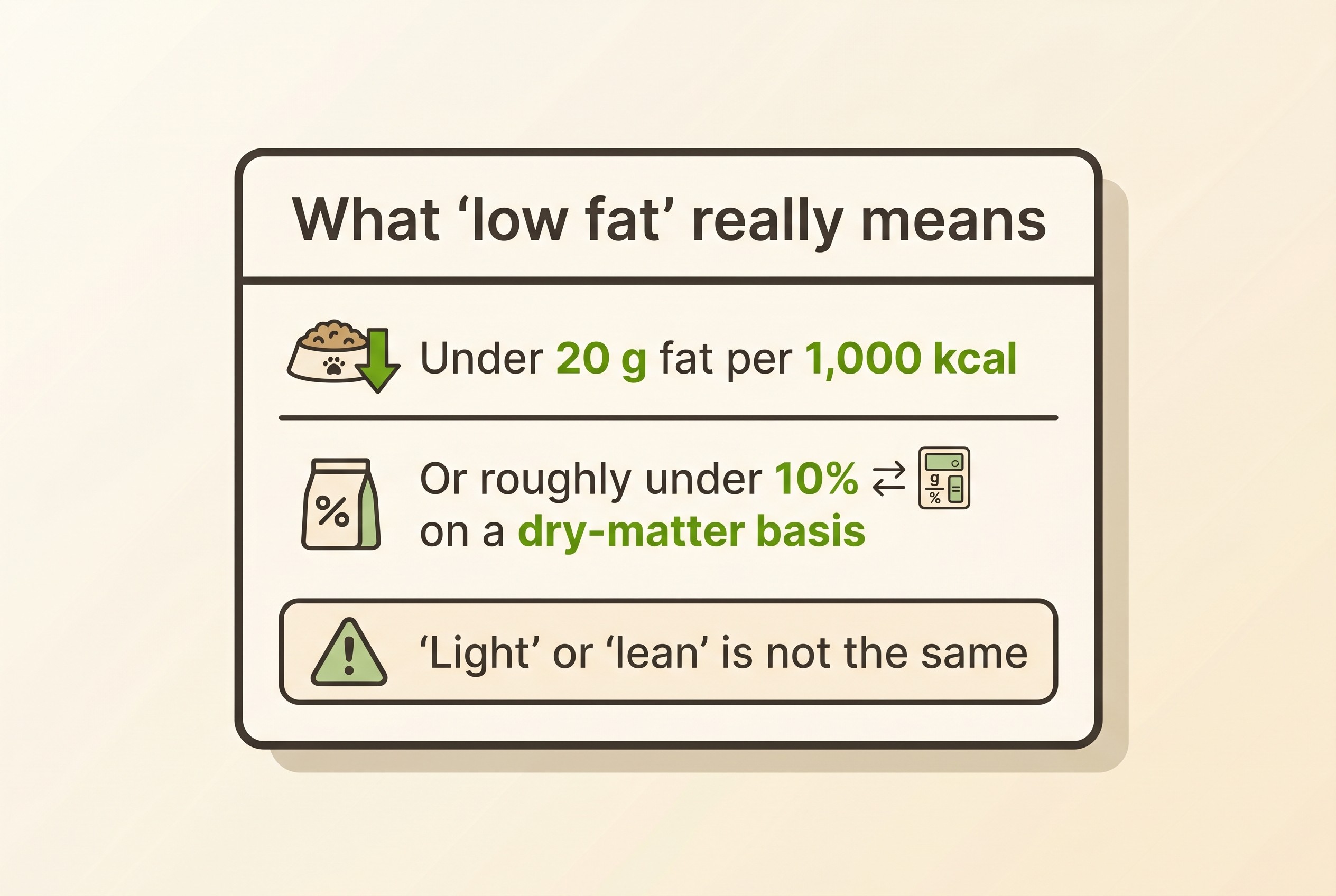
Two traps catch people out. The first is the label. "Light", "lite" and "lean" are marketing claims about calories or a fat ceiling, not a therapeutic low-fat formulation: a word on the front of the pack is not a fat target. The number you want is in the guaranteed analysis, and for a UK shopper the more useful label distinction is "complete" (a food that can be fed as the whole diet) versus "complementary" (one that cannot).
The second trap is water. The fat figure is given "as fed", which includes moisture, so a wet food that looks reassuringly low on the tin can be high once the water is taken out. To compare a tin and a kibble fairly, convert to dry matter: divide the fat percentage by (100 minus the moisture percentage), then multiply by 100. A wet food showing 7% fat at 78% moisture works out at 7 divided by 22, times 100, about 32% fat on a dry-matter basis: not low fat at all (Dog Food Advisor, dry-matter method). That one piece of arithmetic lets you see through a misleading label.
One last point, because owners often overshoot: fat-free is wrong and harmful. Dogs need dietary fat for essential fatty acids and to absorb the fat-soluble vitamins, and even a dog with high blood fats should still receive at least its minimum, with a floor of around 14 g fat per 1,000 kcal cited as illustrative of "no lower than necessary" (Shmalberg, 2016). So aim low, confirm the exact target with your own vet, and do not chase an extreme (Shmalberg, 2016; Cridge et al., 2024).
Prescription diets, home cooking, and small meals
The simplest reliable route is a veterinary therapeutic low-fat or gastrointestinal diet. These are formulated to a known, low fat content and to be complete and balanced, which takes the guesswork and the sums off your plate; they usually need your vet's recommendation, and the right one depends on the dog, not the brand (Cridge et al., 2024).
Home cooking can work, with one real caveat. A plain chicken-and-rice mix is fine for a day or two, but it is not a complete long-term diet, and done casually for months it risks nutrient deficiencies (Cridge et al., 2024; Salinardi, 2018). The safe version is a bespoke recipe from a board-certified veterinary nutritionist, with any supplements specified, rather than one pulled off a forum: a safety point, not a criticism of cooking for your dog. A nutritionist also earns their keep with concurrent disease, where a dog who also has diabetes, high blood fats or kidney disease may not fit one off-the-shelf diet (Cridge et al., 2024). One low-cost tactic: feed the daily ration as several smaller meals rather than one or two large ones, which is often easier to tolerate (Merck Veterinary Manual).
Treats and the whole household
This is where good diets quietly fail: not at the bowl but at the "just one" sausage, the cheese hiding a tablet, the fatty chew, the children sharing crisps. Because dietary indiscretion is a measured risk factor, treats are not a side issue, they are central (Lem et al., 2008).
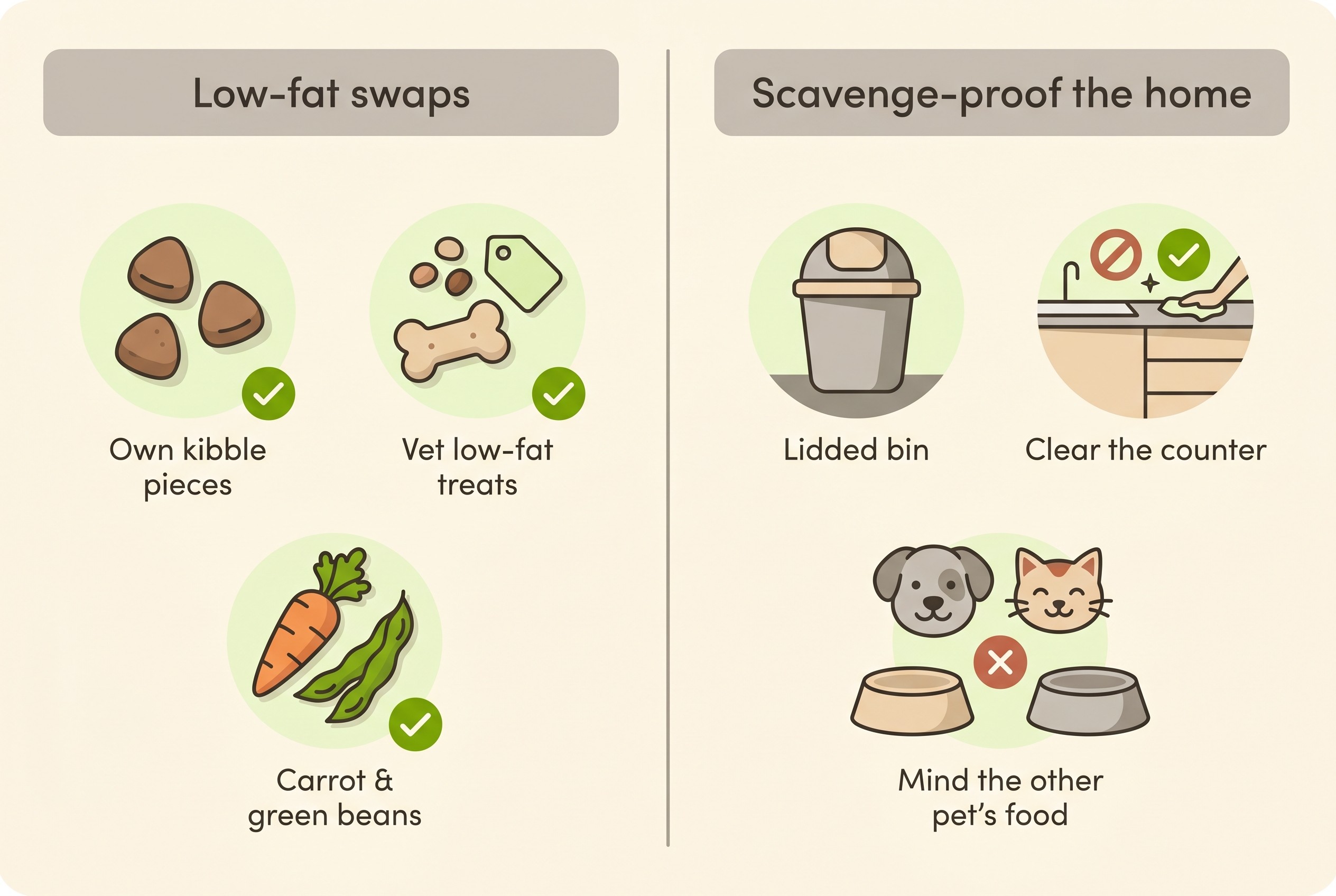
So swap, rather than simply ban. Small pieces of your dog's own low-fat kibble make a perfectly good "treat", as do vet-approved low-fat commercial treats and small amounts of suitable low-fat vegetables such as plain cooked carrot or green beans, all counted within the daily ration so they do not become extra calories. Leave out the fatty things: pizza crusts, fatty meat trimmings, cheese, peanut butter, and fatty dental or rawhide-type chews (and, separately, the foods that are toxic to dogs).
Medication is a sneaky breach too. Tablets are often hidden in cheese or a fatty paste, so the daily pill quietly undoes the diet; use a small piece of the therapeutic food or a low-fat paste instead. The same whole-household discipline that the gut diet-trial articles teach applies here (the chronic enteropathy diet trial covers it in detail): one well-meaning family member or visitor can undo the plan, so everyone who feeds the dog needs to be on the same page.
Then proof the environment, because the single highest-odds risk was getting into the rubbish, at 13.2 (Lem et al., 2008). That means a lidded or cupboard-stored bin, plates cleared promptly, supervision on walks for the bin-raider and counter-surfer, and a plan for the multi-pet house so your pancreatitis dog cannot hoover up the cat's richer food. The committed scavenger is managed in more depth in dietary indiscretion.
The cat is genuinely different
For a cat, please do not import the dog rules. There is no evidence that dietary fat is harmful to cats with pancreatitis, the majority of the feline consensus panel had no concerns about the fat content of the diet, and protein particle size may matter more than fat in cats anyway (Forman et al., 2021; Cridge et al., 2024; Shmalberg, 2016). Feline pancreatitis is not the same condition as pancreatitis in a small dog.
The far bigger risk in cats is not eating. A cat who is prevented from eating or goes off food can develop a serious complication, hepatic lipidosis, which sharply raises the risk to life, so the priority is getting enough calories in rather than cutting fat, and over-restricting can make the food less palatable and worsen the very poor appetite you are trying to fix (Forman et al., 2021). What is sensible is a complete, palatable, highly digestible diet the cat will reliably eat; for the cat that also has a food-responsive gut problem, a hydrolysed diet is often the first choice (Cridge et al., 2024). Feed the cat well and consistently, and do not starve a fat-restriction dogma onto a species it does not help.
The long game, and how to watch it
This is a marathon, and the value of watching it over months is catching a slow drift early: weight creeping up or down, soft stools returning, the odd off day or post-meal lip-licking that might be a quiet flare. Our Faecal Score Tracker is built for this: record stool quality, appetite, any vomiting, treats and slips, and body weight in one place, so scattered "off days" become a trend a vet can act on rather than vanishing into guesswork.
Weight is the quiet metric. Overweight dogs are at higher risk, so weight loss is part of the plan for a heavier dog, but the diet must still deliver enough calories: aim for a slow, monitored change rather than a crash diet (Lem et al., 2008). What "good" looks like is steady: a stable weight at a healthy body condition, normal stools, and a bright dog who is not vomiting or off food. A new cluster of soft stools, repeated inappetence, nausea or any vomiting is worth a vet conversation, and our Vomiting and Diarrhoea Triage helps you decide whether to watch, book or go now, while a very painful belly, repeated vomiting or a collapsing pet is an emergency set out in digestive emergencies. And if your pet seems to "grumble" on and off without a dramatic attack, that smouldering pattern has its own home in chronic, grumbling pancreatitis.
None of this needs to be perfect; it needs to be steady. So this week, confirm the exact fat target for your dog with your own vet, brief the whole household, and start logging in the tracker so a slow drift cannot creep up on you. Most dogs on a consistent low-fat routine do well, and the occasional slip is a reason to tighten the routine, not to despair.
References
- Cridge, H., Parker, V. J., & Kathrani, A. (2024). Nutritional management of pancreatitis and concurrent disease in dogs and cats. Journal of the American Veterinary Medical Association, 262(6), 834-840.
- Dog Food Advisor. Dry matter basis: how to compare pet foods fairly.
- Forman, M. A., Steiner, J. M., Armstrong, P. J., et al. (2021). ACVIM consensus statement on pancreatitis in cats. Journal of Veterinary Internal Medicine, 35(2), 703-723.
- Lem, K. Y., Fosgate, G. T., Norby, B., & Steiner, J. M. (2008). Associations between dietary factors and pancreatitis in dogs. Journal of the American Veterinary Medical Association, 233(9), 1425-1431.
- Merck Veterinary Manual. Pancreatitis in dogs and cats (the exocrine pancreas).
- Salinardi, B. (2018). Evidence surrounding feeding the canine pancreatitis patient. The Veterinary Nurse, 9(5), 240.
- Shmalberg, J. (2016). To feed or not to feed? Controversies in the nutritional management of pancreatitis. Today's Veterinary Practice (ACVN Nutrition Notes).
- Watson, P. (2015). Pancreatitis in dogs and cats: definitions and pathophysiology. Journal of Small Animal Practice, 56(1), 3-12.
Keep track of how your pet is doing
The owners who cope best are the ones who notice changes early. A simple health log shows you what is working, and what is not, before the next vet visit.
Start tracking, freeYou're not doing this alone
Compare treatment journeys and talk to owners managing digestive health. Free to join.
Join PetsLikeMine